Linear Rails vs V Wheels CNC: Which One Should You Buy?
A head-to-head comparison of linear rails vs V-wheels for CNC routers, comparing rigidity, load capacity, maintenance needs, and build complexity.

On this page
Top picks at a glance
As an Amazon Associate I earn from qualifying purchases.
- 1
 VEVOR Linear Rail9.7/10View on Amazon
- 2
 8pcs Upgrade V Solid POM Wheels OD 24mm Rollers Gantry Pulley9.5/10View on Amazon
- 3
 6050 CNC Router Machine9.6/10View on Amazon
Makers building or upgrading a CNC machine to carve signs, furniture, relief panels, or decorative parts often face a crucial drive-axis choice: linear rails vs v wheels cnc. Choosing between supported steel guide rails and polymer wheels running in aluminum extrusions determines cutting rigidity, machine frame requirements, assembly complexity, and ongoing maintenance in your workshop.
LaserEngraveHQ earns a commission from purchases made through these links, at no extra cost to you. Read our affiliate disclosure.
Verdict: pick supported linear rails if you are building a heavy CNC router, mill sled, or rigid gantry that requires supported steel shafts and recirculating ball bearing blocks. Pick V-wheels if you are assembling or maintaining a lightweight desktop machine based on 20-series aluminum extrusions, where compact polymer wheels and simple eccentric spacer adjustment keep assembly straightforward.
Machines on the list
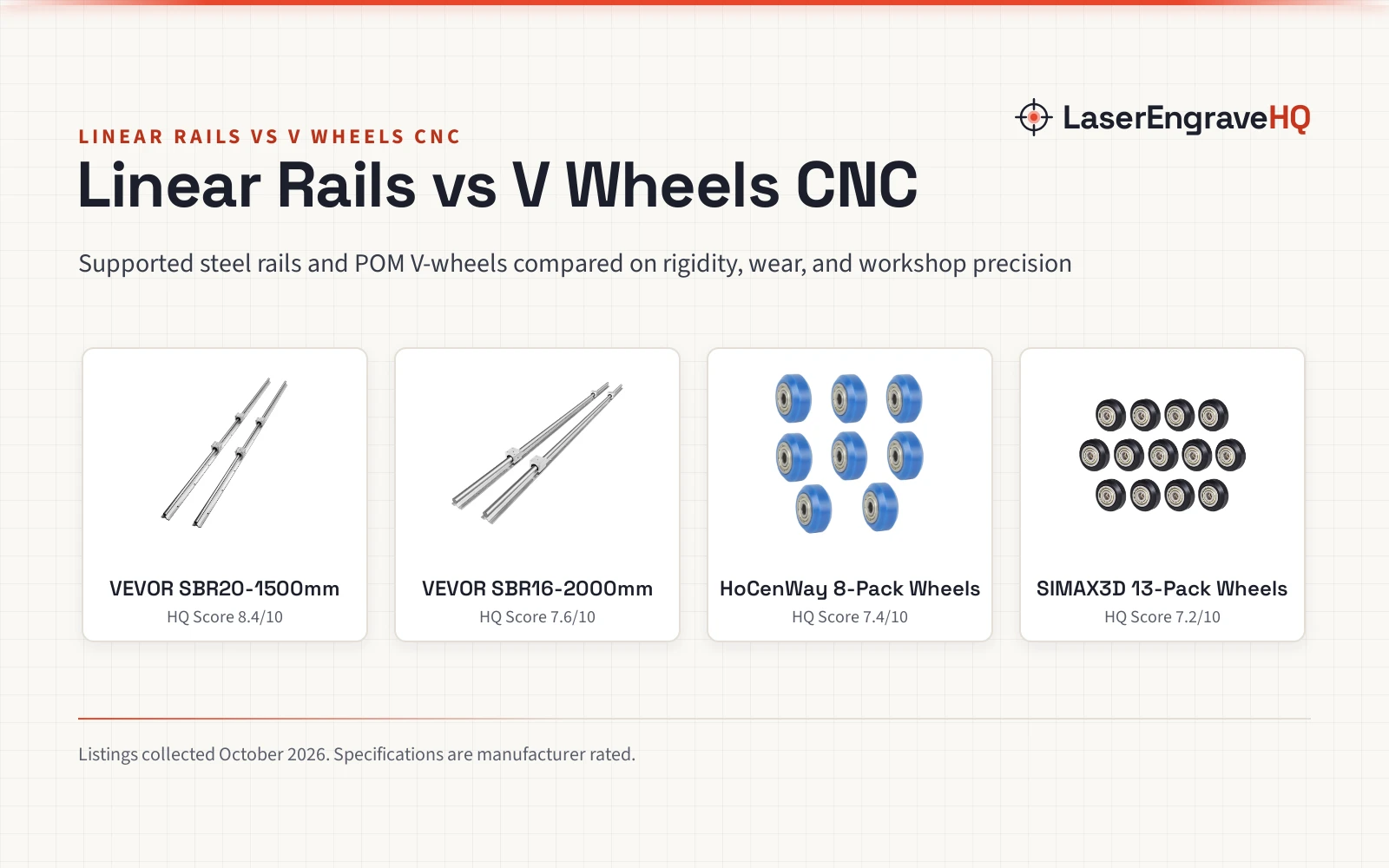
VEVOR Linear Rail, 2PCS SBR20-1500mm
A heavy-duty linear motion guide set featuring two 59 in (1500 mm) SBR20 rails and four SBR20UU bearing blocks rated for 882 N dynamic load.
Pros
- Two 59 in (1500 mm) SBR20 rails provide rigid, supported steel guidance for large CNC machine gantries
- Four aluminum SBR20UU slide blocks feature built-in ball bearings for smooth, low-friction motion
- The maker rates dynamic load at 882 N and static load at 1370 N per block
- Carbon steel rail shafts with chrome-plated surface and aluminum support base resist rust
Cons
- Heavier assembly at 22 pounds requires a rigid supporting frame
- Requires periodic lubrication to maintain smooth ball bearing sliding
- Mounting holes in the aluminum base require accurate drill alignment during machine assembly
- No warranty term is stated in the listing

OrangeA Linear Rail 2PCS SBR16-2000mm
An extra-long linear rail kit offering two 78.7 in (2000 mm) SBR16 rails and four SBR16UU carriage bearing blocks for extended CNC travel.
Pros
- Generous 78.7 in (2000 mm) rail length enables oversized cutting tables and long machine axes
- Carbon steel rail shafts and bearing steel balls housed in aluminum alloy carriage blocks
- Surface chrome plating provides rust resistance and durability on the main axle
- Includes four SBR16UU sliding blocks for dual-carriage gantry support
Cons
- Listing bullet contradicts standard care by claiming there is no need for maintenance
- Brand naming contradiction: title names OrangeA while brand and manufacturer state VEVOR
- Smaller 16 mm shaft diameter allows more flex over 2000 mm than larger SBR20 rails
- No warranty term is stated in the listing
8pcs Upgrade V Solid POM Wheels OD 24mm Rollers
A set of eight 24 mm solid POM V-wheels featuring dual high-speed bearings designed for 20-series V-slot aluminum extrusions.
Pros
- Dual high-speed bearings per wheel improve rotational stability and reduce axis play
- Solid POM outer construction runs quietly and directly inside standard 20-series V-grooves
- Pack of 8 wheels provides enough units to assemble or refresh two machine axes
- Compact 24 mm outer diameter and 5 mm bore match popular V-slot gantry plates
Cons
- Plastic POM material flexes more under heavy lateral routing forces than steel rails
- Listing contains minor text errors, describing material as POM for outer sheel
- Load capacity ratings are not stated in the listing
- No warranty term is stated in the listing

3D Printer Rollers v Slot (13pcs/Pack)
A 13-piece pack of 24 mm POM V-slot pulley wheels with 625zz bearings for maintaining lightweight gantry axes.
Pros
- Generous 13-piece package delivers ample replacements for ongoing workshop maintenance
- Equipped with standard 625zz bearings for smooth low-resistance rolling
- Exact published dimensions: 24 mm outer diameter, 5 mm inner diameter, 10.23 mm height
- Lightweight package weight of 7.4 ounces with quiet POM polymer contact
Cons
- Listing advises switching wheels after 6 to 9 months of use due to material wear
- Single 625zz bearing configuration offers less lateral rigidity than dual-bearing wheels
- Susceptible to dust compaction and flat spots if adjusted too tightly against extrusions
- No warranty term is stated in the listing
Side by side
| Spec | VEVOR SBR20-1500mm | VEVOR SBR16-2000mm | HoCenWay 8-Pack Wheels | SIMAX3D 13-Pack Wheels |
|---|---|---|---|---|
| HQ Score | 62 | 56 | 55 | 53 |
| Guide system side | Linear rails | Linear rails | V wheels CNC | V wheels CNC |
| Track type | SBR20 supported round rail | SBR16 supported round rail | 20-series V-slot aluminum | V-slot aluminum profile |
| Bearing configuration | 4 x SBR20UU ball bearings | 4 x SBR16UU ball bearings | Dual high-speed bearings | Single 625zz bearing |
| Stated load capacity | 882 N dynamic, 1370 N static | Not stated in the listing | Not stated in the listing | Not stated in the listing |
| Published dimensions | 59.06 x 3.54 x 1.43 in | 79 x 2 x 2 in | 0.94 x 0.94 x 0.4 in | 6.14 x 4.49 x 1.69 in |
| Item weight | 22 lb | 22.7 lb | 1.76 oz | 7.4 oz |
| Stated maintenance | Not stated in the listing | Claims no need for maintenance | Not stated in the listing | Switch after 6-9 months use |
| Warranty | Not stated in the listing | Not stated in the listing | Not stated in the listing | Not stated in the listing |
Specifications are manufacturer rated, as published on each listing and collected 13 October 2026.
Linear Rails vs V Wheels CNC: Rigidity and Deflection
The primary mechanical distinction between linear rails and V-wheels lies in guide construction and load support. During routing operations, the cutting bit exerts lateral and vertical cutting forces against the gantry. If the guide mechanism flexes, the cutter can vibrate, creating visible chatter on finished surfaces.
The VEVOR SBR20-1500mm listing is the only product among the four that publishes rated load capacities: 882 N dynamic load and 1370 N static load per block. The VEVOR SBR16 listing, the HoCenWay listing, and the SIMAX3D listing leave dynamic and static load ratings unstated. Under strict comparison rules, that missing data means the listings leave load limits unclear across the other three products, rather than establishing a documented win.
From a construction standpoint, the two systems use fundamentally different materials. The VEVOR linear rails mount cylindrical carbon steel shafts onto continuous aluminum support rails with chrome plating. The V-wheel examples (HoCenWay and SIMAX3D) use solid polyoxymethylene (POM) polymer pulleys riding directly against aluminum extrusion grooves. Steel shafts provide a hard contact surface for steel balls, whereas POM polymer wheels provide compliant contact on 20-series aluminum profiles.
Guide Geometry and Bearing Architecture
Bearing architecture separates these two motion styles. Linear rails use recirculating steel ball bearings enclosed in aluminum carriage blocks. In the VEVOR SBR20 and SBR16 listings, four bearing blocks ride along ground carbon steel cylindrical tracks. The steel balls distribute contact loads across the rail, ensuring smooth rolling motion.
V-wheels employ radial ball bearings pressed into the center of a POM pulley. The SIMAX3D wheels use a single 625zz bearing with a 24 mm outer diameter, a 5 mm inner diameter, and a height of 10.23 mm. Single-bearing wheels can experience slight axial play under tilting forces. The HoCenWay wheels address this by placing dual high-speed bearings on both sides of each 24 mm wheel, with the maker stating this design improves mechanical accuracy and reduces operating noise along 20-series aluminum profiles.
Installation and Machine Frame Alignment
Mounting requirements differ substantially between the two systems. Installing supported linear rails requires a flat, rigid mounting surface. In the VEVOR SBR20-1500mm kit, users must align two 59 in (1500 mm) rails so they remain parallel along the entire axis. Misalignment between parallel linear rails causes the recirculating balls to bind, requiring careful measuring and shimming during machine construction. For builders assembling a custom machine, see our DIY CNC router kit guide.
V-wheels mount directly to aluminum extrusions such as 2020, 2040, or C-Beam profiles. Gantry plates use eccentric spacers on one side of the carriage, allowing the builder to adjust wheel pre-load against the extrusion with a simple wrench turn. This makes V-wheel assemblies forgiving during initial setup, as seen on many starter machines in our desktop CNC machine for beginners guide.
Maintenance, Wear, and Operating Life
Operating life and workshop maintenance highlight a critical trade-off. The SIMAX3D listing gives a specific replacement schedule for its POM wheels, stating that switching wheels after 6 to 9 months of use will extend machine life. The HoCenWay listing does not state a replacement interval, claiming instead that its dual high-speed bearings increase service life. In a workshop environment, POM wheels rolling against aluminum extrusions can develop wear or flat spots if debris embeds in the track, which can affect motion consistency. For troubleshooting axis issues, see our guide on why is my CNC losing steps.
On the linear rail side, the VEVOR SBR16 listing claims ‘It’s no need for maintenance.’ This contradicts practical workshop reality: steel ball bearings running on steel shafts require regular cleaning and lubrication to avoid rust and binding, especially in dusty routing environments. Regular upkeep is outlined in our CNC router maintenance guide. The SBR20 listing leaves maintenance requirements unstated.
Weight and Gantry Inertia
Mass plays an important role in CNC acceleration and stepper motor sizing. The VEVOR SBR20 example weighs 22 pounds, and the VEVOR SBR16 example weighs 22.7 pounds. Adding heavy steel rails and aluminum support bases increases machine weight significantly. A heavier machine helps dampen cutting vibrations, but the increased gantry mass requires adequate motor torque, as discussed in our lead screw vs belt drive CNC comparison.
By comparison, the HoCenWay 8-pack listing shows an item weight of 1.76 ounces, and the SIMAX3D 13-pack spec table lists 7.4 ounces. Polymer wheels add relatively little mass to a gantry carriage, which reduces the moving payload that drive motors must accelerate along the axis.
Choose linear rails if
- You are building a CNC router, milling sled, or lathe attachment that requires rigid steel support rails.
- You want published load ratings, such as the 882 N dynamic load stated on the VEVOR SBR20 example.
- You need extended axis length, such as the 78.7 in (2000 mm) span provided by the VEVOR SBR16 kit.
- You have a flat, rigid frame capable of supporting assemblies weighing 22 pounds or more.
Choose V-wheels if
- You are assembling or maintaining a desktop machine built with 20-series V-slot aluminum profiles.
- You want lightweight motion components, such as the 1.76-ounce HoCenWay set or the 7.4-ounce SIMAX3D set.
- You prefer simple wheel tensioning against aluminum extrusions without parallel rail alignment.
- You want spare rollers on hand for regular replacement, such as the 13-piece SIMAX3D pack.
Operating a CNC router involves high-speed rotating cutters, flying chips, and rapid axis movements. Always wear eye protection, secure workpieces firmly to the wasteboard, never reach into the cutting envelope while the spindle runs, and ensure emergency stop controls are accessible.
Project Match
- High-load CNC machines and router sleds: VEVOR SBR20-1500mm (the listing names router, mill, and CNC sled applications with two 59 in rails; work area and target cutting materials are Not stated).
- Long-axis CNC machinery and transmission equipment: VEVOR SBR16-2000mm (the listing specifies two 78.7 in rails for DIY CNC routers and machine tools; work area and target cutting materials are Not stated).
- 20-series profile CNC machines and 3D printers: HoCenWay 8-Pack Wheels (the listing specifies 20-series V-slot aluminum extrusions; work area and target cutting materials are Not stated).
- Hobby 3D printer and gantry maintenance: SIMAX3D 13-Pack Wheels (the listing names Ender and Sidewinder gantry replacements; work area and target cutting materials are Not stated).
FAQ: lasers and CNC
Are linear rails more accurate than V-wheels on a CNC router?
The listings do not publish numerical accuracy tolerances (such as runout or positional repeatability in inches or millimeters) for either side. The VEVOR SBR20 listing claims high accuracy and repeatability from its circular shaft dimensions and ball bearings, while HoCenWay claims improved mechanical accuracy from dual high-speed bearings. Supported steel rails provide a rigid contact surface that resists cutting deflection under load, but the listings themselves leave measured tolerance differences unstated.
How often do CNC V-wheels need replacement?
Only the SIMAX3D listing states a specific replacement timeline, recommending that users switch wheels after 6 to 9 months of use to extend machine life. The HoCenWay listing does not specify a replacement schedule, stating instead that its dual high-speed bearings increase service life. In a workshop environment, wheel lifespan depends on operating hours, cutting debris, and wheel tension against the aluminum profile.
Do linear rails require regular lubrication?
Yes. Although the VEVOR SBR16 listing claims there is ‘no need for maintenance,’ recirculating steel ball bearings running on steel shafts require regular cleaning and light machine oil or grease in practice. Operating steel bearings in a dusty workshop without lubrication can lead to track scoring, increased friction, and premature wear.
Can a V-wheel CNC router be upgraded to linear rails?
Makers frequently upgrade desktop machines by mounting supported linear rails to their frames. Doing so replaces polymer wheels with steel guide shafts and ball bearing blocks. However, an upgrade adds significant weight (the VEVOR SBR20 rails weigh 22 pounds) and requires parallel alignment across the entire axis to prevent the bearing blocks from binding.
Which guide system is easier to install for a beginner?
V-wheels are generally easier to install on hobby machines because they ride directly in the channels of 20-series aluminum profiles and use eccentric spacers for tension adjustment. Supported linear rails, such as the 59 in VEVOR SBR20 or 78.7 in SBR16 sets, require a flat mounting surface and careful parallel alignment across the full span so the recirculating ball blocks do not bind.
Related: CNC router maintenance, lead screw vs belt drive CNC, desktop CNC machine for beginners, and CNC routers.