Best Heat Resistant 3D Printer Filament (2026)
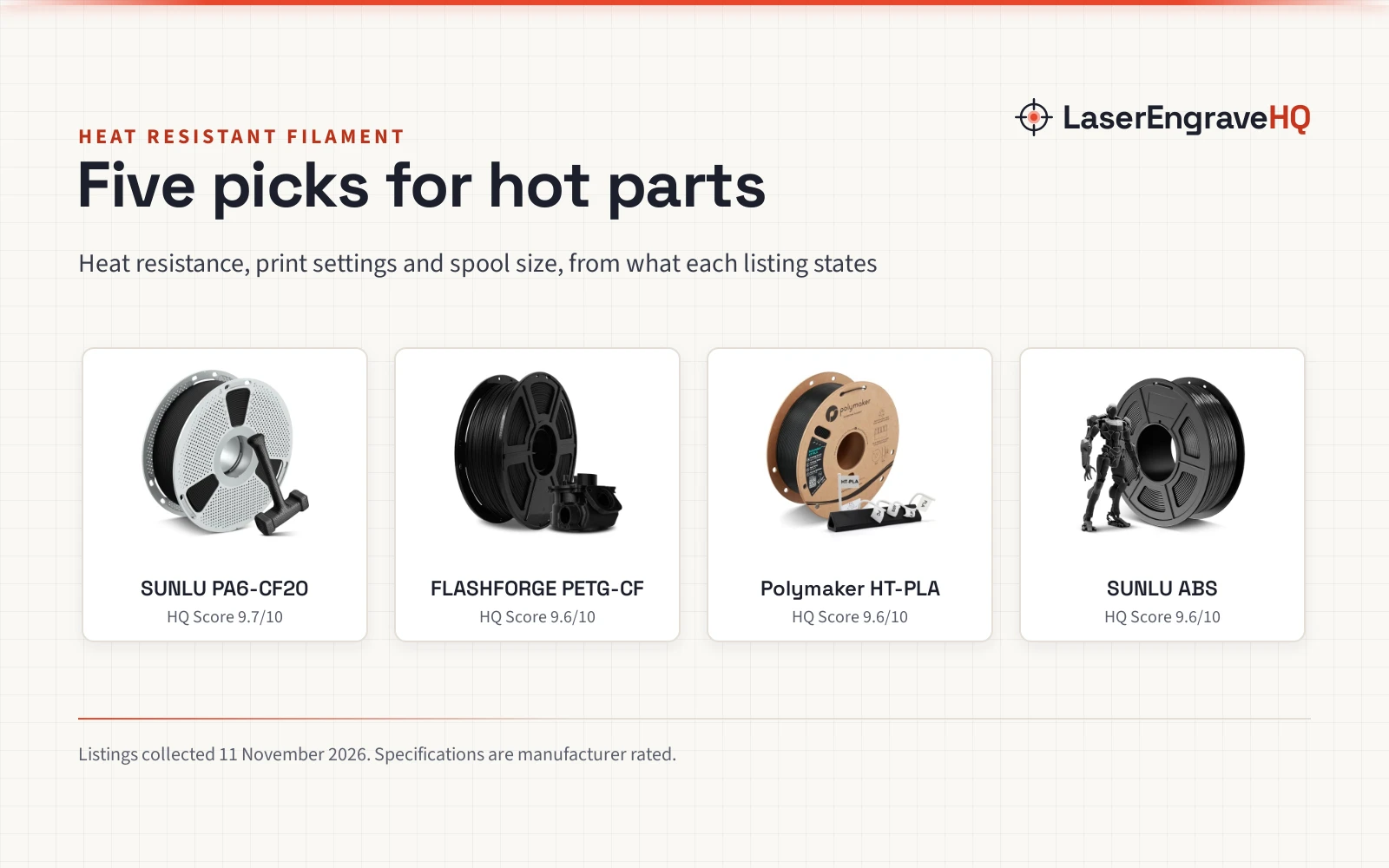
Five heat resistant filaments for functional parts, from PA6 carbon fiber nylon rated to 209°C to easy-printing HT-PLA, compared by heat resistance and print settings.

On this page
Top picks at a glance
As an Amazon Associate I earn from qualifying purchases.
- 1
 Best OverallSUNLU PA6-CF209.7/10View on Amazon
- 2
 Best PETG PickFLASHFORGE PETG-CF9.6/10View on Amazon
- 3
 Easiest to PrintPolymaker HT-PLA9.6/10View on Amazon
- 4
 Best ABS PickSUNLU ABS9.6/10View on Amazon
A bracket beside a motor, a fan blade spinning in warm air, a pot handle over a stove: parts like these need filament that holds its shape when things get hot. The best heat resistant 3d printer filament for the job depends on how hot the part gets and how much strength it needs, and this guide compares filaments that list heat resistance, from carbon fiber nylon to annealed PLA.
LaserEngraveHQ earns a commission from purchases made through these links, at no extra cost to you. Read our affiliate disclosure.
Quick picks
- Best Overall SUNLU PA6-CF20: Heat resistant up to 209°C in PA6 with 20% carbon fiber, with full print settings stated. Check price on Amazon
- Best PETG Pick FLASHFORGE PETG-CF: Carbon fiber PETG dried for 24 hours and vacuum sealed, with a two-month warranty. Check price on Amazon
- Easiest to Print Polymaker HT-PLA: HT-PLA prints at 210-230°C with no enclosed chamber and speeds up to 300 mm/s. Check price on Amazon
- Best ABS Pick SUNLU ABS: ABS with a +/- 0.02mm tolerance and full print settings stated. Check price on Amazon
Machines on the list
SUNLU PA6-CF20 Carbon Fiber Nylon 3D Printing
A 1KG spool of 1.75mm PA6 nylon with 20% carbon fiber, heat resistant up to 209°C, for gears, screws, fan blades and other parts that run hot.
Pros
- Heat resistant up to 209°C, the highest figure here
- 80% PA and 20% carbon fiber for stiffness and strength
- Dimensional accuracy of +/- 0.03mm
- Print settings fully stated: nozzle 270-290°C, bed 50-70°C, speed 50-150 mm/s
Cons
- Not compatible with AMS or other multi-color systems
- Drying required before printing: 80°C for 24 hours or 110°C for 4 hours
- Abrasive on nozzles: hardened steel nozzles recommended
- No warranty term is stated
FLASHFORGE Carbon Fiber PETG Filament 1.75mm
A 1KG spool of 1.75mm carbon fiber PETG, dried for 24 hours before packaging and vacuum sealed with desiccant, for rigid frames, drones, tools and automotive parts.
Pros
- Carbon fiber reinforcement for strength and temperature resistance
- Dimensional accuracy of +/- 0.02mm
- Dried for 24 hours and vacuum sealed with desiccant
- Compatible with 99% of FDM 3D printers, per the listing
Cons
- No heat resistance figure is stated, only that it is heat-resistant
- Bullets call it PLA in one place though the listing is PETG-CF
- No print temperature is stated
Polymaker HT-PLA Filament 1.75mm Black 1KG
A 1KG spool of 1.75mm high-temp PLA, heat resistant to 150°C, that prints at 210-230°C with no enclosed chamber and supports speeds up to 300 mm/s.
Pros
- Heat resistant to 150°C, with annealing for more
- Prints at 210-230°C like PLA, with no enclosed chamber required
- Print speeds up to 300 mm/s on compatible printers
- No hardened nozzle or enclosed chamber required
Cons
- Heat deflection after annealing is approximately 107°C at 0.45 MPa, below the 150°C headline
- Annealing needed for the best heat resistance
- Dry at 60°C for approximately 6 hours if the filament absorbs moisture
- No warranty term is stated
SUNLU ABS Filament 1.75mm,Black,1kg
A 1KG spool of 1.75mm black ABS with a diameter tolerance of +/- 0.02mm, for durable functional parts that need higher heat resistance.
Pros
- Diameter tolerance of only +/- 0.02mm
- Print settings fully stated: nozzle 250-260°C, bed 80-100°C, speed 40-60 mm/s
- Compatible with 99% of FDM 3D printers, per the listing
- Impact resistant and durable for long-term use, per the listing
Cons
- Enclosure recommended during printing
- No heat resistance figure is stated
- No warranty term is stated
- No annealing or drying guidance is stated

Polymaker ABS Filament Black 1KG 1.75mm
A Black ABS spool with a stated Vicat softening temperature of 104°C, low odor resin and stated nozzle and bed settings.
Pros
- Vicat softening temperature of 104°C for heat-resistant functional prints
- Low odor resin with lower volatile content than traditional ABS resins
- Suited to functional prototypes, mechanical parts and robotics
- Vacuum sealed with desiccant, plus a stated drying routine at 70°C for 6 hours
Cons
- No warranty term is stated in the listing
- An enclosed printing chamber is recommended
- Only Black is offered in this listing
- No print speed range is stated
Other machines to compare
 ELEGOO ABS 3D Printer Filament 1.75mm Black 1KG Strong LayerCheck price on Amazon
 Polymaker HT-PLA-GF Filament 1.75mm Black 1KGCheck price on Amazon
 Creality ABS Filament 1.75mmCheck price on Amazon
 OVERTURE ASA Filament 1.75mmCheck price on Amazon
 ELEGOO PC Filament 1.75mm Black 1KGCheck price on Amazon
Best heat resistant 3d printer filament: compare the picks
| Model | HQ Score | Material | Heat resistance | Print temp | Rated speed | Spool | Warranty |
|---|---|---|---|---|---|---|---|
| SUNLU PA6-CF20 | 9.7/10 | PA6 with 20% carbon fiber | Up to 209°C | Nozzle 270-290°C | 50-150 mm/s | 1KG | Not stated |
| FLASHFORGE PETG-CF | 9.6/10 | PETG with carbon fiber | Heat-resistant, no figure stated | Not stated | Not stated | 1KG | Two-month (bullets); 1 Year (table) |
| Polymaker HT-PLA | 9.6/10 | HT-PLA | To 150°C; HDT approx. 107°C at 0.45 MPa after annealing | 210-230°C | Up to 300 mm/s | 1KG | Not stated |
| SUNLU ABS | 9.6/10 | ABS | Heat resistance stated, no figure | Nozzle 250-260°C | 40-60 mm/s | 1KG | Not stated |
| Polymaker ABS | 9.6/10 | ABS | Heat resistant (title only) | Not stated | Not stated | 1KG | Not stated |
We give each product’s specs as its manufacturer rates them; listings read 3 November 2026.
Heat resistance figures are not all measured the same way
Read the figure, not just the headline. SUNLU lists its PA6-CF20 as withstanding up to 209°C, the highest figure here, while Polymaker lists HT-PLA as heat resistant to 150°C and separately states a heat deflection temperature of approximately 107°C at 0.45 MPa after annealing. The two figures describe different things: one is the material figure, the other is deflection under load after annealing. The FLASHFORGE PETG-CF and the SUNLU ABS state heat resistance without giving a figure at all, so compare them on their other stated specs instead.
Annealing and drying change what a printed part can take. SUNLU recommends annealing PA6-CF20 at 80-130°C for 5-12 hours for good heat resistance, and Polymaker says annealing can further improve the heat resistance of HT-PLA. Drying matters too: PA6-CF20 needs drying before printing, and HT-PLA that has absorbed moisture needs drying at 60°C for approximately 6 hours.
Buying guide: heat resistant filament
Match the filament to the heat
Start from the warmest the part will see. For parts near motors, exhausts and stoves, the PA6-CF20 figure of up to 209°C gives the most headroom here. For brackets, housings and fixtures in warmer rooms, HT-PLA rated heat resistant to 150°C is enough, with annealing for more. Where no figure is stated, as with the PETG-CF and the SUNLU ABS, judge by the material and the stated applications instead.
Mind the print settings
Heat resistant filament prints hot. PA6-CF20 lists a nozzle range of 270-290°C and a 50-70°C bed, SUNLU ABS lists a 250-260°C nozzle and an 80-100°C bed, and HT-PLA lists 210-230°C with a 25-60°C bed and the cooling fan on. Check that your printer reaches the nozzle temperature before ordering, and note that SUNLU recommends an enclosure for ABS while HT-PLA needs no enclosed chamber.
Dry it, then anneal it
Nylon drinks moisture, so SUNLU says drying is required before printing PA6-CF20: 80°C for 24 hours or 110°C for 4 hours. HT-PLA that has absorbed moisture needs drying at 60°C for approximately 6 hours. Annealing is a separate step after printing: PA6-CF20 anneals at 80-130°C for 5-12 hours, and HT-PLA gains heat resistance from annealing too.
Where the part will live
Pick from the applications each listing states. PA6-CF20 suits gears, screws, helmets, fan blades, toy car chassis, skateboard parts, bicycle frames, automobile exhaust pipes, motor covers, pot handles and the bottom of the kettle. PETG-CF suits frames, drones, tools and automotive parts. HT-PLA suits brackets, housings, fixtures, tool organizers and functional prototypes. SUNLU ABS suits durable items and functional parts that need higher heat resistance.
Hot nozzles and beds burn on contact, and ABS prints best in an enclosure, which also keeps fumes contained, so ventilate the room and keep hands clear while the printer runs. Dry filament in a dryer or oven only at the temperature and time the maker states, and never leave a running printer unattended for long stretches.
Project Match
Typical projects paired with the picks, from the applications each listing states:
| Project | Pick |
|---|---|
| Gears, screws, fan blades, bicycle frames | SUNLU PA6-CF20 |
| Motor covers, pot handles, exhaust pipes | SUNLU PA6-CF20 |
| Frames, drones, tools, automotive parts | FLASHFORGE PETG-CF |
| Brackets, housings, fixtures, tool organizers, prototypes | Polymaker HT-PLA |
| Durable functional parts that need higher heat resistance | SUNLU ABS |
Polymaker ABS states no applications, so no project pairing is listed for it.
How the scores add up
Each filament is scored out of 10 on performance, build, value, safety and warranty. A spec the listing does not publish scores nothing.
| Product | HQ Score | Perf. /35 | Build /25 | Value /25 | Safety /10 | Warranty /5 |
|---|---|---|---|---|---|---|
| SUNLU PA6-CF20 | 9.7 | 33 | 22 | 21 | n/a | 0 |
| FLASHFORGE PETG-CF | 9.6 | 30 | 21 | 20 | n/a | 1 |
| Polymaker HT-PLA | 9.6 | 29 | 21 | 20 | n/a | 0 |
| SUNLU ABS | 9.6 | 28 | 20 | 20 | n/a | 0 |
Point totals are scaled so the weakest reads 9.2 and the strongest 9.8, with everything between kept in order. An unpowered accessory whose listing names no safety feature is scored without safety, out of 90.
FAQ: lasers and CNC
What is the most heat resistant 3d printer filament here?
SUNLU PA6-CF20, which the listing states withstands up to 209°C. That is higher than the 150°C figure Polymaker lists for HT-PLA, and the other filaments here state heat resistance without a figure.
Can I print heat resistant filament without an enclosure?
It depends on the filament. Polymaker states HT-PLA needs no enclosed chamber, while SUNLU recommends an enclosure for ABS. The PA6-CF20 listing gives nozzle and bed temperatures without mentioning an enclosure.
Do I need to dry nylon filament before printing?
Yes, for the PA6-CF20 here: SUNLU says drying is required before printing, at 80°C for 24 hours or 110°C for 4 hours. The filament is vacuum sealed with a desiccant pack, and it still needs drying once opened.
What does annealing do for HT-PLA?
Annealing can further improve the heat resistance of HT-PLA, per Polymaker. After annealing, the material reaches a heat deflection temperature of approximately 107°C at 0.45 MPa for functional parts used in warmer environments.
Which of these filaments state a warranty?
Only the FLASHFORGE PETG-CF: its bullets state a two-month warranty, while its spec table says 1 Year. The other listings here state no warranty term.
Related: best UV resistant filament, how to dry filament, best 3D PLA filament, 3D printer for car parts and the 3D printers hub.