Best ABS Glass Fiber Filament (2026)
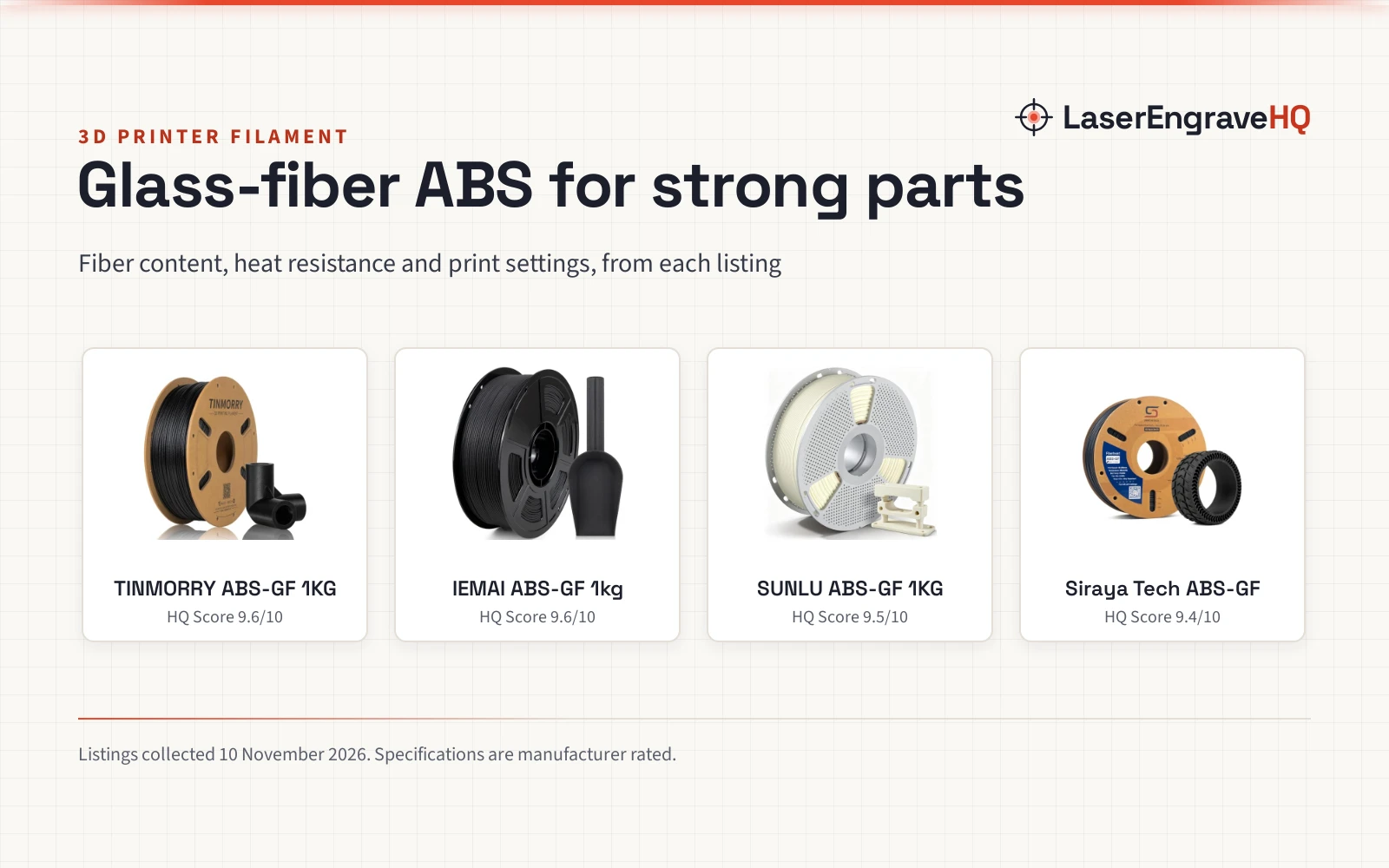
4 glass-fiber ABS spools for functional parts, compared by fiber content, heat resistance, print settings and drying.

On this page
Top picks at a glance
As an Amazon Associate I earn from qualifying purchases.
- 1
 Best OverallTINMORRY ABS-GF 1KG9.6/10View on Amazon
- 2
 Best Heat ResistanceSUNLU ABS-GF 1KG9.5/10View on Amazon
- 3
 Best StiffnessIEMAI ABS-GF 1kg9.6/10View on Amazon
- 4
 Best for Automotive PartsSiraya Tech ABS-GF9.4/10View on Amazon
Functional parts are what ABS glass fiber filament is for: brackets that hold a load, housings that take a knock, jigs that keep their shape in a warm shop. A glass fiber fill stiffens ABS and steadies it as it cools, which is why makers who sell parts or build tooling reach for it over plain ABS. This guide compares the best abs glass fiber filament from the listings, using only what each one states about fiber content, heat resistance, print settings and drying, so the spool matches the parts on the build plate.
LaserEngraveHQ earns a commission from purchases made through these links, at no extra cost to you. Affiliate disclosure.
Quick picks
- Best Overall TINMORRY ABS-GF 1KG: A full set of stated settings, a 100°C heat deflection temperature and a stated fume warning, for functional parts and brackets. Check price on Amazon
- Best Heat Resistance SUNLU ABS-GF 1KG: A stated 104°C heat resistance, the highest of the picks, with full settings and spool dimensions stated. Check price on Amazon
- Best Stiffness IEMAI ABS-GF 1kg: 20% chopped glass fiber and a +/-0.03 mm tolerance, for stiff housings and fixtures. Check price on Amazon
- Best for Automotive Parts Siraya Tech ABS-GF: A 93°C heat deflection temperature and a listing that names automotive parts, drone components and industrial use. Check price on Amazon
Machines on the list
TINMORRY ABS-GF Glass Fiber 3D Printer Filament
A 1 kg glass fiber ABS spool with a stated 100°C heat deflection temperature and a flexural modulus of 2983 MPa, for functional parts and load-bearing brackets.
Pros
- Stated 100°C heat deflection temperature, with low warpage
- Flexural modulus of 2983 MPa, per the listing
- Fume and ventilation warning stated in the listing
- Drying and storage guidance stated: 65°C for 8 hours, under 20% RH
Cons
- No glass fiber percentage stated
- No warranty term in the listing
- Print speed only stated as under 300 mm/s, no lower bound
IEMAI ABS-GF Glass Fiber 3D Printer Filament
A 1 kg matte black spool with 20% chopped glass fiber and a +/-0.03 mm diameter tolerance, for stiff housings, fixtures and industrial tooling.
Pros
- 20% chopped glass fiber, the highest fiber share stated here
- +/-0.03 mm diameter tolerance for consistent extrusion
- Full print settings stated: nozzle, bed, speed, drying and nozzle type
- Wide printer compatibility, from Bambu Lab to Prusa and Creality
Cons
- No heat deflection temperature stated
- No warranty term in the listing
- Print speed of 100 mm/s max, below the other stated speeds
- Needs an enclosed chamber and glue on the base plate
SUNLU ABS-GF 3D Filament 1.75mm 1KG
A 1 kg natural white spool with 10% glass fiber and a stated 104°C heat resistance, for durable functional prototypes, tooling jigs and housings.
Pros
- 104°C heat resistance, the highest stated here
- 10% glass fiber, with 30% greater strength claimed over standard ABS
- Full settings stated: nozzle, bed, speed, drying and spool dimensions
- Vacuum sealed with a desiccant pack, for dry storage
Cons
- Not recommended for AMS, AMS Lite or other multicolor systems
- No warranty term in the listing
- 10% fiber is the lowest fiber share stated here
- Needs adhesive on the print bed to prevent warping
Siraya Tech Fibreheart ABS-GF 3D Printer Filament
A 1 kg black spool of fiberglass-reinforced ABS with a stated 93°C heat deflection temperature, for automotive parts, drone components and industrial projects.
Pros
- Fiberglass reinforcement for toughness and impact resistance
- 93°C heat deflection temperature, above standard ABS per the listing
- Names automotive, industrial and drone-component use
- Lightweight build for parts where weight matters, per the listing
Cons
- No nozzle, bed, speed or drying settings stated
- No glass fiber percentage stated
- No warranty term in the listing
- 93°C is the lowest heat deflection temperature stated here
Other machines to compare
 Polymaker Fiberon PA612-CF15 Carbon Fiber Nylon FilamentCheck price on Amazon
 Creality ABS Filament 1.75mmCheck price on Amazon
 Siraya Tech Fibreheart ABS-GF 3D Printer FilamentCheck price on Amazon
 OVERTURE ABS High Strength 3D Printer Filament 1.75mmCheck price on Amazon
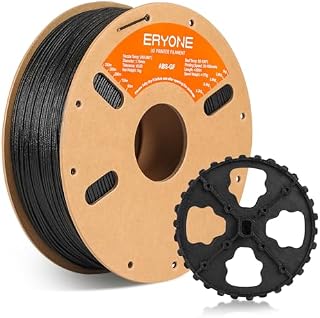 ERYONE ABS FilamentCheck price on Amazon
 ELEGOO Glass Fiber PETG 3D Printer Filament 1.75mm White 1KGCheck price on Amazon
Specs compared
| Model | HQ Score | Glass fiber | Heat resistance | Nozzle temp | Print speed | Drying | Ventilation |
|---|---|---|---|---|---|---|---|
| TINMORRY ABS-GF 1KG | 9.6/10 | Not stated | 100°C HDT | 250-280°C | Under 300 mm/s | 65°C, 8 h | Mild fumes, ventilate |
| IEMAI ABS-GF 1kg | 9.6/10 | 20% | Not stated | 250-280°C | 100 mm/s max | 70°C, 5-8 h | Enclosed chamber |
| SUNLU ABS-GF 1KG | 9.5/10 | 10% | 104°C | 260-280°C | 50-300 mm/s | 80°C, 4-6 h | Not stated |
| Siraya Tech ABS-GF | 9.4/10 | Not stated | 93°C HDT | Not stated | Not stated | Not stated | Not stated |
Size and performance figures are the brand’s ratings quoted from listings on 3 November 2026. Heat resistance is the heat deflection temperature where the listing states one; fiber content is the glass fiber share where the listing states one.
How the picks were scored
Each pick is scored on performance, build, value, safety and warranty, with the weights published on the How We Pick page. A spec the listing does not publish scores nothing, and a safety point needs a stated safety feature, not a general claim.
| Product | HQ Score | Perf. /35 | Build /25 | Value /25 | Safety /10 | Warranty /5 |
|---|---|---|---|---|---|---|
| TINMORRY ABS-GF 1KG | 9.6 | 30 | 21 | 21 | 5 | 0 |
| IEMAI ABS-GF 1kg | 9.6 | 30 | 22 | 20 | 3 | 0 |
| SUNLU ABS-GF 1KG | 9.5 | 32 | 22 | 21 | 0 | 0 |
| Siraya Tech ABS-GF | 9.4 | 27 | 19 | 19 | 0 | 0 |
We translate weighted points into a score with 9.2 as its floor and 9.8 as its cap; the straight-line conversion keeps the ranking exactly.
What the listings tell you, and what they leave out
Only the TINMORRY listing warns about fumes and names a ventilation step. Only the SUNLU listing gives spool dimensions. The Siraya Tech listing gives no nozzle temperature, no bed temperature, no print speed and no drying guidance, so its settings are all Not stated in the table below. The TINMORRY spec table lists its size as ABS-CF/GF while its title and bullets say ABS-GF; the title and bullets win, and the review says so.
None of the listings states a warranty term. The SUNLU bullet that promises a printing result is a maker claim, not a warranty term, and it is not quoted as one.
Buying guide: choosing the best abs glass fiber filament
Fiber content
The IEMAI spool states 20% chopped glass fiber, and the SUNLU spool states 10% glass fiber. The Siraya Tech and TINMORRY listings state no fiber percentage, so their fiber content is Not stated. More fiber stiffens the print, and it also wears a brass nozzle faster, which is why the IEMAI and TINMORRY listings call for a hardened steel nozzle.
Heat resistance
The SUNLU listing states 104°C heat resistance, the TINMORRY listing states a heat deflection temperature of 100°C, and the Siraya Tech listing states a heat deflection temperature of 93°C. The IEMAI listing claims heat resistance but states no temperature, so its heat resistance is Not stated. Match the stated temperature to the warmest place the part will live.
Print settings
The SUNLU listing states a nozzle range of 260-280°C and a bed range of 90-100°C. The IEMAI and TINMORRY listings state a nozzle range of 250-280°C and the same bed range of 90-100°C. Print speed is 50-300 mm/s for SUNLU, 100 mm/s max for IEMAI, and under 300 mm/s for TINMORRY. The Siraya Tech listing states no print settings at all, so start from the maker guidance before printing.
Drying
The SUNLU, IEMAI and TINMORRY listings give a drying step: SUNLU at 80°C for 4-6 hours, IEMAI at 70°C for 5-8 hours, and TINMORRY at 65°C for 8 hours. The Siraya Tech listing states no drying guidance. The SUNLU spool arrives vacuum sealed with a desiccant pack, and the TINMORRY listing says to keep humidity under 20% RH in a sealed container with desiccant.
Nozzles and wear
Glass fiber is abrasive, so the IEMAI listing calls for a 0.4-0.6 mm hardened steel or wear-resistant nozzle, and the TINMORRY listing calls for a wear-resistant steel nozzle, with 0.6 mm recommended and 0.4 mm capable. The SUNLU listing warns that ABS-GF is not recommended for use in AMS, AMS Lite, or other multicolor systems, to prevent filament breakage. Fit a hardened nozzle before the first print, and keep the spool dry between prints.
Ventilation
The TINMORRY listing says ABS-GF may emit mild fumes during printing and to ensure proper ventilation or use a ventilation system. Print in a ventilated space, and keep the printer in an enclosed chamber where the listing calls for one. See the portable fume extractor for 3D printer picks for extraction options.
Glass fiber filament is abrasive: use a hardened steel nozzle, and do not run it through a multicolor system the maker warns against. ABS gives off fumes while printing, so ventilate the print area. ABS is a 3D printing material, not a laser material: never laser cut or laser engrave ABS, and never laser PVC or vinyl either.
Project Match
Match the spool to the project, using only what each listing states:
- Functional prototypes and tooling jigs: SUNLU, with stated 104°C heat resistance and 50-300 mm/s print speed.
- Load-bearing brackets and mechanical parts: TINMORRY, with a stated flexural modulus of 2983 MPa and a 100°C heat deflection temperature.
- Stiff housings and fixtures: IEMAI, with 20% chopped glass fiber and a +/-0.03 mm diameter tolerance.
- Automotive and industrial parts: Siraya Tech, whose listing names automotive and industrial use and drone components.
FAQ: lasers and CNC
What is ABS filament best for?
ABS filament suits functional parts that need strength and heat resistance: the listings here name functional prototypes, tooling jigs, protective housings, high-stress gears, automotive parts, industrial fixtures, mechanical components and electronic housings. Glass fiber ABS adds stiffness and dimensional stability over plain ABS, per the SUNLU and IEMAI listings.
How long to dry ABS filament?
The listings here give different drying steps: SUNLU at 80°C for 4-6 hours, IEMAI at 70°C for 5-8 hours, and TINMORRY at 65°C for 8 hours. The Siraya Tech listing states no drying guidance. Dry the spool before printing, and store it sealed with desiccant, per the TINMORRY listing.
Does ABS filament need ventilation?
Yes, per the TINMORRY listing, which says ABS-GF may emit mild fumes during printing and to ensure proper ventilation or use a ventilation system. Print in a ventilated space, and use an enclosed chamber where the listing calls for one.
Do you need to dry ABS filament?
Yes, per the listings here: SUNLU, IEMAI and TINMORRY each give a drying temperature and time, and the SUNLU spool arrives vacuum sealed with a desiccant pack to keep it dry. The Siraya Tech listing states no drying guidance.
How to print ABS filament?
Use the settings the listing states: a nozzle of 250-280°C and a bed of 90-100°C for IEMAI and TINMORRY, or a nozzle of 260-280°C and a bed of 90-100°C for SUNLU. Print in an enclosed chamber, apply glue to the base plate, and fit a hardened steel nozzle, per the IEMAI listing. The Siraya Tech listing states no print settings.
Related: the ABS plastic 3D printer filament picks, the black ABS filament picks, the portable fume extractor for 3D printer picks, and the Sunlu S1 vs S2 filament dryer comparison.