Best 3D Scanner for Jewelry (2026)
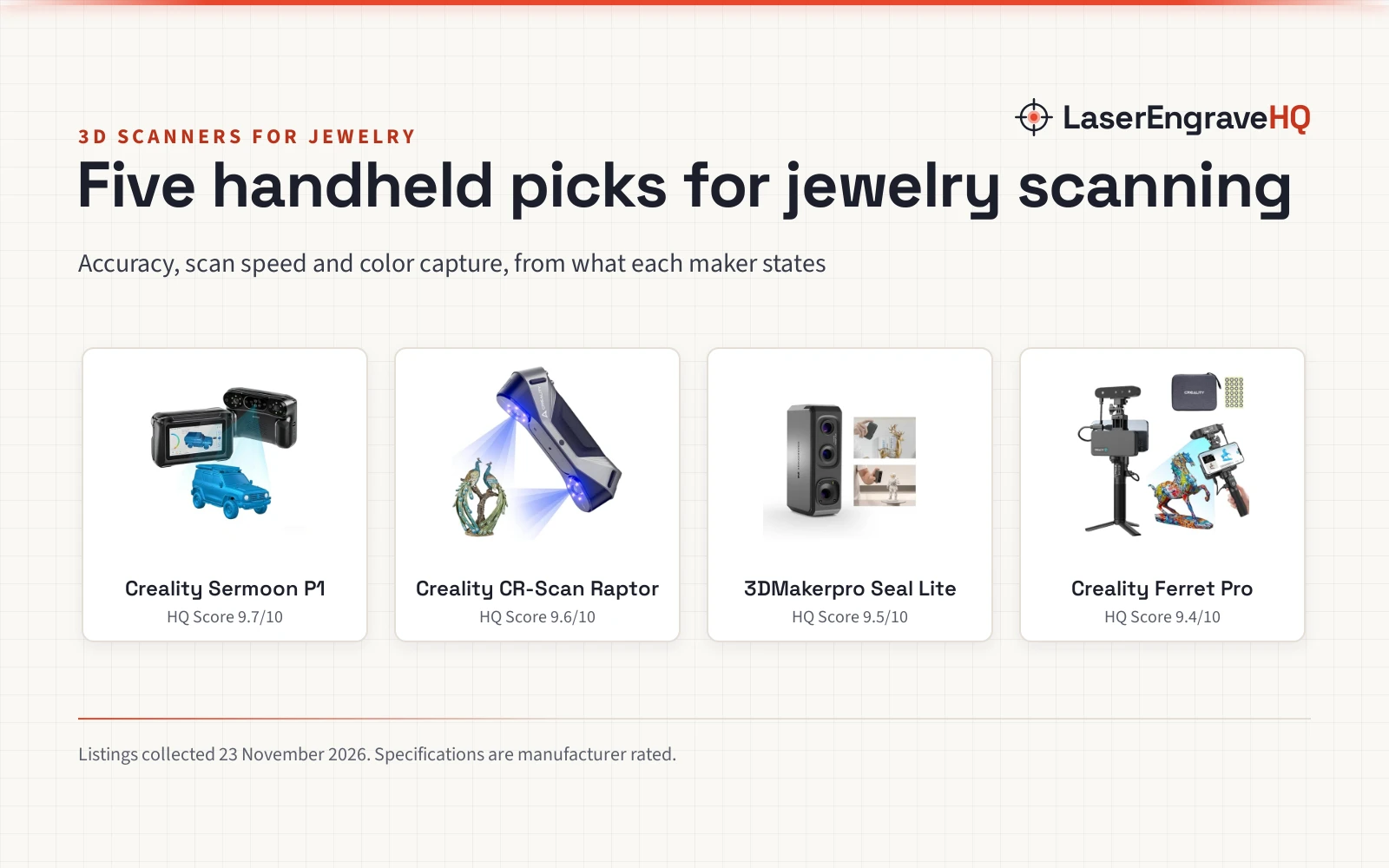
Five handheld 3D scanners for jewelry work, compared by accuracy, scan speed, color capture and weight, from fine laser detail to full-color scans.

On this page
Top picks at a glance
As an Amazon Associate I earn from qualifying purchases.
- 1
 Best OverallCreality Sermoon P19.7/10View on Amazon
- 2
 Best Precision3DMakerpro Seal Lite9.5/10View on Amazon
- 3
 Best for BeginnersCreality Ferret Pro9.4/10View on Amazon
A jeweler who wants to copy a ring, resize a pendant or rebuild a damaged charm needs a digital model that holds fine detail, and a handheld scanner is the quickest way to get one. The best 3d scanner for jewelry captures small metalwork in full color, holds edges that a printer can use, and fits a bench workflow without a fixed rig. This guide compares five handheld scanners by the figures each maker publishes: accuracy, scan speed, color capture, weight and the modes that suit small pieces.
LaserEngraveHQ earns a commission from purchases made through these links, at no extra cost to you. Read our affiliate disclosure.
Quick picks
- Best Overall Creality Sermoon P1: 0.02 mm blue laser accuracy, standalone 6-inch touchscreen, 24GB RAM and 256GB storage. Check price on Amazon
- Best Precision 3DMakerpro Seal Lite: 0.02 mm accuracy with 0.07 mm point spacing at 190 g. Check price on Amazon
- Best for Beginners Creality Ferret Pro: 0.1 mm accuracy at 30 FPS with 24-bit color, WiFi 6 and outdoor scanning to 30,000 lux. Check price on Amazon
Machines on the list
Creality Sermoon P1 3D Scanner
A dual-technology blue laser and infrared handheld scanner with a 6-inch touchscreen, standalone mode, 24GB RAM and 256GB storage.
Pros
- 0.02 mm accuracy with blue laser for fine detail
- Blue laser and infrared in one scanner, with single-line, 7-line and 22-line modes
- 6-inch touchscreen with standalone mode, no computer needed
- 24GB RAM, 256GB storage and Wi-Fi 7 onboard
Cons
- 830 g, the heaviest handheld in this guide
- No scan speed in FPS is stated
- Three scan modes need choosing for each job
- Accuracy over time depends on the included calibration board

Creality CR-Scan Raptor 3D Scanner
A blue laser and NIR handheld scanner with 0.02mm accuracy, 60fps blue light scanning and a Class 1 safety statement in the listing.
Pros
- 0.02mm accuracy with 7 parallel blue laser lines as thin as 0.1mm
- Blue light mode scans at up to 60fps, infrared mode at up to 20fps
- Scans objects from 5×5×5 mm to 2000×2000×2000 mm
- Class 1 blue light statement with skin protection noted in the listing
Cons
- No warranty term is stated
- Needs a high-performance PC: Windows i7-Gen7 with Nvidia 6GB and 16GB RAM, or macOS Apple M/M2/M3 with 16GB RAM
- Avoid direct eye exposure, per the listing
- No turntable or tripod is stated in the listing
3DMakerpro Handheld 3D Scanner for 3D Printer
A 190 g handheld scanner with 0.02 mm accuracy, 0.07 mm point spacing and 9 levels of light adjustment.
Pros
- 0.02 mm accuracy with 0.07 mm minimum point spacing
- 100,000 points per second at 10 FPS
- 190 g, the lowest weight here
- 9 levels of light adjustment for low-light scanning
Cons
- 10 FPS, the slowest scan rate in this guide
- Plastic body, where the standard Seal uses aluminum alloy
- Smart Grip for phone scanning is sold separately
- No object size range is stated
Creality 3D Scanner,CR-Scan Ferret Pro,Handheld 3D
A compact handheld scanner with 0.1 mm accuracy, 30 FPS scanning, 24-bit full-color capture and WiFi 6.
Pros
- 30 FPS scanning with 0.1 mm accuracy and 0.16 mm resolution
- 24-bit full-color scan
- WiFi 6 transfer, stated as 3x faster than WiFi 5
- Scans black, metal and matte objects without spray, outdoors to 30,000 lux
Cons
- 0.1 mm accuracy, coarser than the 0.02 mm accuracy of the Sermoon P1 and the Seal Lite
- No object size range is stated
- Needs a computer with 8GB RAM or more, 4GB for iOS
- Outdoor use is rated to 30,000 lux, so stronger light has no stated coverage

Creality CR-Scan Ferret Pro 3D Scanner for 3D
A wireless handheld scanner with a Wi-Fi 6 bridge, fast full-color scanning and anti-shake tracking for beginners and outdoor work.
Pros
- 0.1 mm accuracy with 0.16 mm resolution
- 30 fps scanning with one-shot 3D imaging
- Wi-Fi 6 transmission, stated as 3x faster than Wi-Fi 5
- Outdoor scanning in ambient light up to 30,000 lux with OBJ, STL and PLY export
Cons
- No object-size range figure is stated in the listing
- No warranty term is stated in the listing
- Avoid highly reflective, transparent or extremely dark surfaces, per the listing
- Wireless scanning for Android and iPhone needs the dedicated bridge
Specs compared
| Model | HQ Score | Accuracy | Scan speed | Color | Weight | Warranty |
|---|---|---|---|---|---|---|
| Creality Sermoon P1 | 9.7/10 | 0.02 mm | Not stated | Color textures on device | 830 g | Not stated |
| 3DMakerpro Seal Lite | 9.5/10 | 0.02 mm | 10 FPS | Not stated | 190 g | Not stated |
| Creality Ferret Pro | 9.4/10 | 0.1 mm | 30 FPS | 24-bit color | Not stated | Not stated |
| Creality CR-Scan Raptor | 9.6/10 | 0.02 mm | 60 FPS | 24-bit color | Not stated | Not stated |
| Creality Ferret Pro WiFi | 9.4/10 | 0.1 mm | 30 FPS | Full color | Not stated | Not stated |
These numbers come straight from each maker’s listing and are rated, not measured by us (22 November 2026).
Small pieces punish coarse accuracy
Jewelry work is small, so accuracy and point spacing decide whether a scan is usable. The Sermoon P1 and the Seal Lite each list 0.02 mm accuracy, and the Seal Lite adds 0.07 mm minimum point spacing, while the Ferret Pro lists 0.1 mm accuracy with 0.16 mm resolution. The Raptor lists 0.02 mm accuracy at 60 FPS, and the second Ferret Pro lists 0.1 mm accuracy at 30 FPS. A scanner that also captures color, such as the Ferret Pro with 24-bit color, saves a separate photography step for client previews.
Scan range matters too: the Sermoon P1 covers tiny 5 mm³ components up to objects 1.45 m wide, and the Raptor covers objects from 5 to 2000 mm. Weight shapes handheld use as well: the Seal Lite weighs 190 g, the Sermoon P1 weighs 830 g, and the other picks give no weight figure.
Buying guide: best 3d scanner for jewelry
Match accuracy to the piece
For rings and small metalwork, 0.02 mm accuracy holds finer edges than 0.1 mm accuracy. The Sermoon P1, the Seal Lite and the Raptor list 0.02 mm accuracy, while both Ferret Pro models list 0.1 mm accuracy. Point spacing adds detail: the Seal Lite lists 0.07 mm minimum point spacing, and the Ferret Pro lists 0.16 mm resolution. When a piece has engraved lines or fine prongs, the finer figures give the printer more to work with.
Scan speed and color capture
Scan speed sets how long a piece must stay still: the Raptor lists 60 FPS, the Ferret Pro models list 30 FPS, and the Seal Lite lists 10 FPS with 100,000 points per second. For color, the Ferret Pro and the Raptor list 24-bit color, and the Sermoon P1 applies color textures on the device.
Weight and handheld use
A light scanner suits long sessions at the bench: the Seal Lite weighs 190 g, against 830 g for the Sermoon P1, and the other picks give no weight figure. Anti-shake tracking, listed for the Ferret Pro and the Raptor, helps when a hand moves during a scan, and the Seal Lite adds optical stabilization with anti-shake lenses.
Standalone or computer
The Sermoon P1 works standalone on a 6-inch touchscreen, with 24GB RAM and 256GB storage onboard, or connected to a PC through USB or Wi-Fi. The Ferret Pro connects by WiFi 6 and works with Windows, macOS, Android and iOS, and needs 8GB RAM or more, 4GB for iOS. The Seal Lite works with Windows and macOS, exports OBJ, STL, PLY and ASC files, and connects to a phone only with the Smart Grip, sold separately. The Raptor works with Windows and macOS.
Light, surfaces and safety
Dark metal and matte finishes challenge many scanners. The Ferret Pro scans black, metal and matte objects without spray, using a texture mode, and scans outdoors to 30,000 lux. The Seal Lite adjusts light across 9 levels for low-light work. On safety, the Sermoon P1 states compliance with Laser Class II and Class I standards, and the other picks state no laser class.
Only the Sermoon P1 states a laser class, Class II and Class I. Treat any laser scanner as a laser device: follow the maker guidance for the model, and do not point a running scanner at eyes.
Project Match
Pair the project with the pick that fits it, using only what each maker states.
- Rings and tiny components: Sermoon P1, which scans from tiny 5 mm³ components, or Seal Lite, with 0.02 mm accuracy and 0.07 mm point spacing.
- Blackened silver, dark metal and matte finishes: Ferret Pro, which scans black, metal and matte objects without spray.
- Full-color models for clients or catalogs: Ferret Pro or Raptor, each with 24-bit color capture.
- Outdoor or market-stall scanning: Ferret Pro, rated for outdoor scanning to 30,000 lux.
- Reverse engineering and prototypes: Sermoon P1, with blue laser and infrared modes and standalone operation.
How the scores add up
Each scanner is scored out of 10 on performance, build, value, safety and warranty, with the weights published on the How We Pick page. A spec the maker does not publish scores nothing.
| Product | HQ Score | Perf. /35 | Build /25 | Value /25 | Safety /10 | Warranty /5 |
|---|---|---|---|---|---|---|
| Creality Sermoon P1 | 9.7 | 33 | 22 | 19 | 8 | 0 |
| 3DMakerpro Seal Lite | 9.5 | 30 | 21 | 21 | 0 | 0 |
| Creality Ferret Pro | 9.4 | 28 | 20 | 21 | 0 | 0 |
Scores never fall under 9.2 or rise above 9.8. A machine’s spot between those limits is set purely by its point total.
FAQ: lasers and CNC
What accuracy do I need to scan jewelry?
Fine detail needs fine accuracy. The Sermoon P1, the Seal Lite and the Raptor list 0.02 mm accuracy, while the Ferret Pro models list 0.1 mm accuracy. For engraved lines and small prongs, the 0.02 mm figures hold more detail, and the Seal Lite adds 0.07 mm minimum point spacing.
Can a 3D scanner capture black or shiny metal jewelry?
Dark surfaces are the hard case. The Ferret Pro scans black, metal and matte objects without spray, using a texture mode. The Seal Lite adjusts light across 9 levels for different colors, materials and lighting, and the Sermoon P1 switches between blue laser and infrared modes.
Do I need a computer to run a jewelry 3D scanner?
Not always. The Sermoon P1 runs standalone on a 6-inch touchscreen with 24GB RAM and 256GB storage onboard. The Ferret Pro works with Windows, macOS, Android and iOS, and the Seal Lite works with Windows and macOS.
What file formats do these scanners export?
Only the Seal Lite states export formats: OBJ, STL, PLY and ASC files through JMStudio. The other picks give no export formats, so check the software that ships with the model before choosing.
Can I scan jewelry outdoors?
Only the Ferret Pro states outdoor scanning, rated to 30,000 lux. The other picks give no outdoor figure, so plan indoor scans for those models.
Related: what is the best 3D scanner for 3D printing, best 3D printer for gaming miniatures, best digital jewelry scales, best light box for jewelry photography and the 3D printers hub.