Best Router Bit Manufacturers (2026)
A practical workshop guide to the best router bit manufacturers, comparing carbide grades, flute geometry, coatings and shank tolerances for clean cuts.


On this page
Top picks at a glance
As an Amazon Associate I earn from qualifying purchases.
- 1
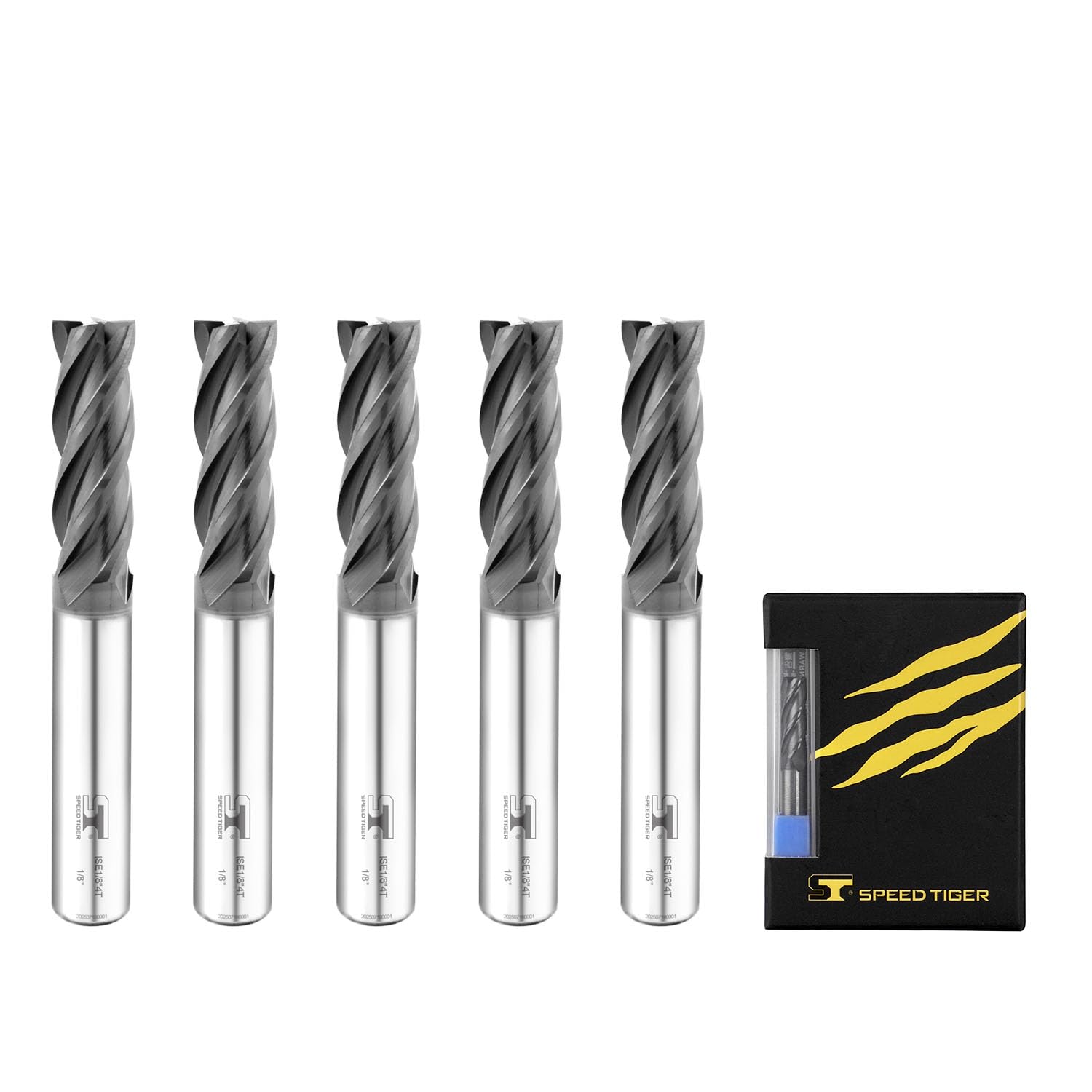 SPEED TIGER ISE Carbide End Mill 1/8”9.8/10View on Amazon
- 2
 Genmitsu 40pcs End Mills CNC Router Bits9.7/10View on Amazon
- 3
 SpeTool 5PCS Spiral Downcut Router Bits 1/4" Shank 1" Cutting9.7/10View on Amazon
When cutting hardwood signs, cabinet parts, decorative plaques and precision joinery, finding the best router bit manufacturers comes down to solid carbide purity, runout tolerances and specialized edge geometry. Premium tooling brands separate themselves through vibration-free balance and durable coatings that resist resin buildup during continuous workshop runs. Established makers such as Whiteside Router Bits with its 1/4-inch shank compression spirals, CMT ORANGE TOOLS with its 1/2-inch shank cutters, and SpeTool with its 2.5 times life coatings stand out because their published specifications match actual shop demands. Understanding how these manufacturers engineer their flutes and grade their carbide ensures clean edges without tearout on your projects.
LaserEngraveHQ earns a commission from purchases made through these links, at no extra cost to you. Read our affiliate disclosure.
Router bit performance depends on machine rigidity, spindle runout and proper feed rates. Premium carbide and specialized coatings extend cutting life, but running a cutter past its rated speed or forcing a dull edge will cause premature wear on any brand.
Step 1: Inspect carbide composition and grain size
The foundation of any quality router bit is the carbide alloy from which it is ground. Economy bits often rely on recycled carbide or coarse-grain grades that chip when cutting dense knots or abrasive glue lines. Leading manufacturers specify virgin micro-grain tungsten carbide, where fine grains create a dense structure that holds a sharp edge under continuous cutting loads.
Hardness and cobalt content determine how well a cutter balances edge retention against brittleness. Akylin notes an original tungsten carbide head with HRA 92° hardness and a 1.0um grain size on its flush trim cutters with silver induction brazing, though listings sometimes describe these hybrid assemblies interchangeably with solid carbide tooling. For industrial tooling, XDENGP publishes an exact metallurgical formulation of 91% ultrafine tungsten carbide particles combined with 9% cobalt binder to absorb shock in fibrous hardwoods. EANOSIC also highlights solid virgin carbide on its spiral flush trim cutters to maintain lubricity and sharpness during repetitive profiling.
Solid carbide construction provides superior rigidity compared to brazed bits. Whiteside Router Bits grinds its model UD2102 entirely from solid carbide stock, eliminating shank flex during deep profiling passes. When exploring tooling in our CNC tooling guide and our guide to the best CNC router bits for hardwood, prioritize brands that openly state their carbide grade, grain size, and virgin material sourcing.
Step 2: Match flute geometry and compression cutting action
Flute geometry dictates how a router bit engages material and clears waste. While straight bits push chips forward into the cut path, spiral flutes act like continuous shearing knives. An upcut spiral pulls chips upward to clear deep grooves, but it can splinter surface veneers. A downcut spiral pushes chips downward to leave a clean top edge, but it packs waste into blind mortises. For sheet goods with delicate surface veneers on both faces, compression geometry provides the ideal solution.
Compression spirals combine an upcut flute at the tip with a downcut flute along the upper cutting length, pulling wood fibers toward the center of the panel to prevent chipout on both surfaces. Whiteside Router Bits utilizes a 2+2 compression spiral with a two-flute design on model UD2102, featuring a 1/4-inch cutting diameter, 1/4-inch shank, 1-inch cutting length, and 2-1/2-inch overall length. Notably, while the primary specification confirms two flutes, secondary retail tables occasionally list 1 flute by mistake, showing why makers verify manufacturer spec sheets directly.
SpeTool produces compression cutters for plywood, laminate, and MDF, offering a 1/4-inch shank bit with a 1-inch cutting length and 2-1/2-inch overall length, as well as an extended model with a 1-1/4-inch cutting length and 3-inch overall length. For heavy template work, CMT ORANGE TOOLS manufactures model 806.690.41B with a 1/2-inch shank, 3/4-inch cutting diameter, 2-inch cutting length, 4-1/2-inch overall length, and 4 cutting edges across 2 flutes. For production workshops, ZahyoX packages 2-flute compression cutters in 2-pack and 5-pack sets with 1/4-inch shanks and 1-inch cutting lengths. For more on flute selection, see our guide on upcut vs downcut end mill geometry and our overview of CNC router bit types.
Step 3: Check shank diameter and collet concentricity
Shank diameter directly affects tool rigidity and deflection under lateral cutting loads. Standard workshop routers and CNC spindles accept bits with either a 1/4-inch or 1/2-inch shank. While 1/4-inch shanks fit palm routers and desktop machines, larger 1/2-inch shanks provide substantially greater cross-sectional rigidity. The heavier shank resists deflection during deep passes in dense hardwoods, preventing chatter marks and uneven wall surfaces.
Heavier cutters like the CMT ORANGE TOOLS model 806.690.41B utilize a 1/2-inch shank to maintain stability and dissipate heat during deep template routing. For intricate carving where fine detail is required, XDENGP balances precision with shank rigidity by grinding a 1/8-inch cutting diameter and 3/4-inch cutting length onto a sturdy 1/4-inch shank with a 2-1/2-inch total length. Whiteside Router Bits similarly maintains consistent 1/4-inch shank dimensions on model UD2102 to ensure true seating in standard collets. Inspect collets regularly for dust and resin accumulation, as collet runout degrades edge quality on any cutter. Our guide on CNC bits explained for beginners breaks down collet care and shank selection.
Step 4: Evaluate heat-resistant coatings and friction specifications
Frictional heat dulls carbide cutting edges quickly, especially in resinous sheet goods like MDF and dense plywood. Premium router bit manufacturers apply thin physical vapor deposition coatings to protect cutting edges from thermal breakdown and resin accumulation.
Nanocomposite surface treatments like nACo, TAC, and nano blue coatings substantially reduce friction between spinning flutes and outgoing wood chips. XDENGP coats its compression spiral cutters with a signature nACo layer specified for a maximum service temperature of 1200℃, a nano hardness of 4500 HV, and a low coefficient of friction of 0.4. This extreme thermal barrier preserves sharpness during sustained CNC cycles.
SpeTool applies a TAC coating to its compression cutters, providing up to 2.5 times the working life of uncoated carbide tooling. BINSTAK also uses a TAC coating on its 1/4-inch shank compression bits with 1-inch cutting lengths to resist heat during slotting and mortising. Similarly, EANOSIC uses a nano blue coating on its virgin carbide flush trim bits, specifying up to 2.5X longer life compared to uncoated cutters. When evaluating manufacturers, check whether the maker states specific coating benefits, such as life multipliers or thermal and friction limits, rather than unverified marketing claims.
Step 5: Review manufacturing tolerances and balance standards
Rotational balance and dimensional precision separate reliable tooling brands from inconsistent cutters. At high spindle speeds, even minor balance variations produce vibration, rough surface finishes, and premature spindle bearing wear. Dependable tooling brands grind their bits on multi-axis CNC machines to maintain tight dimensional consistency.
BINSTAK publishes a strict manufacturing tolerance error specification of ±0.02mm across its solid carbide spiral router bits, ensuring accurate dimensions for joinery, dados, and mortises. Dynamic balance becomes increasingly critical on larger bits spinning at high velocity. CMT ORANGE TOOLS specifies a maximum speed limit of 18,000 RPM on its heavy 3/4-inch diameter model 806.690.41B flush trim bit to keep rotational forces safely in check.
Guide bearing construction also reflects overall manufacturing quality. Akylin integrates an upgraded bearing locking mechanism on its 1/2-inch cutting diameter flush trim bits with 1-inch cutting lengths, securing the guide assembly during high-speed routing. EANOSIC equips its 1/4-inch shank flush trim cutters with two independent ball bearings secured by forced-on steel collars for smooth template tracking. For makers setting up a workshop, our guide to the best CNC bit set for beginners explains how to inspect runout and bearing stability across tooling sets.
Common mistakes to avoid
- Exceeding the manufacturer’s maximum RPM limit on large-diameter cutters, which generates dangerous vibration.
- Using standard straight bits instead of compression spirals when profiling double-sided veneered plywood or laminate.
- Taking full-depth passes in dense stock rather than clearing material in multiple shallow steps.
- Failing to clean pitch and resin from flutes, which accelerates frictional heat buildup.
- Ignoring collet wear and runout, which causes premature cutter chipping.
- Bottoming out the cutter shank inside the collet before tightening, preventing concentric clamping.
Best router bit manufacturers: the short version
- Select the largest shank diameter your router spindle or collet accepts to minimize deflection.
- Choose solid virgin micro-grain carbide from makers that publish verified material specifications.
- Match flute geometry to your cut, using compression spirals for double-sided sheet goods and veneers.
- Consider heat-dissipating coatings when cutting abrasive composite boards in production batches.
- Verify that bits meet strict manufacturing tolerances and never exceed the maker’s maximum RPM limits.
FAQ: lasers and CNC
Who makes the best router bits?
The best router bit manufacturers are makers that publish exact metallurgical specifications, tight manufacturing tolerances, and clear operating limits. Whiteside Router Bits is known for precision solid carbide compression cutters like model UD2102 with a 1/4-inch shank and 1-inch cutting length. CMT ORANGE TOOLS produces heavy industrial tooling, including model 806.690.41B with a 1/2-inch shank and an 18,000 RPM maximum speed limit. SpeTool and BINSTAK provide high-performance coated bits with TAC treatments rated for up to 2.5 times the life of uncoated carbide, with BINSTAK specifying a ±0.02mm tolerance error. Akylin offers pattern bits with guide bearings and HRA 92° carbide hardness, while EANOSIC provides flush trim bits with two independent ball bearings on a 1/4-inch shank.
What is a compression bit?
A compression bit is a spiral router cutter that combines upcut flutes at the bottom tip with downcut flutes along the upper cutting length. As the cutter spins, the opposing spirals pull wood fibers inward toward the vertical center of the workpiece. This dual shearing action prevents tearout on both the top and bottom faces of sheet goods like plywood, MDF, and laminate. Whiteside Router Bits implements this geometry on model UD2102 using a 2+2 compression spiral with two flutes, delivering clean edges on challenging composite panels.
Which router bit to use?
The choice depends on the material, cut depth, and desired edge finish. For sheet goods and veneered panels, choose a compression spiral bit to prevent surface chipping. For clearing blind mortises, pockets and deep slots, use an upcut spiral to extract chips upward efficiently. For through-cuts where top-edge splintering must be avoided, or for shallow decorative surface cuts in solid lumber, a downcut bit keeps surface fibers cleanly sheared downward. When trimming workpieces to match a template, use a flush trim bit with guide bearings. For specialized machining in non-wood materials, consult our guide on the best router bit for plastic and our overview of the best CNC router bits.
How to use a straight router bit?
To use a straight router bit safely and cleanly, select the proper feed direction for your equipment: handheld routers and router tables typically use conventional feeding against cutter rotation for stability, while CNC routers often utilize climb milling to minimize edge tearout. Avoid forcing the cutter through dense stock in a single deep pass; instead, step down the cutting depth across multiple passes to allow chips to clear and prevent overheating. Maintain a steady feed rate so the flutes slice chips cleanly rather than rubbing against wood fibers. Ensure your workpiece is clamped securely before starting the cut.
How to change router bit?
To change a router bit safely, first disconnect the machine from power. Loosen the collet nut using the appropriate wrenches until the collet releases the shank. Inspect the interior of the collet cone and clean out any dust or debris that could introduce runout. Insert the new bit shank into the collet past the minimum insertion mark, leaving a small gap above the spindle base to avoid bottoming out. Tighten the collet nut securely with smooth wrench pressure without over-tightening.
Related: the CNC tooling guide, CNC router bit types and best CNC router bits. Also see our best CNC bit set for beginners. Also see our best surfacing bit for CNC.