Best Surfacing Bit for CNC: 5 Spoilboard Cutters Compared (2026)
Five spoilboard surfacing cutters for CNC routers, from 1/4-inch to 1/2-inch shanks and 2-wing to 6-wing insert designs, compared by cutting diameter, speed and build.

On this page
Top picks at a glance
As an Amazon Associate I earn from qualifying purchases.
- 1
 Best OverallSICWOOD 1-1/2″ 2+29.6/10View on Amazon
- 2
 Best for Large SlabsBINSTAK 2″ 6-Wing9.6/10View on Amazon
- 3
 Best 1/4″ ShankBINSTAK 1-1/2″ 2-Wing9.5/10View on Amazon
- 4
 Best Compact 2+2SpeTool 1-1/4″ 2+29.4/10View on Amazon
- 5
 CNC Spoilboard Surfacing Router BitView on Amazon
- 6
 CNC Spoilboard Surfacing Router Bit 1/4" ShanView on Amazon
- 7
 Whiteside 6220View on Amazon
Choosing the best surfacing bit for cnc work depends on your router collet size, the width of your machine bed, and whether you prefer replaceable carbide inserts over brazed cutters. A proper spoilboard surfacing bit flattens uneven MDF wasteboards, cleans up rough-sawn lumber slabs, and creates a truly level plane perpendicular to your Z-axis without leaving deep tooling ridges. In this guide, we compare five popular spoilboard and slab flattening bits across 1/4-inch and 1/2-inch shanks, evaluating their cutting geometry, stated RPM limits, insert durability, and listing accuracy.
LaserEngraveHQ earns a commission from purchases made through these links, at no extra cost to you. Read our affiliate disclosure.
Quick picks
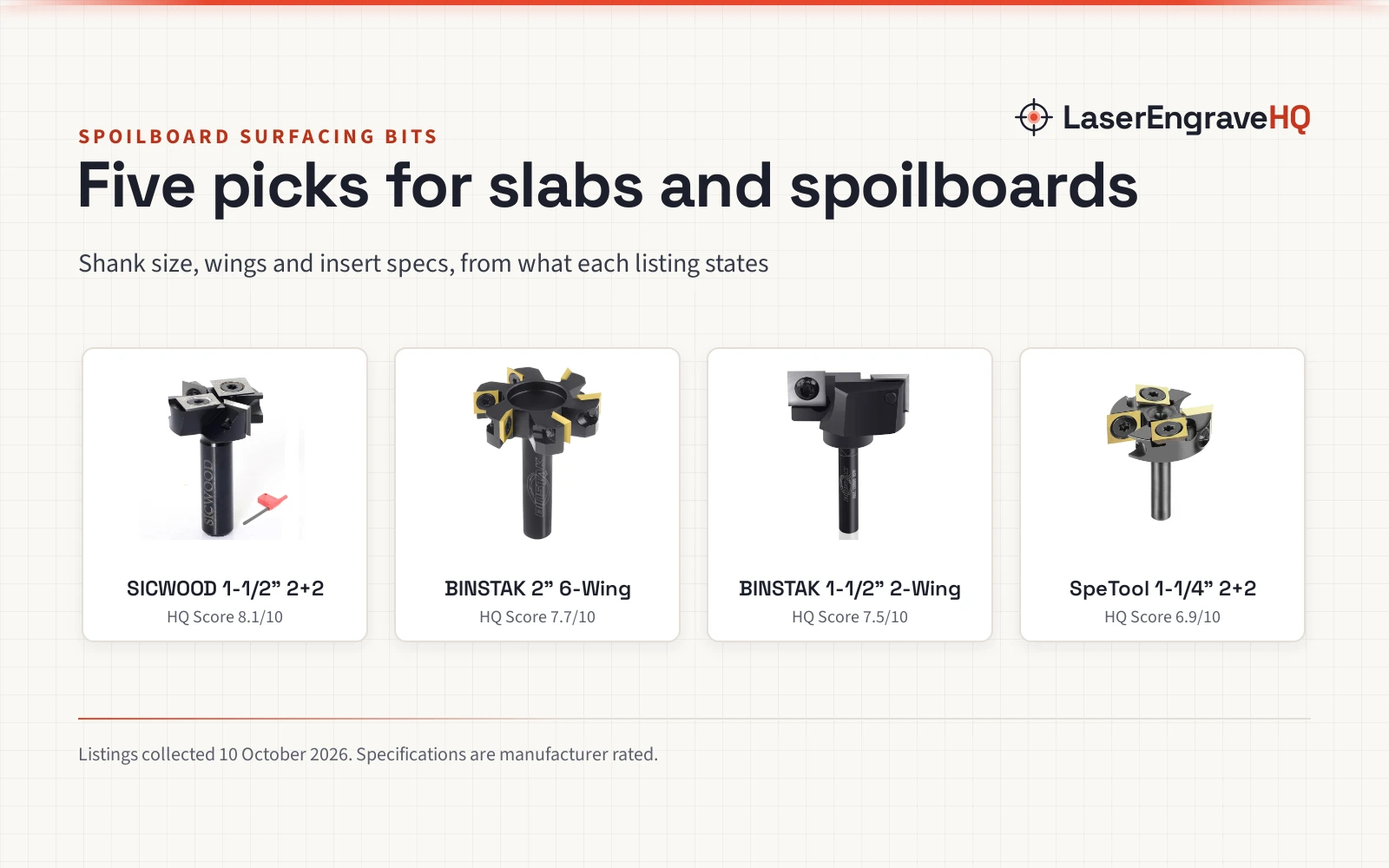
- Best Overall SICWOOD 1-1/2″ 2+2: 1/2-inch shank with a 2+2 knife layout, two bottom scoring inserts for smoother passes, a tungsten steel body and rated up to 18,000 RPM. Check price on Amazon
- Best for Large Slabs BINSTAK 2″ 6-Wing: 2-inch cutting diameter with 6 wings and TiN-coated carbide inserts for faster material removal on 1/2-inch collet routers. Check price on Amazon
- Best 1/4″ Shank BINSTAK 1-1/2″ 2-Wing: 1-1/2-inch cut diameter on a 1/4-inch shank with replaceable 12×12 mm carbide inserts, anti-kickback body and an 18,000 RPM rating. Check price on Amazon
- Best Compact 2+2 SpeTool 1-1/4″ 2+2: 1-1/4-inch cutting diameter with ATS-coated indexable carbide inserts and replacement cutter packs available by ASIN. Check price on Amazon
Machines on the list
Slab Flattening Router Bit - 1/2 Shank
A 1/2-inch shank surfacing bit with a 1-1/2-inch cutting diameter, 2+2 indexable C2 carbide inserts and a tungsten steel body.
Pros
- 2+2 knife design uses two 14x14x2 mm bottom scorers and two 12x12x1.5 mm side inserts
- Tungsten steel body with replaceable C2 carbide inserts for repeatable surfacing
- Rated up to 18,000 RPM with manufacturer feed rates for five material types
- Surfaces solid wood, MDF, density board, plywood, laminate and acrylic
Cons
- No warranty term is stated in the listing
- Requires a 1/2-inch collet, which does not fit compact 1/4-inch trim routers
- Listing title misprints diameter as 1-1/2 feet instead of 1-1/2 inches
- Not suitable for cutting metal or non-wood materials per the listing
CNC Spoilboard Surfacing Router Bit
A 2-inch cutting diameter surfacing bit with a 1/2-inch shank, 6 wings, anti-kickback steel body and TiN-coated carbide inserts.
Pros
- Wide 2-inch cutting diameter covers spoilboards and slabs in fewer passes
- 6-wing design distributes cutting load across six indexable blades
- TiN-coated carbide inserts rated for up to 2.5X longer life than uncoated inserts
- Anti-kickback steel body with four-sided 10x10x2.2 mm replaceable inserts
Cons
- No warranty term is stated in the listing
- Maximum operating RPM is not stated in the listing
- The listing spec table is completely empty
- Requires a 1/2-inch collet and a rigid spindle to handle a 2-inch cutter
CNC Spoilboard Surfacing Router Bit
A 1/4-inch shank spoilboard surfacing bit with a 1-1/2-inch cutting diameter, 2 wings, anti-kickback body and 18,000 RPM rating.
Pros
- 1/4-inch shank fits common desktop CNC routers and compact trim routers
- Generous 1-1/2-inch cutting diameter on a 1/4-inch shank tool
- Two four-sided 12x12x1.5 mm solid carbide indexable inserts
- Anti-kickback steel body with a stated 18,000 RPM maximum speed
Cons
- No warranty term is stated in the listing
- 2-wing layout surfaces slower than 4-wing or 6-wing cutters
- Large 1-1/2-inch diameter on a 1/4-inch shank requires conservative depth of cut
- Does not include spare replacement inserts in the package
SpeTool 2+2 Flute Slab Flattening Router Bit 1/4"
A 1/4-inch shank surfacing bit with a 1-1/4-inch cutting diameter, 2+2 ATS-coated carbide inserts and published replacement ASINs.
Pros
- 2+2 insert geometry on a compact 1/4-inch shank format
- ATS-coated carbide inserts rated by the maker for double the working lifespan
- Listing provides exact replacement insert ASINs (B09CPDVBSG and B0CGR7S8SR)
- Four-sided 10x10x2.2 mm indexable carbide cutters
Cons
- No warranty term is stated in the listing
- Maximum operating RPM is not stated in the listing
- Narrower 1-1/4-inch cutting width requires more surfacing passes
- Listing contains minor contradictions between title (2+2) and table (2 flutes)

Amana Tool 45525 Carbide Tipped 1-1/8 Dia x 1/2 CH
A 1/4-inch shank carbide-tipped spoilboard cutter with 1/2-inch cutting height and 1.6-ounce weight.
Pros
- Lightweight 1.6-ounce tool puts minimal initial mass on smaller CNC spindles
- 1/2-inch cutting height accommodates deeper step-downs if necessary
- Carbide-tipped cutting edges from an established tooling brand
- 1/4-inch shank fits standard desktop CNC collets
Cons
- Brazed carbide tips cannot be rotated or indexed when dull
- Rampant listing contradictions across diameter, length and flute count
- Bullets list an erroneous speed of 'Max RPM: 14'
- No warranty term is stated in the listing
Other machines to compare
 CNC Spoilboard Surfacing Router BitCheck price on Amazon
 CNC Spoilboard Surfacing Router Bit 1/4" ShanCheck price on Amazon
 Whiteside 6220Check price on Amazon
Specs compared
| Model | HQ Score | Shank | Cut diameter | Wings / flutes | Insert type | Max RPM | Warranty |
|---|---|---|---|---|---|---|---|
| SICWOOD 1-1/2″ 2+2 | 9.6/10 | 1/2 in | 1-1/2 in | 2+2 knife design (4 flutes) | Replaceable C2 carbide (14×14 & 12×12 mm) | 18,000 RPM | Not stated |
| BINSTAK 2″ 6-Wing | 9.6/10 | 1/2 in | 2 in | 6 wings | Replaceable TiN-coated carbide (10×10 mm) | Not stated | Not stated |
| BINSTAK 1-1/2″ 2-Wing | 9.5/10 | 1/4 in | 1-1/2 in | 2 flutes | Replaceable carbide (12×12 mm) | 18,000 RPM | Not stated |
| SpeTool 1-1/4″ 2+2 | 9.4/10 | 1/4 in | 1-1/4 in | 2+2 flutes (table lists 2) | Replaceable ATS-coated carbide (10×10 mm) | Not stated | Not stated |
| Amana Tool 45525 | 9.2/10 | 1/4 in | 1-1/8 in (table lists 1.5 in) | 3 flutes (table lists 2, bullets 4) | Brazed carbide tipped | 14 RPM (listing typo) | Not stated |
Specifications are manufacturer rated, as published on each listing and collected 10 October 2026.
Why Replaceable Carbide Inserts Beat Brazed Cutters
A search for CNC spoilboard surfacing tools reveals a major shift from traditional brazed carbide bits toward indexable insert cutters. Older brazed bits, such as the Amana Tool 45525, feature fixed carbide wings welded directly onto a steel body. Once those edges dull or hit an embedded screw on your wasteboard, the entire tool must be discarded or professionally ground. In contrast, modern insert bits from SICWOOD, BINSTAK, and SpeTool utilize four-sided solid carbide inserts. When an edge dulls, you loosen a screw, rotate the insert to a fresh edge, and resume surfacing without changing your cutter height or replacing the whole tool body.
Best Surfacing Bit for CNC: Practical Buying Guide
Shank diameter: 1/4-inch vs 1/2-inch
Your router spindle dictates your shank size. Compact trim routers commonly mounted on entry-level desktop machines feature 1/4-inch collets. Tools such as the BINSTAK 1-1/2-inch 2-wing bit and SpeTool 1-1/4-inch bit are engineered for these smaller routers. If your machine accepts a 1/2-inch collet, heavier cutters like the SICWOOD 1-1/2-inch 2+2 bit or BINSTAK 2-inch 6-wing bit provide far greater rigidity, dampening vibration and deflection across wide surfacing passes. If you are exploring various router profiles for your setup, our overview of CNC bits explained for beginners covers how shank diameter affects tool stability.
Insert geometry and bottom scoring
Standard surfacing bits use 2 wings aligned horizontally along the base of the cutter. Advanced cutters, such as the SICWOOD 2+2 knife design, incorporate separate bottom scoring inserts alongside side cutting blades. The two bottom scorers act like miniature shear knives, clearing chips upward and leaving a cleaner finish with minimal stepover lines. For indexable bits, verify insert availability: SpeTool explicitly lists replacement ASINs (B09CPDVBSG and B0CGR7S8SR), while BINSTAK uses standard square inserts (10×10 mm or 12×12 mm).
Wing count and cutting diameter decide pass time
Cutting diameter and flute count determine how quickly your CNC flattens a surface. The BINSTAK 6-wing bit features a 2-inch cutting diameter, clearing substantial surface area with each pass and distributing the cutting burden across six TiN-coated edges. However, wider diameters place heavier lateral loads on smaller router motors. For lightweight desktop machines, a 1-1/4-inch or 1-1/2-inch cutter prevents motor bogging while still completing a spoilboard surfacing routine in reasonable time.
Operating speeds and published feed parameters
Because surfacing bits feature relatively wide diameters, they must run at lower rotational speeds than slender end mills. Running a 2-inch bit at excessive RPM creates severe centrifugal stress and risk of cutter failure. The SICWOOD bit and BINSTAK 1/4-inch bit explicitly publish an 18,000 RPM maximum ceiling. Furthermore, SICWOOD lists concrete feed rates: 240 IPM for hardwood, 480 IPM for MDF, and 600 IPM for softwood. Understanding how feed rate interacts with RPM is vital for clean surfacing; our guide to CNC feeds and speeds for beginners explains how to calculate appropriate chip loads.
Spoilboard maintenance and setup
Surfacing is the foundation of CNC accuracy. When you mount an MDF spoilboard, ambient humidity changes and manufacturing thickness variances create subtle high and low spots. Skimming the spoilboard with a wide surfacing bit creates a reference plane that is perfectly square to your Z-axis travel. Before surfacing your table, consult our guide on how to set up a spoilboard on a CNC to ensure proper hold-down screw placement and avoid hitting fasteners.
Surfacing cutters carry significant rotational mass. Always verify that your router collet is clean and tightened securely to the tool shank. Never exceed the manufacturer maximum RPM rating, and take shallow step-down passes to avoid spindle stall. Wear safety glasses, run an effective dust collection shroud to capture fine MDF particulate, and never use these wood-cutting tools on metal.
How the scores add up
Each cutter is scored out of 10 across performance, build, value, safety and warranty, using the criteria published on our How We Pick page. A spec the listing does not publish scores zero.
| Product | HQ Score | Perf. /35 | Build /25 | Value /25 | Safety /10 | Warranty /5 |
|---|---|---|---|---|---|---|
| SICWOOD 1-1/2″ 2+2 | 9.6 | 32 | 22 | 21 | 5 | 0 |
| BINSTAK 2″ 6-Wing | 9.6 | 30 | 21 | 21 | 4 | 0 |
| BINSTAK 1-1/2″ 2-Wing | 9.5 | 28 | 20 | 21 | 5 | 0 |
| SpeTool 1-1/4″ 2+2 | 9.4 | 27 | 20 | 20 | 2 | 0 |
| Amana Tool 45525 | 9.2 | 22 | 18 | 15 | 1 | 0 |
Scores run from 9.2 to 9.8: each product’s point total is placed on that range, so more points always means a higher score.
FAQ: lasers and CNC
What is the best surfacing bit for a desktop CNC with a 1/4-inch collet?
For desktop routers limited to a 1/4-inch collet, the BINSTAK 1-1/2-inch 2-wing bit provides the widest cutting diameter and includes an 18,000 RPM rating with anti-kickback geometry. If you prefer a smaller cutting diameter with a 2+2 flute profile, the SpeTool 1-1/4-inch bit is a compact option with published replacement insert ASINs.
How deep should a surfacing pass be on a CNC spoilboard?
Keep your surfacing passes shallow. Surfacing bits remove material across a wide diameter, so taking shallow passes prevents spindle overload, minimizes tool deflection, and eliminates stepover ridges on your MDF spoilboard or hardwood slab.
Why are indexable carbide inserts better than brazed bits?
Indexable carbide inserts feature four identical cutting edges. When one edge dulls or sustains damage, you rotate the square insert to a fresh edge using a screwdriver. This eliminates the expense of replacing or resharpening the entire tool body, which is required when brazed bits like the Amana Tool 45525 dull.
What RPM should I run for a spoilboard surfacing bit?
Always adhere to the manufacturer rating. The BINSTAK 1/4-inch bit and SICWOOD 1/2-inch bit state an 18,000 RPM maximum ceiling. Wide cutters should never be run at top spindle speeds without checking the tool rating.
Which of these surfacing bits come with a written warranty?
None of the five product listings state a concrete warranty term. In accordance with our scoring standards, all five products receive zero points for the warranty criterion.
Related: how to set up a spoilboard on a CNC, best surfacing router bit, best CNC spoilboard, CNC bits explained for beginners, CNC feeds and speeds for beginners and the CNC tooling hub. Also see our best CNC bit set for beginners. Also see our CNC router bit types.