How Deep Can a Fiber Laser Engrave? A Practical Workshop Guide
A practical guide explaining how deep a fiber laser can engrave: understand optical ablation, match power and lens sizes, manage multi-pass relief carving, and avoid common workshop mistakes.

On this page
Top picks at a glance
As an Amazon Associate I earn from qualifying purchases.
- 1
 GWEIKE G2 Max 50W Fiber Laser Engraver with 3D & Deep9.7/10View on Amazon
- 2
 xTool F1 Ultra 20W Fiber & Diode Dual Laser Engraver 16MP9.7/10View on Amazon
- 3
 ComMarker B4 20W Fiber Laser Engraver9.6/10View on Amazon
How deep can a fiber laser engrave depends on optical power, field lens focal length, scan speed, pulse frequency, and the number of repeated passes over the workpiece. A fiber laser does not cut to a fixed mechanical depth in a single pass; instead, it vaporizes microscopic layers of metal through repeated ablation. While surface marking alters only the outer layer, accumulating successive passes allows a fiber laser to achieve deep engraving, 3D relief carving, and thin metal cutting. Because machine listings do not publish a single universal maximum depth specification, practical depth is determined by how you manage laser power, focal point shift, and heat buildup.
LaserEngraveHQ earns a commission from purchases made through these links, at no extra cost to you. Read our affiliate disclosure.
Commercial fiber laser listings do not state a single universal maximum engraving depth specification because depth depends on the metal alloy, lens selection, and accumulated passes. We do not invent depth benchmarks, so this guide explains the physical factors and cites only verified machine specifications.
Step 1: Understand how fiber laser ablation creates depth
To understand engraving depth, you must separate surface marking from deep engraving. A mechanical mill plunges a physical cutting bit to a set depth. A galvo fiber laser works differently: it emits a concentrated beam (such as the 1064nm wavelength specified on the GWEIKE G2 Pro) that heats metal past its vaporization point in nanosecond pulses. Each pulse ejects a microscopic amount of vaporized metal through optical ablation.
Because each pass removes only a thin layer, achieving depth requires repeating passes over the same path. Monport notes in its 30W listing that the system handles 2.5D metal engraving, deep metal engraving, and thin metal sheet cutting. For machine types and working formats, see our fiber laser engraver hub.
Step 2: Match optical wattage to metal removal rate
Optical power dictates how rapidly a fiber laser removes metal and how deep it can carve in practical workshop time. Machine specifications across listings show how power scales:
- 20W fiber lasers: Compact units, such as the Monport 20W model with a 4.3″x4.3″ field, focus primarily on metal marking and light etching. For deeper engraving, Monport recommends 30W or above for stronger and faster results.
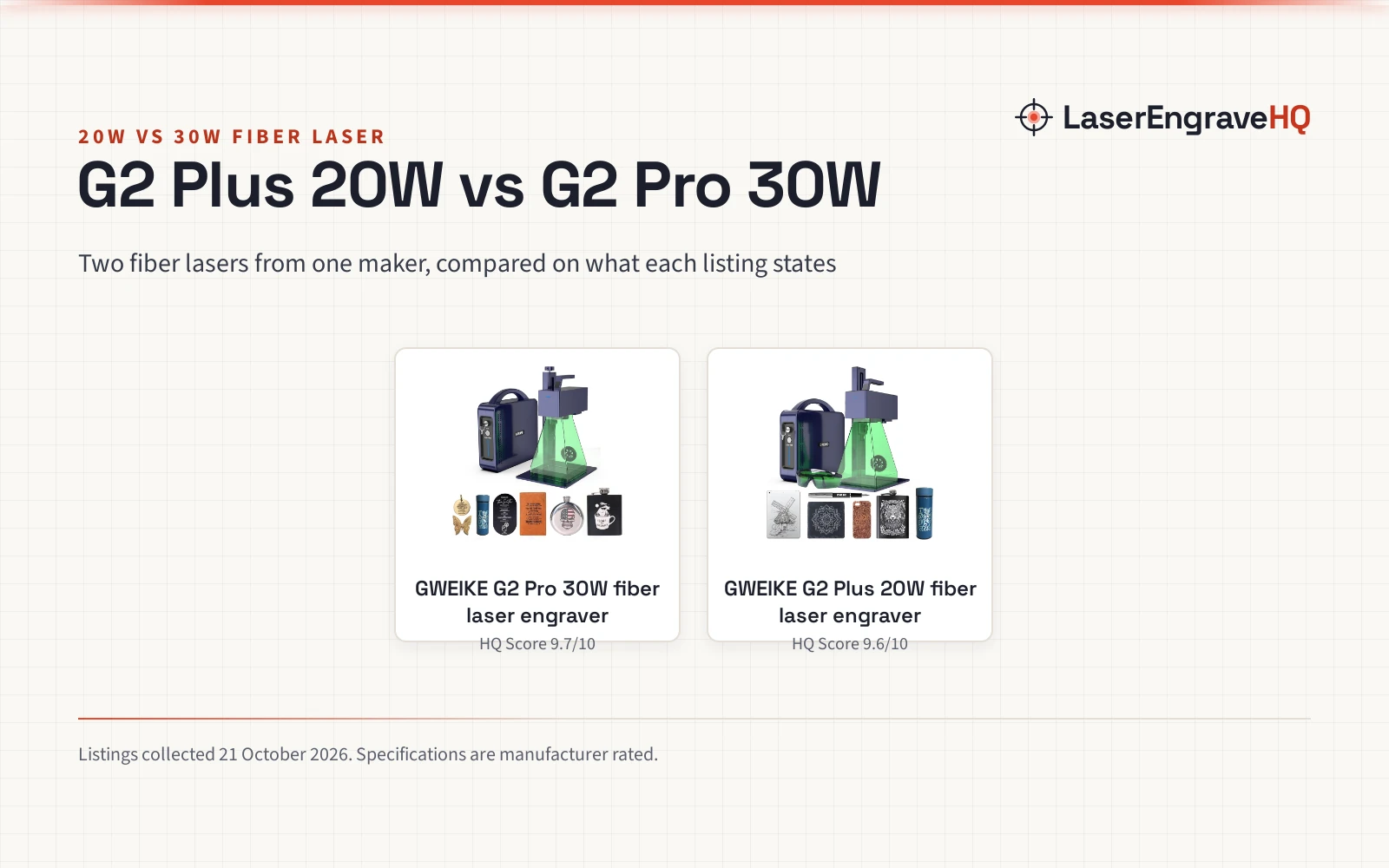
- 30W fiber lasers: The 30W tier, including the GWEIKE G2 Pro (rated at 30W or 30000mW output) and Monport 30W, offers a solid baseline. Monport notes that higher power increases deep engraving and cutting ability, recommending 30W or above for stronger results.
- 50W fiber lasers: Monport 50W listings highlight 3D engraving, deep working capability, and 360° rotational marking across metals like silver, gold, and stainless steel.
- 100W fiber lasers: High-output units, like the Ovsuqu 100W JPT MOPA M7 model with 1.5mJ maximum pulse energy, are built for deep carving and metal cutting.
To compare commercial machines across wattage tiers, read our best fiber laser engraver guide.
Step 3: Select field lens size for beam concentration
Engraving depth depends on optical power density, which is set by your F-theta field lens. A field lens focuses the beam onto the workpiece, balancing marking area against depth capability.
Ovsuqu explains this trade-off directly in its 100W listing: with the same lens, higher power yields deeper engraving; with the same power, a smaller lens yields deeper engraving. A larger lens gives a wider area but weaker light density. A smaller lens concentrates optical energy into a tighter focal spot, delivering higher power density for deeper carving.
Listing data illustrates this range: 110x110mm on the GWEIKE G2 Pro, 4.3″x4.3″ on the Monport 20W, 150x150mm (5.9″x5.9″) on 30W units, 175*175mm (6.9″x6.9″) on Monport MOPA models, 20 x 20 cm on 50W units, and 300x300mm (11.8×11.8″) on the Ovsuqu 100W. If deep relief carving is your goal, choosing a smaller lens like 110x110mm or 150x150mm yields deeper cuts than a 300x300mm lens.
Step 4: Configure speed, frequency, and pulse settings
Galvanometer systems achieve remarkable travel speeds, such as the 15000mm/s listed on the GWEIKE G2 Pro (with 0.001 mm accuracy) and 10000mm/s on Monport models (with 0.01mm carving accuracy). For deep engraving, operators tune travel speed alongside hatch density and pass counts so the beam delivers adequate dwell time to vaporize metal without creating excessive thermal distortion.
Pulse frequency and duration also affect how the laser interacts with metal. Standard fiber lasers operate with fixed pulse settings, while MOPA sources allow adjustable pulses. Listings for the Ovsuqu 100W and Monport 30W MOPA models specify 1-4000kHZ (1-4000kHz) frequencies and 2-500ns pulse durations. Adjusting frequency and pulse duration allows operators to modulate peak power and heat delivery for deep material removal, surface cleanup, or color marking on stainless steel and titanium. For color marking techniques, see how to color engrave stainless steel with a MOPA laser.
Step 5: Manage hatch patterns, repeated passes, and focal drift
Deep engraving requires structured pass planning to overcome physical optical hurdles:
- Alternating hatch angles: Running all passes in a single direction cuts grooves that trap vaporized metal. Rotating hatch angles between passes keeps the cavity floor flat.
- Slag cleanup passes: Optical ablation leaves melted metal that re-solidifies as slag. Periodic high-speed, lower-power cleaning passes sweep away loose oxide so fresh passes strike bare metal.
- Focal drift adjustment: As a trench deepens, the bottom drops below the focal plane. Because the beam diverges outside focus, power density drops. On deep runs, operators lower the focal column periodically. Electric lift columns assist focus adjustments, while vertical supporting towers with rulers help verify focal height measurements.
Step 6: Account for metal hardness and material behavior
Metal composition and surface properties directly affect ablation rates. Listings identify compatible metals including aluminum, brass, copper, carbon steel, stainless steel, titanium, gold, and silver.
Each metal responds differently to fiber laser energy. Carbon steel and stainless steel couple well with the beam and maintain localized heat due to moderate thermal conductivity, allowing consistent layer removal across repeated passes. Highly reflective, thermally conductive metals like copper, gold, and silver reflect a substantial portion of infrared energy and conduct heat away from the beam spot rapidly, requiring higher pulse energies to sustain ablation. Brass and aluminum have distinct thermal properties, where beam reflection and rapid heat dissipation influence how many passes are needed to achieve depth.
Material safety must come first. While some machine listings mention non-metals like PVC or ABS, workshop safety standards strictly advise against them. Never laser PVC, vinyl, PVC-based faux leather, polycarbonate, or ABS. Ablating these materials releases harmful chlorine gas and hazardous fumes that damage laser optics and create health risks. See our guide to materials you should never laser cut.
Step 7: Maintain workshop safety and particulate ventilation
Deep engraving turns metal into fine airborne dust and metallic fumes, requiring firm safety measures:
- Eye protection: Open galvo units carry high safety classes. The GWEIKE G2 Pro lists Class 4 (FDA Accession Number 2211667-002), Monport lists Class 5, and Ovsuqu lists Class 2 guidance (FDA Accession Number 2420799-000). Class 4 diffuse reflections can cause severe eye injury. Wear protective glasses certified with an optical density rating that matches the machine’s specific wavelength, such as the 1064nm wavelength listed on the GWEIKE G2 Pro. Tinted shields without certified ratings do not protect your eyes.
- Fume ventilation: Vaporizing metal produces fine metallic smoke. Exhaust fumes outdoors or use a filter rated for laser particulate. See our fume extractor guide.
- Fire safety: Clamping metal blanks securely and having an emergency stop within reach keeps long multi-pass runs under control.
Common mistakes to avoid
- Using an oversized field lens that spreads optical power too thin for deep carving.
- Engraving every pass in the same direction, creating deep ridges that trap metal slag.
- Failing to lower focal height as the cut deepens, causing the beam to lose focus.
- Running continuous high power without cooldown pauses, warping thin metal blanks.
- Skipping fume extraction during extended multi-pass metal engraving jobs.
How deep can a fiber laser engrave: the short version
- A fiber laser removes metal layer by layer through optical ablation rather than cutting to a fixed single-pass depth.
- Listing specifications do not state a single universal maximum depth because results depend on wattage, lens selection, pass count, and metal hardness.
- Higher optical power (like 30W, 50W, or 100W versus 20W) increases metal removal rates and speeds up deep carving.
- Smaller field lenses (like 110x110mm) concentrate beam energy into a tighter spot, achieving deeper cuts than larger lenses (like 300x300mm).
- Multi-pass relief carving requires alternating hatch angles and cleaning passes to prevent slag accumulation.
- Total practical depth is limited by the lens depth of focus and sidewall taper unless focal height is lowered during the job.
Deep engraving succeeds through deliberate parameter choices, clean multi-pass execution, and proper focal adjustment rather than relying on a single depth number.
FAQ: lasers and CNC
Can a fiber laser cut metal sheet?
Yes. Listings for 30W and 100W fiber lasers state metal sheet cutting capabilities. Cutting is accomplished by repeating focused vector passes along a contour until the beam penetrates the sheet.
Does higher wattage make a fiber laser engrave deeper?
Yes. As Monport and Ovsuqu listings note, higher power provides greater pulse energy and faster material removal. A 50W or 100W laser achieves deep relief in fewer passes than a 20W or 30W machine.
Why does a smaller field lens engrave deeper than a larger lens?
As Ovsuqu explains in its 100W listing documentation, a smaller field lens focuses the laser beam into a smaller spot. This concentrates optical power density, producing deeper penetration per pass compared to an expanded lens where energy spreads over a larger area.
Can a fiber laser produce 3D relief engraving on metal?
Yes. GWEIKE and Monport listings highlight 3D and 2.5D deep engraving. Software slices dimensional artwork into layers, and the galvo laser runs successive passes with varied power or pulse duration to carve relief into brass, steel, or aluminum.
What prevents a fiber laser from engraving infinitely deep?
Physical factors that limit depth include beam defocusing as the trench floor drops below the focal plane, sidewall taper blocking incoming beam rays, and slag redepositing in the cavity. Lowering the focal column extends practical depth.
Do I need specialized safety eyewear for deep metal engraving?
Yes. Galvo fiber machines operate with high optical energy, with listings citing Class 4 (such as the GWEIKE G2 Pro) or Class 5 safety levels. Diffuse reflections can cause permanent eye injury. Operators must wear certified safety glasses with an optical density rating that covers the laser wavelength, such as 1064nm on the GWEIKE unit.
Related: the laser engraver hub, our guide to the best laser engraver for metal, and can a fiber laser cut metal. Also see what is a galvo laser, what is a fiber laser engraver, and our laser safety glasses guide.