Downcut vs Compression Router Bit: Which One Should You Buy?
Downcut and compression router bits compared on flute geometry, chip flow, edge finish, cut depth, workholding stability, and stated workshop specifications.

On this page
Top picks at a glance
As an Amazon Associate I earn from qualifying purchases.
- 1
 SpeTool 5PCS Spiral Downcut Router Bits 1/4" Shank 1" Cutting9.7/10View on Amazon
- 2
 SpeTool 1/8 Inch Spiral Router Bits Up Down Compression Bit9.7/10View on Amazon
- 3
 SpeTool UP&Down Compression Bit 1/4" Shank9.7/10View on Amazon
- 4
 SpeTool 1/8 Inch Spiral Downcut Router Bit 1/4 Inch ShankView on Amazon
- 5
 Milescraft 2215 1/8" Downcut Spiral Router Bit for InlaysView on Amazon
- 6
 ZahyoX 1/4 Inch Downcut Spiral CNC Router Bit for WoodView on Amazon
- 7
 Downcut Spiral Flush Trim Router BitView on Amazon
- 8
 Downcut Flush Trim Router Bit 1/4 Inch ShankView on Amazon
- 9
 ZahyoX 5-Pack 1/4 Inch Downcut Spiral CNC Router Bit for WoodView on Amazon
Makers cutting custom wooden signs, decorative trays, and cabinet components on a CNC router regularly face a choice between a downcut vs compression router bit. Both spiral designs solve tearout problems, but they direct cutting forces in completely different directions. This head-to-head comparison examines the downcut and compression spiral geometries, comparing flute orientation, chip flow, edge finish, and stated specifications across listings from Whiteside and SpeTool to help you choose the right tooling for your workshop.
LaserEngraveHQ earns a commission from purchases made through these links, at no extra cost to you. Read our affiliate disclosure.
Verdict: choose a downcut router bit if you cut shallow dados, pockets, grooves, or delicate inlays where only the top face requires a crisp edge and downward chip ejection helps hold thin sheet material firmly against the wasteboard. Choose a compression router bit if you make full-depth through cuts in plywood, laminates, or double-sided sheet goods where both the top and bottom faces must remain clean and free from delamination.
Machines on the list

SpeTool UP&Down Compression Bit 1/4"
A 1/4-inch shank carbide compression spiral bit with up and down flutes designed to combat top and bottom delamination.
Pros
- Up and down-cut flutes designed to combat delamination on both top and bottom surfaces
- Generous 1-1/4 inch cutting length and 3 inch overall length provide deep reach
- TAC extra long life coating claimed by maker to provide up to 2.5 times life over uncoated bits
- Stated compatibility with soft woods, hard woods, plywood, laminate, oak, and MDF
Cons
- Spec table contradicts title and bullets by listing cut type as down-cut instead of compression
- Spec table lists included components as No with no protective storage box stated
- No warranty term is stated in the listing
- Requires cutting deep enough for both upcut and downcut flute sections to engage the workpiece

SpeTool 1/4 Inch Shank Downcut Spiral Router Bit
A 1/4-inch shank downcut spiral end mill with tungsten carbide construction and extra long life coating for clean top surfaces.
Pros
- Downcut spiral shears downward to leave a clean edge and top surface without tearout
- Tungsten carbide construction with 1 inch cutting length and 2-1/2 inch overall length
- Extra long life coating claimed by maker to provide up to 2.5 times life over uncoated bits
- Comes with a protective plastic storage box included according to the spec table
Cons
- Forces chips downward into the cut channel, requiring effective dust clearance
- Can cause tearout or blowout on the bottom face during full-depth through-cuts
- No warranty term is stated in the listing
- Listing bullets contain minor text errors, writing collect for collet and cycles for cuts

Whiteside RD1600 Spiral Downcut Straight Router
A solid carbide 1/8-inch downcut spiral router bit designed for fine inlays, shallow grooves, dados, and thin sheet stability.
Pros
- Solid carbide spiral helix produces shearing action to eliminate top-surface tearout
- Narrow 1/8 inch cutting diameter allows fine detail routing, precise inlays, and small dados
- Downward cutting action helps hold thin sheets and small workpieces in place during CNC routing
- Stated compatibility with veneer, laminates, and plywood for clean grooves and pockets
Cons
- Listing contradicts itself, stating solid carbide in bullets but carbide-tipped in spec table
- Spec table lists an anomalous item weight of 0.27 g
- No protective coating or storage box is mentioned in the listing
- No warranty term is stated in the listing
Other machines to compare
 SpeTool 1/8 Inch Spiral Downcut Router Bit 1/4 Inch ShankCheck price on Amazon
 Milescraft 2215 1/8" Downcut Spiral Router Bit for InlaysCheck price on Amazon
 ZahyoX 1/4 Inch Downcut Spiral CNC Router Bit for WoodCheck price on Amazon
 Downcut Spiral Flush Trim Router BitCheck price on Amazon
 Downcut Flush Trim Router Bit 1/4 Inch ShankCheck price on Amazon
 ZahyoX 5-Pack 1/4 Inch Downcut Spiral CNC Router Bit for WoodCheck price on Amazon
Side by side
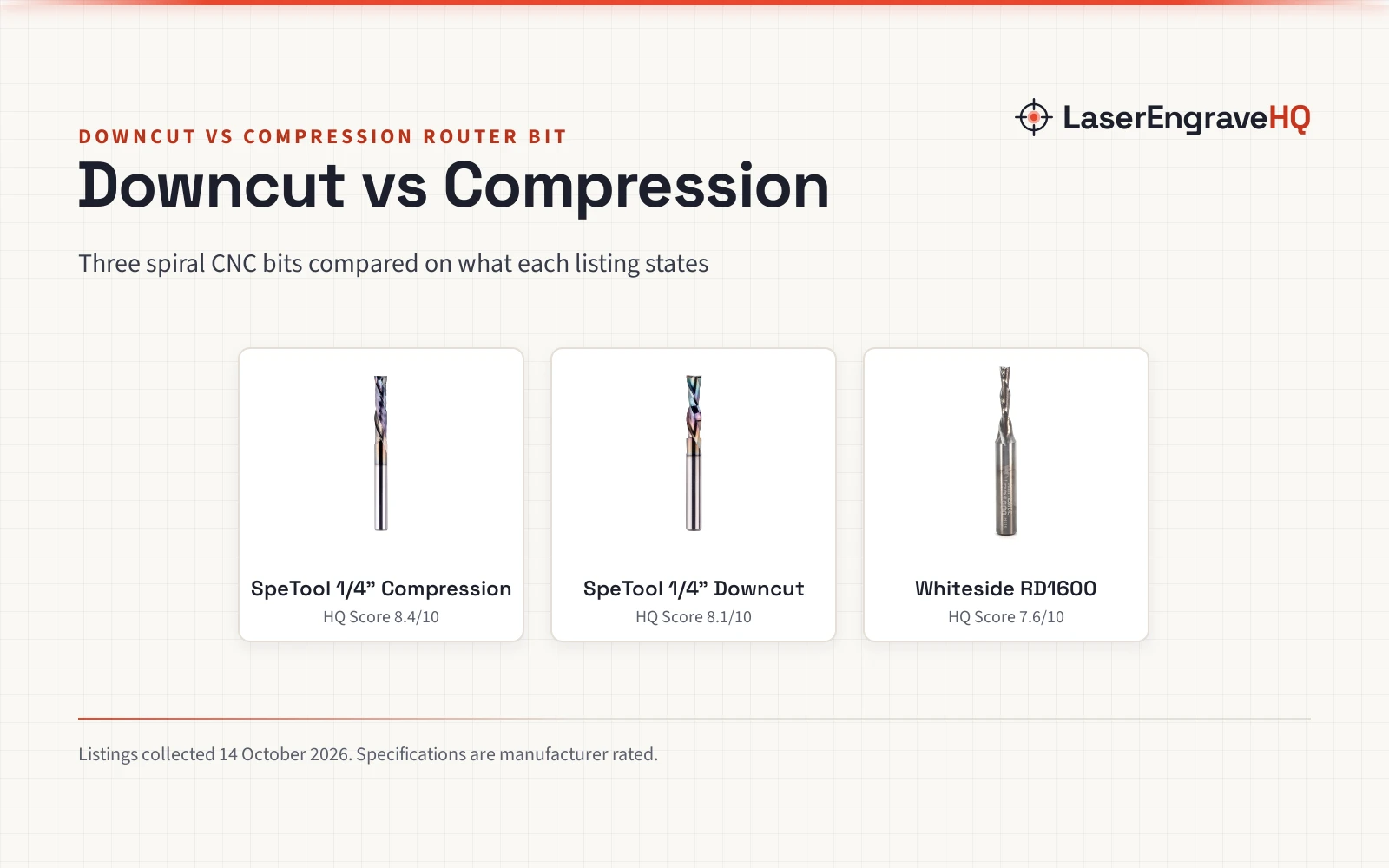
| Spec | SpeTool 1/4″ Compression | SpeTool 1/4″ Downcut | Whiteside RD1600 |
|---|---|---|---|
| HQ Score | 62 | 60 | 56 |
| Tool type | Compression spiral (up and down cut) | Downcut spiral | Downcut spiral |
| Cutting diameter | 1/4 inch (0.25 inches) | 1/4 inch (0.25 inches) | 1/8 inch (0.13 inches) |
| Shank diameter | 1/4 inch | 1/4 inch | 1/4 inch |
| Cutting length | 1-1/4 inches | 1 inch | 1/2 inch (0.5 inches) |
| Overall length | 3 inches | 2-1/2 inches | 2 inches |
| Flutes | 2 | 2 | 2 |
| Material | Carbide | Tungsten Carbide | Solid carbide (Carbide-Tipped in spec table) |
| Coating | TAC Extra Long Life Coating | Extra Long Life Coating | Not stated |
| Included components | No | Plastic Storage Box | Not stated |
| Weight | 1.12 ounces | 1.12 ounces | 0.27 g |
| Warranty | Not stated | Not stated | Not stated |
Specifications are manufacturer rated, as published on each listing and collected 14 October 2026.
Downcut vs compression router bit: cutting action and chip flow
Understanding the mechanical difference between a downcut vs compression router bit begins at the cutting edge. A downcut spiral bit features reverse-helix flutes that shear downward toward the spoilboard. As the router spindle turns, the downward spiral presses material fibers into the core of the workpiece, leaving an exceptionally sharp top surface. However, this downward action pushes waste chips down into the cut channel rather than pulling them up and out.
A compression router bit combines two distinct flute geometries on a single continuous tool. The tip of the bit features an upcut spiral that pulls chips upward from the bottom of the cut, while the upper section transitions into a downcut spiral that pushes downward on the top surface. The two cutting forces meet in the middle of the cut channel, compressing the workpiece fibers toward the center of the panel. For a detailed breakdown of flute spirals across woodworking tools, see our guide to CNC router bit types.
Edge finish and surface delamination
Surface quality on sheet goods depends heavily on flute direction. When routing veneered plywood, melamine, or double-sided laminates, conventional upcut bits tend to lift and splinter the delicate top veneer. Downcut bits eliminate this problem entirely on the upper face. The Whiteside RD1600 listing explicitly notes that its downward cutting action eliminates tearout when cutting grooves, dados, slots, and pockets in veneer, laminates, and plywood.
The limitation of a downcut spiral appears on through cuts. Because the downward cutting force exits through the bottom of the panel, it can push bottom wood fibers or veneer away from the core, creating blowout or ragged fuzz on the underside. This is where a compression cutter excels. The SpeTool 1/4″ Compression listing notes that its up-and-down flutes combat delamination on both the top and bottom of a workpiece. By pulling the bottom face upward and pushing the top face downward, compression bits produce clean edges on both surfaces simultaneously.
Through cuts vs shallow grooves and dados
Project geometry determines which tool profile belongs in your spindle. Downcut bits excel at partial-depth joinery. When carving shallow inlays, blind mortises, shelf dados, or sign lettering, the bottom face of the panel is never breached, so bottom tearout is a non-issue. The Whiteside RD1600 specifies a 1/2-inch cutting length with an 1/8-inch cutting diameter, making it ideal for narrow dados and decorative inlay work. The SpeTool 1/4″ Downcut provides a 1-inch cutting length for deeper mortises and slots in solid hardwoods, oak, and MDF.
Compression bits, by contrast, are engineered specifically for full-depth panel processing. Because the lower upcut section of the tool must completely clear the bottom face while the upper downcut section engages the top face, compression cutters require a cut depth greater than the upcut tip transition height. Attempting to use a compression bit for a shallow dado or surface pocket engages only the lower upcut tip, producing the exact top-edge tearout the tool was designed to prevent. For more on single-direction spiral mechanics, explore our upcut vs downcut router bit comparison.
Workholding and workpiece stability
Workholding requirements differ significantly between these cutter types. The downward thrust of a downcut bit pushes the workpiece directly into the router table or CNC wasteboard. The Whiteside RD1600 listing highlights this stability benefit, noting that downward cutting action is great for holding thin sheets or small pieces in place during CNC routing operations. For makers using vacuum hold-down, mechanical hold-downs, or tape-and-glue workholding, downcut bits reduce the risk of parts shifting or lifting.
Compression cutters exert neutral vertical forces overall because the upward pull of the tip is countered by the downward push of the upper flute. However, during the initial plunge or entry cut before the downcut section engages, the upcut tip pulls upward on the material. Proper hold-down clamping or aggressive tab strategies remain essential when running full-depth profile cuts with compression bits. You can read more about effective securing methods in our guide to clamping ideas on a CNC router.
Tool construction, coatings, and stated specifications
All 3 featured products utilize carbide cutting edges, but the listings reveal distinct specifications and occasional catalog contradictions. The SpeTool 1/4″ Compression bit provides a 1-1/4-inch cutting length and a 3-inch overall length, offering deep reach for thicker panels. SpeTool lists a TAC Extra Long Life Coating on the compression bit and an Extra Long Life Coating on the downcut bit, claiming the coating provides up to 2.5 times the life of uncoated tooling. However, the compression listing’s spec table incorrectly lists its cut type as Down-Cut, conflicting with the title and bullet descriptions that clearly describe an up-and-down compression geometry.
The Whiteside RD1600 provides an 1/8-inch cutting diameter with a 1/4-inch shank, 1/2-inch cutting length, and 2-inch overall length. Its listing also presents an internal contradiction: the bullet points specify solid carbide construction, while the spec table lists the cut type as Carbide-Tipped Cut and records an anomalous weight of 0.27 g. Following editorial guidelines, we trust the bullet description of solid carbide. The SpeTool downcut bit states a 1/4-inch cutting diameter, 1/4-inch shank, 1-inch cutting length, 2-1/2-inch overall length, and an included plastic storage box. None of the 3 listings state a formal manufacturer warranty term.
Choose a downcut router bit if
- You cut shallow dados, blind mortises, shelf grooves, or surface pockets where only the top edge is visible.
- You work with thin sheet goods, veneer, or small workpieces that benefit from downward holding pressure against the spoilboard.
- You route delicate inlay pockets that require a small 1/8-inch cutting diameter like the Whiteside RD1600.
- You do not need clean bottom edges on through-cut parts.
Choose a compression router bit if
- You cut full-depth parts and cabinet components out of plywood, melamine, or double-sided laminate panels.
- You require clean, tearout-free edges on both the top and bottom faces of the workpiece in a single pass.
- Your panel thickness matches or exceeds the transition height of the tool’s lower upcut tip.
- You want extended reach for thicker material, such as the 1-1/4-inch cutting length on the SpeTool compression bit.
Project Match
- Cabinet parts and through-cut plywood panels: SpeTool 1/4″ Compression. Stated materials include plywood, laminate, oak, MDF, soft woods, and hard woods; cutting length 1-1/4 inches; work area Not stated. Pairs with full-depth cuts where both faces must avoid delamination.
- Veneer inlays, shallow dados, and thin craft sheets: Whiteside RD1600. Stated materials include veneer, laminates, and plywood; cutting diameter 1/8 inch, cutting length 1/2 inch; work area Not stated. Downward cutting action keeps thin blanks stable.
- Hardwood mortises, grooves, and joinery slots: SpeTool 1/4″ Downcut. Stated materials include soft woods, hard woods, plywood, laminate, oak, and MDF; cutting length 1 inch; work area Not stated. Leaves pristine top surface edges on solid stock and composite panels.
Always secure workpieces firmly to the spoilboard before starting a CNC routing operation. Downcut spirals push chips downward into the cut channel, which can create packed chips and heat buildup if dust collection or clearing passes are inadequate. Compression bits exert opposing forces that require rigid mechanical hold-down to prevent stock movement during high-speed passes. Always wear safety glasses and hearing protection, ensure collets are clean and properly torqued, and never leave an operating CNC router unattended.
FAQ: lasers and CNC
What is the primary difference in a downcut vs compression router bit?
A downcut bit features a single downward spiral that pushes chips and cutting forces downward, leaving a clean top surface but potentially splintering the bottom during through cuts. A compression router bit combines an upward-cutting tip with a downward-cutting upper flute, pressing both top and bottom edges toward the center of the panel to prevent delamination on both faces.
Can you make through cuts with a downcut spiral bit?
Yes, a downcut bit can cut completely through a panel, but the downward cutting action tends to push fibers out of the bottom face, leaving tearout or ragged fuzz on the underside. If bottom edge quality matters on your project, a compression bit is the better tool.
Why does a compression router bit require a minimum cut depth?
A compression bit has an upcut spiral at the very tip and a downcut spiral above it. To achieve clean edges on both sides, the tool must cut deep enough for the upcut tip to clear the bottom face while the downcut flute engages the top surface. Making a shallow cut with a compression bit engages only the upcut tip, which will tear the top veneer.
Are downcut and compression bits compatible with handheld routers?
Both SpeTool listings and the Whiteside listing state compatibility with handheld routers and CNC routers equipped with a 1/4-inch collet. However, downcut and compression bits require steady, controlled feed rates and rigid workholding, making CNC routers the preferred platform for precision full-depth panel cutting.
How do you learn more about compression bit mechanics?
For an in-depth explanation of how up-and-down compression geometry functions and how to calculate proper pass depths, see our dedicated guide on what is a compression router bit.
Which bit is better for shallow inlays and grooves?
A downcut bit is far better for shallow inlays, dados, and grooves. Because the cut never reaches the bottom of the workpiece, the downcut spiral creates a crisp top edge while pressing the material downward against the CNC wasteboard. A compression bit cannot be used for shallow grooves without tearing the top surface.
Related: upcut vs downcut router bit, compression vs upcut router bit, what is a compression router bit, and clamping ideas on a CNC router.