Ball Nose vs Flat End Mill: Which One Should You Buy?
Ball nose and flat end mills compared on 3D contouring, pocketing, slotting, cutting lengths, coatings and CNC carving performance.

On this page
Top picks at a glance
As an Amazon Associate I earn from qualifying purchases.
- 1
 Genmitsu 40pcs End Mills CNC Router Bits9.7/10View on Amazon
- 2
 SainSmart Genmitsu 10Pcs Nano Blue Coat Flat Nose End Mill9.7/10View on Amazon
- 3
 LUNYEE 40pcs End Mills CNC Router Bits with ER119.5/10View on Amazon
- 4
 5/16'' Shank Carbide Ball Nose End Mill BitsView on Amazon
- 5
 1/2" Carbide Ball Nose end Mill BitsView on Amazon
- 61/4" Carbide Ball Nose end Mill BitsView on Amazon
- 7
 1/8" 4-Flute Ball Nose End MillView on Amazon
- 8
 2 PCS Ball Nose Set CNC Router bits Carbide Ball Nose EndView on Amazon
- 9
 1/4 Ball Nose CNC Router Bits 1/4 Inch Shank Carbide BallnoseView on Amazon
When carving custom signs, decorative reliefs, machine brackets or acrylic panels on a CNC router, choosing between a ball nose vs flat end mill determines your cutting speed, pocket smoothness and fine surface detail. Pick a flat end mill for clearing flat-bottom pockets, cutting profiles through sheet stock, slotting and squaring vertical internal edges. Choose a ball nose end mill for 3D contoured reliefs, curved surfaces and sculptured carvings where a rounded tip minimizes terracing.
LaserEngraveHQ earns a commission from purchases made through these links, at no extra cost to you. Read our affiliate disclosure.
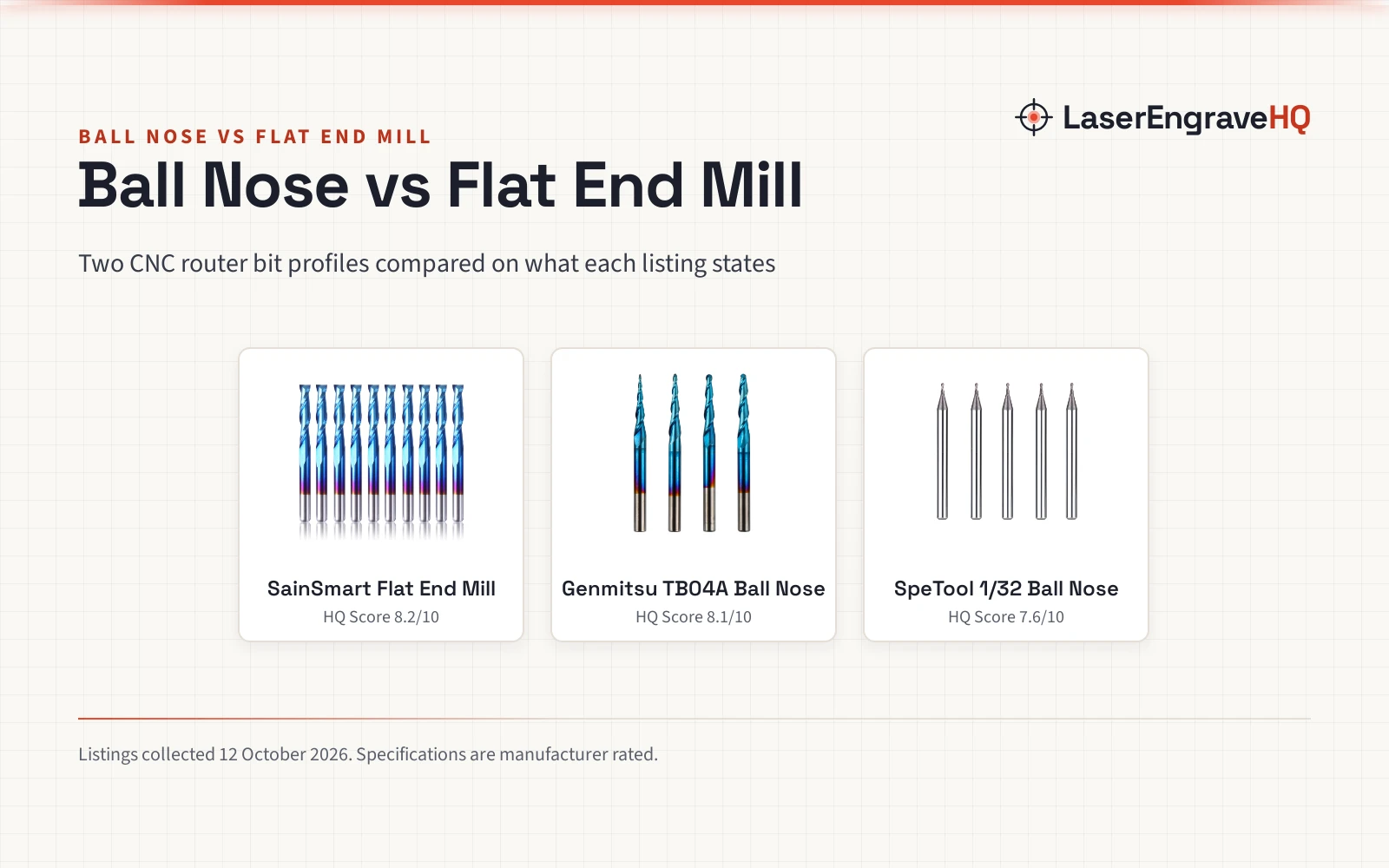
Verdict: choose a flat end mill for pocketing, slotting, parting stock and surfacing flat floors with crisp square corners, represented by the 10-piece SainSmart flat end mill set. Choose a ball nose end mill for 3D curved surfaces, contoured topography and mold cavities where a rounded profile removes stepped ridges, represented by the 4-piece Genmitsu tapered set and SpeTool micro ball nose pack. Match your bit choice to your model geometry.
Machines on the list
SainSmart Genmitsu 10Pcs Nano Blue Coat Flat Nose
A 10-piece set of 1/8 in shank, 2-flute spiral upcut carbide flat end mills with Nano Blue Coating for pocketing and slotting.
Pros
- 10-piece pack provides multiple replacement bits for workshop production
- 17 mm cutting length handles deeper pocketing and stock cutouts
- Flat tip geometry clears flat-bottom pockets and squares vertical edges
- Tungsten carbide steel alloy with Nano Blue Coating for wear resistance
Cons
- Flat tip creates stepped ridges on 3D contoured curved surfaces
- Listing contradicts itself on pack quantity, stating both 10 count and 30
- Spec table lists DLC finish while title and bullets state Nano Blue Coating
- No warranty term is stated in the listing

Genmitsu 4pcs 2-Flute Tapered Ball Nose End Mills
A 4-piece set of 2-flute tapered ball nose carbide bits with 0.25 to 1.0 mm tip radii and Nano Blue Coating for 3D reliefs.
Pros
- Four tip radii included: 0.25 mm, 0.5 mm, 0.75 mm and 1.0 mm
- Tapered profile adds shank rigidity behind fine carving tips
- Ultra-fine 0.2μm tungsten carbide steel alloy rated at HRC 65 hardness
- 15 mm cutting length supports deep 3D contouring passes
Cons
- Ball profile leaves scalloped ridges on flat pocket floors
- Listing contradicts itself with spec table stating 9.25 mm cutting diameter
- Spec table lists 30 count and TiAlN finish against 4 pieces and Nano Blue
- No warranty term is stated in the listing

SpeTool 5Pcs Carbide Ball Nose End Mills
A 5-piece pack of 1/32 in cutting diameter carbide micro ball nose end mills with TiAlN coating for fine metal and steel engraving.
Pros
- Ultra-fine 1/32 in (0.03 in) cutting diameter resolves tiny 3D details
- TiAlN coating with HRC55 hardness for cutting metals and alloy steels
- Standard 1/8 in shank fits standard desktop CNC collets
- 5-piece pack provides spares for delicate micro-machining work
Cons
- Short 5/64 in (0.08 in) cutting length limits cut depth to shallow passes
- Fragile 1/32 in diameter requires conservative feed rates to avoid breakage
- Spec table contradicts packaging by listing unit count as 1 Count
- No warranty term is stated in the listing
Other machines to compare
 5/16'' Shank Carbide Ball Nose End Mill BitsCheck price on Amazon
- 1/2" Carbide Ball Nose end Mill BitsCheck price on Amazon
- 1/4" Carbide Ball Nose end Mill BitsCheck price on Amazon
 1/8" 4-Flute Ball Nose End MillCheck price on Amazon
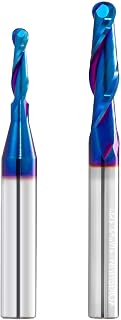 2 PCS Ball Nose Set CNC Router bits Carbide Ball Nose EndCheck price on Amazon
 1/4 Ball Nose CNC Router Bits 1/4 Inch Shank Carbide BallnoseCheck price on Amazon
Side by side
| Spec | SainSmart Flat End Mill | Genmitsu TB04A Ball Nose | SpeTool 1/32 Ball Nose |
|---|---|---|---|
| HQ Score | 61 | 60 | 56 |
| Profile | Flat nose spiral upcut | Tapered ball nose | Micro ball nose upcut spiral |
| Shank diameter | 1/8 in (3.175 mm) | 1/8 in (3.175 mm) | 1/8 in |
| Cutting diameter | 3.175 mm (1/8 in approx) | 0.25, 0.5, 0.75, 1.0 mm tip radii | 1/32 in (0.03 in) |
| Cutting length | 17 mm | 15 mm | 5/64 in (0.08 in) |
| Overall length | 38 mm (1.5 in) | 40 mm | 1-1/2 in |
| Number of flutes | 2 | 2 | 2 |
| Material | Tungsten carbide steel alloy | 0.2μm tungsten carbide steel alloy | Tungsten carbide |
| Hardness | Not stated in the listing | HRC 65 | HRC55 |
| Coating | Nano Blue Coating | Nano Blue Coating | TiAlN coated |
| Pack quantity | 10 pieces | 4 pieces | 5 pieces |
| Warranty | Not stated in the listing | Not stated in the listing | Not stated in the listing |
Specifications are manufacturer rated, as published on each listing and collected 12 October 2026.
Ball Nose vs Flat End Mill: Tip Geometry and Cut Profiles
The core distinction between a ball nose vs flat end mill lies in the tip profile. A flat end mill has a squared, flat cutting face that meets the tool flutes at crisp perpendicular corners. When a flat end mill moves across a workpiece, it leaves a smooth, level bottom on pockets, dados and stepped mortises, along with vertical sidewalls. In contrast, a ball nose end mill features a continuous hemispherical radius at its tip. When carving contours or fluting, it produces rounded grooves and smooth organic transitions rather than square edges.
On contoured 3D surfaces, a flat end mill creates staircase stepping or terracing along slopes because its flat corners cannot follow a curved gradient smoothly. A ball nose end mill rolls across curved contours with minimal stepping, requiring only fine stepover passes to leave a clean finish. Conversely, using a ball nose end mill on a wide, flat pocket leaves continuous scalloped ridges across the floor, making it poorly suited for flat pocketing compared to a flat end mill.
Flute Geometry and Cutting Lengths
Flute designs and reach vary across the featured listings. The SainSmart flat end mill and SpeTool ball nose listing both specify 2-flute upcut spiral geometry, which pulls chips upward out of the cut channel. Genmitsu lists 2 flutes with a ball end cut type. Cutting lengths also differ substantially. The SainSmart flat end mill listing provides a 17 mm cutting length with a 3.175 mm (1/8 in approx) cutting diameter, allowing deep slotting and perimeter cutouts through thicker material over multiple stepped passes. The Genmitsu TB04A tapered ball nose end mills deliver a 15 mm cutting length across all four included tip sizes, providing reach for deep 3D relief carvings and mold cavities.
In contrast, the SpeTool micro ball nose end mill features a short 5/64 in (0.08 in) cutting length on a 1/32 in (0.03 in) cutting diameter. This micro geometry is designed specifically for shallow, fine-pitch engraving and micro-machining rather than deep carving reach. Carving or engraving with the SpeTool requires shallow passes to prevent exceeding the stated 5/64 in cutting length.
Materials and Surface Finishing
The materials stated across the listings reflect how each cutter geometry is applied in workshop production. SainSmart lists its flat end mill for nylon, resin, ABS, acrylic, PVC, MDF and hardwood. Its flat bottom and upcut flutes clear chips efficiently when cutting out flat sheet parts, milling signs and cutting mortises. Genmitsu lists its tapered ball nose bits for plastics, aluminum, circuit board and wood, focusing on 3D machining jobs like molds, rapid prototyping and model carving.
SpeTool specifies its micro ball nose cutters for carbon steel, mould steel, inconel, stainless steel and titanium alloy, as well as finish machining and engraving. For complex carvings, makers frequently combine both geometries in a two-stage workflow: a flat end mill performs the roughing stage to clear away bulk waste material in stepped levels, followed by a ball nose end mill for the final detailed finishing pass. For more guidance on choosing cutters for your shop, read our guide on CNC bits explained for beginners.
Carbide Builds and Tool Coatings
All three listings feature solid tungsten carbide construction, but their carbide grain sizes and protective coatings differ. Genmitsu manufactures its TB04A tapered ball nose bits from ultra-fine 0.2μm tungsten carbide steel alloy and applies a Nano Blue Coating. The maker claims this combination retains cutting edge sharpness and lubricity over 800 minutes of continuous machining, with an HRC 65 hardness. The SainSmart flat end mill set also features tungsten carbide steel alloy with a Nano Blue Coating to resist heat and friction during high-speed routing.
SpeTool builds its micro ball nose end mills from tungsten carbide and applies a TiAlN coating, stating HRC55 hardness for machining harder alloy steels. The tapered design of the Genmitsu ball nose cutters provides an additional structural advantage: the wide angled body supports the delicate ball tip, increasing tool rigidity compared to straight-shank micro end mills. For an overview of cutter materials and flute directions, see our guide on upcut vs downcut end mill bits.
Pack Sizes and Shank Compatibility
All three featured sets use a 1/8 in shank (with SainSmart and Genmitsu noting 3.175 mm), making them directly compatible with common desktop CNC router collets, such as the Genmitsu 3018 Series explicitly referenced by Genmitsu. SainSmart offers the largest pack size with 10 identical flat end mills, providing convenient replacements when running recurring production batches. SpeTool includes 5 identical 1/32 in ball nose end mills in individual plastic cases.
Genmitsu supplies a 4-piece variety pack of tapered ball nose cutters, including four distinct tip radii: 0.25 mm, 0.5 mm, 0.75 mm and 1.0 mm. This variety gives carvers immediate flexibility to select a finer 0.25 mm radius for micro relief work or a broader 1.0 mm radius for faster finishing passes on larger models.
Support, Warranty, and Listing Accuracy
None of the three listings publish a concrete manufacturer warranty term, so warranty support remains unstated across all three options. Furthermore, each listing exhibits internal contradictions between its title, bullet points and specification table. The SainSmart flat end mill listing states a 10-piece pack in its title and bullets, but the specification table lists a quantity of 30 and notes DLC finish instead of Nano Blue Coating.
Genmitsu’s TB04A listing also shows a spec table quantity of 30 against its 4-piece title and bullet count, and mistakenly lists a cutting diameter of 9.25 mm for a tool on a 1/8 in (3.175 mm) shank. SpeTool’s listing shows a unit count of 1 Count in its spec table despite stating a 5-piece pack in the title and bullets. We rely on the titles and bullet points over the specification tables, but buyers should note these clerical discrepancies.
Choose a flat end mill if
- You need to mill flat-bottom pockets, dados, grooves or step-down mortises.
- You are cutting out shapes and parts from sheet stock like MDF, plywood or acrylic.
- You want sharp, square internal edges on your finished pieces.
- You need an economical multi-pack with 10 identical cutters for continuous shop production.
Choose a ball nose end mill if
- You are carving 3D relief sculptures, contoured topography, curved panels or decorative moldings.
- You want to eliminate stepped staircase ridges on organic, rounded surfaces.
- You need multiple tip radii (from 0.25 mm to 1.0 mm) to balance carving speed against fine detail.
- You are detailing molds or engraving fine lettering in hard metals and steels.
For more bit profiles and cutter setups, see our complete guide to CNC router bit types.
Always secure workpieces firmly with mechanical clamps, ensure adequate dust collection or wear a respirator when cutting MDF or plastics, wear eye protection, and verify collet tightness before starting spindle rotation. Never leave an active CNC machine unattended.
Project Match
- Flat sheet cutouts and pocketed signs: SainSmart Flat End Mill matches profile cutting, dados and pocketing in MDF, hardwood, acrylic, nylon, PVC and ABS with its 17 mm cutting length and 1/8 in flat tip.
- 3D decorative panels and contour molds: Genmitsu TB04A Ball Nose matches 3D machining jobs and relief carving in wood, aluminum, circuit boards and plastics with four tip radii (0.25 mm to 1.0 mm) and a 15 mm cutting length.
- Fine metal engraving and mold detailing: SpeTool 1/32 Ball Nose matches micro-machining and fine engraving in carbon steel, mould steel, inconel, stainless steel and titanium alloy with a 1/32 in cutting diameter and 5/64 in cutting length.
FAQ: lasers and CNC
Can you use a ball nose end mill for flat pocketing?
You can, but it is inefficient. Because a ball nose cutter has a rounded tip, each pass leaves a scalloped channel across the floor. Clearing a flat pocket requires an extremely small stepover to reduce those ridges, which takes significantly more machine time than using a flat end mill with a square bottom.
Why do you use a flat end mill before a ball nose?
In 3D carving workflows, makers typically use a flat end mill for the roughing pass to clear away bulk waste stock in stepped levels. A ball nose end mill is then used for the finishing pass, tracing the final curved contour without bearing heavy chip loads.
What is the benefit of a tapered ball nose end mill?
A tapered ball nose end mill, such as the Genmitsu TB04A, features an angled conical body that widens from the small cutting tip up to the 1/8 in shank. This conical geometry increases tool stiffness and reduces deflection compared to straight micro bits, helping maintain dimensional accuracy on deep carving passes.
Can these 1/8 inch shank bits fit a desktop CNC router?
Yes. All three featured bit sets use a 1/8 in shank diameter (with SainSmart and Genmitsu noting 3.175 mm). They fit standard 1/8 in collets commonly found on desktop CNC machines, including the Genmitsu 3018 Series noted in the Genmitsu listing.
Can these end mills cut aluminum or steel?
Only where the manufacturer specifies metal capability. Among the featured listings, the Genmitsu TB04A tapered ball nose listing explicitly includes aluminum among its applicable materials, while the SpeTool ball nose listing specifies carbon steel, mould steel, stainless steel and titanium alloy. In contrast, the SainSmart flat end mill listing specifies non-metal materials including hardwood, MDF, nylon, resin, ABS, acrylic and PVC, without claiming metal suitability. Machining metals requires matching the bit coating, carbide grade and conservative stepdowns to the workpiece.
Related: CNC bits explained for beginners, upcut vs downcut end mill, best CNC bit set for beginners, and best CNC router bits for hardwood.