3D Scanner vs iPhone LiDAR: Which One Should You Buy?
A dedicated scanner lists precision figures the iPhone LiDAR listing never states, while the phone puts a scanner in a pocket; this guide ranks the gear and matches each option to the job.

On this page
Top picks at a glance
As an Amazon Associate I earn from qualifying purchases.
- 1
 Revopoint MIRACO Plus 3D Scanner9.7/10View on Amazon
- 2
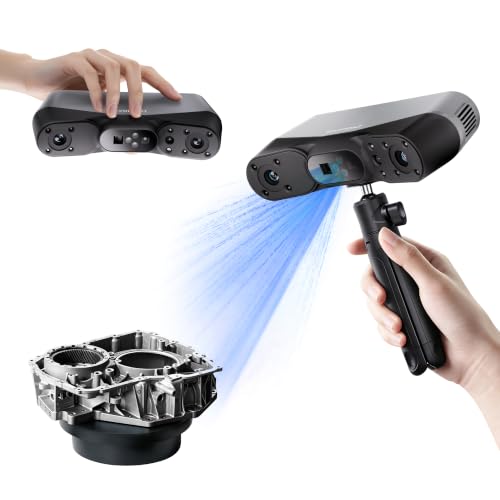 Revopoint POP 4 3D Scanner9.6/10View on Amazon
- 3
 Creality 3D Scanner CR-Scan Raptor for 3D Printing9.6/10View on Amazon
- 4
 Revopoint MetroY Ultra 3D ScannerView on Amazon
- 5
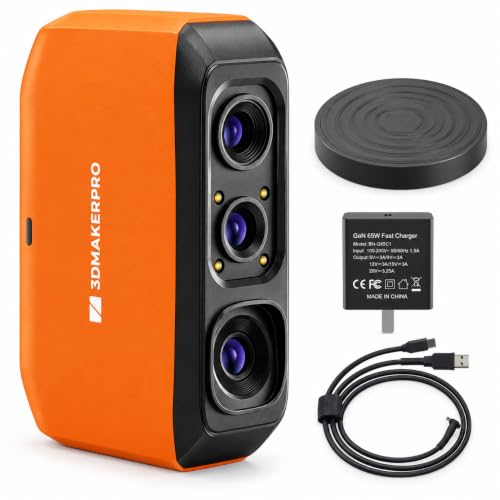 Fox 3D ScannerView on Amazon
- 6
 Creality CR-Ferret SE 3D ScannerView on Amazon
- 7
 3DMakerpro Fox 3D ScannerView on Amazon
- 8
 3DMakerpro 3D Scanner Moose LiteView on Amazon
- 9
 EINSTAR 2 Wireless 3D ScannerView on Amazon
A maker who wants to turn a real object into a printable file faces a simple choice: buy a dedicated scanner or use the LiDAR Scanner already built into an iPhone. 3D scanner vs iPhone LiDAR is a question of precision against convenience, and the answer depends on what the scan is for. A dedicated scanner lists accuracy figures in fractions of a millimetre and software built for measurement, while a phone puts a scanner in a pocket. This guide compares each approach and ranks the gear the listings show, so the choice matches the project.
Other machines to compare
 Revopoint MetroY Ultra 3D ScannerCheck price on Amazon
 Fox 3D ScannerCheck price on Amazon
 Creality CR-Ferret SE 3D ScannerCheck price on Amazon
 3DMakerpro Fox 3D ScannerCheck price on Amazon
 3DMakerpro 3D Scanner Moose LiteCheck price on Amazon
 EINSTAR 2 Wireless 3D ScannerCheck price on Amazon
LaserEngraveHQ earns a commission from purchases made through these links, at no extra cost to you. Read our affiliate disclosure.
The iPhone listing states a LiDAR Scanner but gives no accuracy figure for it, so this guide compares stated specs only and never assigns the phone a precision number it does not claim.
3D scanner vs iPhone LiDAR: what each type does
A dedicated 3D scanner is a tool built for a single job: capturing the shape of an object as a digital model that can go to a printer or a CAD program. The listings here show a laser and structured light model and a NIR optical model, with stated accuracy figures, a stated scan range and stated export formats, so the buyer can see what each scanner captures before buying.
An iPhone with a LiDAR Scanner uses the same idea at a different scale: the phone sends out light pulses and reads the return to map the space in front of it, which suits room scans, furniture and rough object captures. The iPhone 15 Pro Max listing names the LiDAR Scanner among its camera features, next to a 48MP main camera, a 6.7-inch Super Retina XDR display and an A17 Pro chip with a 6-core GPU, so the scanner is a feature of a phone, not a standalone tool.
The split is precision against reach. A dedicated scanner states how fine a detail it can resolve, while the phone states no accuracy figure and leans on convenience: the scanner is already in the hand, the capture is quick, and the file can move to a computer over USB 3 at up to 20x faster transfers.
The gear, ranked
The listings below are ranked from the strongest stated specs to the weakest as a scanning tool, weighing stated accuracy, stated range, stated software and stated warranty, and treating the phone as a scanner only.
Top pick: Revopoint MetroY Ultra 3D Scanner. The listing states 0.01mm single-frame precision and 0.015mm plus 0.04mm/m volumetric accuracy, with PTB-certified Revo Measure software for measurement and reporting. It scans with 34 laser cross-lines, 15 parallel lines, a single-line mode for deep holes, full-field blue structured light for marker-free scans, and a turntable mode, which the listing counts as 5 modes. Speed reaches up to 90 fps with an NVIDIA GPU or 60 fps on a CPU, and the laser modes work outdoors in light up to 100,000 lux. A 5600mAh battery grip gives about 2.5 hours of power, Wi-Fi 6 links the scanner to a PC, tablet or mobile device, and the CMM Edition adds a metrology-grade carbon fiber ball plate for on-site verification plus a 1-year license for Revo Measure. The maker states a 2 Year Manufacturer warranty. Revo Measure runs on Windows 10/11 only, and the kit is built for industrial inspection, so it suits measurement work more than casual captures.
Next: Fox 3D Scanner. The listing states up to 0.07mm accuracy and 0.10mm resolution, and it scans objects from 40mm to 1200mm, which covers small parts and full-size subjects. AI SLAM tracking works without markers and re-locks onto scanned areas if tracking breaks, and the NIR optical system handles matte dark and low-reflective surfaces with less preparation. The scanner weighs 210g, connects to a computer and runs JMStudio software, which turns a raw scan into a clean model with a single click. Export formats are OBJ, STL, PLY and ASC, and the listing states compatibility with Windows 10/11 64-bit and macOS 12/13. The listing gives no warranty term, so the buyer has no stated cover period to rely on.
The phone option: Apple iPhone 15 Pro Max. The listing is for a renewed phone locked to AT&T, with 512GB of storage, a 6.7-inch Super Retina XDR display with ProMotion, a 48MP main camera with up to 10x optical zoom, and up to 29 hours of video playback. The LiDAR Scanner sits among the camera features, and the listing gives no accuracy figure for it and no scan range. As a scanner it ranks last here because it states no precision, no export format for scan files and no scanning software, while the dedicated scanners state precision and software, and the Fox states export formats too. This guide ranks it as a scanning tool only, and a renewed, carrier-locked phone is a poor way to buy a scanner.
Accuracy, range and workflow
Accuracy is where the gap shows. The MetroY Ultra lists 0.01mm single-frame precision, the Fox lists 0.07mm accuracy, and the iPhone listing states no accuracy figure at all, so the phone cannot be compared on precision. For work that feeds a CAD program or a printer, the stated figure decides whether a detail survives the scan.
The Fox lists a scan range of 40mm to 1200mm, which covers parts and full-size subjects. The MetroY Ultra lists 5 modes for small parts to medium-sized objects, with a single-line mode for deep holes and full-field blue structured light for marker-free scans. The iPhone listing states no scan range.
Workflow is the phone’s strength and the MetroY Ultra’s trade-off. The iPhone captures with the phone in hand and moves files over USB 3, while the MetroY Ultra needs a PC or a device running Revo Mirror over Wi-Fi 6, and its Revo Measure software runs on Windows 10/11 only. The Fox sits between them: it connects to a computer, runs JMStudio with guided workflows, and exports OBJ, STL, PLY and ASC files for CAD software and 3D printing workflows.
Which should you buy?
Buy the MetroY Ultra if the scan feeds measurement, inspection or a CAD model where a stated accuracy figure is the point. Its 0.01mm single-frame precision, PTB-certified software and 2 Year Manufacturer warranty are the strongest stated specs in this guide, and its 5 modes cover small parts, deep holes and marker-free scans. Its Windows-only software makes it a poor fit for casual room captures.
Buy the Fox if the goal is scan-to-print work at home. Its 0.07mm accuracy, 40mm to 1200mm range and 210g weight suit parts, collectibles and sculptures, and its one-click modeling and OBJ, STL, PLY and ASC export fit a 3D printing workflow.
Use the iPhone LiDAR if the phone is already in hand and the job is a quick room scan or a rough reference model. The LiDAR Scanner, the 48MP camera and the 6.7-inch display make capture fast and easy, and the files move over USB 3. Do not buy a renewed, AT&T-locked phone as a scanner: the listing states no accuracy figure, no scan range and no scanning software.
FAQ: lasers and CNC
Can an iPhone LiDAR scan replace a dedicated 3D scanner?
For rough captures, often yes; for precision work, no. The iPhone listing states a LiDAR Scanner but no accuracy figure, while the MetroY Ultra states 0.01mm single-frame precision and the Fox states 0.07mm accuracy. If the scan feeds a printer or a CAD program, the stated figure matters.
Which 3D scanner is best for 3D printing?
The Fox suits scan-to-print work: it states 0.07mm accuracy, a 40mm to 1200mm range and export in OBJ, STL, PLY and ASC, and its JMStudio software turns a raw scan into a clean model with a single click. The MetroY Ultra suits prints that need measurement-grade precision, with 0.01mm single-frame precision and 5 modes.
Do I need markers to scan with these scanners?
The MetroY Ultra offers full-field blue structured light for marker-free scans, and the Fox uses AI SLAM tracking that works without markers and re-locks if tracking breaks. The iPhone LiDAR needs no markers either, since it maps space with light pulses.
Can I scan outdoors with a 3D scanner?
The MetroY Ultra lists laser modes that work in light up to 100,000 lux, with a 5600mAh battery grip giving about 2.5 hours of power. The Fox listing states no outdoor light figure, and the iPhone listing states no scan range.
What file formats do these scanners export?
The Fox exports OBJ, STL, PLY and ASC files. The MetroY Ultra listing names Revo Measure software for measurement and PDF report generation, and it states no export format list. The iPhone listing states no scan export format.
Is the iPhone 15 Pro Max in this guide new?
No. The listing states renewed condition, locked to AT&T, with 512GB of storage and a Blue Titanium finish.
Related: the 3D printers hub, best 3D scanner picks, 3D scanner vs 3D printer, structured light vs laser 3D scanner and best professional 3D scanner picks.