Best 3D Scanner (2026): 5 Picks Compared
5 3d scanners compared by accuracy, scanning speed, object size and warranty, from blue laser scanners to wireless units.

On this page
Top picks at a glance
As an Amazon Associate I earn from qualifying purchases.
- 1
 Best OverallCreality Pika9.7/10View on Amazon
- 2
 5 ModesRevopoint POP 49.6/10View on Amazon
- 3
 Laboratory PrecisionCreality Raptor Pro9.5/10View on Amazon
- 4
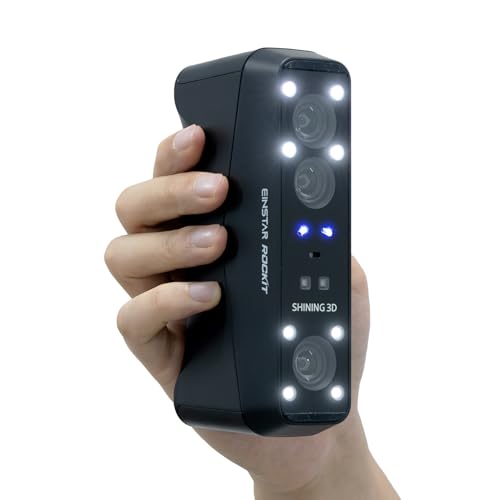 True WirelessEINSTAR Rockit9.4/10View on Amazon
A shop that needs a digital copy of a physical part, a prototype or a household object, needs a scanner that captures shape without touching the object. That is the job the best 3d scanner is built for: a scanner that turns an object into a file for printing, reverse engineering or inspection.
LaserEngraveHQ earns a commission from purchases made through these links, at no extra cost to you. Read our affiliate disclosure.
Quick picks
- Best Overall Creality Pika: 0.03 mm accuracy, up to 110 fps and a 3-inch touchscreen Check price on Amazon
- 5 Modes Revopoint POP 4: 5 modes, up to 105 fps and a 2 year warranty Check price on Amazon
- Laboratory Precision Creality Raptor Pro: 0.02 mm accuracy in laboratory conditions with 22+7 blue laser lines Check price on Amazon
- True Wireless EINSTAR Rockit: True wireless scanning with a swappable battery for up to 3 hours Check price on Amazon
Machines on the list
Creality 3D Scanner Wireless Pika with 7-Line Blue
A wireless scanner with a 7-line blue laser, infrared structured light, a 3-inch touchscreen and Class 1 eye-safe infrared light.
Pros
- 0.03 mm accuracy with marker-free blue laser capture
- Up to 110 fps in laser mode over a USB3.0 PC link
- Built-in Wi-Fi 6 and a 3-inch touchscreen for cable-free scanning
- AI texture enhancement, AI human body completion and AI auto hole-filling
Cons
- Laser mode runs at 40 fps and infrared at 20 fps when connected to phones
- Cannot operate as a fully standalone scanner; a smartphone or a computer is required
- Recommended computer specification includes 32GB RAM
- No warranty term is stated
Revopoint POP 4 3D Scanner, AI Segmentation
A 5-mode scanner with up to 105 fps, 0.03 mm single-frame accuracy and Wi-Fi 6 streaming to PCs and smartphones.
Pros
- Single-frame accuracy up to 0.03 mm and 5 scanning modes
- Multi-line laser mode delivers up to 105 fps with NVIDIA GPU acceleration
- Scan volume from 10x10x10 mm to 2x2x2 m
- Outdoor laser scanning up to 50,000 lux, and up to 100,000 lux with an outdoor filter
Cons
- Outdoor filter is sold separately
- 5500mAh battery grip is available separately for up to 4 hours of untethered scanning
- AI object segmentation is Windows only
- Revo Design and Revo Measure are paid software sold separately and support Windows only
Creality 3D Scanner Raptor Pro and Scan Bridge
A wireless scanner with 22+7 blue laser lines, 0.02 mm accuracy in laboratory conditions and a Scan Bridge for wireless scanning.
Pros
- 0.02 mm accuracy in laboratory conditions
- Up to 60 frames per second with 660,000 points per second
- 22+7 blue laser lines with marker-based alignment
- Full-color 3D scanning for realistic texture reproduction
Cons
- No warranty term is stated
- No laser class is stated
- Larger objects rely on stitching of multiple scans
- The 0.02 mm accuracy figure applies in laboratory conditions

Creality CR-Ferret SE 3D Scanner for 3D Printing
A desktop scanner with 0.1 mm accuracy, 30 fps scanning and a 2MP color camera for black and metal objects without spray.
Pros
- 0.1 mm accuracy with 0.16 mm resolution
- Scanning speed of 30 fps with one-shot 3D imaging technology
- 2MP high-resolution color camera for colored 3D models in original colors
- Scans black or metal objects without white powder or spray
Cons
- No warranty term is stated
- No laser class is stated
- Stated scanning range starts at 150 mm
- No connection type is stated
EINSTAR Rockit Wireless Laser 3D Scanner
A wireless scanner with 38 laser lines, marker-free laser scanning and a swappable battery with up to 3 hours runtime.
Pros
- 38 laser lines from 19 + 19 crossed laser lines, plus 7 parallel laser lines
- Marker-free laser scanning, so no markers are needed for feature-rich objects
- Built-in Wi-Fi with a swappable battery for up to 3 hours runtime
- VCSEL infrared scanning for medium to large objects, from face to feet in 60 seconds
Cons
- No accuracy figure is stated
- No warranty term is stated
- Recommended system memory is 64 GB or more
- Wi-Fi interference calls for a cable connection
Specs compared
| Scanner | HQ Score | Accuracy | Speed | Object size | Connection | Safety | Warranty |
|---|---|---|---|---|---|---|---|
| Creality Pika | 9.7/10 | 0.03 mm | Up to 110 fps | Not stated | Wi-Fi 6 | Class 1 | Not stated |
| Revopoint POP 4 | 9.6/10 | 0.03 mm | Up to 105 fps | 10x10x10 mm to 2x2x2 m | Wi-Fi 6 | Not stated | 2 year |
| Creality Raptor Pro | 9.5/10 | 0.02 mm | Up to 60 fps | 5 mm to 2000 mm | Scan Bridge wireless | Not stated | Not stated |
| Creality CR-Ferret SE | 9.4/10 | 0.1 mm | 30 fps | 150 mm to 2000 mm | Not stated | Not stated | Not stated |
| EINSTAR Rockit | 9.4/10 | Not stated | Up to 90 fps | Not stated | Wi-Fi | Not stated | Not stated |
Specifications are manufacturer rated, as published on each listing and collected 3 November 2026. Accuracy is the figure each listing states for its own scanner.
What the listings tell you, and what they leave out
The 5 listings state accuracy, speed and object size in different ways, and some figures need a closer look. The Raptor Pro accuracy figure applies in laboratory conditions. The POP 4 accuracy figure depends on mode: single-frame accuracy up to 0.03 mm, Full-Field Structured Light accuracy 0.08 mm, and VCSEL mode 0.10 mm @ 300-500 mm and 0.20 mm @ 500-800 mm. Only the POP 4 states a warranty term, at 2 year. Only the Pika states a laser class, at Class 1. The Rockit states no accuracy figure, and the Ferret SE states no connection type. Treat a missing figure as Not stated, not as a zero.
Buying guide: choosing the best 3d scanner
Accuracy and precision
The Raptor Pro states 0.02 mm accuracy in laboratory conditions. The Pika and the POP 4 each state 0.03 mm accuracy. The Ferret SE states 0.1 mm accuracy with 0.16 mm resolution. Accuracy for the Rockit is Not stated. Read the words around each figure: laboratory conditions, single-frame and volumetric accuracy are not the same measure.
Speed and scanning modes
Frame rate is stated as fps, and points per second is a separate measure. The Pika reaches up to 110 fps in laser mode over a USB3.0 PC link. The POP 4 reaches up to 105 fps in multi-line laser mode. The Raptor Pro reaches up to 60 fps with 660,000 points per second. The Ferret SE runs at 30 fps. The Rockit reaches up to 90 fps with marker alignment. The POP 4 lists 5 modes. The Pika lists a 7-line blue laser mode and an infrared structured light mode.
Object size and connection
The POP 4 scan volume runs from 10x10x10 mm to 2x2x2 m. The Raptor Pro captures objects from 5 mm to 2000 mm. The Ferret SE scans from 150 mm to 2000 mm. Object size for the Pika and the Rockit is Not stated. For connection, the Pika and the POP 4 use Wi-Fi 6. The Rockit uses built-in Wi-Fi. The Raptor Pro uses Scan Bridge wireless scanning. Connection for the Ferret SE is Not stated.
Safety classes
Only the Pika states a laser class in its listing: Class 1 eye-safe infrared light. A class statement on a listing is not a substitute for the safety information on the machine itself. Outdoor brightness limits are stated in lux for the POP 4 and the Rockit. The POP 4 laser mode operates up to 50,000 lux, and up to 100,000 lux with an outdoor filter. The Rockit laser HD mode works up to 110,000 Lux and IR Rapid mode up to 70,000 Lux. Safety for the other scanners is Not stated.
Project Match
Match the scanner to the work you do most, using only what each listing states:
- Reverse engineering and precision modeling: the Raptor Pro with 0.02 mm accuracy in laboratory conditions, and the POP 4 with 0.03 mm single-frame accuracy and 5 modes.
- Small to large objects: the POP 4 with a scan volume from 10x10x10 mm to 2x2x2 m, and the Raptor Pro with objects from 5 mm to 2000 mm.
- Dark and reflective surfaces without spray: the POP 4 with 30-Cross Blue Laser Lines for dark objects, the Ferret SE for black or metal objects, the Pika for black metal without spray coating, and the Rockit with blue laser adaptability for black and reflective surfaces without spray.
- Full human bodies and large scenes: the Pika with Class 1 eye-safe infrared light for full human bodies in 1 minute, and the Rockit with VCSEL infrared scanning from face to feet in 60 seconds.
- Wireless work away from a desk: the Rockit with a swappable battery for up to 3 hours, and the POP 4 with Wi-Fi 6 streaming to PCs and smartphones.
How the scores add up
Each scanner is scored out of 10 on performance, build, value, safety and warranty, with the weights published on our How We Pick page. A spec the listing does not publish scores nothing.
| Product | HQ Score | Perf. /35 | Build /25 | Value /25 | Safety /10 | Warranty /5 |
|---|---|---|---|---|---|---|
| Creality Pika | 9.7 | 32 | 22 | 21 | 7 | 0 |
| Revopoint POP 4 | 9.6 | 30 | 21 | 20 | 0 | 4 |
| Creality Raptor Pro | 9.5 | 32 | 21 | 21 | 0 | 0 |
| Creality CR-Ferret SE | 9.4 | 28 | 20 | 21 | 0 | 0 |
| EINSTAR Rockit | 9.4 | 27 | 21 | 20 | 0 | 0 |
Scores run from 9.2 to 9.8: each product’s point total is placed on that range, so more points always means a higher score.
FAQ: lasers and CNC
What does a 3d scanner do?
A 3d scanner captures the shape of a physical object and turns it into a digital file for modeling, inspection or printing. The Pika generates mesh models ready for 3D printing in STL, OBJ, PLY and ASC formats.
How accurate are 3d scanners?
Accuracy varies by model and mode. The Raptor Pro states 0.02 mm in laboratory conditions. The Pika and the POP 4 state 0.03 mm. The Ferret SE states 0.1 mm. Accuracy for the Rockit is Not stated.
Do I need scanning spray for dark surfaces?
Spray is not needed on several picks here. The POP 4 handles dark objects in its 30-Cross Blue Laser Lines mode without scanning spray. The Ferret SE scans black or metal objects without white powder or spray. The Pika scans black metal without spray coating. The Rockit works on black and reflective surfaces without spray.
Which scanner has the longest warranty?
The Revopoint POP 4 lists a 2 year warranty. The other listings state no warranty term.
Related: the 3D printers hub, 3D printer accessories, handheld vs desktop 3D scanners, and professional 3D scanners.