Wood Pla vs Marble Pla: Which One Should You Buy?
A guide to wood PLA listings and a checklist for comparing marble PLA listings before buying.

On this page
Top picks at a glance
As an Amazon Associate I earn from qualifying purchases.
- 1
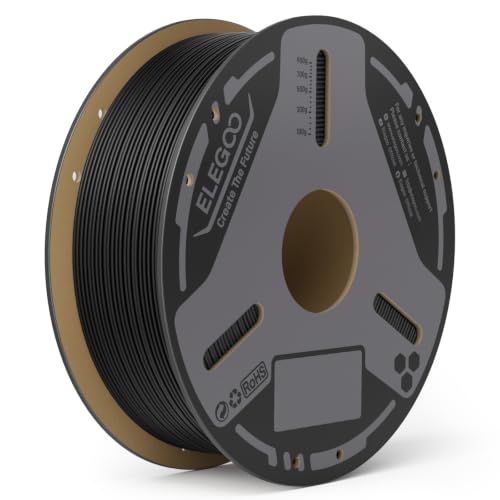 ELEGOO Carbon Fiber PLA 3D Printer Filament 1.75mm Black 1KG9.5/10View on Amazon
- 2
 SUNLU PLA 3D Printer FilamentView on Amazon
- 3
 SUNLU PLA+2.0 3D Printer FilamentView on Amazon
- 4
 ELEGOO PLA 3D Printer Filament 1.75mm Wood 1KGView on Amazon
- 5
 SUNLU Wood PLA Filament 1.75mmView on Amazon
- 6
 Polymaker Panchroma Matte PLA Filament 1.75mmView on Amazon
- 7
 SUNLU Real Wood Fiber Wood PLA FilamentView on Amazon
A maker planning carved-look signs, architectural models, planters or ornaments wants a filament whose finish matches the project, and wood pla vs marble pla frames that choice as a wood tone against a marble tone. The listings in this guide cover wood PLA only, so the marble side cannot be compared from these sources, and any marble claim would need its own listing to check. For the wood side, the listings below give a usable comparison across wood-color spools, a wood-powder spool and a wood-fiber bundle.
Other machines to compare
 SUNLU PLA 3D Printer FilamentCheck price on Amazon
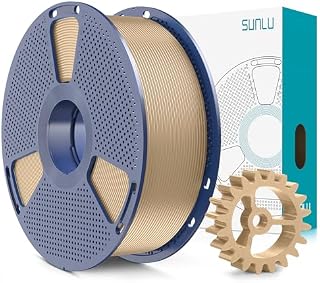 SUNLU PLA+2.0 3D Printer FilamentCheck price on Amazon
 ELEGOO PLA 3D Printer Filament 1.75mm Wood 1KGCheck price on Amazon
 SUNLU Wood PLA Filament 1.75mmCheck price on Amazon
 Polymaker Panchroma Matte PLA Filament 1.75mmCheck price on Amazon
 SUNLU Real Wood Fiber Wood PLA FilamentCheck price on Amazon
LaserEngraveHQ earns a commission from purchases made through these links, at no extra cost to you. Read our affiliate disclosure.
No marble PLA listing is included in this guide, so every marble statement below is a checklist item to verify, not a stated marble spec. The wood figures below come from the wood listings themselves.
Wood pla vs marble pla: the short answer
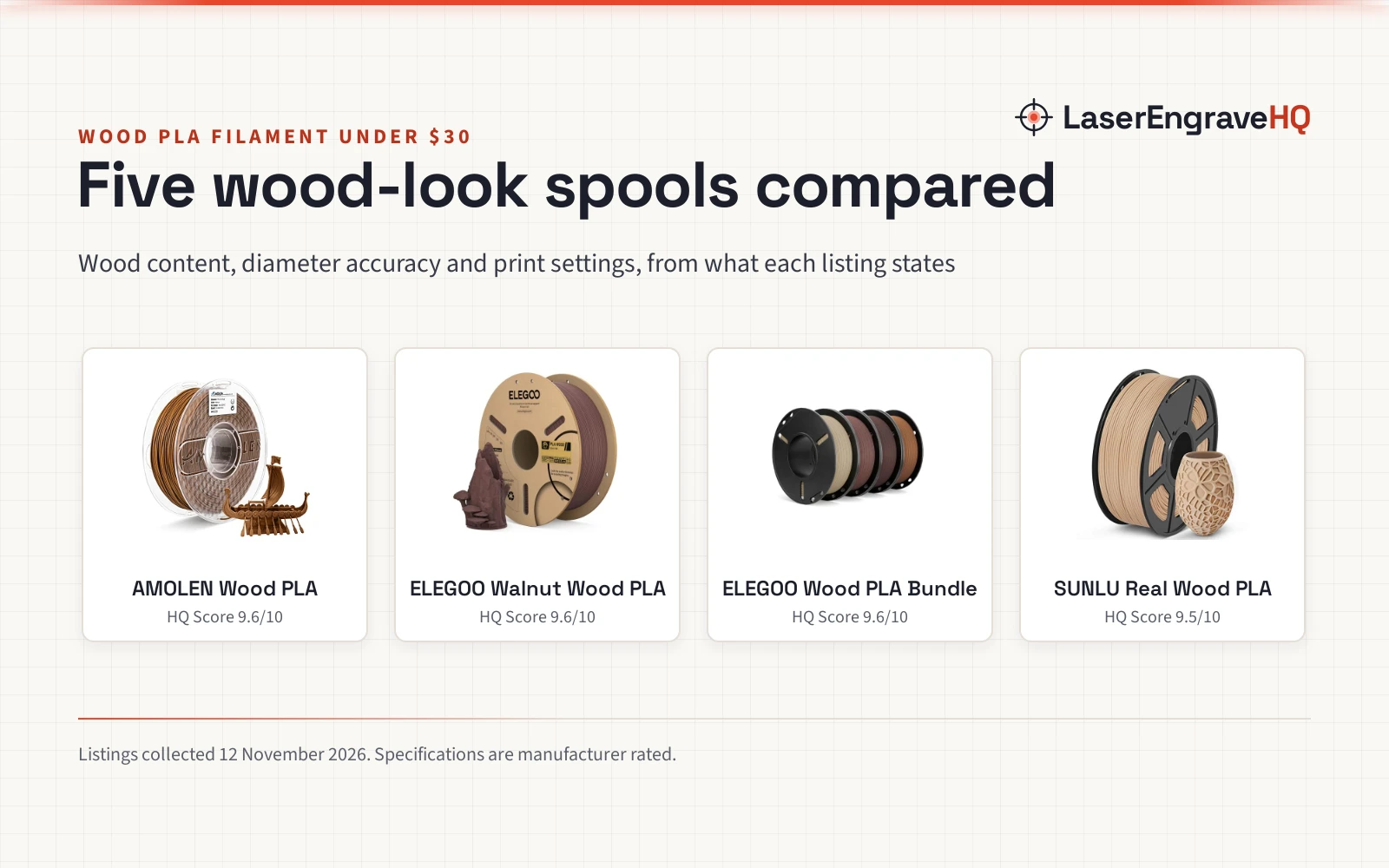
Wood PLA, as listed here, splits into wood color and real wood content. SUNLU PLA and SUNLU PLA+2.0 Oak are listed as wood color, ELEGOO Wood is listed as enhanced with real wood powder, and the YOOPAI bundle is listed as blended with 20% real wood fibers. Marble PLA, by contrast, has no listing in this guide, so its filler, finish and settings are Not stated here. A buyer who wants the marble look should therefore treat marble PLA as unverified until its own listing states diameter, filler content, nozzle temperature, bed temperature and print speed.
That gap matters because the wood listings differ on exactly those points. Stated nozzle temperatures run from 200-230°C on SUNLU PLA to 205-220°C on SUNLU PLA+2.0, while ELEGOO Wood and the YOOPAI bundle state no nozzle temperature at all. Stated print speeds run from 50-100mm/s on SUNLU PLA to up to 300mm/s on SUNLU PLA+2.0, while the other listings state no speed. A marble listing that states none of those figures leaves the same gaps.
The wood PLA listings in this guide
The gear below leads with the highest stated speed and fullest stated settings, then the listings that state real wood content, and closes with the wood-color spool that states settings but no wood content. Diameter is 1.75mm on every listing here, and dimensional accuracy is stated as +/-0.02mm on every listing here.
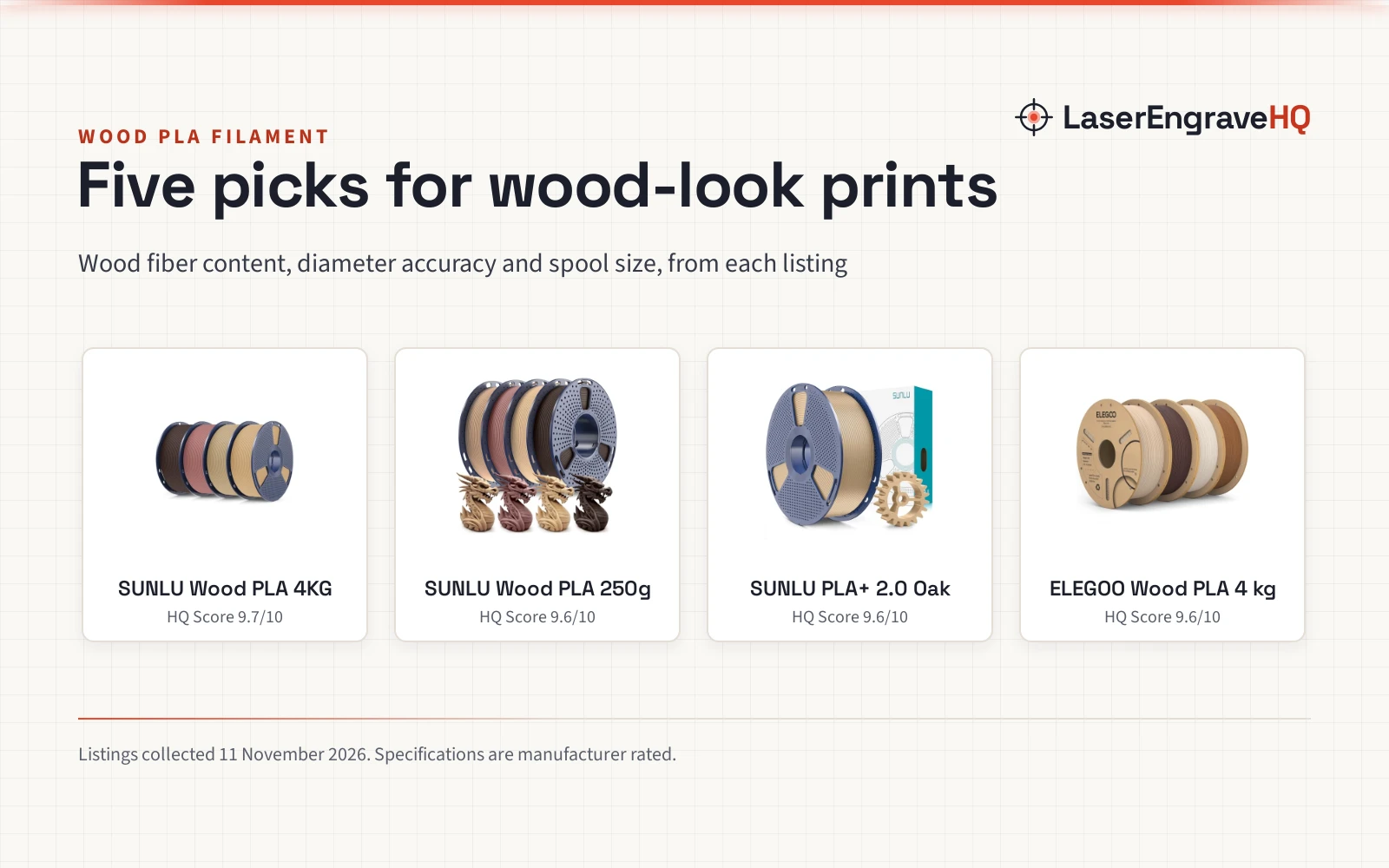
SUNLU PLA+2.0 Oak (Wood Color) leads on stated speed and toughness claims. The listing describes an upgraded PLA+ filament that resists brittleness and cracking better than standard PLA+ filament, melts quickly, flows smoothly and supports print speeds of up to 300mm/s. Recommended settings are a nozzle temperature of 205-220°C, a bed temperature of 50-60°C and a print speed of 100-300mm/s, with a dimensional accuracy of +/-0.02mm on a 1.75mm filament. The spool is a 1kg spool with a diameter of 195mm, a width of 57mm and a hub hole diameter of 63mm, sealed in airtight vacuum packaging, and the spec table lists a 30-Day warranty description. It suits functional parts, high-precision models and decorative items, per the listing.
The YOOPAI bundle trades spool size for variety: 4 rolls of 250g in Walnut, Logs, Cherry and Maple, blended with 20% real wood fibers for a textured surface, subtle wood grain and warm handcrafted appearance. Each spool measures 140mm in diameter and 36mm in width, with a 53mm center hole, and the listing says the bundle fits most 1.75mm FDM printers with external, top-mounted or open spool holders. A consistent 1.75mm diameter with +/-0.02mm accuracy supports stable flow and even layers, per the listing. The spec table lists a 180 days warranty. One wrinkle: the title names SUNLU Wood PLA Filament while the brand field lists YOOPAI. For Bambu Lab AMS or AMS lite, the listing says to search MakerWorld for a compatible 250g spool adapter before use.
ELEGOO Wood is the straightforward wood-powder spool: PLA enhanced with real wood powder, giving prints a natural wood-like colour and matte finish, per the wood-finish bullet. It is a 1kg spool on a cardboard spool, listed as 2.2lbs, with a 1.75mm diameter and +/-0.02mm dimensional accuracy. A separate general bullet claims lower melting temperature and ease of use, low warp and shrinkage, odorless printing and a glossy surface finish, plus full mechanical winding, strict manual examination, clogging-free and bubble-free extrusion, and vacuum sealing after complete drying. No nozzle temperature, bed temperature or print speed is stated, and no warranty term is stated, so makers who print by stated settings get less guidance here.
SUNLU PLA Wood closes the ranking as the wood-color spool that states settings but no wood content. The listing gives a nozzle temperature of 200-230°C, a bed temperature of 50-65°C and a printing speed of 50-100mm/s, with a 1.75mm diameter and +/-0.02mm accuracy, neatly wound with a 100% neat rate, per the listing. Spool size is stated in inches: a diameter of 8.00 inches, a width of 2.50 inches and a hub hole diameter of 2.20 inches, on a 1kg spool. No warranty term is stated. It suits beginners and experienced users, per the listing.
Settings to compare before buying
The table below lines up the stated settings for the wood listings. ELEGOO Wood and the YOOPAI bundle state no temperatures or speeds, so their rows read Not stated across the board. Compare any marble listing against the same columns.
| Filament | Nozzle | Bed | Speed |
|---|---|---|---|
| SUNLU PLA+2.0 Oak | 205-220°C | 50-60°C | 100-300mm/s |
| YOOPAI Bundle | Not stated | Not stated | Not stated |
| ELEGOO Wood | Not stated | Not stated | Not stated |
| SUNLU PLA Wood | 200-230°C | 50-65°C | 50-100mm/s |
Spool format matters as much as settings. The 1kg spools suit makers who print often, while the 250g bundle suits small prints, multicolor models and accent parts, per the listing, without filling a shelf with full 1kg spools. Check spool holder fit before ordering: the YOOPAI spools measure 140mm by 36mm with a 53mm center hole, and the SUNLU PLA spool measures 8.00 inches by 2.50 inches with a 2.20 inch hub hole.
What to check on a marble PLA listing
Use the wood listings as the checklist for any marble listing:
- Diameter and accuracy: every wood listing here states 1.75mm and +/-0.02mm, so a marble listing should state both figures plainly.
- Filler content: the YOOPAI bundle states 20% real wood fibers and ELEGOO Wood states real wood powder, so a marble listing should state what gives it its marble look, in figures rather than adjectives.
- Settings: SUNLU PLA and SUNLU PLA+2.0 state nozzle temperature, bed temperature and print speed, so a marble listing should state all of them.
- Spool and warranty: check spool size, spool holder fit and whether any warranty term is stated. SUNLU PLA+2.0 states a 30-Day warranty description and the YOOPAI bundle states a 180 days warranty.
If a marble listing leaves any of those columns blank, the honest comparison is wood PLA with stated figures against marble PLA with gaps. For wider filament comparisons, the PLA vs wood filament guide and the high speed PLA vs regular PLA guide put PLA variants side by side.
Filament care and storage
Neat winding and dry storage come up on every wood listing here. SUNLU PLA claims a 100% neat rate from its winding device, SUNLU PLA+2.0 claims consistent winding with no tangling or clogging, ELEGOO Wood claims full mechanical winding with strict manual examination, and the YOOPAI bundle claims precision winding for smooth, consistent feeding. SUNLU PLA+2.0 is sealed in airtight vacuum packaging, and ELEGOO Wood is dried before packaging and vacuum sealed to protect the filament from moisture. Keep light tension on the filament end while loading or unloading, and fasten it before storage to prevent loose loops, per the YOOPAI listing.
For storage hardware, the filament dry box guide and the PLA filament for 3D printers guide cover sealed storage and spool picks.
FAQ: lasers and CNC
Is wood PLA real wood?
It depends on the listing. ELEGOO Wood states real wood powder and the YOOPAI bundle states 20% real wood fibers, while SUNLU PLA and SUNLU PLA+2.0 Oak state wood color only. Color alone does not mean fiber content, so read the listing’s own wording.
Which listing states the highest print speed?
SUNLU PLA+2.0 states print speeds of up to 300mm/s and a recommended print speed of 100-300mm/s. SUNLU PLA states 50-100mm/s, and ELEGOO Wood and the YOOPAI bundle state no print speed.
What spool sizes do the listings state?
SUNLU PLA, SUNLU PLA+2.0 and ELEGOO Wood list 1kg spools, while the YOOPAI bundle lists 4 rolls of 250g in Walnut, Logs, Cherry and Maple.
Does any listing state a warranty?
SUNLU PLA+2.0 lists a 30-Day warranty description and the YOOPAI bundle lists a 180 days warranty. SUNLU PLA and ELEGOO Wood state no warranty term.
Can marble PLA be compared from this guide?
Not from these sources, because no marble PLA listing is included here. Use the checklist above: diameter, accuracy, filler content, settings, spool size and warranty, and compare only stated figures.
Related: the how to choose a laser engraver guide, PETG vs PLA Plus and TPU vs TPE filament. Also see filament dryer vs dry box.