Types of Laser Engraving: Methods, Beam Sources, and Material Guide
A practical guide to the primary types of laser engraving, comparing surface marking, shallow etching, and deep ablation across diode, CO2, and fiber machines.

On this page
Top picks at a glance
As an Amazon Associate I earn from qualifying purchases.
- 1
 xTool S1 40W Laser Cutter and Laser Engraver for Tumblers9.7/10View on Amazon
- 2
 xTool M2 20W Color Craft Laser Engraver9.7/10View on Amazon
- 3
 OMTech 100W CO2 Laser Engraver with 4 Way Pass Through Air9.7/10View on Amazon
- 4
 100 Pcs Metal Business Cards for Laser EngravingView on Amazon
- 5
 Orange Rubber Stamp Sheet for Laser Engraving Machine with A4View on Amazon
- 6
 Twotrees TTS-55 Pro Laser Engraver 5500mW Laser EngravingView on Amazon
- 7
 Tondiamo A4 Rubber Stamp Sheet for Laser Engraving MachineView on Amazon
- 8
 40Pcs Unfinished Laser Engraving Carving Blank Wood PiecesView on Amazon
- 9
 48 PCS Slate Coasters BulkView on Amazon
Types of laser engraving divide into distinct processes: surface laser marking, shallow laser etching, and deep laser engraving, each defined by beam intensity, penetration depth, and material interaction. Laser marking alters surface color without cutting, etching melts a thin surface layer or fractures brittle materials, and deep engraving vaporizes material volume to create dimensional relief. Choosing among these processes depends on your blank material and whether your machine uses a diode, CO2, or fiber laser source. Below, we explain each process step by step.
Other machines to compare
 100 Pcs Metal Business Cards for Laser EngravingCheck price on Amazon
 Orange Rubber Stamp Sheet for Laser Engraving Machine with A4Check price on Amazon
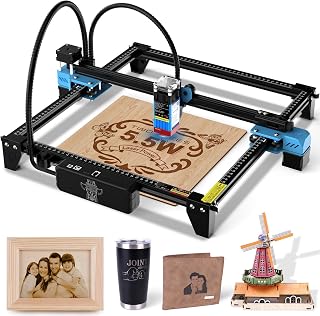 Twotrees TTS-55 Pro Laser Engraver 5500mW Laser EngravingCheck price on Amazon
 Tondiamo A4 Rubber Stamp Sheet for Laser Engraving MachineCheck price on Amazon
 40Pcs Unfinished Laser Engraving Carving Blank Wood PiecesCheck price on Amazon
 48 PCS Slate Coasters BulkCheck price on Amazon
LaserEngraveHQ earns a commission from purchases made through these links, at no extra cost to you. Read our affiliate disclosure.
Laser engraving involves intense heat and rapid material vaporization. Always verify blank compositions before running a job. Never engrave PVC, vinyl, or unknown synthetic plastics, as thermal decomposition releases corrosive chlorine gas and hazardous fumes that ruin laser optics and endanger health.
Step 1: Understand surface laser marking and annealing
Laser marking alters surface coloration without cutting or removing material volume. On metals, this process is known as laser annealing. Controlled laser heat induces localized oxidation, creating a durable, high-contrast dark mark while preserving a smooth finish that resists corrosion.
ALRALLI provides solid 304 stainless steel coin blanks measuring 32 mm in diameter and 3 mm thick (with alternative maker options of 32 mm by 4 mm and 40 mm by 3 mm, weighing approximately 19 g and 25 g per piece). On dense 304 stainless steel, surface annealing produces dark text while maintaining structural integrity. On coated metal blanks, such as INKNOTE black aluminum tag pendants measuring 2 x 1 inches with 30 inches chains, surface etching removes the black surface coating to create clear identification text without warping thin metal. For more blank comparisons, see our guide to stainless steel blanks for laser engraving.
Step 2: Apply shallow laser etching on coated and brittle blanks
Laser etching sits between surface marking and deep engraving. In laser etching, the beam melts an extremely thin surface layer or micro-fractures brittle substrates, creating contrast through altered surface texture or by exposing an underlying contrasting core.
Laser etching is widely used on coated metals. For instance, weparmeety lists anodized aluminum business card blanks measuring 86 x 54 mm with a thickness of 0.45 mm (approx. 3.38 x 2.12 inches and 0.02 inch thick, in packages of 100 pieces). A modest laser beam removes the blue anodized layer to reveal a crisp, contrasting white mark on the aluminum surface.
Etching also serves brittle blanks like stone and glass. Natural rock tends to fracture under thermal shock rather than vaporizing cleanly. DASSNANE lists 4 inch square black slate coasters measuring 0.3 cm thick with 4 anti-slip rubber pads in packs of 60 pieces. Laser etching these coasters micro-fractures the dark slate surface into permanent light-gray patterns. Similar surface micro-fracturing occurs on drinkware, as covered in our laser cutter for glass guide.
Step 3: Cut deep laser engraving into wood, acrylic, and leather
Deep laser engraving, also called laser ablation, vaporizes material volume to produce a noticeable three-dimensional cavity. Wood is one of the most common substrates for deep engraving. SPROOKJE offers basswood sheets measuring 12 x 16 inches at 3 mm thick (1/8 inch), with thickness error controlled within ±0.1 mm, as well as size options from 8 x 12 to 12 x 20 inches in packs of 12 pieces. Basswood provides uniform density and low resin content for consistent beam penetration. Read our guide to the best wood to laser engrave.
Cast acrylic also supports deep engraving, producing a frosted white relief when vaporized. Deep engraving also creates contrast on layered synthetics. GrliTra lists rectangle faux leather hat patches measuring 3 x 2 inches (about 7.6 x 5.1 cm) with adhesive that irons at 285 degrees for 20 seconds, backed by a 30 days warranty. Tikjiua supplies PU leather key fob blanks measuring 40*65 mm (approx. 2.56 x 1.57 inches) in 6 colors in packs of 30 pieces. Deep engraving removes the top polyurethane layer to reveal the contrasting backing. See our leather patches for laser engraving guide. On two-color signage blanks, Gem Awards lists gray and white name tags measuring 1×3 inches in packs of 10 pieces, using two-ply plastic where the beam vaporizes the gray top layer to reveal the contrasting white core.
Step 4: Distinguish engraving from laser cutting and scoring
Understanding engraving types requires recognizing how engraving differs from cutting and vector scoring:
- Raster engraving: The laser head sweeps horizontally across the bed, pulsing the beam to build filled graphics and text line by line.
- Vector scoring: The laser head traces vector perimeters at low power, creating fine outline grooves without penetrating the blank.
- Vector cutting: The laser head traces paths at high power, penetrating completely through the material to separate finished parts.
Balancing raster engraving with vector scoring saves machine time. To compare machine capabilities, see our guide on laser engraver vs laser cutter, and explore projects in our uses for laser engraver overview.
Step 5: Match laser source technologies to your target material
Engraving results depend on laser beam wavelength and machine architecture:
- Diode lasers: Emitting visible blue light, diode modules handle wood, leather, dark acrylic, and coated metal blanks. Highly reflective bare metals like aluminum reflect blue diode light and dissipate heat quickly. Read can a 10W laser engrave metal to see what diode beams can and cannot mark.
- CO2 lasers: Operating in the long-wave infrared spectrum, CO2 gas tubes produce beams absorbed by non-metallic substances, excelling at wood engraving, glass etching, and cutting acrylic. See what is a CO2 laser engraver and our diode vs CO2 laser breakdown.
- Fiber lasers: Generating a narrow infrared beam, fiber lasers are optimized for bare metals, excelling at fast direct marking and deep engraving on steel and aluminum without chemical sprays. Learn more in what is a fiber laser engraver and our guide to the best metal for laser engraving.
Review our guide on how to choose a laser engraver to match your budget and goals.
Step 6: Screen blank materials and verify chemical safety
Material composition dictates engraving quality and workshop safety. Woods, slate, and coated metals engrave cleanly, but synthetic polymers require strict screening.
Never engrave PVC, vinyl, PVC-based faux leather, polycarbonate, or ABS. Under laser heat, PVC and vinyl release hydrogen chloride gas, forming corrosive hydrochloric acid that ruins linear rails, optics, and circuit boards while endangering lungs. Polycarbonate produces dense toxic smoke, and ABS emits hazardous fumes while catching fire easily.
To practice safely, makers often use multi-material assortment kits. K KERNOWO offers a 185 pieces materials kit (item model LC-EGS-S, weighing 5.19 pounds) including basswood, acrylic, felt, and metal card blanks. Because some craft kits mention PVC sheets in marketing descriptions, inspect every blank and discard vinyl items. JETJIAN provides a 166 pieces kit (weighing 3.72 pounds, package dimensions 11 x 10 x 3 inches) offering 22 types of blanks designed for diode and CO2 machines. Ensure faux leather is PU (polyurethane), and source safe plastics from our acrylic sheets for laser engraving guide and engraving materials directory.
Step 7: Configure ventilation, fire watch, and eye protection
Every type of laser engraving generates airborne particulate and optical radiation hazards. Establishing a safe workspace is essential before running a job:
- Fume extraction: Engraving wood, acrylic, and leather produces soot and volatile organic compounds. Route fumes outdoors using dedicated inline duct fans, or pass exhaust through a multi-stage filtration unit. Browse options in our best fume extractor for laser engraver review.
- Fire prevention: Deep engraving on organic blanks concentrates high heat that can ignite wood dust. Never leave an operating laser unattended, keep a fire blanket or extinguisher nearby, and utilize air assist to clear smoke and embers.
- Optical eye protection: Direct and reflected laser beams cause permanent eye injury. Standard sunglasses offer zero protection. Laser eyewear protects only if its frame and lenses state a verified optical density (OD) and a certified wavelength range matching your laser source. Consult our guide on how to choose laser safety glasses and visit our laser safety hub.
Common mistakes to avoid
- Attempting to mark highly reflective bare metals like aluminum or brass with a low-power diode laser without an appropriate thermal marking compound.
- Engraving PVC, vinyl, or unknown synthetic plastics, causing machine corrosion and toxic gas release.
- Neglecting air assist during deep wood engraving, resulting in heavy scorch marks and blurred edges.
- Trusting unrated colored acrylic machine covers instead of wearing certified optical density laser safety glasses.
- Using raster engraving for thin vector outlines instead of vector scoring, inflating job run time.
- Over-powering delicate blanks, which causes thin metal cards or thin wood sheets to curl from thermal stress.
Types of laser engraving: the short version
- Surface laser marking: heats the workpiece to produce localized annealing or color contrast without carving depth.
- Shallow laser etching: melts thin surface layers or micro-fractures brittle blanks like stone and glass.
- Deep laser engraving: ablates and vaporizes material volume to create dimensional relief and tactile depth.
- Vector scoring: traces perimeter lines at low power to create crisp boundaries without cutting through.
- Beam selection: match diode lasers to wood and coated blanks, CO2 lasers to organics and acrylic, and fiber lasers to bare metals.
- Workspace safety: ventilate exhaust fumes, keep fire suppression equipment nearby, and wear certified wavelength-matched safety glasses.
Mastering these engraving types allows you to select the ideal process for each blank, balancing speed, graphic detail, and material integrity on every project.
FAQ: lasers and CNC
What is the difference between laser engraving and laser etching?
Laser engraving vaporizes material to cut a deep cavity into the substrate. Laser etching melts an ultra-thin surface layer or micro-fractures brittle blanks like stone and glass, producing visual contrast with minimal material loss.
Can a diode laser engrave bare metal?
A diode laser cannot cut or deep-engrave bare metal because it lacks the peak pulse power required to vaporize metal. However, diode lasers can etch coated metals like anodized aluminum, and higher-power diode units can produce surface marks on bare stainless steel or use thermal marking spray on other metals.
Which type of laser engraving is best for wood?
Deep laser engraving using raster motion is best for wood. Focused beams vaporize wood fibers cleanly, leaving darkened recessed graphics with distinct relief. Vector scoring can sharpen fine outline details.
What materials should never undergo laser engraving?
Never engrave PVC, vinyl, PVC-based faux leather, polycarbonate, or ABS. Thermal degradation of PVC and vinyl releases corrosive hydrochloric acid, while polycarbonate and ABS emit toxic fumes, heavy soot, and present severe fire risks.
How does laser marking differ from surface ablation?
Laser marking alters surface color through thermal annealing without removing material, keeping the surface flat and sealed. Surface ablation actively vaporizes material volume to create a recessed groove or tactile texture.
Do I need different safety glasses for different types of laser engraving?
Yes. Eye protection depends strictly on the laser source rather than the engraving style. Diode, CO2, and fiber lasers operate at completely different optical wavelengths, requiring safety glasses certified for that specific wavelength range.
Related: the laser engraver hub, engraving materials category, and diode vs CO2 laser comparison. Also see our how to choose a laser engraver guide, best metal for laser engraving, and laser safety hub.