Temperature Guide for Heat Press by Material
A plain guide to checking platen heat with an infrared thermometer, matching the setting to the material, and keeping transfers bonded without scorching.

On this page
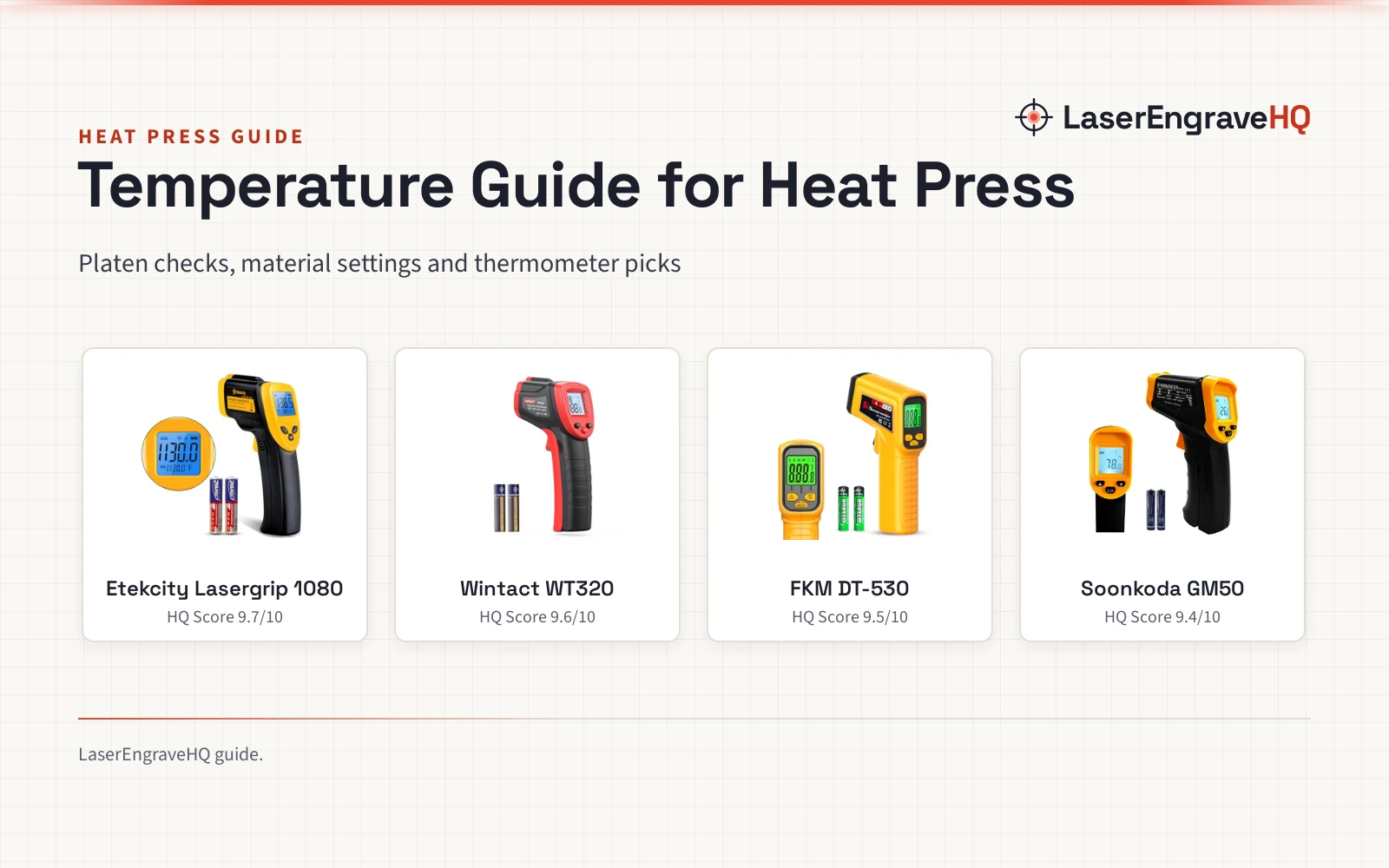
Top picks at a glance
As an Amazon Associate I earn from qualifying purchases.
- 1
 Etekcity Infrared Thermometer Laser Temperature9.7/10View on Amazon
- 2
 Wintact Infrared Thermometer9.6/10View on Amazon
- 3
 FKM Infrared Thermometer Gun Non-Contact Laser9.5/10View on Amazon
- 4
 Digital Infrared Thermometer gun9.4/10View on Amazon
A transfer bonds well only when the platen is at the heat the material and the transfer need, and a temperature guide for heat press work starts with that surface reading: check the platen, match the setting to the material, and press only when the reading holds steady across the area the design will cover. The dial shows a target or a sensor reading, while an infrared thermometer shows what the platen surface is doing, and that gap is where scorched shirts and peeling vinyl usually begin.
LaserEngraveHQ earns a commission from purchases made through these links, at no extra cost to you. Read our affiliate disclosure.
Etekcity Infrared Thermometer Laser Temperature
An infrared thermometer that measures -58 to 1130°F in 0.5 seconds, with adjustable emissivity and a MAX display for checking platen heat.
Pros
- Measures -58 to 1130°F and shows the result in 0.5 seconds
- Adjustable emissivity from 0.1 to 1.0 for different surfaces
- Distance-to-spot ratio of 12:1 for readings from a safe distance
- Backlit LCD with °F/°C conversion and a MAX display
Cons
- No accuracy figure is stated in the listing
- Reads surface temperature only, not the heat inside a thick blank
- Shiny metal surfaces need emissivity adjustment for a true reading
- Battery type is not stated in the listing
Wintact Infrared Thermometer
An infrared thermometer that reads -58 to 1094°F in less than 0.5 seconds, with adjustable emissivity and max/min modes for checking platen heat.
Pros
- Reads -58 to 1094°F in less than 0.5 seconds
- Accuracy of ±1.5% (±2.7°F) is stated in the listing
- Distance-to-spot ratio of 12:1 for readings from 14.17 inches away
- Emissivity preset at 0.95, with 0.10 to 1.00 optional
Cons
- The listing states a 12 months warranty, shorter than the 2-year term on the top pick
- The actual measurement position is 2 cm below the laser spot, so aim matters
- Glass surfaces need black insulating tape for a true reading, per the listing
- Auto power off after 7 seconds of inactivity switches the unit off if you pause between readings
FKM Infrared Thermometer Gun Non-Contact Laser
An infrared thermometer that reads -58 to 986°F in 0.5 seconds, with adjustable emissivity and a backlit LCD for checking platen heat.
Pros
- Reads -58 to 986°F in 0.5 seconds
- Precision of ±2% or ±2°C across the range
- Emissivity adjusts from 0.1 to 0.99 by holding the MODE key for 3 seconds
- Backlit LCD with one-touch °F/°C conversion and 15-second auto-off
Cons
- No warranty term is stated in the listing
- The top of the range is 986°F, below the 1130°F top of the Etekcity
- Not for human use, per the listing
- No MAX display is stated in the listing
Digital Infrared Thermometer gun
A handheld infrared thermometer that reads -58 to 932°F with a backlit LCD and a preset emissivity of 0.95 for checking platen heat.
Pros
- Reads -58 to 932°F with a display resolution of 0.1°C or 0.1°F
- LCD backlight suits use at night or in a dim room
- Data hold shows SCAN while the trigger is pulled and HOLD when released
- °C/°F conversion selection on the display
Cons
- No warranty term is stated in the listing
- Emissivity is preset at 0.95 with no adjustment stated
- The top of the range is 932°F, the lowest here
- Shiny or polished metal gives inaccurate readings unless taped or painted, per the listing
Temperature Guide for Heat Press: How to Use It
Start with a clean platen and a thermometer that reads the full range the press can reach. Point the thermometer at the centre of the platen, then at the edges, and compare the readings before loading a blank. A surface that reads low at the edges will bond a design unevenly, so move the blank toward the area that holds steady and recheck after the press closes and opens again.
Emissivity affects whether the reading is true. A bare metal platen reflects infrared light, so a thermometer with adjustable emissivity gives a truer reading on metal than a fixed preset. The listings in this guide state emissivity ranges and presets, and the product cards below name them, so match the thermometer to the surface it will read. Where a surface is shiny, a strip of masking tape or flat black paint on a spare area gives the beam a surface it can read, a method the listings describe.
Settings by Material
Polyester, cotton and blends behave differently under heat, and the transfer maker sets the setting for each combination. Vinyl on polyester usually asks for a gentler setting and a shorter dwell than heavy cotton, since polyester can scorch under high heat, while coated sublimation blanks need the heat the coating was made for. Read the guidance that comes with the transfer paper or vinyl, set the press to that guidance, and use the thermometer to confirm the platen matches it before pressing a blank that matters.
A mini press suits small designs and curved areas, while a flat press covers full shirt fronts; the mini heat press versus a flat press comparison covers that choice. Whatever the press size, check the heat across the whole platen, not only at the centre, and recheck when the press has sat idle, since a platen can drift as it cycles. A teflon sheet between the platen and the design protects the platen and the design from sticking and scorching, and a foam pad helps on uneven blanks.
The Gear: Thermometers That Check Platen Heat
A thermometer earns its place here because the platen reading, not the dial, decides whether a transfer bonds, and each pick below states the range it brings to that check.
FAQ: lasers and CNC
What temperature should a heat press be for polyester?
Follow the guidance from the transfer or vinyl maker for that exact material, since vinyl on polyester usually asks for a gentler setting than heavy cotton. Set the press to that guidance, then confirm the platen surface with a thermometer before pressing, and press a spare piece of the same fabric before a blank that matters.
How do I check heat press temperature?
Aim an infrared thermometer at the platen surface from the distance the listing states, read the centre and the edges, and compare the readings. Adjust emissivity for a bare metal surface, and recheck after the press has cycled, since the surface can drift between presses.
Why does a transfer peel after pressing?
Peeling usually points to a platen that was cooler than the guidance, a surface that was not checked across its full area, or a press that opened before the bond set. Recheck the platen with a thermometer, confirm the setting against the transfer maker guidance, and press a spare before repeating the job.
Can I use a mini heat press for the same projects?
A mini press suits small designs, patches and curved areas, while a flat press covers full fronts and larger blanks. Check the heat across the smaller platen in the same way, and move the design toward the area that holds steady.
Do I need a thermometer if the press has a display?
A display shows a target or a sensor reading, while a thermometer shows the surface the blank touches. The heat gun versus heat press comparison explains the difference in tools, and a quick surface check before pressing catches a platen that has drifted from its display.
Related: the heat presses and sublimation hub, heat press cover guide and heat press vinyl transfers.