Heat Gun Temperature Control: How to Adjust and Choose
Heat gun temperature control sets how hot the air gets: learn the dial, the modes and the airflow that fit each job.

On this page
Top picks at a glance
As an Amazon Associate I earn from qualifying purchases.
- 1
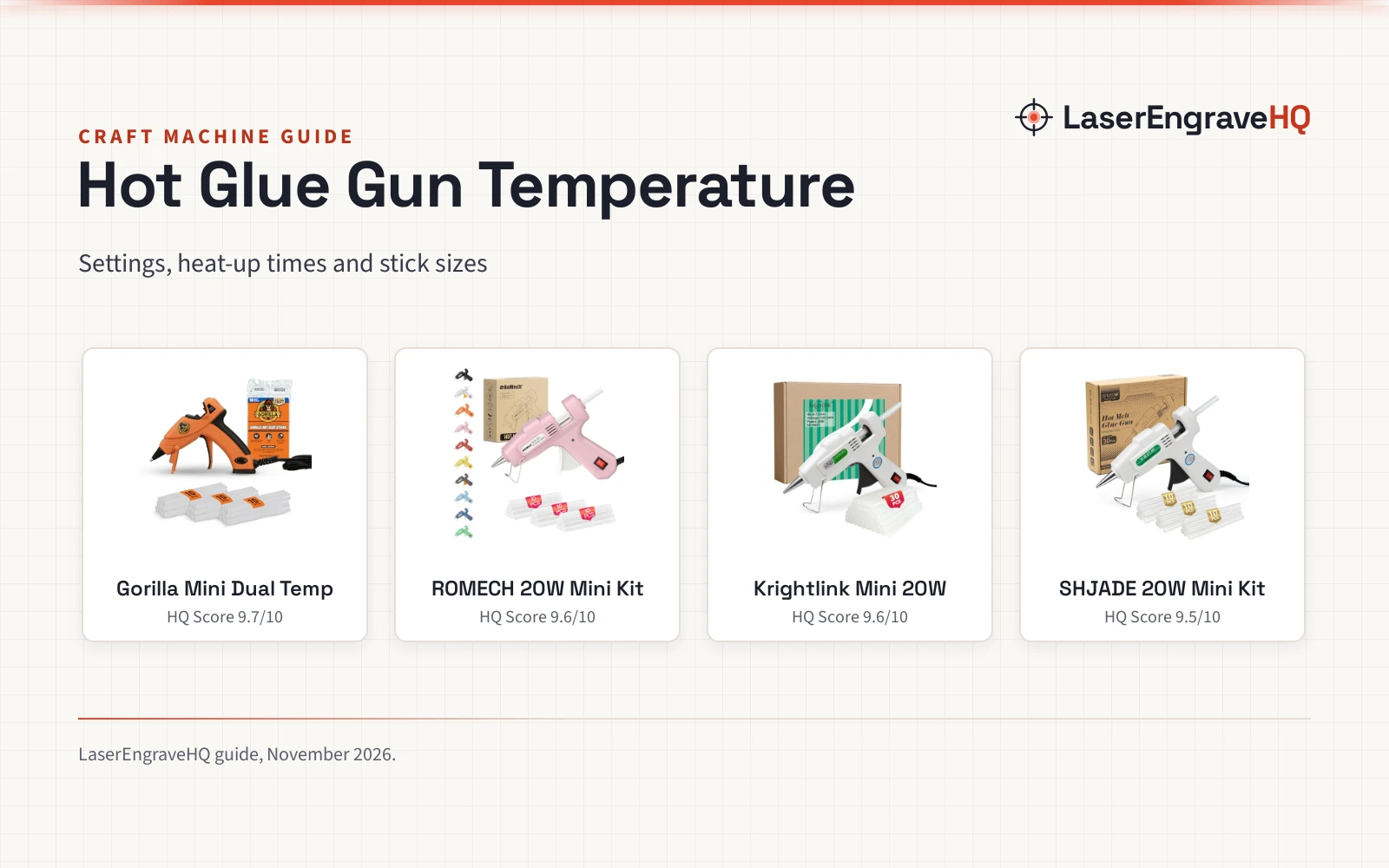
 Gorilla Mini Hot Glue Gun Kit9.7/10View on Amazon
- 2
 ROMECH 20W Mini Hot Glue Gun Kit9.6/10View on Amazon
- 3
 Krightlink Mini Hot Glue Gun Kit with 30 Glue Sticks 20w Fast9.6/10View on Amazon
Heat gun temperature control is the dial, slider or digital setting that sets how hot the air leaving the nozzle gets, so the same gun can soften vinyl wrap on one job and strip paint on the next. A gun with a fixed heat setting forces every job to take the same heat, while variable control matches the heat to the material in front of it.
LaserEngraveHQ earns a commission from purchases made through these links, at no extra cost to you. Read our affiliate disclosure.
Every figure in this guide comes from the listing that states it, and figures differ from one maker to the next. Confirm the setting on a scrap piece before heating the finished work.
Step 1: Find the range on the listing
The temperature range is the figure to compare. Batavia, COMTO, TGK and a SEEKONE compact model state 122°F to 1202°F. ROMECH states 120°F to 1200°F, with 50℃ to 500℃ in the same line. The Master Appliance EC-200 (on Amazon) states a narrower range of 100°F to 930°F, at 120V and 10 Amps. The DEWALT listing states variable temperature control but gives no range figure.
Power figures run from 1200W to 1800W across these listings: Master states 1200W, ROMECH states 1500W, and Batavia, COMTO, TGK and SEEKONE state 1800W. A higher wattage figure does not set the temperature by itself; the dial does that. Several listings state peak heat in 1.5 seconds. Warranty terms differ too: Batavia states a 2 Year Manufacturer warranty, ROMECH states a 12-month warranty with 45-day money back, and Master a 1-year limited warranty.
Step 2: Start at the low end and raise the heat in small moves
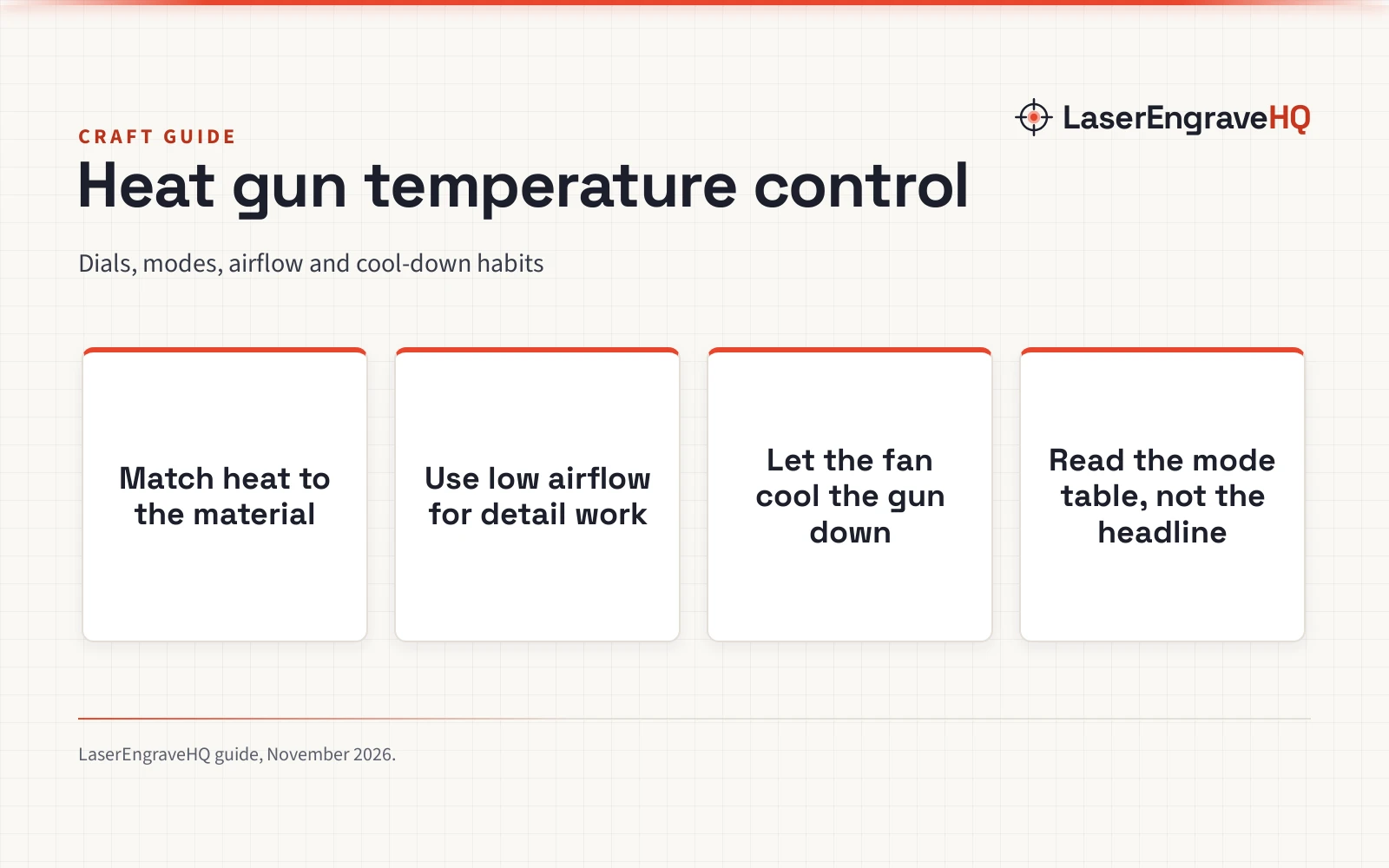
Start at the low end of the stated range and raise the heat in small moves until the material responds. Vinyl wrap softens before paint strips, so the right setting is the lowest one that does the job. Starting at the high end risks scorching the surface and leaves no room to adjust upward.
Give each move a moment to show its effect: hold the gun at a steady distance, keep it moving, and watch the surface change before turning the dial again. A scrap piece of the same material is the place to learn the setting, not the finished work.
Step 3: Pick a mode, then set the dial
Most of these listings pair the dial with 2 modes, each with its own range and airflow. SEEKONE states Mode I at 120°F to 840°F (50℃ to 450℃) with 190-210 L/min, and Mode II at 120°F to 1112°F (50℃ to 600℃) with 250-500 L/min on its carry-case model. Its LCD model states Mode I at 120°F to 750°F (50℃ to 400℃) and Mode II at 120°F to 1100°F (50℃ to 600℃). TGK states Mode I at 122°F to 572°F with 250 L/min and Mode II at 122°F to 1202°F with 500 L/min.
Read the mode table rather than the headline. One SEEKONE title lists 122℉ to 1112℉ and 122℉ to 1202℉ in the same line, while its mode table tops out at 1112℉. The compact model states Mode I at 50 to 300℃ with 300 L/min and Mode II at 50 to 650℃ with 500 L/min. For craft work, start in Mode I and move to Mode II only when the material needs more heat. The best heat gun for crafts guide compares models for this kind of work.
Step 4: Set the airflow to match the heat
Airflow is the other half of heat gun temperature control, stated in L/min, gallon/min or CFM. Batavia states Mode I at 190 to 210 L/min and Mode II at 250 to 500 L/min. ROMECH states 66 gallon/min or 132 gallon/min. The Master EC-200 states 2 fan speeds at 5 and 9 CFM. Low airflow suits detail work; high airflow suits stripping and drying, where broad heat moves the job along.
Match the airflow to the heat setting: a high temperature with low airflow gives a small hot spot, while a low temperature with high airflow spreads gentle heat wider. Batavia, ROMECH, COMTO and SEEKONE state 4 nozzles, and one SEEKONE kit states 5 nozzles with 7 accessories. One TGK listing states 3 nozzle attachments in its title and 4 nozzles in its package list, so trust the package list. A heat press uses a different kind of heat: see the temperature guide for heat press.
Step 5: Use the display and memory when the gun has them
Some guns show the set temperature on a display, and some remember it. The SEEKONE LCD models state an LCD display that shows the temperature in real time, a power-on memory function that returns to the last set temperature and speed, and a ℃ to ℉ conversion set by pressing a button. The compact model states the same memory and conversion, set by pressing the M button for a few seconds.
A display does not change the heat; it only shows the figure the dial set. TGK states a red stepless roller that provides rheostat-type heating, with a high/low switch on the handle for airflow.
Step 6: Cool down, store the gun, and read the safety lines
The SEEKONE LCD model states a power-off delay: after the switch goes off, the fan keeps running for a few seconds to cool the heater down, then the power cuts off. ROMECH, COMTO, TGK, SEEKONE and DEWALT all state overload or overheat protection, and Batavia states dual fuses that cut power when the gun overheats.
DEWALT states a built-in kickstand, Master a built-in wire stand, and Batavia a hanging hook. COMTO states a retractable heat shield, and Batavia flame-retardant PA6 composite shielding around the nozzle. Batavia and Master state ETL, while ROMECH, SEEKONE and TGK state UL-certified parts or wire. COMTO states a 1.8m power cord and TGK states a 5.2 ft cable. Ventilation belongs in every session, so work where air moves. The cordless vs corded heat gun comparison covers the trade-offs when the work moves away from an outlet.
Common mistakes to avoid
- Starting at the high end of the dial instead of the low end.
- Using high airflow on a small part and blowing heat past the work area.
- Trusting a headline figure when the listing disagrees with itself: one SEEKONE title lists 2 top temperatures, and one TGK listing lists 2 nozzle counts.
- Skipping the cool-down and setting a hot gun down on a surface that cannot take it.
- Reaching for a heat gun when a cooler tool fits the job: see the hot glue gun temperature guide.
Heat gun temperature control: the short version
- Read the stated range on the listing.
- Start at the low end and raise the heat in small moves.
- Pick Mode I for detail work and Mode II when the material needs more heat.
- Set the airflow to match the heat.
- Use the display and memory to repeat a setting.
- Let the fan cool the gun down, then rest it on its stand or hook.
FAQ: lasers and CNC
What temperature should a heat gun be set to for shrink tubing?
There is no single figure: top ends run from 930°F to 1202°F, with low ends from 100°F to 122°F. Start at the low end of the dial and raise the heat in small moves until the tubing shrinks evenly around the joint.
What is the difference between Mode I and Mode II on a heat gun?
Mode I covers the lower part of the range with lower airflow; Mode II covers the full range with higher airflow. On the SEEKONE carry-case model, Mode I states 120°F to 840°F with 190-210 L/min, while Mode II states 120°F to 1112°F with 250-500 L/min.
Do I need an LCD display for heat gun temperature control?
No. A dial or roller sets the same kind of range, and the listings without a display still state variable control. The display adds a clear reading, and the memory function returns the gun to the last set temperature and speed.
Why do heat guns list different top temperatures?
Each maker states its own range, and the figures differ: ROMECH states 120°F to 1200°F, SEEKONE states 122°F to 1112°F on two models, and Master states 100°F to 930°F. Compare the mode table on each listing rather than the headline.
Is it safe to leave a heat gun switched on between jobs?
Switch it off between jobs and let the fan finish the cool-down. Overheat protection and overload protection cut power when the gun gets too hot, and stands and hooks keep a hot nozzle off the work surface. Never leave a running gun alone on a bench.
Related: the craft machines hub, best heat gun and best heat gun for crafts. Also see the cordless vs corded heat gun comparison.