Rack and Pinion vs Ball Screw CNC: Which One Should You Buy?
Rack and pinion and ball screw CNC drive mechanisms compared on travel speed, positioning precision, span length limits, rigidity and workshop hardware.

On this page
Top picks at a glance
As an Amazon Associate I earn from qualifying purchases.
- 1
 Ball Screw CNC Parts SFU1605 RM1605 16mm 1000mm with Metal9.6/10View on Amazon
- 2
 Ball Screw SFU1605 2000mm Diameter 16mm9.6/10View on Amazon
- 3
 CNC Router Machine 4030-Evo Ultra 2View on Amazon
- 4
 LUNYEE 3020 Nova CNC Router MachineView on Amazon
- 5
 Genmitsu CNC MDF Spoilboard Table for 3018 CNC Router MachineView on Amazon
- 6
 Genmitsu 4040-PRO CNC Router Machine for Metal AcrylicView on Amazon
- 7
 Genmitsu CNC MDF GRID Spoilboard for 3018 CNC Router MachineView on Amazon
Makers carving hardwood signs, milling custom aluminum brackets, or shaping decorative cabinet panels on a CNC router eventually face a core mechanical choice: rack and pinion vs ball screw cnc. Both transmission systems translate stepper or servo motor rotation into linear carriage motion, but they serve different machine formats and workshop priorities. This guide compares rack and pinion against ball screw CNC drives on speed, positioning precision, span limits, rigidity, and maintenance, using concrete hardware kits to anchor the numbers.
LaserEngraveHQ earns a commission from purchases made through these links, at no extra cost to you. Read our affiliate disclosure.
Verdict: choose a rack and pinion drive if you are building a large-format CNC router and prioritize rapid traverse speeds across expansive spans without mechanical whipping. Choose a ball screw CNC drive if you build a compact to mid-size machine where fine positioning precision, high axial thrust, and low-friction motion matter more than long travel lengths. Pick between the two featured ball screw hardware kits based on your target axis span.
Machines on the list
Ball Screw CNC Parts SFU1605 RM1605 16mm 1000mm
A 1000 mm alloy steel ball screw kit with 16 mm diameter, BK/BF12 end supports, metal deflector nut, housing and coupler for CNC router axis builds.
Pros
- Alloy steel build with case-hardened surface and high stiffness rating
- Complete hardware kit including BK/BF12 end supports, nut housing and coupler
- Features a metal deflector ball nut design for smooth ball bearing recirculation
- Manufacturer specifies lubrication compatibility with either oil or grease
Cons
- 1000 mm length restricts working travel on larger CNC router beds
- Listing does not state the exact lead or pitch in the specification table
- No warranty term is stated
- Coupler bore and motor mounting dimensions are not stated
Ball Screw SFU1605 2000mm Diameter 16mm,5mm Pitch
A 2000 mm ball screw assembly with 16 mm diameter, 5 mm pitch, BK12/BF12 end supports, nut bracket and coupler for extended CNC axis travel.
Pros
- Long 2000 mm length accommodates larger axis travel on custom CNC routers
- Listing clearly specifies 16 mm diameter with a 5 mm lead and pitch
- Includes BK12 and BF12 end supports, ball nut housing bracket and coupler
- Spec table confirms wear resistance and high strength characteristics
Cons
- 2000 mm span on a 16 mm screw requires careful speed management to avoid whipping
- Specific steel alloy grade is not stated in the listing specifications
- No warranty term is stated
- Compatible lubricant type is not stated
Other machines to compare
 CNC Router Machine 4030-Evo Ultra 2Check price on Amazon
 LUNYEE 3020 Nova CNC Router MachineCheck price on Amazon
 Genmitsu CNC MDF Spoilboard Table for 3018 CNC Router MachineCheck price on Amazon
 Genmitsu 4040-PRO CNC Router Machine for Metal AcrylicCheck price on Amazon
 Genmitsu CNC MDF GRID Spoilboard for 3018 CNC Router MachineCheck price on Amazon
Side by side
| Product | HQ Score | Length | Diameter & Pitch | Material & Hardware |
|---|---|---|---|---|
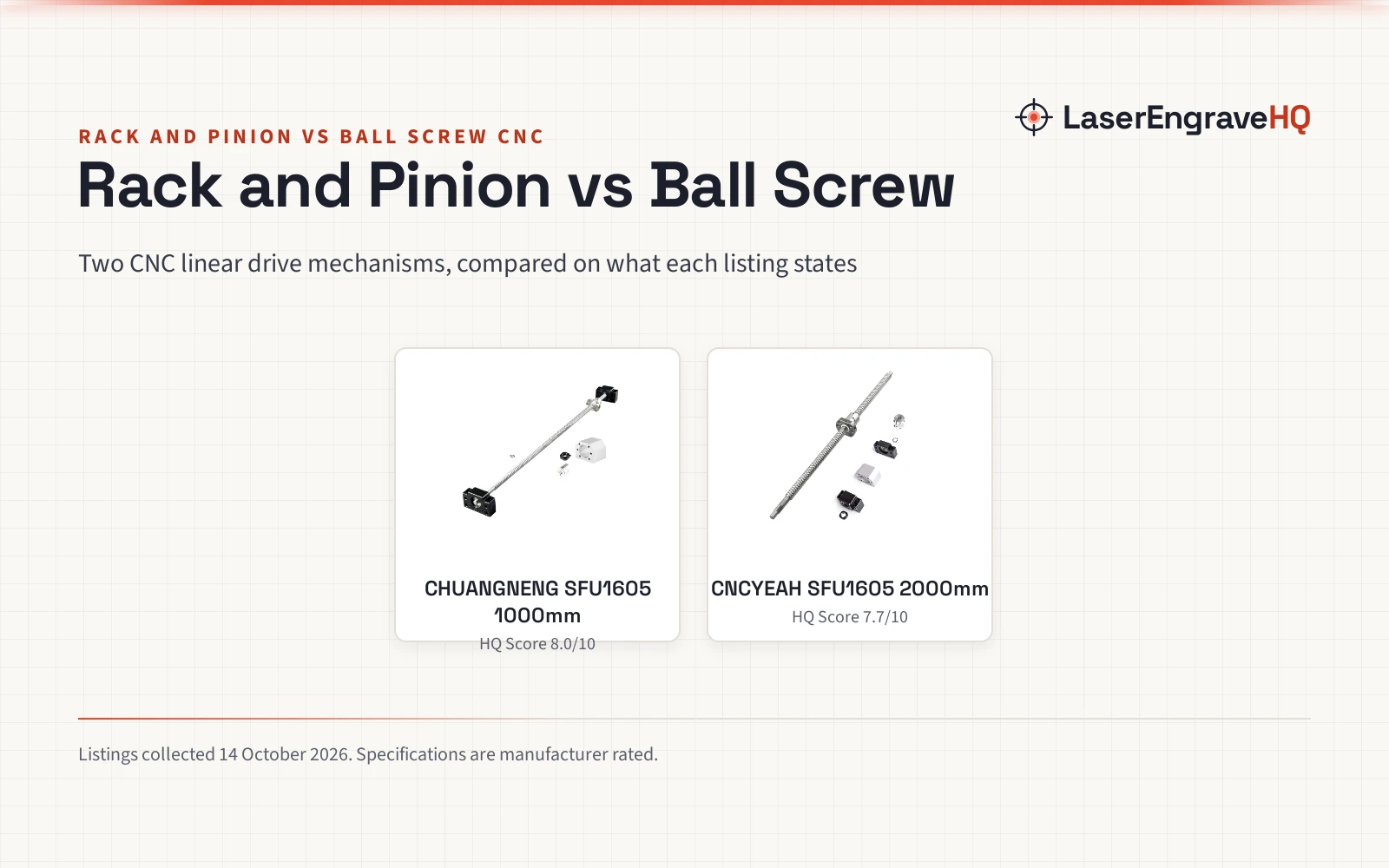
| CHUANGNENG SFU1605 1000mm | 9.6/10 | 1000 mm (approx 39.37 in) | 16 mm diameter (pitch unstated) | Alloy steel, BK/BF12 supports, nut housing, coupler |
| CNCYEAH SFU1605 2000mm | 9.6/10 | 2000 mm | 16 mm diameter, 5 mm pitch | BK12 and BF12 supports, nut bracket, coupler |
Specifications are manufacturer rated, as published on each listing and collected 14 October 2026.
Rack and pinion vs ball screw cnc: speed and travel length
Rack and pinion systems excel over long axis runs. A motorized pinion meshes with a stationary gear rack along the machine beam, allowing high traverse rates across long distances without the rotational vibration that plagues long spinning shafts. By contrast, a ball screw rotates a threaded rod through a recirculating ball nut. On longer axes, spinning a slender screw induces centrifugal whip, which forces builders to restrict motor rotation speed. In our concrete hardware examples, the CHUANGNENG listing provides a 1000 mm screw shaft (approx 39.37 inches), while the CNCYEAH listing extends to 2000 mm. At a 16 mm diameter across 2000 mm, rapid traverse speeds must remain controlled to prevent centrifugal whip. For larger spans or high-speed production on 4×4 and larger tables, rack and pinion mechanisms scale easily by adding stationary rack segments without whip concerns.
Positioning precision and backlash
Precision machining requires repeatable positioning under cutting loads. Ball screw systems provide high mechanical resolution because a fine screw lead converts rotation into small linear movements; the CNCYEAH example specifies a 5 mm lead and pitch, giving builders predictable linear advance per revolution. The recirculating bearing balls inside the nut maintain close contact with the ground or rolled threads, minimizing axial play. The CHUANGNENG example includes a ball nut with a metal deflector designed for smooth ball circulation. In contrast, standard rack and pinion setups have gear tooth clearance that can introduce backlash unless builders install split-pinion gears or spring-loaded anti-backlash mounts. When carving fine lettering or intricate relief carving, ball screws deliver tight positioning repeatability and low friction, although eliminating backlash entirely still depends on ball nut fit and bearing preload.
Rigidity and mechanical advantage
Cutting through dense hardwoods or non-ferrous metals exerts substantial cutting forces against the gantry carriage. Ball screws offer high axial thrust because a fine screw lead provides substantial mechanical advantage, reducing the holding torque required from the drive motor; for instance, the CNCYEAH listing specifies a 5 mm lead and pitch. The CHUANGNENG listing specifies case-hardened alloy steel construction rated for high stiffness and load carrying capacity, supported by BK12 and BF12 bearing blocks. Rack and pinion drives offer high stiffness along the axis because the steel rack mounts firmly to the gantry beam, eliminating tensile stretching. However, because a pinion gear travels further per revolution than a fine screw pitch, rack systems often require a planetary gearbox to achieve sufficient mechanical reduction and torque for heavy routing passes.
Maintenance, dust, and workshop reliability
Woodchips, MDF powder, and abrasive debris challenge workshop motion components. Ball screw ball tracks can trap dust if sawdust slips past the nut seals, which can lead to binding or uneven ball circulation. The CHUANGNENG example specifies compatibility with either oil or grease lubricant to maintain smooth bearing function, while the CNCYEAH listing leaves recommended lubricant unstated. Proper CNC router maintenance requires periodic cleaning and relubrication of ball screw assemblies. Rack and pinion systems handle workshop dust more forgivingly, especially when the gear rack is mounted face-down to prevent chips from settling into the gear teeth. Worn pinions can be replaced individually without replacing the entire drive assembly.
Drive hardware and installation complexity
Installing a ball screw requires precise parallel alignment between the screw shaft, end supports, and linear guide rails. The CNCYEAH package includes BK12 and BF12 end supports, a nut housing bracket, and a coupler, weighing 11.02 pounds with package dimensions of 79 x 4.5 x 3 inches. The CHUANGNENG kit similarly provides BK/BF12 supports, a ball nut housing, and a coupler with machined ends, weighing 2450 g. Misalignment on either ball screw kit can cause binding, increased motor draw, or premature bearing wear. Rack and pinion setups require straight mounting of the gear rack along the extrusion and consistent pinion gear engagement, but they avoid the critical concentric alignment required by long spinning screws. Builders assembling a custom router from a DIY CNC router kit should evaluate whether their frame allows rigid end-support tensioning.
Choose rack and pinion if
- You are building a 4×4 or larger CNC router table that requires extended travel without axis whipping.
- Your production workflow emphasizes high rapid traverse speeds and fast clearing passes on sheet goods.
- You operate in heavy dust environments and prefer face-down gear racks that shed debris easily.
- You want modular travel lengths that can expand by mounting additional gear rack sections.
Choose ball screw CNC if
- You build a compact benchtop or mid-format router focused on detailed carving, fine inlays, or metal plate milling.
- You want high native axial thrust and low friction using standard stepper motors.
- Your machine axis lengths match available screw hardware, using manageable spans like the 1000 mm CHUANGNENG kit or accepting speed limits on the 2000 mm CNCYEAH assembly.
- You prefer a complete mechanical package with matched BK12 and BF12 end supports and a ball nut housing.
Project Match
- Full-sheet cabinet parts and large signs: choose rack and pinion. Neither listing states a machine work area, but rack drives avoid the rotational whip of long screws on expansive beds.
- Mid-size router builds (up to 1000 mm axis reach): choose the CHUANGNENG SFU1605 1000mm. The listing states alloy steel construction, case hardening, and a 1000 mm length (approx 39.37 inches). Work area is Not stated.
- Extended custom axes (up to 2000 mm reach): choose the CNCYEAH SFU1605 2000mm for longer ball screw travel where traverse speeds are kept moderate to control screw whip. Work area is Not stated.
- High-precision aluminum milling and fine relief carving: choose ball screw CNC. Both listings provide recirculating ball nuts and BK/BF12 end supports for rigid, low-friction linear positioning. Work area is Not stated.
Always verify mechanical stops and emergency limit switches before powering high-torque stepper motors. Never reach into the cutting envelope while an axis is in motion. Keep a fire extinguisher in the shop, ensure proper dust collection, and follow workshop safety standards.
FAQ: lasers and CNC
Can a ball screw CNC run as fast as rack and pinion?
Generally, no. As a ball screw rotates faster over longer spans, the shaft experiences centrifugal whipping that limits rapid traverse rates. Rack and pinion mechanisms place the rotating pinion directly on a stationary rack, allowing significantly higher speeds across long travel lengths.
Which drive system has less backlash?
Ball screw systems typically offer less native backlash than standard spur gear racks because recirculating bearing balls roll with close thread conformity. However, rack and pinion systems can achieve near-zero backlash when fitted with spring-loaded or split-pinion anti-backlash mechanisms, while ball screws rely on ball nut preload to eliminate all axial play.
What does SFU1605 mean on a ball screw listing?
In CNC hardware, SFU1605 indicates a ball screw with a 16 mm outside diameter and a 5 mm lead or pitch. The CNCYEAH listing explicitly states both the 16 mm diameter and 5 mm pitch, while the CHUANGNENG listing states the 16 mm outside diameter but leaves pitch unstated in its table.
Why do CNC routers use rack and pinion on 4×4 and larger tables?
Large tables require long axis travel. Rotating a screw over expansive spans causes severe deflection unless the screw is exceptionally thick. Rack and pinion drives eliminate screw whip entirely because the gear rack remains stationary along the machine frame.
How do you prevent CNC motors from losing steps?
Steps are lost when cutting resistance or mechanical binding exceeds motor torque. Proper lubrication, correct feed rates, and rigid alignment prevent binding; see our guide on why is my CNC losing steps.
Related: ball screw vs lead screw CNC, planetary gearbox vs direct drive stepper CNC, linear rails vs V wheels CNC, DIY CNC router kit, and 4×4 and larger CNC routers.