Lead Screw vs Belt Drive CNC: Which One Should You Buy?
A practical comparison of lead screw and belt drive CNC systems, covering rigidity, cutting forces, rapid travel speed, backlash, and maintenance for makers.

On this page
Top picks at a glance
As an Amazon Associate I earn from qualifying purchases.
- 1
 2PCS 400mm(15.75 Inches)Tr8x8 Lead Screw with T8 Brass Nut9.5/10View on Amazon
- 2
 SpeTool Carbide Single Flute CNC Router Bits 1/8" Cutting9.7/10View on Amazon
- 3
 Genmitsu 4040-PRO CNC Router Machine for Metal Acrylic9.4/10View on Amazon
- 4
 2PCS 400mm(15.75 Inches)Tr8x2 Lead Screw with T8 Brass NutView on Amazon
- 52PCS 150mm(5.9 Inches)Tr8x2 Lead Screw with T8 Brass NutView on Amazon
- 6
 SFU1605 Ball Screw SetView on Amazon
- 7
 150mm SFU1605 Ball Screw SetView on Amazon
- 8
 2pcs 500mm Tr8X8 Lead Screw with T8 Brass Nut for 3D PrinterView on Amazon
- 9
 2pcs 300mm Tr8X2 Lead Screw with T8 Brass Nut for 3D PrinterView on Amazon
When you set out to cut hardwood signs, carve relief panels, or mill aluminum parts on a desktop router, deciding between a lead screw vs belt drive cnc machine sets your cutting rigidity, travel speed, and part accuracy. Choose a lead screw CNC if your workflow prioritizes dense hardwood milling, non-ferrous metal cutting, and fine detail where mechanical stiffness prevents tool deflection. Choose a belt drive CNC if your production focuses on large wooden signs, sheet goods, rapid laser marking, and fast rapids where swift job completion matters more than heavy cutting force. The sections below break down both drive mechanisms step by step to help you pick the right motion platform for your workshop.
Other machines to compare
 2PCS 400mm(15.75 Inches)Tr8x2 Lead Screw with T8 Brass NutCheck price on Amazon
- 2PCS 150mm(5.9 Inches)Tr8x2 Lead Screw with T8 Brass NutCheck price on Amazon
 SFU1605 Ball Screw SetCheck price on Amazon
 150mm SFU1605 Ball Screw SetCheck price on Amazon
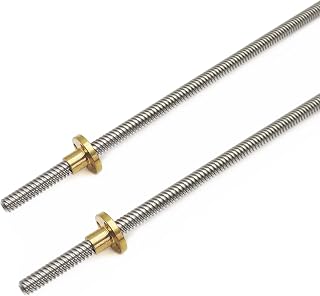 2pcs 500mm Tr8X8 Lead Screw with T8 Brass Nut for 3D PrinterCheck price on Amazon
 2pcs 300mm Tr8X2 Lead Screw with T8 Brass Nut for 3D PrinterCheck price on Amazon
LaserEngraveHQ earns a commission from purchases made through these links, at no extra cost to you. Read our affiliate disclosure.
Drive mechanisms interact directly with frame stiffness and spindle power. A rigid screw cannot compensate for a flexible gantry, and reinforced belts perform best with properly tensioned pulleys and sturdy guide rails.
Lead Screw vs Belt Drive CNC: Key Differences Compared
A CNC router converts motor rotation into linear movement along each axis. In a lead screw setup, a threaded steel rod turns inside a matching nut, driving the carriage. Because the screw is a rigid solid rod, it resists pushing and pulling forces during heavy passes. In a belt drive system, a grooved pulley pulls a flexible toothed belt along the axis. Belts move rapidly because a single motor revolution covers the entire pulley circumference, whereas a screw advances only by its thread lead.
Lead screws deliver mechanical advantage, maintaining axis position under heavy cutting loads. Belts deliver high velocity and rapid acceleration across broad work areas without rotational whipping. Choosing between them requires balancing cutting forces against production speeds. For complete machine options, browse our how to choose a desktop CNC router guide.
Step 1: Compare Rigidity and Resistance to Cutting Forces
Cutting force is the resistance an end mill encounters in dense hardwoods or metals. If the drive mechanism flexes, the cutter wanders, causing chatter marks or broken bits.
Lead screw drives provide superior resistance to cutting forces. Solid steel screws possess high axial stiffness, holding the carriage firmly on path during heavy passes. Machine builders rely on steel screws for these loads, such as the 400mm (15.75 Inches) Tr8x8 SUS304 stainless steel lead screw listed by VICHSAMWY, which features an 8mm diameter, a 2mm pitch, 4 thread entries, and an 8mm lead. In contrast, miniature stages reflect lighter duty limits; for example, Befenybay lists a compact actuator with a T6x1 lead screw specifying a horizontal maximum load capacity of 2.5kg and a vertical maximum load capacity of 1kg while moving 1mm in one turn. Milling metal requires full-sized steel screws rather than miniature stages. For tooling, see our best end mill for aluminum guide.
Belt drives use flexible belts that can stretch under heavy cutting pushback. While belts handle light cuts smoothly, deep passes in dense oak cause deflection. Belt systems suit lighter materials like softwoods, plastics, and foam at high feed rates. For wood carving, review our guide to the best CNC router bits for hardwood.
Step 2: Evaluate Motion Speed and Rapid Travel Needs
Production efficiency depends on cutting feed rates and rapid travel during non-cutting repositioning moves.
Belt drives dominate in motion velocity and rapid acceleration. Because pulleys turn motor rotation into swift linear motion, belt routers achieve high travel speeds easily. Zeelo lists a GT2 timing belt pulley with 20 teeth, a 5mm bore, a 2mm pitch, and a 6mm wide rubber belt, providing swift linear travel per motor rotation. MOTOU lists a 6mm wide GT2 timing belt engineered with anti-wear nylon tooth cloth for anti-slip power transmission during rapid directional shifts. High speed also suits desktop routers running diode lasers.
Lead screws run at lower maximum speeds due to rotational mechanics. While a pulley moves linear distance across multiple teeth per turn, a screw advances only by its thread lead. LC LICTOP lists an 8mm diameter T8 lead screw that moves 8mm per turn, whereas Befenybay lists a compact actuator with a fine T6x1 lead screw moving 1mm in one turn that operates at a speed of 0-120mm/min driven by a DC 24V stepper motor. Furthermore, long spinning screws risk centrifugal screw whip at high speeds, requiring conservative travel rates. While lead screws traverse slower during rapids, their reduction delivers dependable cutting thrust. For feed rate planning, see our overview of CNC feeds and speeds for beginners.
Step 3: Check Backlash, Pitch, and Positioning Precision
Positioning accuracy determines whether carved joints fit snugly and circular holes remain round.
Backlash occurs on direction reversals from clearance between screw threads and nuts. Builders resolve this using anti-backlash nuts. LC LICTOP lists an 8mm diameter T8 lead screw that moves 8mm per turn, paired with an anti backlash brass nut to reduce play, a zinc alloy pillow block featuring a 42mm mounting hole distance, and a flexible coupler connecting 5mm to 8mm shafts. VICHSAMWY lists a 400mm (15.75 Inches) Tr8x8 lead screw made of SUS304 stainless steel with an 8mm diameter, 2mm pitch, 4 thread entries, and an 8mm lead paired with a copper nut. With anti-backlash hardware, lead screws achieve tight repeatability, as seen in the Befenybay actuator listing repeat positioning accuracy of ± 0.05mm.
Tensioned belts exhibit negligible backlash because toothed profiles mesh without thread clearance. However, tooth wear and gradual slackening introduce play over time. Long belt spans can also flex during sudden stops, causing ringing artifacts. Regular tensioning maintains precision carving.
Step 4: Assess Workshop Dust, Debris, and Maintenance Demands
CNC routers operate in environments filled with sawdust, chips, and debris, affecting servicing needs.
Lead screws require lubrication between steel threads and brass nuts. Wet grease on exposed screws attracts dust, forming an abrasive paste that accelerates nut wear. Lead screw maintenance requires wiping down threads, brushing away packed chips, and applying dry lubricant. For servicing routines, see our complete guide to CNC router maintenance.
Belt drives operate dry, making them tolerant of dusty woodshops. Sawdust clears from pulley grooves during travel. Heavy-duty belts also tolerate harsh conditions; Bemonoc lists an HTD3M open-ended timing belt with a 15mm width made of polyurethane with a steel core, handling high torque across a temperature range of -30°C to 85°C. While belts avoid lubrication, they require checks for slack and tooth wear. If your machine skips positions during cuts, our guide on why is my CNC losing steps covers belt tension and troubleshooting.
Step 5: Match the Drive System to Machine Size and Axis Travel
Machine size influences which drive mechanism makes practical sense.
On desktop routers with compact travel spans, lead screws perform exceptionally well. Over short spans, an 8mm lead screw maintains rigidity without screw whip, providing high accuracy for relief carvings. Compact entry routers often use lead screws on all axes, as described in our DIY CNC router kit guide. Over long spans, rotating lead screws must become thicker to prevent whipping, increasing weight and inertia.
Belt drives scale easily across large formats. Extending axis travel simply requires a longer belt loop and extended aluminum rails. The rotating mass remains low because only the lightweight pulley turns with the stepper motor. This scalability makes belt drives common on wide-format machines for large signs and sheet goods. If comparing machine classes, explore our list of the best desktop CNC for beginners, or evaluate commercial models in our review of the best CNC router for small business.
Common Drive System Mistakes to Avoid
- Over-tightening timing belts: Stretches the belt core, strains motor bearings, and binds linear guide rails.
- Neglecting lead screw lubrication: Increases friction, causes premature nut wear, and leads to skipped motor steps.
- Applying wet grease in dusty shops: Attracts fine airborne sawdust, creating an abrasive paste that jams threads.
- Forcing belts through heavy metal cuts: Heavy milling passes on light belts cause deflection, tooth skip, and tool chatter.
- Ignoring backlash adjustments: Loose anti-backlash nuts introduce play on reversals, ruining joint fitment.
Lead Screw vs Belt Drive CNC: The Short Version
- Identify your material: Choose lead screws for dense hardwoods and aluminum; choose belts for softwoods, plastics, foam, and sheet signs.
- Determine required motion speed: Belts deliver fast rapids and rapid laser marking; lead screws prioritize steady cutting thrust.
- Factor in axis travel: Lead screws excel on compact desktop footprints; belts scale efficiently across wide work areas.
- Plan maintenance: Lead screws need periodic thread cleaning and dry lubrication; belts need tension and tooth wear checks.
- Check hybrid drive options: Many routers use rigid lead screws on the vertical Z axis and fast belts on horizontal X and Y axes.
For beginners, our overview of what is a CNC router machine explains how spindles, controllers, and axes function together.
FAQ: lasers and CNC
Which drive system is better for cutting aluminum on a CNC router?
Lead screw systems are superior for machining aluminum and non-ferrous metals. Rigid steel screws resist cutting deflection, preventing chatter and preserving tight tolerances. Belt drives can cut aluminum using shallow depths of cut, but belt flex increases vibration risk.
Can a CNC router use both lead screws and belt drives?
Yes, many hybrid CNC routers use belt drives along horizontal X and Y axes for swift travel, combined with a lead screw on the vertical Z axis. The Z-axis lead screw carries spindle weight and resists downward plunge forces, maintaining precise cut depth control.
How do I know when a timing belt needs tensioning?
Re-tension belts if you observe lost motion during directional changes, wavy cut lines, or oval profiles on round pockets. If a belt feels loose or slips under load, adjust tension brackets until firm without deflecting the motor shaft.
Why do lead screws suffer from whipping at high speeds?
Screw whip occurs when a long threaded rod spins beyond its critical rotational frequency. Centrifugal force causes the center of the rod to bow and oscillate, limiting travel speed over long spans.
Do lead screws require special lubricants in a woodshop?
Yes, dry lubricants like PTFE or dry graphite spray are preferred for woodshop lead screws. Wet grease traps floating sawdust, forming an abrasive paste that accelerates nut wear. Clean threads before applying a dry lubricating film.
Related: the CNC router hub, best CNC router for sign making and best desktop CNC for beginners. Also see our how to choose a desktop CNC router. Also see our CNC router maintenance guide.