How to Recycle PLA Filament at Home
A plain guide to recycling PLA filament at home, from sorting and drying scraps to joining short ends and extruding filament again.

On this page
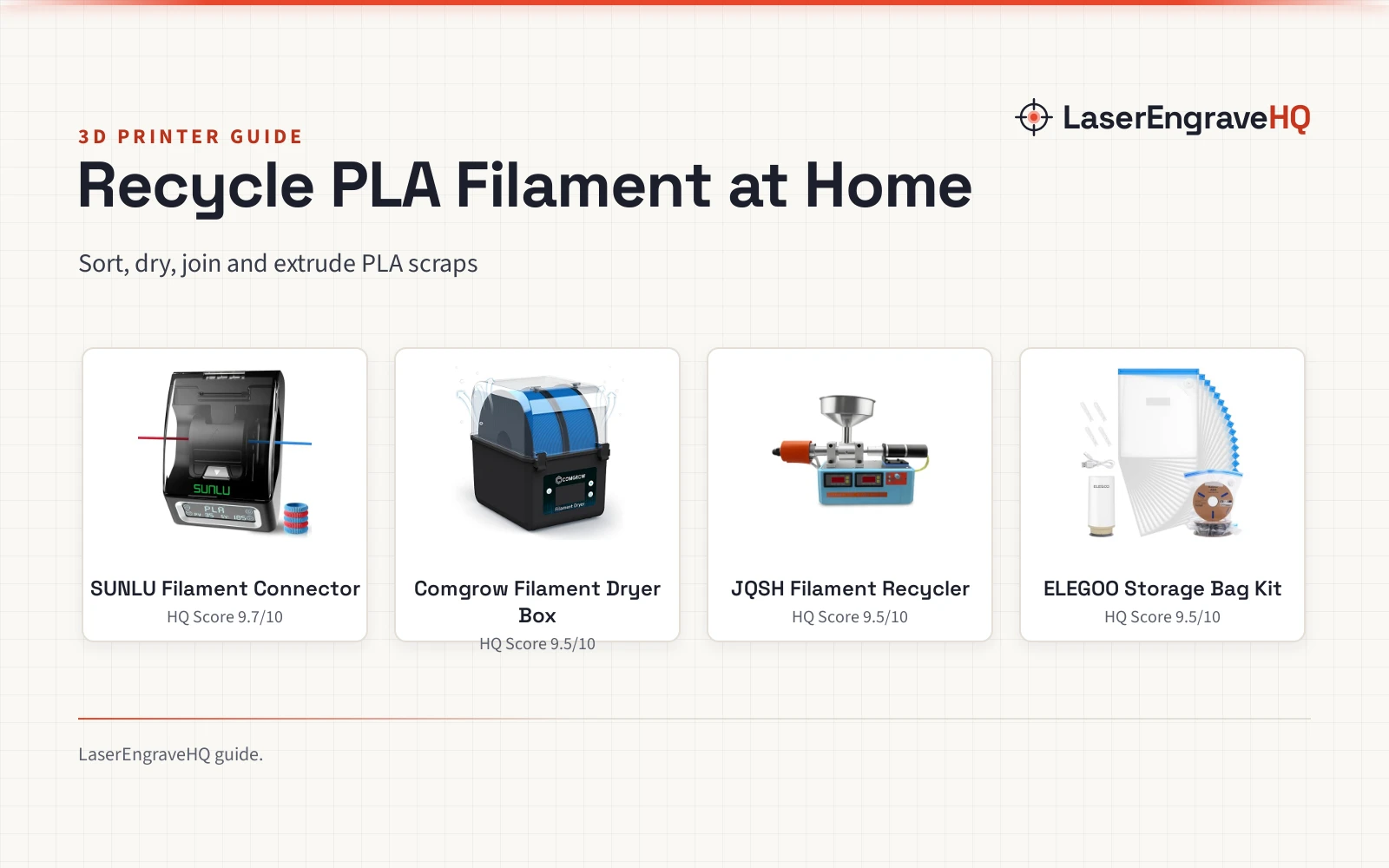
Top picks at a glance
As an Amazon Associate I earn from qualifying purchases.
- 1
 SUNLU Official Filament Connector9.7/10View on Amazon
- 2
 Comgrow Filament Dryer Box for 1.75/2.85mm PLA9.5/10View on Amazon
- 3
 110V Filament Recycler Machine,3D Filament9.5/10View on Amazon
- 4
 ELEGOO 20pcs Filament Storage Bags with Auto Pump9.5/10View on Amazon
How to recycle PLA filament begins with a simple choice: keep clean PLA scraps and failed prints, or send them to waste. The usable material can be dried, joined into longer lengths, or formed into filament again, while damp or mixed material stays out of the printer. This guide shows how, step by step, with the gear that handles sorting, drying, joining and extrusion.
LaserEngraveHQ earns a commission from purchases made through these links, at no extra cost to you. Read our affiliate disclosure.
No listing in this guide states that recycled filament prints like new filament, so treat recycled filament as material for practice prints and simple parts.
SUNLU Official Filament Connector
A connector that fuses short ends of 1.75mm filament and works up to 240°C.
Pros
- Fuses leftover 1.75mm filament of the same material
- Heats to 185°C in about 3 minutes, per the maker
- Maximum 240°C covers PLA, PETG, TPU, ABS, PA and Nylon
- One-click operation with a display screen and viewing window
Cons
- No power adapter included; a 5V 2A adapter is recommended
- Handles 1.75mm filament only, so other diameters do not fit
- Joins filament of the same material only
- Each join uses a PTFE sleeve from the pack of 200
Comgrow Filament Dryer Box for 1.75/2.85mm PLA
A dryer box that holds up to 2 1kg spools and dries at 40°C to 50°C for 6 to 12 hours.
Pros
- Holds up to 2 1kg spools at once
- Dries at 40°C to 50°C for 6 to 12 hours
- Display shows temperature and humidity, per the maker
- Covers PLA, PETG, TPU, ABS and SILK
Cons
- Drying takes 6 to 12 hours
- Internal size of 9.29 x 6.49 x 9.13 inches limits the spools that fit
- Needs work mode confirmed on the display
- Only the listed materials are named
110V Filament Recycler Machine,3D Filament
A 600W, 110V desktop extruder with 1.75mm and 2.3mm nozzles for clean pellets or granules.
Pros
- Forms filament with interchangeable 1.75mm and 2.3mm nozzles
- Front and rear heating zones, the rear typically about 20°C lower
- 120W brushless motor with screw speeds from 0 to 40 RPM
- Handles materials with melting points below 300°C
Cons
- No warranty term is stated
- Needs clean pellets or granules 3mm or smaller
- Machine must reach at least 220°C before the motor starts
- Weighs 12.5 pounds and measures 18.1 inches
ELEGOO 20pcs Filament Storage Bags with Auto Pump
A kit with 20 filament storage bags, a 60 KPa auto pump and 4 sealing clips that keeps spools up to 1kg airtight for over 30 days.
Pros
- 20 bags in the kit, each 13.8 x 12.6 inch
- 60 KPa auto pump with 4 sealing clips in the kit
- 0.21 mm bags stay airtight for over 30 days, per the maker
- Fits spools up to 1kg and 1.75mm, 2.85mm and 3mm filament
Cons
- No warranty term is stated
- Bags suit spools up to 1kg, so larger spools do not fit
- Valve must stay flat during use
- Storage only: bags do not dry filament or join ends
Step 1: Sort PLA scraps and failed prints
Keep PLA separate from other plastics, and keep clean scraps separate from material with dirt, glue or mixed colours. The connector in this guide fuses filament of the same material, so mixed ends stay separate. The PLA vs PETG filament guide shows how the two materials differ, which helps when a print has no label left on the spool.
Step 2: Dry PLA before reuse
Dry PLA before it is joined or extruded. The dryer box in the gear section dries at 40°C to 50°C for 6 to 12 hours, with a display that shows temperature and humidity. After drying, keep the filament sealed: the vacuum bags in the gear section stay airtight for over 30 days, per the maker.
Step 3: Join short ends instead of discarding them
Short ends still have value when they can be joined. The connector in the gear section fuses 1.75mm filament of the same material, heats to 185°C in about 3 minutes, and works up to 240°C. The pack includes a USB cable and 200 PTFE sleeves, while a power adapter is not included and the maker recommends a 5V 2A adapter.
Step 4: Extrude filament from clean pellets
For larger amounts of clean material, an extruder forms filament from pellets or granules. The recycler in the gear section is a 600W machine at 110V with a 120W brushless motor and interchangeable 1.75mm and 2.3mm nozzles. The maker states it suits materials with melting points below 300°C. Feed only clean pellets or granules 3mm or smaller, fed gradually, and let the machine reach at least 220°C before the motor starts.
How to Recycle PLA Filament: Gear That Helps Each Step
Each step above needs a different piece of gear: drying calls for the dryer box, joining calls for the connector, extrusion calls for the recycler, and dry storage calls for the vacuum bags.
Common mistakes to avoid
- Mixing PLA with other plastics before joining or extrusion.
- Skipping the drying step and feeding damp PLA into the printer.
- Feeding dirty or mixed material into an extruder.
- Starting the motor before the machine reaches the stated temperature.
- Leaving dried filament in open air instead of sealing it for storage.
How to recycle PLA filament: the short version
- Sort clean PLA and keep it separate from other plastics.
- Dry the PLA before reuse.
- Join short ends of the same material and diameter.
- Extrude clean pellets or granules into filament.
- Store the finished filament sealed and dry.
FAQ: lasers and CNC
Can PLA filament be recycled at home?
Yes: clean PLA scraps can be dried, short ends can be joined, and clean pellets or granules can be extruded into filament. No listing in this guide states that recycled filament prints like new filament, so use it for practice prints and simple parts.
Can short ends of PLA filament be joined and printed again?
Yes, when the ends are the same material and the same diameter. The SUNLU connector (on Amazon) fuses 1.75mm filament, heats to 185°C in about 3 minutes, and works up to 240°C, with 200 PTFE sleeves in the pack.
Does recycled PLA filament need drying?
Dry PLA before reuse. The Comgrow dryer box (on Amazon) dries at 40°C to 50°C for 6 to 12 hours and holds up to 2 1kg spools, and the maker states dry filament helps reduce tangling, clogging, poor adhesion and layer misalignment.
How should PLA filament be stored after recycling?
Store it sealed and dry. The ELEGOO kit holds 20 bags at 13.8 x 12.6 inch with a 60 KPa auto pump, and the maker states the bags stay airtight for over 30 days. The best filament storage rack guide covers rack storage for spools that stay in use.
Can PLA be mixed with PETG or ABS for recycling?
Keep the materials separate. The connector fuses filament of the same material, and the extruder lists PETG, PLA and ABS as separate materials with melting points below 300°C. Sorting keeps each batch within the maker’s stated procedure.
Related: the best PLA filament for 3D printers, PLA vs PETG filament and best filament storage rack.