Flat End Mill vs Roughing End Mill: Which One Should You Buy?
Flat end mills and roughing end mills compared on cutting geometry, material removal rate, edge quality, tool wear, and machining applications.

On this page
Top picks at a glance
As an Amazon Associate I earn from qualifying purchases.
- 1
 Genmitsu 40pcs End Mills CNC Router Bits9.7/10View on Amazon
- 2
 SPEED TIGER Carbide Square End Mill9.7/10View on Amazon
- 3
 SPEED TIGER INTA Carbide Roughing End Mill9.7/10View on Amazon
- 4
 2pcs End Mill Set 4-Flute CNC Milling Bit 10mm/0.4" CuttingView on Amazon
- 5
 joleully 1/2" Carbide Square End MillView on Amazon
- 6
 Accusize 90 Degree Indexable End MillView on Amazon
- 7
 SpeTool 5PCS 2 Flutes Square Nose End Mill Set Power MillingView on Amazon
- 8
 1/4" Carbide Roughing End MillView on Amazon
- 93/8" Carbide Roughing End MillView on Amazon
When carving parts, cutting decorative sign blanks, or machining metal brackets on a CNC router, choosing the right cutter profile determines material removal speed, tool deflection, and edge quality. In the head-to-head comparison of flat end mill vs roughing end mill, the fundamental difference comes down to surface finish versus bulk stock removal: flat end mills produce smooth floors and straight sidewalls for final passes, while roughing end mills feature serrated chip-breaker teeth that chew through tough stock quickly.
LaserEngraveHQ earns a commission from purchases made through these links, at no extra cost to you. Read our affiliate disclosure.
Verdict: choose a roughing end mill for rapid material removal, heavy pocketing, and deep profiling in tough metals or dense stock where breaking up chips reduces spindle load. Choose a flat end mill for final perimeter cuts, decorative slotting, plastic sheet cutting, and flat-bottom pockets that demand a smooth, ridge-free surface.
Machines on the list


Accusize Industrial Tools 1/2'' Dia
A heavy-duty coarse tooth roughing end mill crafted from M42 8% cobalt with TiAlN coating for deep slotting and rapid stock removal.
Pros
- M42 8% cobalt steel construction provides heat resistance and toughness for aggressive machining
- Coarse tooth 4-flute design with chip breakers reduces cutting loads during heavy stock removal
- Large 1/2 inch cutting diameter and 2 inch flute length handle deep profiling and slotting
- TiAlN coating enhances wear resistance during extensive milling operations
Cons
- Coarse tooth profile leaves corrugated scallops that require a flat end mill finish pass
- Requires a rigid CNC spindle or milling machine with a 1/2 inch collet
- Single-tool pack with no extra replacement bits included
- No warranty term is stated

Accusize Industrial Tools Standard Tooth M42 8%
A versatile 3/8 inch coarse tooth roughing end mill in M42 8% cobalt with TiAlN coating, suited for mid-sized CNC milling spindles.
Pros
- M42 8% cobalt steel with TiAlN coating delivers durability in hard and abrasive materials
- 3/8 inch shank and diameter fit mid-sized desktop CNC routers and benchtop mills
- 4-flute coarse tooth profile with center-cutting end allows plunging and ramping operations
- Breaks chips into small segments for efficient chip clearing in deep slots
Cons
- Roughing serrations leave ridges on sidewalls, unsuitable for final cosmetic surfaces
- Flute length is limited to 3/4 inch compared to longer reach alternatives
- Only 1 bit included in the package
- No warranty term is stated

SpeTool 5Pcs/Set Flat Nose Double Flute Carbide
A precision 5-piece set of miniature 1/32 inch solid tungsten carbide flat end mills with TiAlN coating for fine detail and clean finishing.
Pros
- Ultra-fine 1/32 inch cutting diameter cuts intricate details, micro-slots, and clean edges
- Solid tungsten carbide rated at HRC55 with TiAlN coating for wear resistance
- Includes 5 bits packaged in individual plastic storage boxes
- Flat nose 2-flute design creates smooth floor and wall finishes on metals and wood
Cons
- Delicate 1/32 inch diameter is prone to deflection and snapping under heavy feed pressure
- Short 5/64 inch cutting length limits cuts to very shallow passes
- Spec table contains contradictions, listing a 0.13 inch corner radius and a 2 degree helix angle
- No warranty term is stated

SainSmart Genmitsu 10Pcs Nano Blue Coat Flat Nose
A 10-piece pack of 1/8 inch single-flute spiral upcut flat end mills in tungsten carbide alloy for smooth slotting and cutting in plastics and wood.
Pros
- Single flute spiral upcut geometry evacuates chips rapidly from slots and pockets
- Common 1/8 inch shank fits standard hobby CNC router collets
- Tungsten carbide alloy construction rated for plastics, MDF, and hardwood
- Pack includes 10 router bits for convenient workshop replacements
Cons
- Upcut spiral pulls chips upward, creating potential fuzzing or tear-out on top wood veneers
- Single flute design requires precise feed rates to prevent chatter compared to multi-flute tools
- Listing contains conflicting details, citing 10 bits in the title versus 30 in the spec table and Nano Blue versus TiAlN finish
- No warranty term is stated
Other machines to compare
 2pcs End Mill Set 4-Flute CNC Milling Bit 10mm/0.4" CuttingCheck price on Amazon
 joleully 1/2" Carbide Square End MillCheck price on Amazon
 Accusize 90 Degree Indexable End MillCheck price on Amazon
 SpeTool 5PCS 2 Flutes Square Nose End Mill Set Power MillingCheck price on Amazon
 1/4" Carbide Roughing End MillCheck price on Amazon
- 3/8" Carbide Roughing End MillCheck price on Amazon
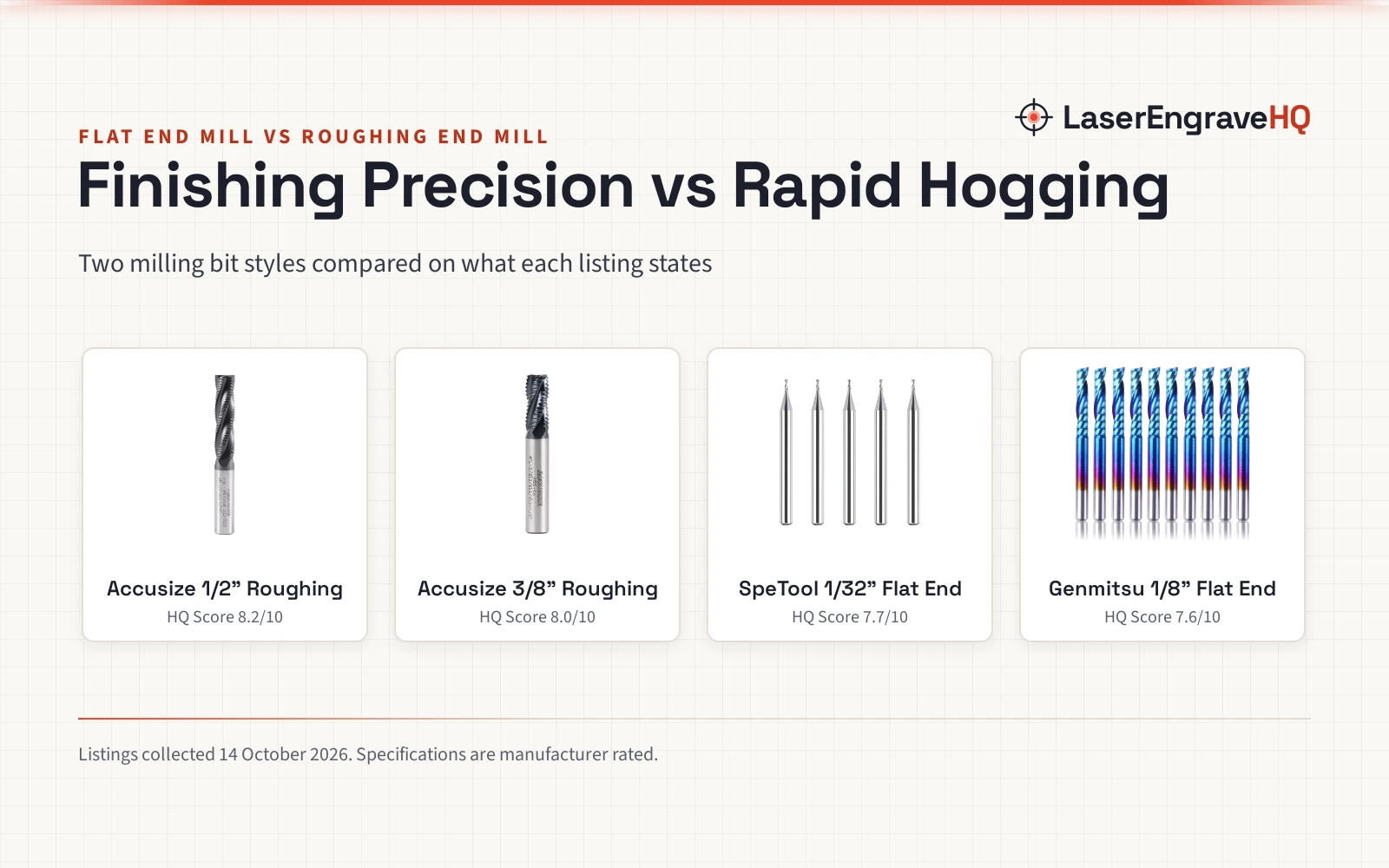
Side by side
| Product | Side | Cutting Diameter | Flutes | Material |
|---|---|---|---|---|
| Accusize 1/2″ Roughing | Roughing end mill | 1/2 in (0.5 in) | 4 flutes | M42 8% cobalt |
| Accusize 3/8″ Roughing | Roughing end mill | 3/8 in (0.38 in) | 4 flutes | M42 8% cobalt |
| SpeTool 1/32″ Flat End | Flat end mill | 1/32 in (0.03 in) | 2 flutes | Tungsten carbide |
| Genmitsu 1/8″ Flat End | Flat end mill | 1/8 in (3.175 mm) | 1 flute | Tungsten carbide alloy |
Specifications are manufacturer rated, as published on each listing and collected 14 October 2026.
Flat End Mill vs Roughing End Mill: Cutting Geometry and Mechanics
The primary difference between a flat end mill and a roughing end mill lies in the profile of the cutting flutes. A flat end mill, represented by the Genmitsu and SpeTool listings, features continuous, straight or spiral cutting edges terminating in a square, flat nose. When the cutter engages the workpiece, the entire edge shears a continuous shaving, leaving a flat floor and smooth vertical walls. In contrast, roughing end mills, illustrated by the 4-flute Accusize examples, feature serrated cutting edges known as chip breakers along their flutes. These serrations divide the cut into smaller, narrower chips rather than wide continuous shavings, reducing cutting resistance.
Material Removal Rates and Roughing Efficiency
When clearing deep pockets or hogging out perimeter profiles, roughing end mills excel at material removal efficiency. The chip breakers reduce the contact area between the cutter and the workpiece at any given instant, substantially lowering cutting resistance and chatter. This design allows operators to push heavier feed rates and deeper axial step-downs without overloading the spindle. While flat end mills can clear pockets, their continuous cutting edges experience higher lateral resistance, increasing deflection risks in deep cuts.
Surface Finish and Edge Cleanliness
Surface quality is where the flat end mill stands unchallenged. Because its cutting edges are uninterrupted, a flat end mill shears walls cleanly and leaves crisp, square transitions between the pocket floor and vertical sidewalls. The SpeTool 1/32″ Flat End example is designed specifically for finish machining and micro-slots where cosmetic surface smoothness is critical. Roughing cutters, however, leave distinct corrugated ridges along vertical surfaces matching the pitch of the serrations. Although the Accusize listings state that their coarse tooth profile often eliminates the need for a finishing cut for profiling and shallow slots, a secondary pass with a flat end mill remains necessary whenever an immaculate finish is desired.
Tool Wear, Heat Dissipation, and Rigidity
Cutting geometry directly affects heat dissipation, while tool material determines hardness and toughness. Geometrically, roughing serrations produce smaller, broken chips that evacuate heat from deep cuts quickly. In terms of construction, the specific listings in this comparison use different tool steels and alloys. The Accusize roughing end mills are made from M42 high-speed steel with 8 percent cobalt and a TiAlN coating, prioritizing shock resistance and toughness under heavy shock loads. In contrast, the SpeTool and Genmitsu flat end mill listings use solid tungsten carbide or carbide alloy, which provides superior hardness and edge retention for fine detailing, though continuous flutes experience greater localized friction in deep cuts.
Collet Compatibility and Shank Sizing
Shank diameter determines whether your spindle or router collet can hold a bit safely. Shank sizing is a specification of individual bits rather than the cutter category, as both flat and roughing end mills are manufactured across many shank diameters. In the listings compared here, the Genmitsu and SpeTool flat end mills use 1/8 inch shanks, matching standard hobby routers and compact collets. Meanwhile, the Accusize roughing end mill listings feature 3/8 inch and 1/2 inch shanks that require larger collets and rigid milling spindles capable of handling heavy radial cutting forces without runout. Always check your machine’s collet capacity and spindle rigidity before selecting either bit style.
Choose a flat end mill if
- You need a flat, smooth bottom floor across pockets and shallow slots.
- You are machining final perimeter passes, clean vertical edges, or flat-bottom pocket details.
- You work with plastics such as acrylic, nylon, or ABS where smooth flutes eject chips cleanly without snagging.
- You are performing a finishing pass to clean away roughing scallops and reach final dimensions.
Choose a roughing end mill if
- You need to remove large volumes of metal or dense hardwood in bulk clearing cycles.
- You want serrated chip breakers that divide chips into smaller segments to reduce spindle load and cutting resistance.
- You want to minimize chatter and tool deflection during deep slotting or aggressive profiling.
- You plan to follow with a secondary finishing pass to clean up corrugated sidewall ridges.
Always secure workpieces firmly with clamps, wear eye and hearing protection during milling operations, and never touch rotating end mills or clear chips while the spindle is running.
Project Match
- Plastic and wood sheet routing: the Genmitsu 1/8″ Flat End is matched for nylon, resin, ABS, acrylic, PVC, MDF, and hardwood, with a 17 mm cutting length and 38 mm overall reach. Work area is not stated beyond bit dimensions.
- Intricate mold making and metal engraving: the SpeTool 1/32″ Flat End is matched for carbon steel, mould steel, inconel, stainless steel, titanium alloy, die steel, tool steel, cast iron, and wood, with a 5/64 inch cutting length. Work area is not stated beyond bit dimensions.
- Mid-scale slotting and metal profiling: the Accusize 3/8″ Roughing is matched for hard and abrasive materials requiring rapid stock removal, with a 3/4 inch flute length and 2-1/2 inch overall reach. Work area is not stated.
- Heavy bulk machining and deep slotting: the Accusize 1/2″ Roughing is matched for difficult-to-cut metals and aggressive machining tasks, with a 2 inch flute length and 4 inch overall reach. Work area is not stated.
FAQ: lasers and CNC
Can a roughing end mill replace a flat end mill for finishing?
The Accusize listings state that their coarse tooth profile produces a smooth finish that often eliminates the need for a finishing cut for profiling and shallow slots. In practice, roughing serrations leave subtle scallop ridges along cut walls, so critical cosmetic edges and mirror-flat floors still require a flat end mill pass.
Why do roughing end mills generate lower cutting resistance?
Roughing end mills feature serrated cutting edges known as chip-breaker teeth. These notches divide the cut into smaller individual chips, reducing cutting contact area, vibration, and heat buildup during heavy passes.
Can a flat end mill handle bulk roughing passes?
A flat end mill can remove bulk stock, but continuous cutting edges encounter higher cutting resistance, greater tool deflection, and heavier heat buildup in deep slots compared to roughing bits with serrated chip breakers.
Which bit style is better suited for acrylic and plastics?
Flat end mills, especially single-flute spiral upcut designs like the Genmitsu listing, are better suited for plastics. Their open flute space evacuates chips quickly without friction melting, whereas roughing serrations can snag or create rough burrs in soft plastics.
Do CNC workshops need both flat and roughing end mills?
Makers cutting dense hardwoods and metals benefit from using both: a roughing end mill hogs away material quickly with minimal tool wear, followed by a flat end mill that cleans walls and floors to precise tolerances.
Related: CNC bits explained for beginners, carbide vs high speed steel end mill, two flute vs four flute end mill, and ball nose vs flat end mill.