Center Drill Size: Chart, Angles and Uses
A plain chart of center drill sizes, from #1 to #5 and 1.0 to 6.0 metric, with the 60 degree angle and how to pick a size for lathe work.

On this page
Top picks at a glance
As an Amazon Associate I earn from qualifying purchases.
- 1
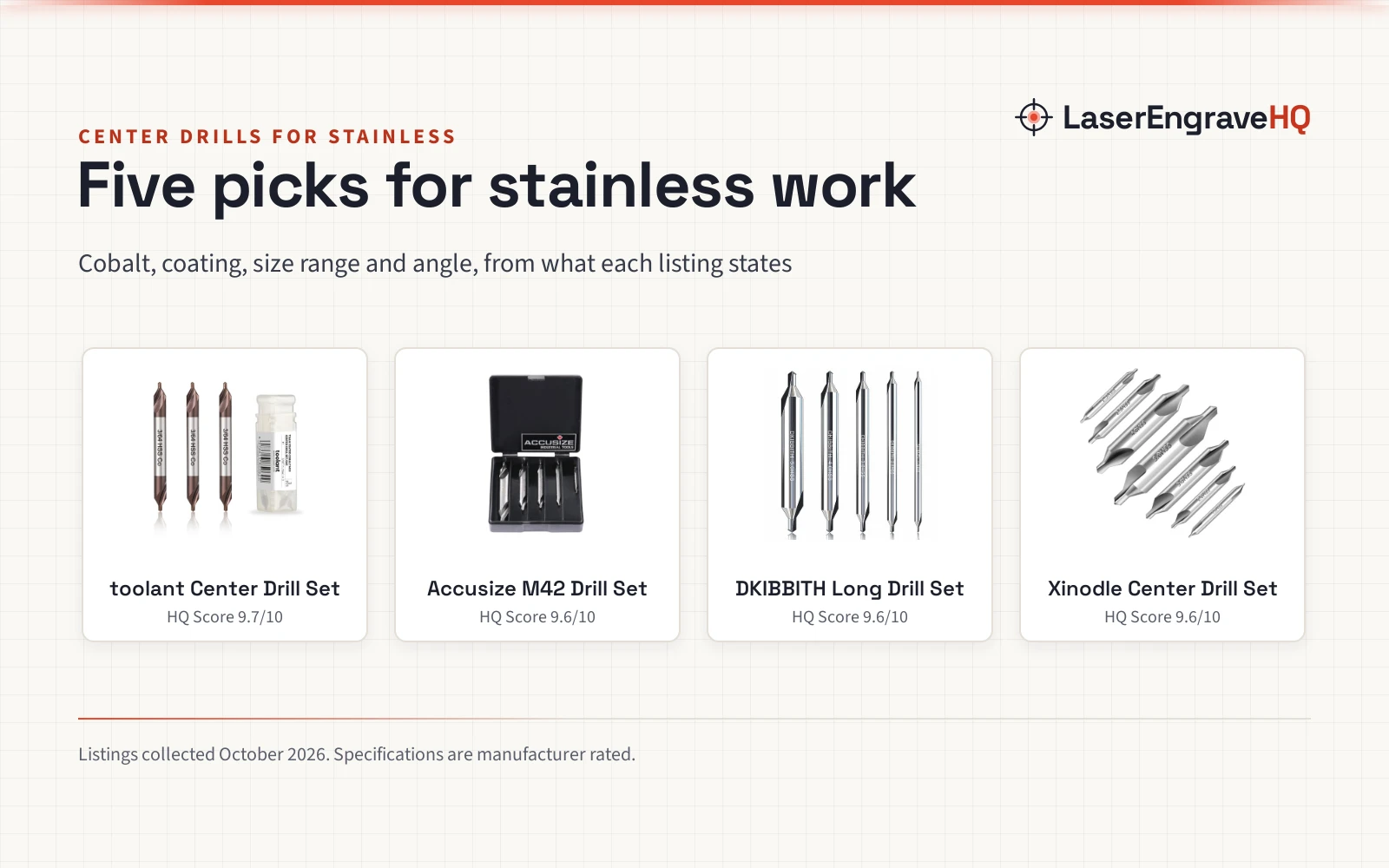
 toolant Center Drill Bit Set9.7/10View on Amazon
- 2
 Accusize Center Drill Set9.6/10View on Amazon
- 3
 DKIBBITH 5pc Long Center Drill Bit Set9.6/10View on Amazon
A center drill starts the hole that a lathe center or a twist drill follows, and center drill size is the number stamped on the bit. In the toolant set that number runs #1 to #5, and each number fixes the pilot diameter: #1 cuts a 3/64 inch pilot, #2 a 5/64 inch pilot, #3 a 7/64 inch pilot, #4 a 1/8 inch pilot and #5 a 3/16 inch pilot. The sections below walk through the chart, the angle, the material and how to pick a size for the work in front of you.
LaserEngraveHQ earns a commission from purchases made through these links, at no extra cost to you. Read our affiliate disclosure.
Center drill sizes are not the same across every maker. The figures in this guide come from the listings cited, so check the size chart on the listing you buy from before you order.
Step 1: Read the size number
A center drill carries a size number, and that number is the size. The toolant inch set uses #1 to #5, and metric sets list sizes as 1.0, 1.5, 2.0, 2.5, 3.0, 4.0 and 5.0, with the SeonFook set adding 6.0. The number does not describe the shank or the overall length; it describes the small pilot tip that starts the hole. When the toolant listing says #1 to #5, it means the set covers the 5 most commonly used inch sizes, and it lists them as #1 3/64 inch, #2 5/64 inch, #3 7/64 inch, #4 1/8 inch and #5 3/16 inch.
The same number can still differ between makers, so read the pilot diameter next to the number, not the number alone. A #5 in the toolant set cuts a 3/16 inch pilot, and the HHIP set runs #1 to #4, so it has no #5 at all. If the listing gives no pilot diameter, the number alone tells you little.
Step 2: Read the size chart
The chart below gathers the figures the listings state. Use it to match a size number to a pilot diameter before you order, and check the listing for the same row.
| Size number | Pilot diameter |
|---|---|
| #1 | 3/64 inch |
| #2 | 5/64 inch |
| #3 | 7/64 inch |
| #4 | 1/8 inch |
| #5 | 3/16 inch |
| 1.0 to 6.0 | 1.0 to 6.0 mm |
The inch rows come from the toolant set, which lists #1 3/64 inch through #5 3/16 inch, and the HHIP set covers #1 to #4. The metric row covers the Aleric set at 1.0 to 5.0 and the SeonFook set at 1.0 to 6.0. When a set lists a size you do not recognize, look for the pilot diameter in the listing before you match it to your work.
Step 3: Match the size to the work
Pick the size from the work, not from the set. The toolant listing states its bits suit materials with diameters of 3/16 inch (5 mm) to 5 inches (130 mm), so check the diameter of the work in front of you against the range the listing states. A small pilot starts a small center hole, and a large pilot starts a large center hole, and the center hole must fit the lathe center that follows it. When the listing gives no work range, pick from the sizes the set lists and check the pilot diameter against the center you plan to use.
Sets cover the choice for you when the work varies. The toolant set holds 6 pieces across 5 sizes, with the #1 size listed twice, so a worn #1 has a spare in the case. The HHIP set holds 4 pieces across #1 to #4. For metric work, the Aleric set holds 7 pieces from 1.0 to 5.0 and the SeonFook set holds 8 pieces from 1.0 to 6.0.
Step 4: Check the angle
A center drill has a countersink angle. The HHIP listing states a 60 degree countersink angle that fits all standard centers, and the Aleric and SeonFook listings state a 60 degree tip angle for the centering hole and countersink. Read the angle on the listing before you buy, because the angle decides whether the bit seats against a standard center.
The toolant set lists a 118 degree split point instead, which the listing says prevents walking and makes drilling precise. The split point is the tip shape, not the countersink angle, so read both figures where the listing gives both. When a listing states neither figure, the angle is not stated, and the listing gives you nothing to check against your centers.
Step 5: Check the material and coating
The center drills here come in high speed steel, and the toolant set uses M35 cobalt high speed steel with 5% cobalt and a TiAlN coating, which the listing says makes the bit harder and more wear resistant. The HHIP set is high speed steel, and the SeonFook set is high speed steel as well. Match the bit material to the work material: the listings name stainless steel, carbon steel, alloy steel, cast iron, copper, aluminum, wood and brass, and SeonFook states a hardness range of 170HB to 200HB for the work it suits. For cutting fluid, see the best aluminum cutting fluid and best metal tapping fluid guides.
Step 6: Check the set, the case and the warranty
Count the pieces and the sizes before you order. The toolant set holds 6 pieces in 5 sizes, the HHIP set holds 4 pieces in #1 to #4, the Aleric set holds 7 pieces from 1.0 to 5.0, and the SeonFook set holds 8 pieces from 1.0 to 6.0. Both the toolant set and the Aleric set come with a storage case, which keeps the small bits together between jobs.
Warranty terms differ. The toolant set lists a 90 day warranty with a refund or replacement, and the Aleric set offers a refund or replacement after 45 days. The HHIP and SeonFook listings state no warranty term. Read the term on the listing you buy from, and keep the case so the bits stay sharp and sorted.
Common mistakes to avoid
- Reading the size number without the pilot diameter next to it.
- Assuming every #5 is 3/16 inch across every maker.
- Skipping the angle check against the center you plan to use.
- Ordering a set that stops at #4 when the work needs a #5.
- Storing loose bits without a case, so the small sizes go missing.
Center drill size: the short version
- Read the size number, #1 to #5 in the toolant set or 1.0 to 6.0 in the SeonFook set.
- Match the number to the pilot diameter in the chart.
- Pick the size from the work diameter the listing states.
- Check the angle the listing states against your centers.
- Check the material, the coating and the warranty term.
FAQ: lasers and CNC
What size is a #5 center drill?
A #5 center drill cuts a 3/16 inch pilot, as the toolant set lists it. Other makers may list a different pilot for #5, so check the chart on the listing you buy from.
What is the angle on a center drill?
The HHIP, Aleric and SeonFook listings state a 60 degree countersink angle, which the HHIP listing says fits all standard centers. The toolant set instead lists a 118 degree split point, which is the tip shape, not the countersink angle.
What sizes come in a center drill set?
It depends on the set. The toolant set holds 6 pieces in 5 sizes from #1 to #5, the HHIP set holds 4 pieces from #1 to #4, and the metric sets run 1.0 to 5.0 in 7 pieces and 1.0 to 6.0 in 8 pieces.
What materials can a center drill cut?
The listings name stainless steel, carbon steel, alloy steel, cast iron, copper, aluminum, wood and brass. SeonFook states a hardness range of 170HB to 200HB for the work its bits suit.
How do I pick a center drill size for my work?
Check the work diameter against the range the listing states: the toolant listing states 3/16 inch (5 mm) to 5 inches (130 mm). Pick a size from a set that covers that range, and read the pilot diameter next to the size number.
Related: the CNC tooling hub, drill bit types chart, Q drill bit size and best countersink drill bit with depth stop.