Cast vs Extruded Acrylic for Laser Cutting: Complete Workshop Guide
A practical guide comparing cast and extruded acrylic for laser cutting: understand melting behavior, frosted engraving contrast, tolerances and safety.

On this page
Top picks at a glance
As an Amazon Associate I earn from qualifying purchases.
- 1
 Pack of 10 Clear Cast Acrylic Sheet 8" x 10" x 1/8" Thick9.6/10View on Amazon
- 2
 Pack of 10 Clear Cast Acrylic Sheet 12" x 16" x 1/8" Thick9.6/10View on Amazon
- 3
 KAITELA Pack of 10 Clear Cast Acrylic Sheet 12" x 12" x 1/8"9.6/10View on Amazon
- 4
 KINLINK 12x12 3mm 1/8" Clear Cast Acrylic Sheets PlasticView on Amazon
- 5
 Duco 1/4" Clear Cast Acrylic SheetView on Amazon
- 6
 Colored Cast Acrylic SheetsView on Amazon
- 7
 KAITELA Pack of 10 Colored Cast Acrylic Sheet 12" x 12" xView on Amazon
- 8
 TOEPODO 2 Pack 1/8 Fluorescent Neon Cast Acrylic SheetsView on Amazon
- 9
 Duco 1/8" Clear Cast Acrylic SheetView on Amazon
Cast vs extruded acrylic for laser cutting comes down to whether your project requires frosted engraving contrast or strict thickness uniformity for interlocking parts. Cast acrylic excels at laser engraving because the beam creates a crisp, frosted white mark, cutting cleanly with minimal melting and no gummy edge recast. In contrast, extruded acrylic provides superior sheet thickness consistency for slotted joinery and cuts efficiently with flame-polished edges, though it engraves with poor, clear-to-grey contrast. The sections below compare these materials step by step.
Other machines to compare
 KINLINK 12x12 3mm 1/8" Clear Cast Acrylic Sheets PlasticCheck price on Amazon
 Duco 1/4" Clear Cast Acrylic SheetCheck price on Amazon
 Colored Cast Acrylic SheetsCheck price on Amazon
 KAITELA Pack of 10 Colored Cast Acrylic Sheet 12" x 12" xCheck price on Amazon
 TOEPODO 2 Pack 1/8 Fluorescent Neon Cast Acrylic SheetsCheck price on Amazon
 Duco 1/8" Clear Cast Acrylic SheetCheck price on Amazon
LaserEngraveHQ earns a commission from purchases made through these links, at no extra cost to you. Read our affiliate disclosure.
Cast and extruded acrylic share the same chemical family, but their molecular structures react differently to laser heat. Always evaluate edge quality and engraving clarity on scrap material before running full project jobs.
Step 1: Understand how cast and extruded manufacturing shapes laser results
Both materials are polymethyl methacrylate, but their production methods create distinct molecular weights. Cell cast acrylic is made by pouring liquid monomer between glass plates, yielding long polymer chains and high molecular weight. Extruded acrylic is manufactured by melting pellets through roller dies, resulting in shorter chains, lower molecular weight, and directional stress.
Because cast acrylic has a higher molecular weight, it depolymerizes and vaporizes cleanly under laser heat with minimal liquid pooling, creating crisp corners. In contrast, extruded acrylic has a lower melting threshold, causing it to soften along the kerf before vaporizing. Manufacturer listings confirm these behaviors: Duco Plastics & Supply notes that cast acrylic delivers clean edges with minimal melting compared to extruded sheets, while KINLINK notes that its cast panels produce clean cuts without scorching or melting during engraving.
Step 2: Compare cutting speed, edge quality and melting behavior
For vector cuts, extruded acrylic melts easily, producing a glossy, flame-polished edge directly from the laser bed. However, if the laser moves too slowly, excess heat widens the kerf, produces gummy slag, or welds parts back together. For techniques on managing heat accumulation, see our guide on how to laser cut acrylic without melting edges.
Cast acrylic cuts cleanly with square, sharp edges and minimal liquid pooling, preventing parts from welding back into the sheet. For heavy-duty fabrication, Duco Plastics & Supply lists clear cast acrylic panels in 1/4 inch (6mm, or 0.25 inches) thickness, measuring 12 x 12 inches and 8 x 12 inches with a stated cut tolerance of ±1/8 inch. For standard decorative work, KINLINK supplies 12 x 12 inches clear cast sheets at 3mm (0.13 inches) thickness in a 4 Pack.
Step 3: Compare engraving contrast and surface frosting
For raster engraving, cast acrylic is the superior stock. The beam vaporizes microscopic pockets of material, leaving an opaque, frosty white finish ideal for edge-lit signs, awards, and desk plaques. Extruded acrylic melts into a shallow, smooth depression that lacks microscopic texture, producing a dull, greyish mark that fails to scatter light.
In our collection of acrylic sheets for laser engraving, cast options dominate. Adrattnay provides opaque cast panels in 20 colors measuring 8 x 8 inches at 3mm (1/8 inch) thickness, as well as 10 colors in 12 x 12 inches sheets. Geetery lists 30 Pack bundles of 3mm (1/8 inch) cast sheets in 6 x 6 inches and 12 x 8 inches formats. Where complete opacity is needed, YMYKLB lists 12 x 12 inches cast sheets at 3mm (0.12 inches) thickness featuring 0% light transmittance for colored panels.
Step 4: Account for sheet thickness tolerances and joint design
Extruded acrylic holds an advantage in thickness consistency because it passes through precision steel rollers. This uniform thickness makes extruded acrylic ideal for interlocking assemblies, slotted box joints, and multi-layer dimensional signs where tabs must slide snugly into matching slots.
Cast acrylic exhibits natural thickness variation across a single panel because liquid monomer polymerizes between glass plates. For comparison with natural sheet goods that share thickness variations, review our guide to the best plywood for laser cutting. When working with cast stock from our engraving materials directory, design joints with generous clearances rather than rigid friction fits. Furthermore, extruded acrylic retains internal stress from roller extrusion, making it prone to stress crazing when cleaned with alcohol or solvents, whereas cast acrylic remains chemically stable.
Step 5: Select proper surface masking and bed support
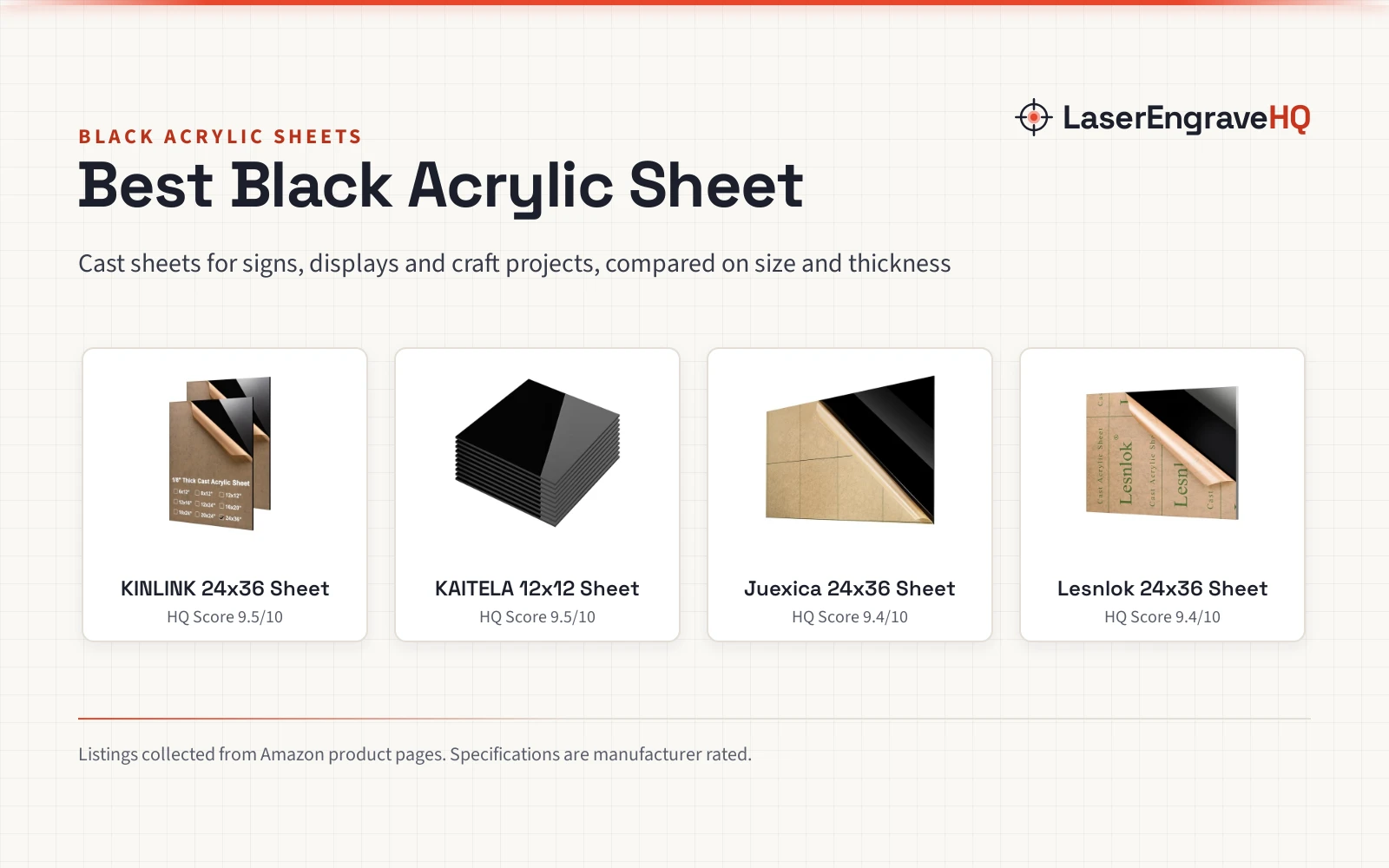
Surface protection preserves acrylic during laser work. Maker listings, including KINLINK, Duco Plastics & Supply, Adrattnay, Geetery, KAITELA, and Ailaimiya, feature protective paper masking on both sides of each panel. Ailaimiya supplies a 12 Piece pack of 12 x 12 inches cast panels at 3mm (0.12 inches) thickness with double-sided kraft paper. Paper masking protects against scratches, smoke residue, and honeycomb back-reflection. Keep masking adhered during vector cuts, evaluating whether to peel it for engraving.
Machine selection must align with optical properties. CO2 lasers emit an infrared wavelength absorbed by clear and colored acrylic, making CO2 systems the primary choice. Review machines in our guide to the best CO2 laser cutter for home use. KAITELA supplies opaque cast sheets in a 10 Pack of 12 x 12 inches panels at 3mm (0.12 inches) nominal thickness, noting CO2 compatibility, and Adrattnay similarly suggests using a CO2 laser rather than a diode for cutting. In contrast, visible diode lasers pass through clear acrylic, meaning diode units can only process select dark, opaque sheets.
Step 6: Set up workshop ventilation and fire prevention
When acrylic vaporizes, it generates methyl methacrylate vapors that irritate eyes and airways. Unfiltered fumes must never accumulate indoors. Route exhaust gases outdoors using dedicated ducting, or pass effluent through a filtration unit equipped with HEPA and activated carbon filters. For filtration setups, consult our guide to the best fume extractor for laser cutting, following OSHA ventilation guidelines.
Fire prevention is critical because acrylic is combustible. If the beam pauses or air assist drops, acrylic can ignite. Never leave a running laser unattended while processing acrylic. Keep a fire extinguisher within reach, and review emergency procedures on what to do if your laser engraver catches fire. Always wear eye protection with certified optical density and wavelength ratings matching your laser, as explained in our laser safety glasses guide.
Verify that your material is authentic acrylic. Some listings include misleading terms; for instance, KINLINK and YMYKLB include terms like polycarbonate or plexipolycarbonate in descriptive text. Polycarbonate, polyvinyl chloride (PVC), vinyl, and acrylonitrile butadiene styrene (ABS) must never be cut with a laser due to toxic fumes and corrosive acid release. For details, see our guide to materials you should never laser cut.
Common mistakes to avoid
- Attempting frosted raster engraving on extruded acrylic, which creates a faint, melted mark.
- Designing rigid tabs and slots in cast acrylic without measuring sheet thickness variations.
- Attempting to cut clear acrylic with a visible diode laser, which transmits through the sheet without cutting.
- Wiping freshly cut extruded acrylic edges with alcohol or solvents, triggering stress crazing.
- Leaving an operating laser unattended during acrylic cutting, risking flame ignition.
Cast vs extruded acrylic for laser cutting: the short version
- Choose cast acrylic for frosted raster engraving, edge-lit signage, and clean cuts with minimal gummy recast.
- Choose extruded acrylic for vector cutouts requiring strict sheet thickness consistency for interlocking joints.
- Confirm that sheet stock is genuine polymethyl methacrylate rather than prohibited plastics like PVC or polycarbonate.
- Leave protective paper masking on during cutting to prevent smoke condensation and bed flashback blemishes.
- Match your laser to the material, using CO2 for clear sheets and reserving diode lasers for dark opaque colors.
- Run active exhaust ventilation for vapors and keep a fire extinguisher within immediate reach.
FAQ: lasers and CNC
Which acrylic is better for laser cutting, cast or extruded?
Neither is universally superior; the choice depends on the project. Cast acrylic is ideal for frosted engraving and cuts with minimal recast, while extruded acrylic provides uniform thickness for interlocking joints.
Why does cast acrylic engrave white while extruded acrylic does not?
Cast acrylic depolymerizes and vaporizes under the beam, leaving textured pits that scatter light to produce a bright white finish. Extruded acrylic melts into a smooth groove that lacks contrast.
Can you cut clear acrylic with a diode laser?
Standard diode lasers emit blue light that transmits through clear acrylic without absorption. Cutting clear sheets requires a CO2 laser cutter; diode lasers can only process select dark, opaque sheets.
Why do laser-cut acrylic edges crack when cleaned with alcohol?
Laser cutting introduces localized thermal stress. When cut edges contact solvents or alcohol, tension releases through micro-cracking, known as crazing. Extruded acrylic is especially vulnerable due to residual extrusion stress.
Is extruded acrylic cheaper than cast acrylic?
Extruded acrylic typically costs less because continuous extrusion is rapid and automated. Cast acrylic requires labor-intensive batch processing between individual glass plates, resulting in a higher retail price point.
How do you tell whether an acrylic sheet is cast or extruded?
Check the label or run a shallow engraving mark on scrap stock. Cast acrylic produces a crisp white frosted mark, whereas extruded acrylic creates a clear, melted groove with gummy burrs.
Related: explore our engraving materials hub, compare sheet stock in our best acrylic sheet roundup, and review laser-ready blanks in our guide to acrylic sheets for laser engraving. For wood alternatives, see our guide to the best plywood for laser cutting.