Best Surfacing Bit for Epoxy Tables (2026)
Five surfacing router bits for flattening epoxy tables compared on cut diameter, insert versus brazed cutters, shank size, RPM limits and each listing's contradictions.

On this page
Top picks at a glance
As an Amazon Associate I earn from qualifying purchases.
- 1
 Best OverallBINSTAK Insert Bit9.6/10View on Amazon
- 2
 Widest CutSICWOOD 2-3/8 in Bit9.5/10View on Amazon
- 3
 Premium PickFreud 16-1089.5/10View on Amazon
- 4
 Best Value PackGenmitsu RB03A 3-Pack9.4/10View on Amazon
- 5
 Whiteside 6220View on Amazon
- 6
 SpeTool CNC Spoilboard Surfacing Router Bit 1/2 Shank 2 InchView on Amazon
- 7
 CNC Spoilboard Surfacing Router Bit 1/4 Inch ShankView on Amazon
- 8
 CNC Spoilboard Surfacing Router BitView on Amazon
- 9
 CNC Spoilboard Surfacing Router Bit 1/4" ShanView on Amazon
An epoxy river table starts as a slab with character and a pour full of promise, and the moment of truth comes when you flatten it. The best surfacing bit for epoxy tables is a wide-diameter router bit that cuts wood and hardened resin cleanly without chipping the epoxy edge. This guide compares five surfacing bits on cut diameter, cutter design, shank size and RPM limits, scored from what each listing states.
LaserEngraveHQ earns a commission from purchases made through these links, at no extra cost to you. Read our affiliate disclosure.
Quick picks
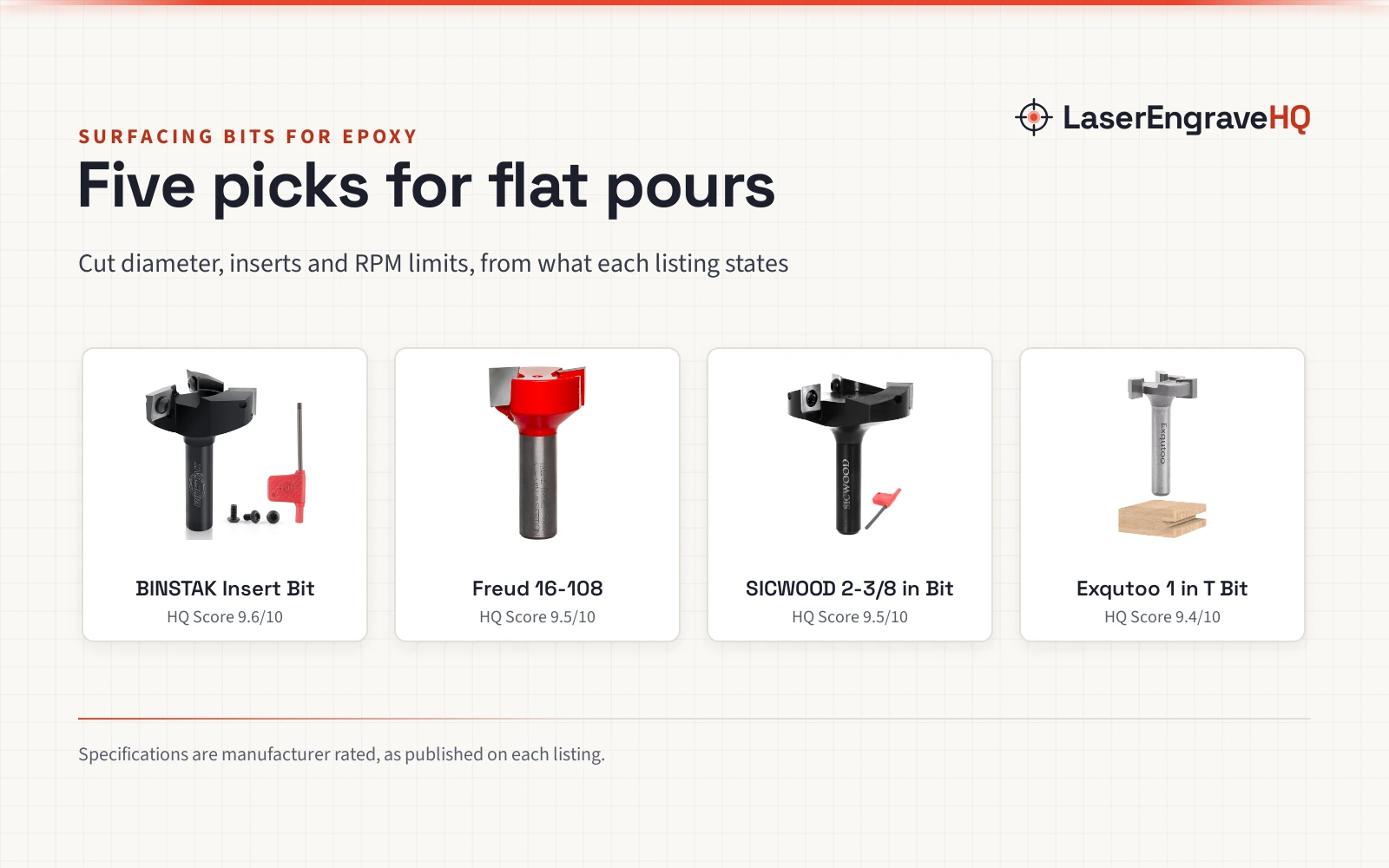
- Best Overall BINSTAK Insert Bit: 2 in cut, 3-wing insert carbide, 4-sided inserts, anti-kickback, 16000 rpm max. Check price on Amazon
- Widest Cut SICWOOD 2-3/8 in Bit: 2-3/8 in cut diameter with replaceable C2 inserts, max 16000 rpm. Check price on Amazon
- Premium Pick Freud 16-108: Freud Perma-SHIELD, anti-kickback, balanced over 22,000 rpm, chemical resistant. Check price on Amazon
- Best Value Pack Genmitsu RB03A 3-Pack: Three 3-flute bits plus 1/2 to 1/4 in collets for slab and spoilboard work. Check price on Amazon
Machines on the list
CNC Spoilboard Surfacing Router Bit
A 1/2 in shank, 2 in cut diameter 3-wing insert carbide surfacing bit, max 16000 rpm, with anti-kickback design.
Pros
- 2 in cutting diameter with three wings for wide surfacing passes
- 4-sided carbide inserts: rotate to a fresh edge instead of replacing the bit
- Anti-kickback design on a steel body, max 16000 rpm stated
- Listed for soft and hard woods, MDF, plywood, laminate and acrylic
Cons
- No warranty term stated
- 2 in cut is narrower than the 2-3/8 in SICWOOD
- Inserts rotate with a screwdriver; spare inserts not listed
- No feed rate guidance in the listing

Freud 16-108: 1-1/4" (dia.)
A 1-1/4 in diameter spoilboard surfacing and mortising bit with 1/2 in shank, 2 cutters and Perma-SHIELD coating.
Pros
- Perma-SHIELD coating and titanium-ground carbide for long life
- Anti-kickback design, computer balanced for speeds over 22,000 rpm
- Down shear design for clean top surfaces; deep gullets for chip removal
- Impervious to chemical attack, per the listing: suits resin work
Cons
- No concrete warranty term; Freud Limited Tooling Warranty has no term stated
- 1-1/4 in diameter is the narrowest full-size cut here
- 1/2 in carbide height limits depth per pass
- Listing gives no maximum RPM figure, only the balance rating
Slab Flattening Router Bits 1/2 Shank
A 1/2 in shank, 2-3/8 in cut diameter insert carbide slab flattening bit, max 16000 rpm.
Pros
- Widest cut here at 2-3/8 in for fewer passes on slabs
- Replaceable C2 carbide inserts, 12x12x1.5mm
- Tungsten steel body; max 16000 rpm stated
- Listed for live-edge slabs and architectural panels
Cons
- No warranty term stated
- No anti-kickback or safety feature stated
- Not for metal or non-wood materials, per the listing
- Spec table lists a single flute

Exqutoo 1/4" Shank 1 inch Cutting Diameter T Shape
A 1/4 in shank, 1 in cutting diameter T-shape bottom cleaning bit with C3 carbide, 2 flutes.
Pros
- T-shape bottom cleaning geometry for flat surfacing
- C3 micro-grain carbide with anti-kickback design
- Spindle speed 18000-24000 rpm and feed 5-8 m/min stated
- 1/4 in shank fits handheld and table-mounted routers, per the listing
Cons
- No warranty term stated
- 1 in cut diameter is the narrowest here: more passes on wide slabs
- Cutting depth contradiction: bullets say 1/4 in, spec table says 1.45 in cutting length
- Not for ferrous metal or non-wood materials, per the listing
Genmitsu 3pcs 3-Flute CNC Spoilboard Surfacing
A 3-pack of 3-flute 1/4 in shank surfacing bits, 0.94 in cut diameter, with 1/2 to 1/4 in collets.
Pros
- Three bits in the pack with 1/2 to 1/4 in collets included
- 3-flute design for surfacing, per the title
- Tungsten carbide steel alloy; 0.94 in cut diameter
- Listed for slab flattening, spoilboards, trimming and slotting
Cons
- No warranty term stated
- Flute contradiction: title says 3-flute, spec table says 1
- Quantity contradiction: spec table says 5, listing is a 3-count
- No anti-kickback or safety feature stated
Other machines to compare
 Whiteside 6220Check price on Amazon
 SpeTool CNC Spoilboard Surfacing Router Bit 1/2 Shank 2 InchCheck price on Amazon
 CNC Spoilboard Surfacing Router Bit 1/4 Inch ShankCheck price on Amazon
 CNC Spoilboard Surfacing Router BitCheck price on Amazon
 CNC Spoilboard Surfacing Router Bit 1/4" ShanCheck price on Amazon
Specs compared
| Model | HQ Score | Cutting diameter | Shank | Cutters | Max RPM | Anti-kickback | Warranty |
|---|---|---|---|---|---|---|---|
| BINSTAK Insert Bit | 9.6/10 | 2 in | 1/2 in | 3-wing insert carbide | 16000 | Yes | Not stated |
| Freud 16-108 | 9.5/10 | 1-1/4 in | 1/2 in | 2 brazed | Over 22,000 | Yes | Not stated |
| SICWOOD 2-3/8 in Bit | 9.5/10 | 2-3/8 in | 1/2 in | Insert carbide | 16000 | Not stated | Not stated |
| Exqutoo 1 in T Bit | 9.4/10 | 1 in | 1/4 in | 2 brazed | 18000-24000 | Yes | Not stated |
| Genmitsu RB03A 3-Pack | 9.4/10 | 0.94 in | 1/4 in | 3-flute (title) | Not stated | Not stated | Not stated |
Specifications are manufacturer rated, as published on each listing and collected 18 October 2026.
Best Surfacing Bit for Epoxy Tables: What to Look For
Cut diameter sets your pass count
A wider bit covers more slab per pass. Here the range runs from 0.94 in to 2-3/8 in. Wider is faster, but a wide bit in a small router is a mismatch: the 2 in and 2-3/8 in bits use 1/2 in shanks for a reason.
Insert cutters versus brazed
Insert bits, like the BINSTAK and SICWOOD, let you rotate or swap carbide inserts when an edge dulls; the listings sell this as the cost-effective route. Brazed bits, like the Freud, Exqutoo and Genmitsu, have fixed cutters that cannot be rotated. For epoxy, which turns abrasive as it hardens, a fresh edge matters more than the cutter style. See carbide vs HSS router bits for the material behind the edge.
Shank size and router fit
1/2 in shank bits suit full-size routers and CNC spindles; 1/4 in shank bits fit compact routers. Match the shank to your collet: the Genmitsu 3-pack includes 1/2 to 1/4 in collets. Our best spoilboard surfacing bit for desktop CNC guide covers the smaller-machine end of this same job.
Respect the RPM limit
The BINSTAK and SICWOOD list 16000 rpm max, the Exqutoo lists 18000-24000 rpm, and the Freud is balanced for speeds over 22,000 rpm. Never exceed the listing’s figure. A big-diameter bit run too fast is where vibration and chatter start.
Epoxy-specific notes
Hardened epoxy cuts like a hard plastic: sharp cutters, light passes, dust extraction. The Freud listing claims imperviousness to chemical attack, which suits resin work. None of the listings names epoxy outright, so treat resin compatibility as workshop practice rather than a listed spec.
Surfacing bits are wide, heavy cutters. Never exceed the max RPM on the listing, clamp the slab so it cannot shift, and keep hands clear of the cut path. Wear eye and hearing protection and extract the dust; epoxy and MDF dust do not belong in lungs. Unplug the router for bit changes. See clamping ideas on a CNC router for workholding that holds.
Cutter Count, Bit Weight and Depth of Cut
Diameter and shank get the attention, but three more listing figures decide how the bit behaves on an epoxy table: how many cutters it carries, how much it weighs, and how deep each pass can go.
Flute count and finish quality
More cutting edges per revolution generally leave a smoother surface. The BINSTAK lists 3 flutes on its 3-wing insert head, the Freud lists 2 cutters and the Exqutoo lists 2 flutes, while the SICWOOD and Genmitsu spec tables each list 1 flute. The Freud adds a down shear design the listing says gives clean top surfaces, plus deep center gullets for fast chip removal. On epoxy, where every pass shows, that chip evacuation matters: packed dust re-cuts and heats the resin.
Bit weight and router strength
Surfacing bits are heavy for router bits, and the listings show the spread: the BINSTAK weighs 6.72 ounces and the Freud 5.6 ounces, the SICWOOD lists 0.29 kg, the Genmitsu 0.14 kg, and the Exqutoo just 22 g. The heavier 1/2 in shank bits belong in full-size routers, table mounts or CNC spindles that can carry them without flex; the featherweight Exqutoo suits a compact router. If the router strains, the cut quality drops before anything breaks.
Depth of cut and insert life
Take light passes. The Exqutoo lists a 1/4 in cutting depth, the Genmitsu a 7 mm cutting length and the Freud a 1/2 in carbide height, while the BINSTAK lists a full 2 in cutting length. Those are maximums, not targets: shallow passes keep epoxy from chipping and the bit from overheating. When an edge dulls, the BINSTAK four-sided 12×12 mm inserts rotate to a fresh edge with a screwdriver, and SICWOOD sells 3-piece 12x12x1.5 mm replacement insert sets; the listings frame both as the cost-effective route against buying a whole new bit.
Project Match
- River tables in wood and epoxy: BINSTAK or SICWOOD, listed for hardwoods and acrylic with wide insert cutters.
- Spoilboard resurfacing between jobs: Freud 16-108, listed as ideal for spoilboard surfacing, or the BINSTAK.
- Compact router setups: Exqutoo 1 in or the Genmitsu 3-pack, each 1/4 in shank.
- New to surfacing: Genmitsu 3-pack with included collets.
How the scores add up
Performance, build, value, safety and warranty each get a score, with the weights published on our How We Pick page. A spec the listing does not publish scores nothing.
| Product | HQ Score | Perf. /35 | Build /25 | Value /25 | Safety /10 | Warranty /5 |
|---|---|---|---|---|---|---|
| BINSTAK Insert Bit | 9.6 | 30 | 21 | 21 | 5 | 0 |
| Freud 16-108 | 9.5 | 28 | 22 | 18 | 5 | 0 |
| SICWOOD 2-3/8 in Bit | 9.5 | 32 | 21 | 20 | 0 | 0 |
| Exqutoo 1 in T Bit | 9.4 | 23 | 19 | 19 | 4 | 0 |
| Genmitsu RB03A 3-Pack | 9.4 | 24 | 19 | 21 | 0 | 0 |
Scores run from 9.2 to 9.8: each product’s point total is placed on that range, so more points always means a higher score.
FAQ: lasers and CNC
What size surfacing bit do I need for an epoxy table?
Match the bit to your router: 1/2 in shank bits need a full-size router or CNC spindle. Then pick the widest cut your machine handles comfortably; here that runs from 0.94 in to 2-3/8 in. Wider means fewer passes across a slab.
Are insert carbide bits better than brazed bits for epoxy?
Each has a case. Insert bits let you rotate to a fresh cutting edge when resin dulls the carbide, which the BINSTAK and SICWOOD listings highlight. Brazed bits like the Freud have fixed cutters with coatings such as Perma-SHIELD. For abrasive hardened epoxy, easy access to a fresh edge is the practical advantage.
Can I use a surfacing bit in a handheld router?
Yes, with the right match. The listings cover handheld, table-mounted and CNC routers. Keep 2 in class bits on 1/2 in shank routers, respect the max RPM, and clamp the slab; a 1/4 in shank bit suits compact routers.
What RPM should I run a surfacing bit at?
Follow the listing: 16000 rpm max for the BINSTAK and SICWOOD, 18000-24000 rpm for the Exqutoo, and speeds over 22,000 rpm for the Freud balance rating. Never exceed the stated figure.
Will a surfacing bit chip the epoxy edge?
A sharp cutter and light passes keep edges clean; dull cutters and deep cuts cause chipping. The listings publish little feed guidance beyond the Exqutoo 5-8 m/min, so start shallow and inspect the edge as you go.
Related: best spoilboard surfacing bit for desktop CNC, carbide vs HSS router bits, downcut vs compression router bit, best CNC router bits for hardwood and CNC router maintenance.