UV vs Fiber Laser: Differences Explained
A detailed comparison of UV and fiber lasers covering wavelength differences, cold marking versus thermal engraving, material limits and workshop setup.

On this page
Top picks at a glance
As an Amazon Associate I earn from qualifying purchases.
- 1
 GWEIKE G2 Max 50W Fiber Laser Engraver with 3D & Deep9.7/10View on Amazon
- 2
 xTool F1 Ultra 20W Fiber & Diode Dual Laser Engraver 16MP9.7/10View on Amazon
- 3
 ComMarker B4 20W Fiber Laser Engraver9.6/10View on Amazon
- 4
 Brilliance Laser Inks Black Metal Liquid-Ready Laser MarkingView on Amazon
- 5
 Brilliance Laser Inks Copper-Tone Red Liquid-Ready MarkingView on Amazon
- 6
 xTool SafetyPro AP2 Smoke Purifier for Laser EngraverView on Amazon
- 7
 LaserPair Laser Safety Glasses 200-460nm OD6+ & 800-1095nmView on Amazon
- 8
 Genmitsu Laser Engraver Kortek 10W 10000mWView on Amazon
- 9
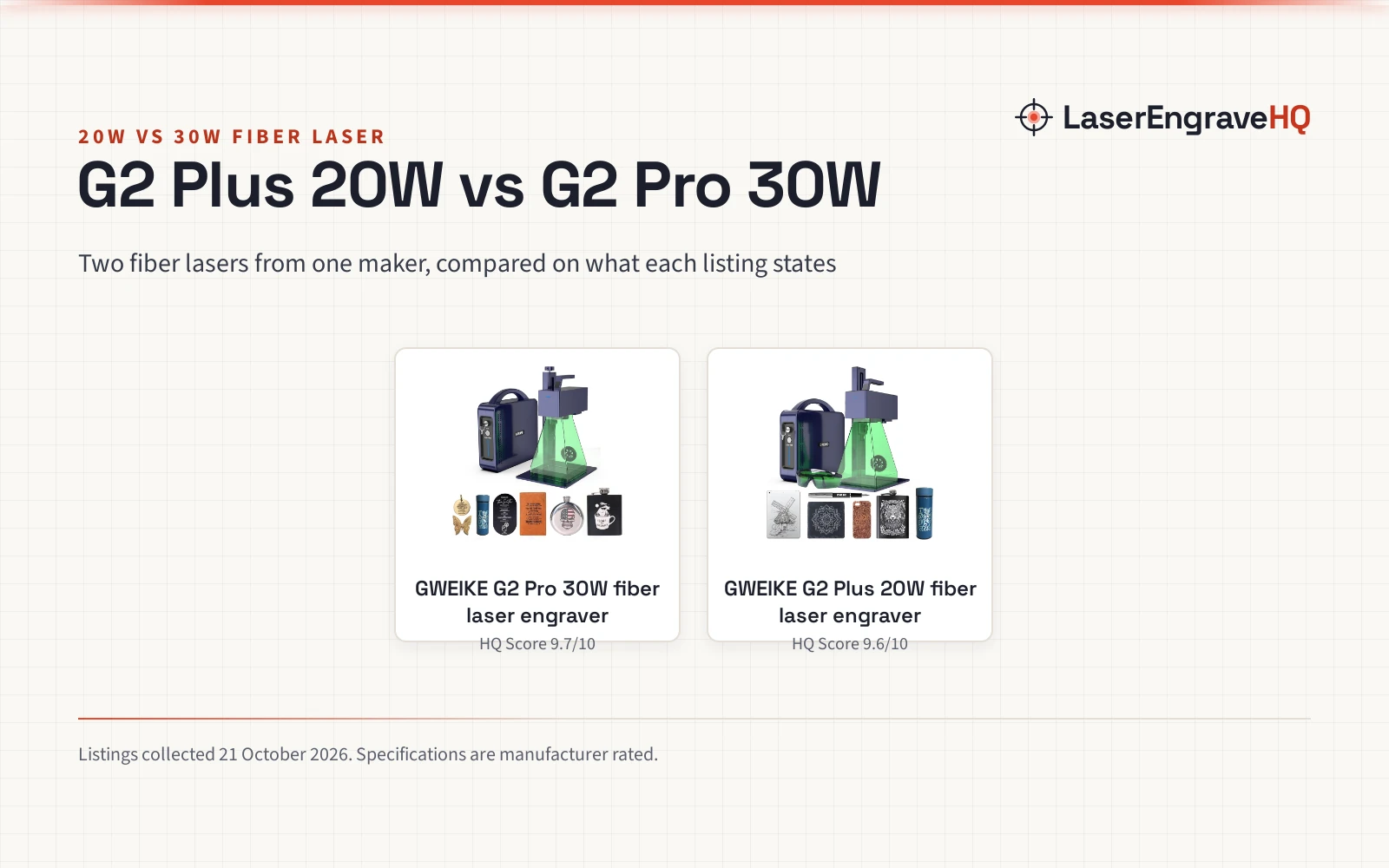
 GWEIKE G2 Pro 30W Fiber Laser EngraverView on Amazon
Choosing between a UV vs fiber laser comes down to beam wavelength and material absorption: a fiber laser uses concentrated heat to etch, anneal and deeply mark metals and dense polymers, whereas a UV laser uses cold photochemical processing to mark glass, delicate plastics and heat-sensitive items without surface damage. Deciding whether you need a UV or fiber laser depends on whether your shop prioritizes high-speed metal engraving or fine surface detail on delicate substrates. The sections below walk through the wavelength differences, material capabilities, marking speeds, detail resolution and safety setup step by step.
Other machines to compare
 Brilliance Laser Inks Black Metal Liquid-Ready Laser MarkingCheck price on Amazon
 Brilliance Laser Inks Copper-Tone Red Liquid-Ready MarkingCheck price on Amazon
 xTool SafetyPro AP2 Smoke Purifier for Laser EngraverCheck price on Amazon
 LaserPair Laser Safety Glasses 200-460nm OD6+ & 800-1095nmCheck price on Amazon
 Genmitsu Laser Engraver Kortek 10W 10000mWCheck price on Amazon
 GWEIKE G2 Pro 30W Fiber Laser EngraverCheck price on Amazon
LaserEngraveHQ earns a commission from purchases made through these links, at no extra cost to you. Read our affiliate disclosure.
Makers often assume higher wattage solves every engraving challenge, but beam wavelength determines absorption far more than raw power. A fiber laser passes directly through clear glass without absorption, while a UV laser marks glass cleanly with modest power. Always match the beam type to your specific material chemistry rather than buying based on power claims alone.
Step 1: Understand beam wavelength and cold versus thermal processing
The core difference between these two systems begins with the optical spectrum. A fiber laser operates in the infrared spectrum, producing a beam with a longer wavelength. This infrared energy couples readily with conductive metals, heating the surface rapidly. As the beam strikes the workpiece, intense thermal energy melts or vaporizes the surface layer to create contrast. This photothermal reaction makes fiber units effective for heavy-duty metal marking and deep relief, but the localized heat can easily warp thin sheets or scorch sensitive polymers.
In contrast, a UV laser operates in the ultraviolet spectrum, generating a beam with a substantially shorter wavelength. Because ultraviolet light has a shorter wavelength, each photon carries greater individual energy. When the ultraviolet beam hits a workpiece, it breaks chemical molecular bonds directly rather than relying on heat accumulation. This photochemical interaction is known as cold marking. Because cold marking transfers minimal heat to surrounding areas, it prevents melting, charring, bubbling and micro-cracking on delicate substrates. Both systems steer the beam across the workpiece using high-speed galvanometer mirrors, as explained in our galvo laser guide, but the marking physics at the focal point remain entirely different.
Step 2: Match the laser source to your target materials
Material selection is the decisive factor when choosing between these two beam sources. Each machine handles distinct material groups depending on how the substrate absorbs the incoming wavelength:
- Bare metals: Fiber lasers dominate metal engraving. They mark bare stainless steel, brass, copper, titanium, aluminum and tool steel with high speed and crisp contrast. A fiber beam creates dark oxidation, clean bright etching or deep dimensional engraving. A UV laser can create superficial marks on select metals, but the process is slow and shallow. If metal marking is your primary workshop objective, explore our dedicated fiber laser engravers category.
- Glass and crystal: A UV laser marks glass drinkware and crystal awards with outstanding clarity and smooth surface definition. Because glass absorbs ultraviolet light efficiently, the surface alters with minimal micro-fracturing and no heavy chipping. A fiber laser cannot mark transparent glass directly because the infrared beam passes straight through without absorbing.
- Plastics and polymers: UV lasers excel on plastics, creating clean contrast on white, colored and dark synthetic polymers without burning or melting. A fiber laser can mark certain dark, opaque engineering plastics through foaming or carbonization, but it often scorches, bubbles or fails to absorb on lighter and heat-sensitive polymers.
- Ceramics and delicate substrates: UV lasers mark smooth ceramics, printed circuit boards and silicon wafers without creating micro-fissures or thermal shock.
Safety note: never process PVC, vinyl, faux leather made with PVC, polycarbonate or ABS. Heating PVC and vinyl releases corrosive hydrogen chloride gas, while lasering ABS and polycarbonate produces toxic fumes that harm workshop air and corrode delicate optical coatings. Review our full guide on materials you should never laser cut before loading unfamiliar blanks.
Step 3: Compare marking speed and engraving depth
Production goals determine whether raw speed or surface gentleness matters more in your shop. Fiber lasers are engineered for aggressive material removal and swift cycle times on durable goods. In manufacturing environments where shops mark thousands of metal tags, tools or serialized barcodes, a fiber laser completes each mark rapidly. The photothermal process vaporizes metal layers quickly, allowing operators to achieve deep tactile relief. Readers curious about metal penetration limits can read our breakdown on how deep can a fiber laser engrave.
A UV laser takes the opposite approach. Cold photochemical marking is designed for high-contrast surface modification rather than bulk material excavation. While a UV laser scans rapidly, it removes minimal material per pass. Using a UV laser to carve deep grooves into dense metal is inefficient. However, for surface coding on delicate plastics or etching thin-walled glassware where material removal would weaken the product, the gentle marking profile of a UV laser is unmatched. For makers comparing desktop diode engravers with industrial gear, our comparison of fiber vs diode laser for metal highlights how dedicated galvo beams outperform gantry modules on metal surfaces.
Step 4: Evaluate beam spot size and detail resolution
Focal spot geometry dictates how finely a laser can resolve tiny graphics, micro-text and dense barcodes. Shorter wavelengths focus to smaller optical spot diameters. Because a UV laser operates at a shorter wavelength than an infrared fiber beam, its optical system can focus down to an exceptionally tiny spot size.
This microscopic focal diameter allows UV systems to produce intricate detail that other laser types cannot match. Micro-lettering on jewelry, high-density data matrix codes on electronic chips, fine graduation marks on medical instruments and delicate decorative filigree all benefit from the precision of a UV beam. The edge sharpness of a UV mark is crisp, with no thermal bleeding around the perimeter.
Fiber lasers also produce sharp marks, especially when equipped with specialized lenses with compact focal lengths, but their spot size remains naturally larger than a UV beam. For bold logos, high-contrast industrial barcodes, serial tags and deep firearm engraving, a fiber beam provides ideal line thickness and readability. For fine micro-scale applications on delicate surfaces, the UV laser holds a clear advantage.
Step 5: Review workspace safety and ventilation setup
Both laser systems require rigorous safety protocols, but their optical hazards differ significantly due to their distinct wavelengths:
- Wavelength-matched eye protection: Eye safety is essential. Both fiber and UV lasers operate as high-power unshielded units when mounted on open galvo columns. Eyewear must explicitly state a certified optical density and designate the precise wavelength range of your machine. Safety glasses designed for infrared fiber lasers provide zero attenuation against ultraviolet light, while UV glasses provide no protection against infrared radiation. Never rely on unrated orange shields or colored acrylic sheets.
- Proper enclosure design: Installing an interlocked protective enclosure around the marking area safeguards operators and nearby personnel from scattered reflections, which can cause permanent retinal and skin injury.
- Fume extraction: Marking plastics with a UV laser releases fine chemical particulates, while fiber engraving on metal generates airborne metal dust and combustion byproduct. Always exhaust fumes outdoors or vent through a multi-stage filter. Browse our fume extractor guide to select appropriate air filtration.
Common mistakes to avoid
- Purchasing a fiber laser expecting to engrave clear glass or light-colored plastics without surface scorching.
- Choosing a UV laser for deep dimensional carving, metal tool embossing or heavy metal stock removal.
- Sharing safety glasses between machines without confirming that the certified optical density matches the specific laser wavelength.
- Engraving prohibited materials such as PVC, vinyl or ABS, which release corrosive acid vapors and toxic fumes that damage galvo mirrors and optics.
- Running an open galvo marking station without dedicated fume extraction or proper eye barriers.
UV vs fiber laser: the short version
- Fiber lasers rely on infrared thermal energy, while UV lasers utilize cold ultraviolet photochemical reactions.
- Choose a fiber laser for deep metal engraving, bare steel serialization, brass marking and high-volume metal production.
- Choose a UV laser for heat-sensitive plastics, glassware, fine ceramics, electronic circuit boards and micro-detail coding.
- Fiber units excel at rapid material removal and depth; UV units excel at damage-free surface contrast and tiny spot resolution.
- Always verify that safety eyewear, protective enclosures and exhaust filters match your specific machine wavelength.
Matching the beam source to your core workshop materials prevents ruined blanks, protects delicate workpieces and ensures smooth production runs.
FAQ: lasers and CNC
Can a UV laser engrave bare metal?
A UV laser can create faint surface discoloration and shallow oxidation on bare metals like stainless steel or titanium, but it lacks the thermal energy needed for deep engraving. Because the photochemical process removes material slowly, using a UV laser for production metal marking is slow and inefficient compared to a dedicated fiber unit.
Can a fiber laser mark clear glass?
Standard fiber lasers cannot mark clear glass because the infrared beam passes straight through transparent glass without being absorbed. While applying a dark marking spray or backing tape can transfer a surface mark, the result often suffers from thermal stress and micro-cracking. A UV laser marks glass cleanly through direct ultraviolet absorption without requiring sprays or coatings.
Why is UV laser marking described as cold processing?
UV laser marking is termed cold processing because high-energy ultraviolet photons break molecular chemical bonds directly on the surface. Rather than melting or vaporizing the substrate through thermal heating, the beam creates discoloration and structural change with minimal heat conduction into surrounding areas.
Can I wear the same safety glasses for both machines?
No. Laser safety eyewear is calibrated to absorb specific optical wavelengths. Glasses rated for infrared fiber lasers do not block ultraviolet radiation, and UV safety glasses do not protect against infrared beams. Each pair must display an optical density rating specifically matching the wavelength band of your laser.
Which laser marks faster on metal serial plates?
A fiber laser marks substantially faster on metal serial plates, tags and tools. Its concentrated thermal beam alters and vaporizes metal surfaces rapidly, making it the industry standard for rapid manufacturing and industrial identification.
Can either machine cut through sheet metal?
Galvanometer marking lasers are built for surface marking, etching and shallow relief, not for cutting sheet metal. While a fiber laser can slice through very thin shim stock or foil with multiple passes, production sheet metal cutting requires specialized flatbed cutting machines with high-pressure assist gas.
Related: our guide to the best fiber laser engraver, our overview of the best uv laser engraver, the laser safety glasses guide, and our advice on how to choose a laser engraver.