Fiber vs Diode Laser for Metal: Differences Explained
A practical comparison of fiber and diode lasers for metal marking, covering wavelength absorption, rated speed, engraving depth and workshop safety.

On this page
Top picks at a glance
As an Amazon Associate I earn from qualifying purchases.
- 1
 GWEIKE G2 Max 50W Fiber Laser Engraver with 3D & Deep9.7/10View on Amazon
- 2
 xTool F1 Ultra 20W Fiber & Diode Dual Laser Engraver 16MP9.7/10View on Amazon
- 3
 WeCreat Lumos Flex 15W Fiber & 15W Diode Dual Laser Engraver9.6/10View on Amazon
- 4
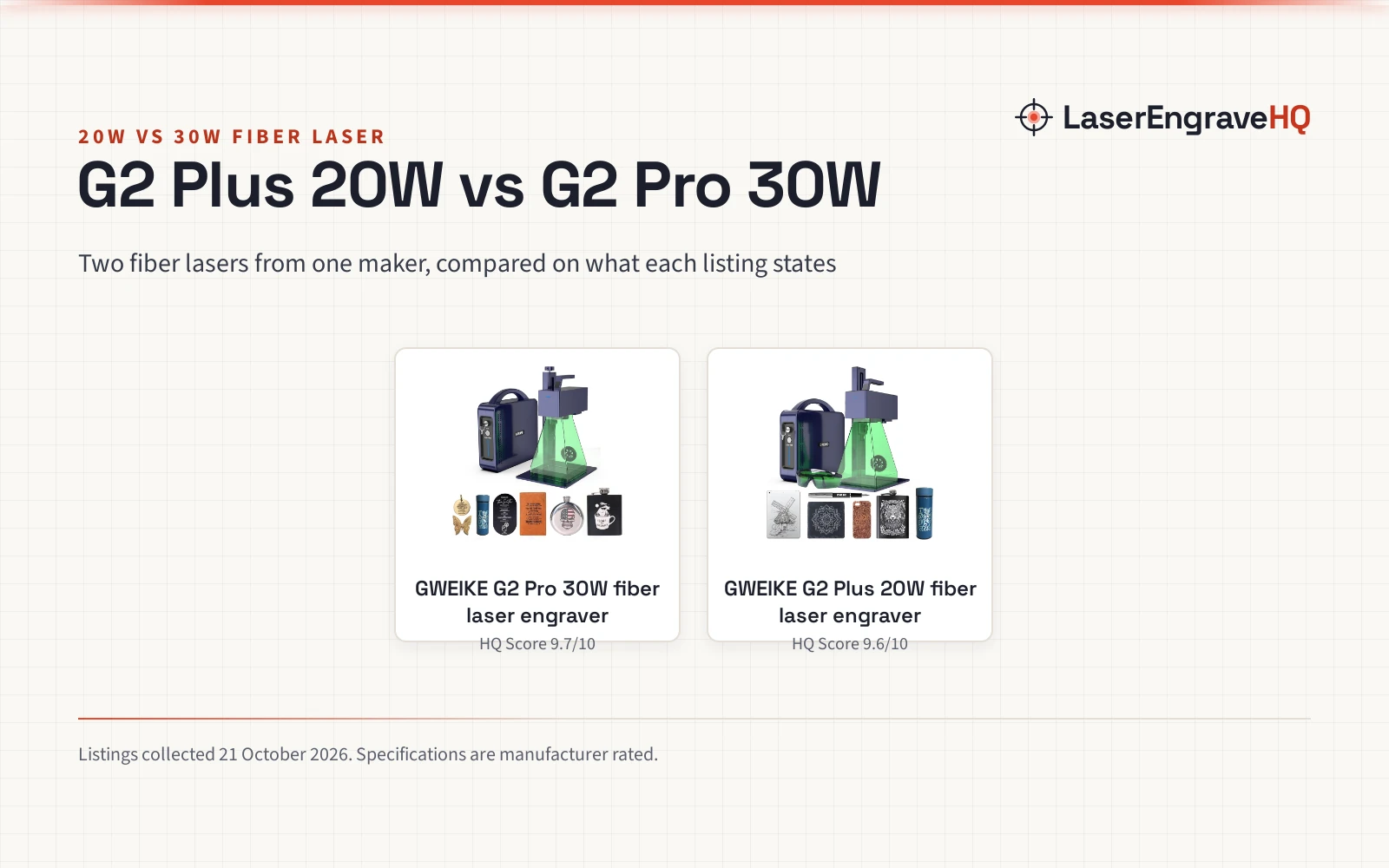
 GWEIKE G2 Plus 20W Fiber Laser EngraverView on Amazon
- 5
 GWEIKE G2 Pro 30W Fiber Laser EngraverView on Amazon
- 6
 GWEIKE G2 20W Fiber Laser EngraverView on Amazon
- 7
 xTool F2 Ultra Single 60W MOPA Fiber Laser Engraver 100+View on Amazon
- 8
 ComMarker B4 20W Fiber Laser EngraverView on Amazon
- 9
 US Stock 50W JPT Fiber Laser Engraver Machine Fiber LaserView on Amazon
Fiber vs diode laser for metal comes down to wavelength and absorption: a 1064nm fiber laser marks bare metal directly, while a diode laser reflects off bare metal and only etches surface coatings. Diode machines handle wood and leather well, but bare metal requires the infrared beam of a fiber galvanometer system. Below, we compare wavelength, speed, power and safety.
Other machines to compare
 GWEIKE G2 Plus 20W Fiber Laser EngraverCheck price on Amazon
 GWEIKE G2 Pro 30W Fiber Laser EngraverCheck price on Amazon
 GWEIKE G2 20W Fiber Laser EngraverCheck price on Amazon
 xTool F2 Ultra Single 60W MOPA Fiber Laser Engraver 100+Check price on Amazon
 ComMarker B4 20W Fiber Laser EngraverCheck price on Amazon
 US Stock 50W JPT Fiber Laser Engraver Machine Fiber LaserCheck price on Amazon
LaserEngraveHQ earns a commission from purchases made through these links, at no extra cost to you. Read our affiliate disclosure.
Diode listings often claim metal marking when they only vaporize paint, anodization or powder coat. Stripping paint is not bare metal engraving. For permanent marks directly on bare steel, brass, copper or aluminum without marking paste, a 1064nm fiber laser is required.
Step 1: Compare wavelength and beam absorption on metal
The main difference between fiber and diode systems is beam wavelength. Fiber engravers emit infrared light at 1064nm. Bare metals absorb this 1064nm wavelength efficiently, letting the beam heat and alter the metal surface directly. Standard diode engravers emit visible blue light that bare reflective metals reflect away. Because the light reflects, standard diode beams cannot heat bare metal enough to mark it.
Certain modular systems offer add-on heads. For example, BlazeX lists a 1064nm infrared laser head with 0.01mm motion accuracy for gold, silver, copper, aluminum and stainless steel. Without an infrared source, diode users must apply chemical marking paste. Learn more in our guide on can a diode laser engrave metal.
Step 2: Contrast galvanometer and gantry motion systems
Motion systems dictate marking speed. Most fiber lasers use a galvanometer head with motorized mirrors that steer the beam across a stationary field. GWEIKE lists its G2 Plus fiber machine reaching speeds up to 15000mm/s with 0.001 mm accuracy across a 150x150mm area. ComMarker lists its B4 30W unit reaching 15000mm/s across a 110x110mm or 200x200mm field. OMTech lists a 50W fiber model running at 7000 mm/s (rated at 275.6 ips) across a 7.9″x7.9″ (200×200 mm) workspace.
Most diode engravers use a gantry frame with belts and stepper motors, moving the entire laser head along rails at slower speeds. Portable units like the LaserPecker LP4 use galvanometer mirrors to reach 2000 mm/s or 4000mm/s across a 160 × 120 mm area, but standard gantry diode machines operate at much lower travel rates. See what is a galvo laser for mirror mechanics.
Step 3: Compare optical power and engraving speed
Optical output power determines how fast a beam marks or engraves. Always separate optical output from electrical input: machines advertising large electrical input draws often deliver modest optical wattage. Fiber engravers generally deliver 20W to 60W of optical power. Monport lists a 30W fiber machine running at 10000mm/s, while OMTech lists a 60W MOPA model reaching 10000mm/s with pulse widths of 2-500 ns and frequencies of 1-4000 kHz.
Diode lasers typically produce 10W or 2W of optical power in compact formats. While 10W cuts wood cleanly, it cannot match the bare metal processing speed of a 30W or 60W fiber beam. To evaluate workshop machines, read our best fiber laser engraver guide and compare options in our best laser engraver for metal review.
Step 4: Understand marking versus deep engraving and cutting
Laser metal processing includes surface marking, deep engraving and sheet cutting. Surface marking darkens or alters surface polish without deep relief. MOPA fiber lasers can generate colors on stainless steel and titanium by altering oxide thickness; GWEIKE lists 30+ colors on its G2 Plus and 90+ colors on its G2 Pro.
For deep engraving, ComMarker lists an engraving depth of 0.3-0.5mm with a minimum line width of 0.01mm on its B4 model, while OMTech lists a maximum depth of 0.1 mm on its 60W unit. Slicing sheet metal is different: desktop fiber lasers can trim thin metal foils, but they cannot cut structural plate. Diode lasers cannot cut metal at all, though listings like the LaserPecker LP4 note cutting wood up to 8mm and dark opaque acrylic up to 5mm. Check how deep can a fiber laser engrave and can a fiber laser cut metal for realistic limits.
Step 5: Evaluate bare metals versus coated materials
Your blanks determine which laser fits. Fiber lasers engrave bare metals without pastes or sprays. Monport notes that its 30W fiber laser engraves all metals, including gold, silver, copper, stainless steel, brass and titanium.
Diode lasers suit organic materials like wood, leather, paper and slate. For metal blanks, diode machines require a coating: powder-coated drinkware, anodized tags or painted cards. The diode beam vaporizes the dark coating to reveal the metal beneath. For bare steel on a diode, you must apply and wash off marking compound. Read how to engrave stainless steel with a diode laser, and explore our fiber laser engravers hub.
Step 6: Plan workshop safety and optical density protection
Workshop safety is critical. Eyewear protects only if the listing states optical density (OD) and a wavelength range that matches the machine. Tinted acrylic or orange shields without ratings offer no protection. Fiber lasers emit 1064nm infrared radiation, requiring glasses certified for 1064nm with verified OD. Diode glasses designed for blue wavelengths offer no protection against 1064nm light.
Check certifications: ComMarker B4 and B6 cite IEC 60825-1 report 2501Q25848E-SFA1 and FDA Accession Number 2521455-000 with a CLASS 1 rating. GWEIKE G2 units cite Class 4 and FDA Accession Number 2211667-002 with emergency stop switches. Never laser PVC, vinyl, PVC-based faux leather, polycarbonate or ABS on any machine; they release toxic hydrochloric acid fumes that damage optics and present severe hazards. Always vent exhaust outside or use a filter. See our laser safety glasses guide, our fume extractor guide, and materials you should never laser cut.
Step 7: Select the right machine for your workload
Match the laser to your primary products. If your shop engraves jewelry, bare knives, serialized stainless tags, brass badges or deep metal relief, a 30W or 50W fiber laser is the right choice. Fiber machines deliver the speed, reliability and 0.01mm or 0.001 mm precision required for bare metal.
If your business focuses on wooden gifts, leather goods, acrylic crafts and coated tumblers, a diode laser provides broader material versatility at a lower entry cost. Diode machines also offer larger work areas than standard 150x150mm fiber lenses. Choose the machine that fits your core inventory before ordering blanks.
Common mistakes to avoid
- Expecting a diode laser to engrave bare brass, copper or aluminum without marking paste.
- Using blue diode safety glasses when operating a 1064nm infrared fiber laser.
- Assuming desktop fiber lasers can cut thick sheet metal.
- Overlooking small marking fields on standard 150x150mm or 110x110mm galvo lenses.
- Lasering dangerous materials like PVC, vinyl, polycarbonate or ABS.
- Operating metal engraving jobs without dedicated exhaust ventilation.
Fiber vs diode laser for metal: the short version
- Choose a 1064nm fiber laser for permanent bare metal marking, color etching and deep engraving.
- Choose a diode laser for organic materials and removing powder coatings from metal blanks.
- Use galvanometer scanning mirrors for high-speed batch marking up to 15000mm/s.
- Wear protective glasses certified for 1064nm with verified optical density when operating fiber lasers.
- Ventilate metallic fumes outdoors or through a multi-stage fume extractor.
- Never engrave PVC, vinyl, polycarbonate or ABS on any laser machine.
Matching machine wavelength to your metal inventory prevents ruined blanks and ensures crisp, durable marks.
FAQ: lasers and CNC
Can a diode laser engrave bare metal?
A standard diode laser cannot engrave bare metal directly because reflective metals reflect the beam. Diode machines can only mark bare metal if you apply chemical marking spray, or if the unit uses an add-on 1064nm infrared module.
Can a fiber laser cut metal sheets?
Desktop fiber lasers rated at 30W or 50W are engineered for surface marking and shallow relief, not structural metal fabrication. While they can cut thin jewelry foils with repeated passes, cutting sheet metal requires high-power industrial cutters.
What laser power is needed to mark stainless steel?
A 20W or 30W fiber laser marks stainless steel quickly and legibly. Higher-output models with 50W or 60W optical power engrave deeper relief and finish production runs faster.
Can a fiber laser produce color on metal?
Yes. MOPA fiber lasers can create colors on stainless steel and titanium by adjusting pulse frequency and pulse duration, which changes oxide layer thickness. GWEIKE lists 30+ colors on its G2 Plus and 90+ colors on its G2 Pro.
Do I need special safety glasses for fiber lasers?
Yes. Fiber lasers emit invisible 1064nm infrared radiation, requiring glasses certified for 1064nm with verified optical density. Eyewear made for blue diode lasers provides zero protection against 1064nm light.
Which laser is better for a small metal engraving shop?
A fiber laser is the clear choice for a metal shop because it marks bare steel, brass, copper, silver and gold directly at high speeds. A diode laser is better for craft shops focused on wood, leather and coated drinkware.
Related: our fiber laser engravers category, the diode laser engravers hub, and our guide to the best fiber laser engraver. Also see our roundup of the best laser engraver for metal and our laser safety glasses guide.