CO2 Laser Water Chiller Explained: Types, Sizing, and Workshop Setup
A practical guide to CO2 laser water chillers: understand passive radiators versus active refrigeration, choose proper cooling capacity, and keep laser tubes safe.

On this page
Top picks at a glance
As an Amazon Associate I earn from qualifying purchases.
- 1
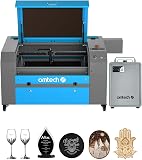 OMTech Maker 90W CO2 Laser Engraver & Cutter with Water9.6/10View on Amazon
- 2
 OMTech 100W CO2 Laser Engraver with 4 Way Pass Through Air9.7/10View on Amazon
- 3
 xTool P3 80W Flagship CO2 Laser Cutter with Intelligent9.7/10View on Amazon
- 4
 Cloudray Water Chiller CW-5200DH 6L 0.81HP 3.43gpmView on Amazon
- 5
 S&A CW-5200DH 7L Industrial Water ChillerView on Amazon
- 6
 OMTech CW-3000 9L Industrial Water Chiller for CO2 Lasers upView on Amazon
- 7
 OMTech CW-5200 6L Industrial Water Chiller For up to 150W CO2View on Amazon
- 8
 S&A CW-5000 DG Industrial Water Chiller 7L 1.14HP 2.64gpmView on Amazon
- 9
 OMTECH 9L Industrial Water Chiller 2.6gpm Water CoolingView on Amazon
CO2 laser water chiller explained simply: a dedicated water chiller circulates cooling liquid through the water jacket of a glass laser tube to absorb excess heat generated during cutting and engraving. Because glass laser tubes convert only a fraction of electrical power into optical laser light, unmanaged heat degrades laser output power and cracks the glass tube under thermal stress. Understanding how passive radiators differ from compressor-based refrigeration systems ensures your workshop equipment runs reliably without unexpected tube failure.
Other machines to compare
 Cloudray Water Chiller CW-5200DH 6L 0.81HP 3.43gpmCheck price on Amazon
 S&A CW-5200DH 7L Industrial Water ChillerCheck price on Amazon
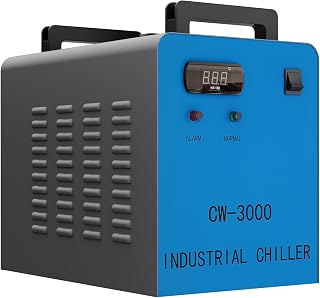 OMTech CW-3000 9L Industrial Water Chiller for CO2 Lasers upCheck price on Amazon
 OMTech CW-5200 6L Industrial Water Chiller For up to 150W CO2Check price on Amazon
 S&A CW-5000 DG Industrial Water Chiller 7L 1.14HP 2.64gpmCheck price on Amazon
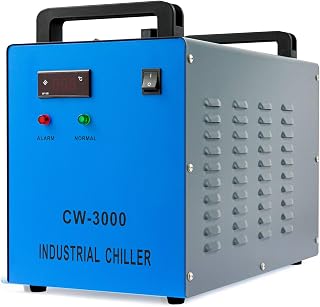 OMTECH 9L Industrial Water Chiller 2.6gpm Water CoolingCheck price on Amazon
LaserEngraveHQ earns a commission from purchases made through these links, at no extra cost to you. Read our affiliate disclosure.
Water cooling needs depend on tube wattage and duty cycle. We compare published listings so you can match the right cooling system to your workshop setup without guessing.
Step 1: Understand why a CO2 laser tube generates heat
Glass CO2 laser tubes rely on an electrical discharge passing through a gas mixture of carbon dioxide, nitrogen, and helium to produce an infrared beam. Most electrical power supplied to the tube turns into waste heat rather than light, transferring directly into the glass envelope of the laser tube.
Without constant cooling, thermal buildup causes optical power to drop, stresses internal mirror mounts, and can shatter the glass casing. Proper temperature control directly influences how long CO2 laser tubes last in a workshop.
Basic 40W K40 setups often ship with an open bucket and a submersible pump. While an open reservoir works for brief engraving jobs, the water absorbs heat continuously without shedding it, requiring operators to monitor temperatures manually.
Step 2: Differentiate passive radiators from active refrigeration
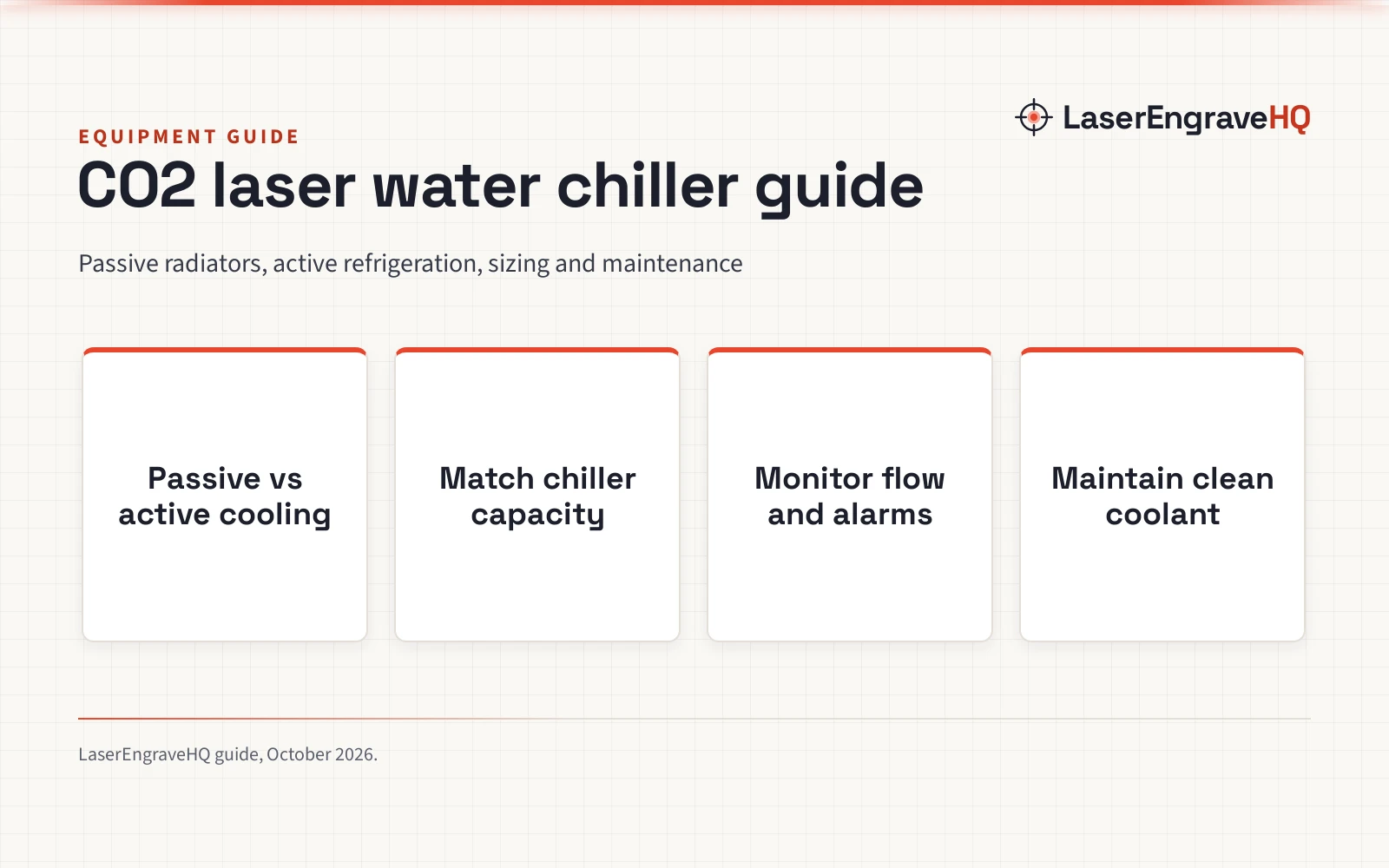
Dedicated cooling units use two distinct designs: passive radiator coolers and active compressor-based chillers.
Passive units, widely designated as CW-3000 models, lack a refrigeration circuit. Instead, a pump circulates water through a radiator while a fan blows ambient air across the cooling fins. OMTech lists its CW-3000 radiating heat away rather than using refrigeration, providing 50W/°C heat dissipation with a 2.6 gpm flow rate and a 9L reservoir (2.4 gallons). Cloudray lists its CW-3000 delivering 50W/℃ cooling capacity with a 9L tank and 10L/min maximum pump flow (10m lift). Because passive coolers rely on ambient air exchange, they only shed heat when water exceeds room temperature (OMTech notes 50W dissipated per 1 degree rise). A passive unit cannot cool water below ambient room temperature.
Active refrigeration chillers incorporate a compressor, condenser, evaporator, and refrigerant to cool water below ambient room levels. S&A lists its CW-5000 using R134a refrigerant and a 1.1hp compressor to deliver 3868 BTU/Hour cooling capacity with a 7L tank (1.85 gallon). For larger loads, S&A lists its CW-5200DH with a 0.9hp compressor and R410a refrigerant, delivering 5699 BTU/h cooling capacity and a 7L tank. Cloudray lists its CW-5200DH with a 0.9HP compressor using R32 refrigerant, delivering 5596 Btu/h cooling capacity and a 6L tank. OMTech lists its CW-5200 providing 5186 BTU/h cooling capacity with a 3.2 gpm flow rate and a 6L tank (1.6-gallon).
Step 3: Match chiller capacity to laser tube wattage
Matching cooling capacity to tube wattage prevents overheating and saves workshop space. Compare machines in our CO2 laser cutters hub and our guide to the best CO2 laser cutter for home use.
For compact 40W and 50W lasers, passive cooling can suffice in climate-controlled rooms. OMTech specifies its CW-3000 for lasers up to 50W, and Cloudray specifies its CW-3000 for 40W and 50W machines.
For mid-range 60W to 100W machines, active refrigeration is needed for continuous cutting. S&A lists its CW-5000 for 40W, 50W, 60W, 70W, 80W, 90W, and 100W machines, stating it keeps cutting and engraving systems up to 80W-100W well and cool.
High-power 100W to 150W tubes require higher capacity. Cloudray rates its CW-5200DH for 60W-150W tubes, S&A rates its CW-5200DH for 60W to 150W systems (up to 150W-180W), and OMTech rates its CW-5200 for up to 150W lasers. For multiple machines, OMTech lists its CW-5202 with dual inlet and outlet ports and a 0.9hp compressor delivering 5186 BTU/h to chill 2 laser engravers from a single 6L tank.
Step 4: Verify built-in safety alarms and flow protection
If coolant flow stops while the beam fires, a glass tube can crack within seconds. Integrated flow alarms safeguard your equipment.
Manufacturer listings detail specific alarms. S&A includes multiple protection and alarm functions, providing an automatic alarm prompt for abnormal flow, an automatic alarm if water temperature gets too high, and compressor overcurrent protection. Cloudray lists integrated water flow and over-temperature alarms on its CW-3000. OMTech equips its CW-5200 with internal sensors, a digital display, indicator lights, audible alarms, and an included alarm signal output plug.
Wiring the chiller alarm plug into your laser controller water protection terminal pauses laser firing if water circulation stops, saving the tube from heat fracture.
Step 5: Connect coolant lines and select proper fluids
Durable fittings prevent leaks: OMTech specifies 0.4 in. OD premium brass inlet and outlet ports, Cloudray specifies OD 10mm barbed connectors on its CW-3000, and S&A uses precision-engineered brass ports.
Never fill a chiller with tap water. Minerals form scale inside the glass tube, insulating it and causing hotspots. Use pure water or ionized water. Cloudray states pure water and ionized water can be used, and notes antifreeze may be added provided the proportion does not exceed 30%. OMTech also offers a 1 gal non conductive liquid cooler fluid prediluted for CO2 laser tubes to inhibit biological growth.
Enclosed reservoirs reduce evaporation: S&A features a closed design on its 7L (1.85 gallon) tank, Cloudray lists a 6L tank, and OMTech provides enclosed 6L and 9L tanks with observation windows.
Step 6: Monitor operating temperatures and routine maintenance
Active chillers offer selectable temperature control. S&A specifies dual mode temperature control (intelligent and constant) keeping temperatures constant within 0.3°C, with manual settings between 5-40 degree. Cloudray lists intelligent and constant modes on its controller. OMTech lists internal sensors maintaining temperatures within 0.3℃ of constant (±0.3°C). Cloudray lists a minimum temperature setting of 5 degrees for its CW-5200DH, cautioning users to avoid keeping the minimum temperature for an extended period because it may cause the flow switch to break.
Workshop maintenance: check the water observation window, clear dust from ventilation grilles and dust-proof nets (S&A lists a customized dust-proof net), check hoses for kinks, and flush the reservoir periodically with fresh pure water.
Common mistakes to avoid
- Using a passive CW-3000 radiator on a high-power laser above 50W or in a hot workshop.
- Failing to wire the chiller alarm signal output plug into the laser controller water protection terminal.
- Filling the reservoir with mineral-heavy tap water rather than pure distilled or ionized water.
- Adding excessive antifreeze beyond the 30% maximum proportion stated by Cloudray.
- Ignoring listing contradictions during purchasing, such as OMTech CW-5200 stating a 0.58 hp compressor in bullets while listing a 0.9 HP compressor in highlights.
- Setting chiller temperatures excessively low, causing condensation to form along the cooled outer surface of the glass tube.
CO2 laser water chiller explained: the short version
- Glass CO2 laser tubes require active liquid circulation to prevent power loss and thermal cracking.
- Passive coolers like the CW-3000 dissipate heat via a fan and radiator (OMTech rates its unit at 50W/°C), but cannot cool below room temperature.
- Active chillers like the CW-5000 and CW-5200 use compressors and refrigerants (R134a, R410a, R32) to cool water below ambient temperatures.
- Match capacity to wattage: reserve passive units for 40W to 50W machines, and install active chillers for 60W to 150W cutters.
- Use pure distilled or ionized water in closed tanks (6L, 7L, or 9L), keeping any antifreeze mix below 30% as Cloudray specifies.
- Wire the chiller alarm output to your controller to halt laser cutting if water flow stops.
FAQ: lasers and CNC
Do you need a chiller for CO2 laser machines?
All glass tube CO2 laser machines require liquid cooling. Small 40W machines can operate for short hobby jobs with a submersible pump in a water bucket. For tubes rated at 60W or higher, or for continuous production, a dedicated chiller is essential to stabilize temperatures and provide flow alarm protection.
What is the difference between a CW-3000 and a CW-5000 series chiller?
A CW-3000 is a passive radiator using a fan to dissipate heat (rated at 50W/°C) without a compressor or refrigerant. A CW-5000 is an active chiller featuring a 1.1hp compressor with R134a refrigerant, delivering 3868 BTU/Hour cooling capacity to lower coolant temperatures below room levels.
Can I use regular tap water in a CO2 laser chiller?
No. Tap water carries dissolved minerals that form scale on the inner glass walls of the tube, creating hotspots and reducing tube life. Fill your chiller with pure distilled water, ionized water, or dedicated non conductive laser coolant.
Can a water chiller cool multiple laser engravers at the same time?
Standard chillers have one inlet and outlet port for a single laser. Specialized dual-port models, such as the OMTech CW-5202, provide two sets of inlet and outlet ports with a 0.9hp compressor and a 6L tank to cool 2 laser engravers from a single unit.
What happens if cooling water stops flowing through the laser tube?
Without coolant flow, heat accumulates rapidly. Extreme thermal stress can crack the glass tube within seconds. Wiring the chiller flow alarm to your controller halts laser firing before damage occurs.
How often should you replace the water in the reservoir?
Check the observation window before each session. In a closed reservoir, pure distilled water lasts several months if kept clean. Flush and refill with fresh pure water whenever you notice cloudiness or debris.
Related: the CO2 laser category, our guide on best CO2 laser cutter for home use and how long CO2 laser tubes last. Also see our what is a CO2 laser engraver guide and diode vs CO2 laser comparison.