Do You Need a Business License to Sell Laser Engraved Items?
A clear legal and licensing guide for selling laser engraved items: determine local license requirements, obtain sales tax permits, clear home zoning, and sell custom products legally.

On this page
Top picks at a glance
As an Amazon Associate I earn from qualifying purchases.
- 1
 ATOMSTACK 20W Laser Engraver9.6/10View on Amazon
- 2
 ATOMSTACK 20W Laser Engraver9.5/10View on Amazon
Do you need a business license to sell laser engraved items? Yes, in almost all jurisdictions across the United States, you need a basic business license, tax registration, or commercial permit before selling laser engraved items to customers. Whether you plan to sell personalized wooden cutting boards, custom signage, or marked drinkware through an online storefront, a craft fair booth, or a home workshop, local and state governments require commercial enterprises to register legally. The precise paperwork depends on your city, county, and state, but typical requirements include a local general business license, a sales tax certificate, and municipal zoning compliance. This guide explains how to navigate each licensing stage, understand local agency rules, and establish your engraving operations on a compliant foundation.
LaserEngraveHQ earns a commission from purchases made through these links, at no extra cost to you. Read our affiliate disclosure.
This guide provides general educational information regarding commercial licensing and operations. It does not constitute legal, tax, or accounting advice. Regulations vary across states, counties, and municipalities. Always consult your municipal business office, county clerk, or a qualified attorney to confirm local compliance.
Step 1: Verify municipal and county business license requirements
The primary legal document most small business owners encounter is a general local business license, frequently designated as a business tax certificate. Municipalities and county governments issue these licenses to track commercial activity within their boundaries and assess local business taxes. Even if your laser engraving setup begins as a spare-bedroom activity or garage venture, earning commercial revenue classifies the endeavor as an enterprise subject to local oversight.
Licensing authority is divided between municipal city halls and county administration buildings. If your workshop resides inside incorporated city boundaries, check with the city clerk or city finance department to confirm whether a general license or business tax registration applies. In unincorporated areas, consult county authorities to see whether local licensing is mandated, as some county jurisdictions do not require a general business license for home-based crafts.
Step 2: Choose your business structure and register your legal entity name
Before submitting permit applications, establish which business structure suits your operational goals. Sole proprietorships represent the simplest structure, while establishing a limited liability company creates an independent legal entity that separates personal assets from business liabilities. Consult an attorney or certified accountant if you are uncertain which entity fits your commercial expansion plans.
If you market your engraved items under a commercial brand rather than your personal legal surname, state and county rules require filing a fictitious business name, commonly known as a Doing Business As registration. Additionally, consider obtaining an Employer Identification Number from federal tax agencies to safeguard personal privacy on supplier accounts and wholesale purchase orders, even though sole proprietors without staff may legally use personal tax identifiers.
Step 3: Obtain a state sales tax permit and resale certificate
Laser engraved items constitute tangible personal property under state tax codes, making retail sales subject to state and local sales taxes in states that impose them. Nearly every state with a sales tax mandates that sellers acquire a state sales tax permit before making retail sales. While major platforms such as Etsy collect sales tax for remote buyers under marketplace facilitator statutes, state revenue departments frequently still require resident creators to maintain an active sales tax registration for local craft markets and direct invoicing.
Holding a state sales tax permit also enables you to issue resale certificates to wholesale material vendors, buying raw blanks without paying retail sales tax at checkout. For example, Oskal supplies packs of 100 aluminum business card blanks measuring 3.39 inches by 2.13 inches with a thickness of 0.008 inches. Similarly, hansmaker lists aluminum card blanks measuring 86 by 54 millimeters with a thickness of 0.21 millimeters in packs of 50 blanks. Presenting a state resale certificate allows you to buy production inventory tax-exempt before engraving.
Step 4: Check home occupation permits and municipal zoning regulations
Because many laser engraving artisans begin in residential settings, municipal zoning regulations play a decisive role in legal compliance. Local planning departments establish residential zoning codes to preserve neighborhood character. To operate lawfully from a house or apartment, you often need to obtain a home occupation permit from your municipal zoning board. If your workshop operates inside a home or garage, read our guide on running a laser engraver indoors to establish sensible safety boundaries.
If your engraving catalog expands into architectural signage or commercial displays, municipal building codes and sign ordinances regulate installations. For example, PlaqueMaker supplies custom laser engraved plastic signs measuring 4 inches by 6 inches, with options reaching up to 24 inches by 48 inches. PlaqueMaker also produces 24-gauge 304 stainless-steel signs measuring 2 inches by 5 inches. For storefront displays, Housignz lists backlit acrylic signs operating on 12V low-voltage LEDs with an IP67 waterproof protection and a 1-year warranty.
Step 5: Follow workshop safety, ventilation, and material compliance
Maintaining a safe workshop environment directly impacts commercial licensing, building inspections, and insurance coverage. Laser machinery produces concentrated optical radiation, heat, and airborne byproducts that require rigorous controls under municipal fire codes and occupational safety standards outlined by agencies such as the Occupational Safety and Health Administration.
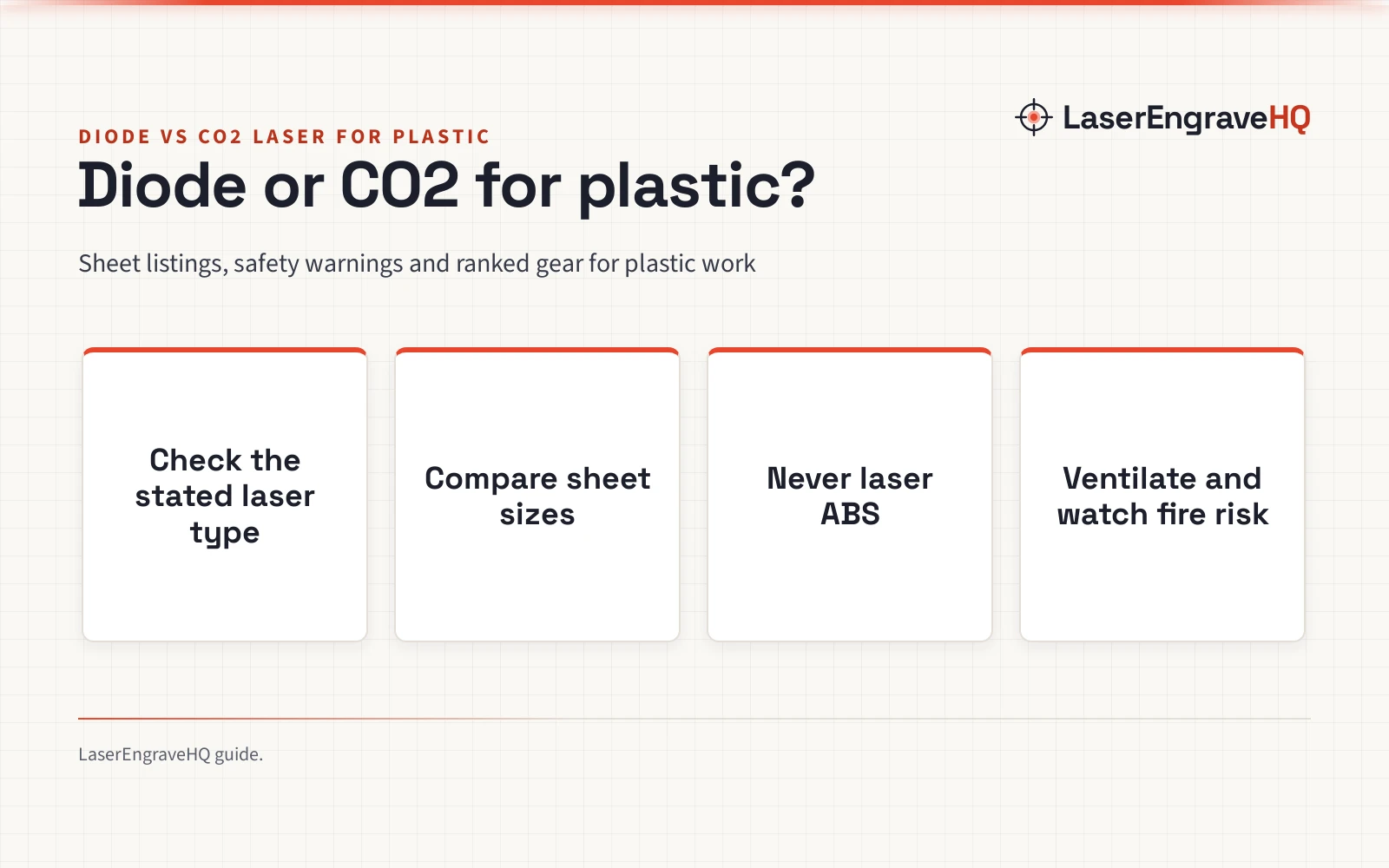
Proper air management remains fundamental. Exhaust workshop fumes to the outdoors using dedicated ducting or process them through a filtration system designed specifically for laser processing. Read our laser fume extractor guide to review filtration systems with activated carbon chambers. Pair ventilation with fire vigilance: keep a suitable fire extinguisher within arm’s reach of your machine table and never leave an active job unattended.
Material safety rules require strict discipline. Crucially, never laser PVC, vinyl, PVC-based faux leather, polycarbonate, or ABS. Processing polyvinyl chloride releases corrosive hydrochloric acid vapor and toxic chlorine gas, which degrades linear rails, clouds focusing lenses, and creates acute health hazards.
When selecting production equipment, review our best laser engraver for small business guide to compare enclosed machinery and protective viewports. When choosing safe materials, brushed metals provide stable laser-compatible options without hazardous emissions. For desktop plates, FuleTechMix offers brushed stainless steel plates in sizes including 1 inch by 3 inches, 2 inches by 4 inches, and 3 inches by 6 inches with a thickness of 0.02 inches.
Step 6: Separate commercial finances and obtain liability insurance
Once your business permits, sales tax registrations, and home occupation clearances are approved, establish sound financial and risk boundaries. Open a dedicated commercial checking account solely for enterprise transactions. Mixing personal household funds with commercial engraving revenue complicates bookkeeping and weakens legal liability shields.
Commercial insurance coverage forms another protective layer. Standard homeowner or renter policies generally exclude incidents arising from business manufacturing. Look into commercial general liability insurance to safeguard against customer property claims, product liability coverage for personalized goods, and equipment riders that protect your laser machinery.
Common mistakes to avoid
- Selling engraved merchandise before verifying state sales tax registration requirements.
- Operating inside a residential neighborhood without verifying municipal home occupation codes.
- Co-mingling personal household finances with commercial business income and material expenses.
- Failing to register a fictitious business name when advertising under a distinctive shop identity.
- Assuming that third-party craft platforms handle all municipal licensing requirements automatically.
- Neglecting workshop ventilation standards, fire prevention equipment, and material safety restrictions.
Do you need a business license to sell laser engraved items: the short version
- Confirm municipal and county general business license requirements with your local clerk or revenue department.
- Select a business entity structure and file a fictitious business name registration if using an assumed brand name.
- Acquire a state sales tax permit where required, and utilize resale certificates to purchase raw blanks without paying retail sales tax.
- Verify municipal residential zoning ordinances and acquire a home occupation permit if mandated for home-based workshops.
- Implement compliant workshop ventilation, certified eye protection, and fire safety protocols.
- Establish an independent commercial bank account and obtain commercial liability insurance coverage.
Following these steps systematically ensures that your laser engraving venture operates lawfully, shields personal assets, and builds a sustainable foundation for long-term commercial success.
FAQ: lasers and CNC
Do I need a business license to sell laser engraved items on Etsy?
In most localities, yes. While Etsy provides the online storefront and collects retail sales tax under marketplace facilitator laws for many states, you remain an independent enterprise owner. Many municipalities require anyone conducting commercial enterprise from their residence to hold a local business license or tax certificate, regardless of whether orders originate online or locally. Check with your municipal clerk to confirm local thresholds.
Can I run a laser engraving business from my home?
Yes, many makers operate commercial engraving setups from residential workshops. However, you need to verify local zoning rules and acquire a home occupation permit where required. You are also required to satisfy municipal fire codes, vent processing smoke safely to the outdoors, and comply with neighborhood rules regarding commercial deliveries and visitor traffic.
What is the difference between a business license and a sales tax permit?
A general business license grants municipal or county authorization to conduct commercial enterprise within a local jurisdiction. A sales tax permit, issued by your state department of revenue, authorizes you to collect and remit retail sales tax on tangible physical goods in states that impose sales taxes. Many laser engraving businesses require both credentials to operate legally.
Do I need an Employer Identification Number if I operate as a sole proprietorship?
Sole proprietors without employees are not federally required to obtain an Employer Identification Number, as federal tax agencies allow using personal identification numbers. However, acquiring an Employer Identification Number is free and recommended because it allows you to open commercial bank accounts and establish wholesale vendor accounts without exposing personal identifiers.
What happens if I sell laser engraved crafts without a license?
Operating without mandated municipal licenses and state tax permits can result in statutory financial penalties, local citations, back-tax assessments with interest, and formal cease-and-desist orders from local authorities. Additionally, unlicensed sellers risk suspension from online marketplaces and merchant processing platforms.
Do hobby sellers need liability insurance for laser engraved goods?
Commercial liability coverage is strongly advisable for anyone selling physical products to the public. Standard homeowner and renter policies typically exclude incidents connected to business production. Commercial general liability and product liability policies protect you against customer claims, shop fires, and equipment damage.
Related: the laser engraver hub and our comprehensive guide on how to start a laser engraving business. Also explore our practical guides on how to price laser engraving work, how much you can make with a laser engraver, and best selling laser engraved products on Etsy.