Laser Safety Glasses Guide: Optical Density, Wavelength and Workshop Safety
A complete laser safety glasses guide explaining optical density ratings, wavelength matching, EN 207 standards, frame styles and workshop eye safety.

On this page
Top picks at a glance
As an Amazon Associate I earn from qualifying purchases.
- 1
 LaserPair Laser Safety Glasses 200-534nm and 740-1095nm Laser9.7/10View on Amazon
- 2
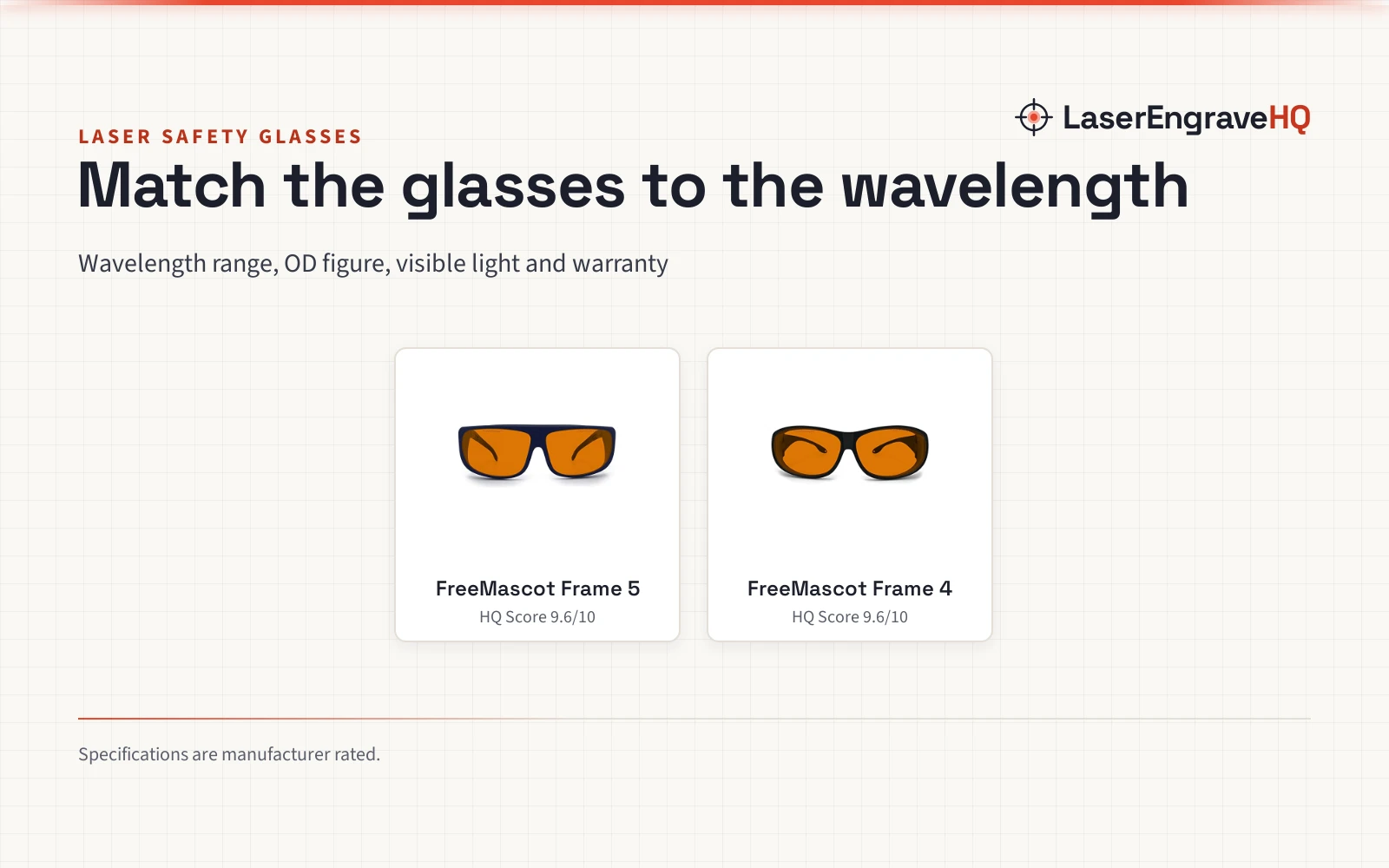
 FreeMascot Professional OD 6+ 190nm-490nm Wavelength9.7/10View on Amazon
- 3
 190nm-490nm OD 6+ Laser Safety Eye Protection Glasses UV9.6/10View on Amazon
- 4
 LaserPair Laser Safety Glasses 200-460nm OD6+ & 800-1095nmView on Amazon
- 5
 xTool Laser Safety GlassesView on Amazon
- 6
 JILERWEAR Laser Safety Glasses OD 6+ for 180-540nm VioletView on Amazon
- 7
 4 Pieces Laser Engraving Making Paper for Glass CeramicsView on Amazon
- 8
 Professional Laser Safety GlassesView on Amazon
- 9
 Phillips Safety Laser Safety Glasses for Co2/EximerView on Amazon
This laser safety glasses guide explains how to protect your eyes around engraving equipment: identify your machine wavelength, select eyewear with certified optical density, verify EN 207 markings, ensure wrap-around side coverage and balance visible light transmission so you can monitor your work clearly. Proper laser eyewear filters specific beam wavelengths to prevent eye injury from scattered reflections and accidental exposure. The sections below explain each selection step in order, followed by common mistakes and care rules for your workshop.
Other machines to compare
 LaserPair Laser Safety Glasses 200-460nm OD6+ & 800-1095nmCheck price on Amazon
 xTool Laser Safety GlassesCheck price on Amazon
 JILERWEAR Laser Safety Glasses OD 6+ for 180-540nm VioletCheck price on Amazon
 4 Pieces Laser Engraving Making Paper for Glass CeramicsCheck price on Amazon
 Professional Laser Safety GlassesCheck price on Amazon
 Phillips Safety Laser Safety Glasses for Co2/EximerCheck price on Amazon
LaserEngraveHQ earns a commission from purchases made through these links, at no extra cost to you. Read our affiliate disclosure.
Never rely on ordinary sunglasses, welding masks or unmarked tinted acrylic shields for laser operations. Protective eyewear safeguards your vision only when the maker states a verified optical density rating and an exact wavelength band that matches your machine.
Step 1: Identify your laser type and operating wavelength
Laser safety eyewear does not provide universal protection. A dedicated single-wavelength filter designed solely for a 450nm blue diode beam will offer no defense against a 1064nm infrared fiber beam. Your first task is identifying the exact operating wavelength of your laser source. Our guide to types of laser engraving breaks down how different beam sources operate in maker workshops.
Most desktop engravers use blue diode modules emitting at 450nm, with related diodes operating across 405nm and 445nm. Fiber laser sources used for metal marking operate in the infrared spectrum at 1064nm, as detailed in our guide to fiber laser engravers. In contrast, sealed-tube CO2 machines operate in the far-infrared region at 10600nm. Comparing a diode vs CO2 laser highlights these fundamental differences. Specialized ultraviolet systems emit at 355nm. You must verify your machine output before selecting glasses because eyewear marked solely for 450nm will not provide certified protection against 1064nm infrared radiation.
Step 2: Check the required optical density rating
Optical density, abbreviated as OD, measures a lens filter capacity to attenuate beam energy at a specific wavelength. Because optical density follows a logarithmic scale, each higher OD number reduces transmitted beam energy by an order of magnitude. For example, OD 5+ provides stronger attenuation than OD 4+, while OD 7+ provides higher protection against intense scattered reflections. Eyewear lacking a marked optical density rating cannot be verified for workshop safety.
Published equipment listings demonstrate how optical density pairs with wavelength coverage. For example, LP-LaserPair lists safety goggles offering OD 7+ protection across 180-534nm and 900-1095nm, alongside separate models delivering OD6+ protection from 200-460nm and OD7+ from 800-1095nm. Similarly, MCWlaser specifies OD 5+ across 190-540nm and 800-1700nm. Another maker, ULTREMA, lists OD 4+ across 200-2000nm. When reviewing our list of safety glasses for laser engraving, always confirm that the published OD rating matches the output power and operating wavelength of your machine.
Step 3: Verify certification under EN 207 standards
A printed label on a sales page does not guarantee protection unless backed by recognized safety standards. In professional and hobby workshops, reliable laser protective eyewear references formal standards such as European standard EN 207. Unlike basic optical density ratings that only measure light absorption, EN 207 requires eyewear lenses and frames to withstand direct laser beam strikes without shattering or melting.
In published reference specifications, LP-LaserPair lists CE certification by DIN CERTCO meeting EN207 and A1EN207 standards for laser eyewear. Similarly, MCWlaser documents compliance with Standard EN 207:2017. Laser equipment sold in the United States falls under regulatory guidelines established by the FDA Center for Devices and Radiological Health, known as CDRH, alongside workplace oversight from OSHA. Choosing eyewear certified to established standards ensures that your protective gear performs reliably under unexpected beam contact.
Step 4: Balance visible light transmission for clear view
Visible Light Transmission, abbreviated as VLT, indicates the percentage of normal ambient light that passes through the protective filter to your eyes. When laser glasses block specific hazard wavelengths, they also absorb portions of the visible spectrum. If the VLT is too low, your surroundings appear very dark, making it difficult to align workpieces or inspect engraving progress.
Reference listings publish widely differing VLT figures depending on the filter formulation. For example, ULTREMA lists a visible light transmittance of 15% on its broad-spectrum glasses. MCWlaser publishes 35% visible light transmittance on its multi-wavelength frame. Across its specialized models, LP-LaserPair lists visible light transmission percentages including 10%, 20%, 23%, 29%, 30%, 40%, 43%, 45%, 50% and 70%. For detailed engraving work, select the highest VLT that still delivers the required optical density for your laser wavelength, and add adequate workshop lighting if your filter has a lower VLT percentage.
Step 5: Select frame style, side shield coverage and fit
Laser radiation scatters in every direction when a beam strikes wood, metal or acrylic. Standard flat eyeglasses leave large gaps around the temples and cheeks where reflected light can enter. Effective protective eyewear features wrap-around frames or integrated side shields to prevent peripheral beam entry.
Makers publish specific frame measurements and weights to guide user selection. For example, MCWlaser lists an over-glasses design weighing 0.05 kg designed to fit comfortably over prescription spectacles. Across several wrap-around models, LP-LaserPair publishes frame dimensions of 6.3 x 6.3 x 2.05 inches with weights of 0.1 kg, 0.19 kg, 1.6 ounces and 3.52 ounces, including temple widths of 20 centimeters and 160 mm. The same maker also publishes 7.5 x 7.5 x 2 inches frames weighing 2.5 ounces molded from TR90 resin and polycarbonate. ULTREMA lists a lightweight polycarbonate frame at 1.44 ounces. Pairing well-fitted eyewear with laser engravers with enclosures provides multi-layered protection in any workspace.
Step 6: Avoid unrated materials and common workshop hazards
Eye protection is only one component of a safe engraving environment. Workshop operators must also control material hazards and airborne emissions. Never cut or engrave PVC, vinyl, PVC-based faux leather, polycarbonate or ABS on any laser machine. Under intense beam heat, PVC and vinyl release toxic chlorine gas and hydrogen chloride, which can cause severe respiratory irritation and corrode machine components. Polycarbonate melts and catches fire easily, while ABS releases hazardous airborne fumes.
Proper ventilation is equally critical when processing approved materials such as plywood, leather and slate. Laser engraving produces dense smoke and fine particulates that must be vented outdoors or captured using dedicated fume extractors for laser engravers. In addition, always keep a suitable fire extinguisher within reach and never leave an active engraving job unattended.
Step 7: Inspect lenses and follow proper cleaning rules
Protective eyewear requires regular inspection and careful cleaning to preserve its optical properties. Scratched, pitted or cracked lenses can allow stray radiation to penetrate. Inspect your glasses before every engraving session and replace damaged eyewear immediately.
Cleaning requirements depend on frame and lens construction. For example, product documentation for LP-LaserPair explicitly states: Do not use alcohol or alcohol containing disinfectant to wipe the frame, because solvents can degrade polymer frame materials. In contrast, MCWlaser notes that its reinforced optical lens is alcohol-resistant. To avoid damaging coatings or frame plastics, follow the specific care instructions for your model, use mild soap and water with a soft lint-free cloth when in doubt, and store glasses in a protective case away from direct sunlight. Warranty coverage varies among suppliers: ULTREMA provides a 1 Year Manufacturer replacement service, while LP-LaserPair lists a 2 Year Manufacturer term on select models, with other listings stating no warranty.
Common mistakes to avoid
- Using ordinary tinted sunglasses or welding shades that lack verified optical density ratings.
- Choosing glasses for the wrong wavelength, such as wearing 450nm diode glasses while operating a 1064nm fiber machine.
- Selecting flat eyewear without side shields, leaving gaps where reflected beams can reach your eyes.
- Failing to account for low visible light transmission on dark protective filters, leaving the workspace too dim to inspect work safely.
- Wiping frames with alcohol when the product care instructions warn that solvents degrade frame polymers.
Laser safety glasses guide: the short version
- Identify your machine beam type and operating wavelength.
- Check that the optical density rating matches your machine output power.
- Verify formal certification under EN 207 standards.
- Balance visible light transmission with required optical density to maintain visibility and protection.
- Select wrap-around frames or side shields that prevent peripheral light leakage.
- Follow maker cleaning instructions and use mild soap and water rather than unapproved solvents.
Following these steps ensures reliable eye protection whenever you power on your engraving equipment. Always keep your safety glasses on before firing the laser beam and ensure everyone in the workspace wears matching protective gear.
FAQ: lasers and CNC
Can I use ordinary sunglasses for laser engraving?
No. Ordinary sunglasses reduce visible glare but provide no protection against intense laser radiation. Laser safety glasses use specialized absorbing dyes or reflective coatings calibrated to block exact wavelengths such as 450nm or 1064nm at verified optical density levels.
What does optical density mean on laser glasses?
Optical density, or OD, measures how effectively a filter blocks beam energy at a specific wavelength. Higher ratings, such as OD 5+ or OD 7+, provide greater beam attenuation. Protective eyewear must always state both the OD rating and the exact wavelength range it covers.
Can a single pair of safety glasses protect against multiple laser types?
Yes, if the glasses are certified multi-wavelength models. Reference listings from LP-LaserPair and MCWlaser demonstrate filters that cover both 450nm diode wavelengths and 1064nm fiber wavelengths. However, no single pair protects against every existing wavelength, so you must always verify that your machine output falls within the filter marked coverage range.
What is visible light transmission?
Visible Light Transmission, or VLT, indicates how much ordinary ambient light passes through the lens. Listings in our reference data publish VLT values ranging from 10% to 70%. Higher VLT provides a brighter view of your engraving workpiece, while lower VLT creates a darker image.
Do I need safety glasses if my laser has an enclosure?
You should still wear matching protective glasses. An enclosure or orange shield provides verified protection only if its listing explicitly states a certified optical density and a matching wavelength rating. Unrated tinted acrylic panels do not qualify as certified eye protection against scattered laser radiation.
How should I clean laser safety goggles?
Clean lenses and frames using mild soap and water with a soft, lint-free cloth. Check maker care instructions before using any chemicals, as some frames are damaged by alcohol or harsh disinfectants, and store eyewear in a protective case when not in use.
Related: the laser safety hub, best safety glasses for laser cutting and how to choose laser safety glasses. Also see our guide explaining what is a CO2 laser engraver.