Od5 vs Od7 Laser Safety Glasses: Which One Should You Buy?
od5 vs od7 laser safety glasses compared: what the ratings mean, how to match wavelength range to a laser, and what two OD5+ pairs actually state.

On this page
Top picks at a glance
As an Amazon Associate I earn from qualifying purchases.
- 1
 Laser Safety Glasses OD5+ 190-540nm & 800-1700nm9.6/10View on Amazon
- 2
 LaserPair Laser Safety Glasses 200-460nm OD6+ & 800-1095nm9.7/10View on Amazon
- 3
 Laser Safety Goggles OD5+9.6/10View on Amazon
- 4
 190‑490nm OD6+ Laser Safety Glasses Adjustable FrameView on Amazon
- 5
 Laser Safety GlassesView on Amazon
- 6
 1064nm Laser Safety Glasses for YAG Fiber Laser EngraverView on Amazon
- 7
 Professional OD6+ CO2 Laser Safety GlassesView on Amazon
Standing at a laser engraver with a fresh design ready to run, eye protection is the piece of gear that has to match the machine before anything starts. The question behind od5 vs od7 laser safety glasses is simple: which optical density rating gives enough protection for the laser in the shop, without dimming the work area so much that alignment becomes guesswork. The short answer is that the rating only helps when it comes with a wavelength range that covers the laser being used, and a pair that states OD5+ can be the right choice for many diode, blue, green and YAG setups, while a higher rating is worth seeking when the machine or the material calls for stronger attenuation.
Other machines to compare
 190‑490nm OD6+ Laser Safety Glasses Adjustable FrameCheck price on Amazon
 Laser Safety GlassesCheck price on Amazon
 1064nm Laser Safety Glasses for YAG Fiber Laser EngraverCheck price on Amazon
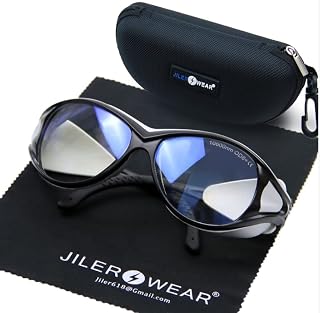 Professional OD6+ CO2 Laser Safety GlassesCheck price on Amazon
LaserEngraveHQ earns a commission from purchases made through these links, at no extra cost to you. Read our affiliate disclosure.
od5 vs od7 laser safety glasses: what the ratings mean
Optical density, written as OD, describes how strongly a lens attenuates laser light at the wavelengths it is rated for. A higher OD number means stronger attenuation at those wavelengths, and a lower number means weaker attenuation. That is the whole comparison in one line, and it is also why the number alone never settles the choice: a high rating at the wrong wavelengths does not protect the eyes from the laser actually in use.
The plus sign in OD5+ matters too. It signals a rating of OD5 or better at the stated wavelengths, as listed by the maker, rather than a single fixed value across every wavelength. Both pairs featured below state OD5+, so neither listing claims the higher OD7 rating. Readers shopping for OD7 specifically should look for a listing that states OD7 and a wavelength range that matches their machine, and should not assume that an OD5+ pair covers an OD7 requirement.
Visible light transmittance, often shortened to VLT, is the other figure that shapes daily use. It describes how much ordinary visible light reaches the eyes through the lens. A higher VLT keeps the work area brighter and makes alignment easier to see, while a lower VLT dims the view more. The pairs below state different VLT figures, so brightness in use is a real point of difference between them.
Match the rating to the laser wavelength
Matching starts with the machine, not the glasses. Find the laser wavelength or wavelength range in the machine manual, then compare it with the range stated on the glasses listing. If the machine wavelength falls inside the stated range, the pair is a candidate. If it falls outside the stated range, the pair is not a match for that machine, whatever its OD number says.
Diode, blue and green lasers, ND:YAG lasers and fiber lasers cover different wavelength ranges, and those ranges overlap: a fiber laser and an ND:YAG laser can share the 1064nm region, so the listings below must be checked wavelength by wavelength rather than by laser type alone. A pair that covers blue and green diode wavelengths may not cover a fiber laser wavelength, and a pair rated for one band should never be treated as covering every laser in the shop. Where a listing gives no range for a particular machine type, the honest entry is Not stated, and the reader should check with the maker before relying on the pair for that machine.
The gear section: pairs that state OD5+
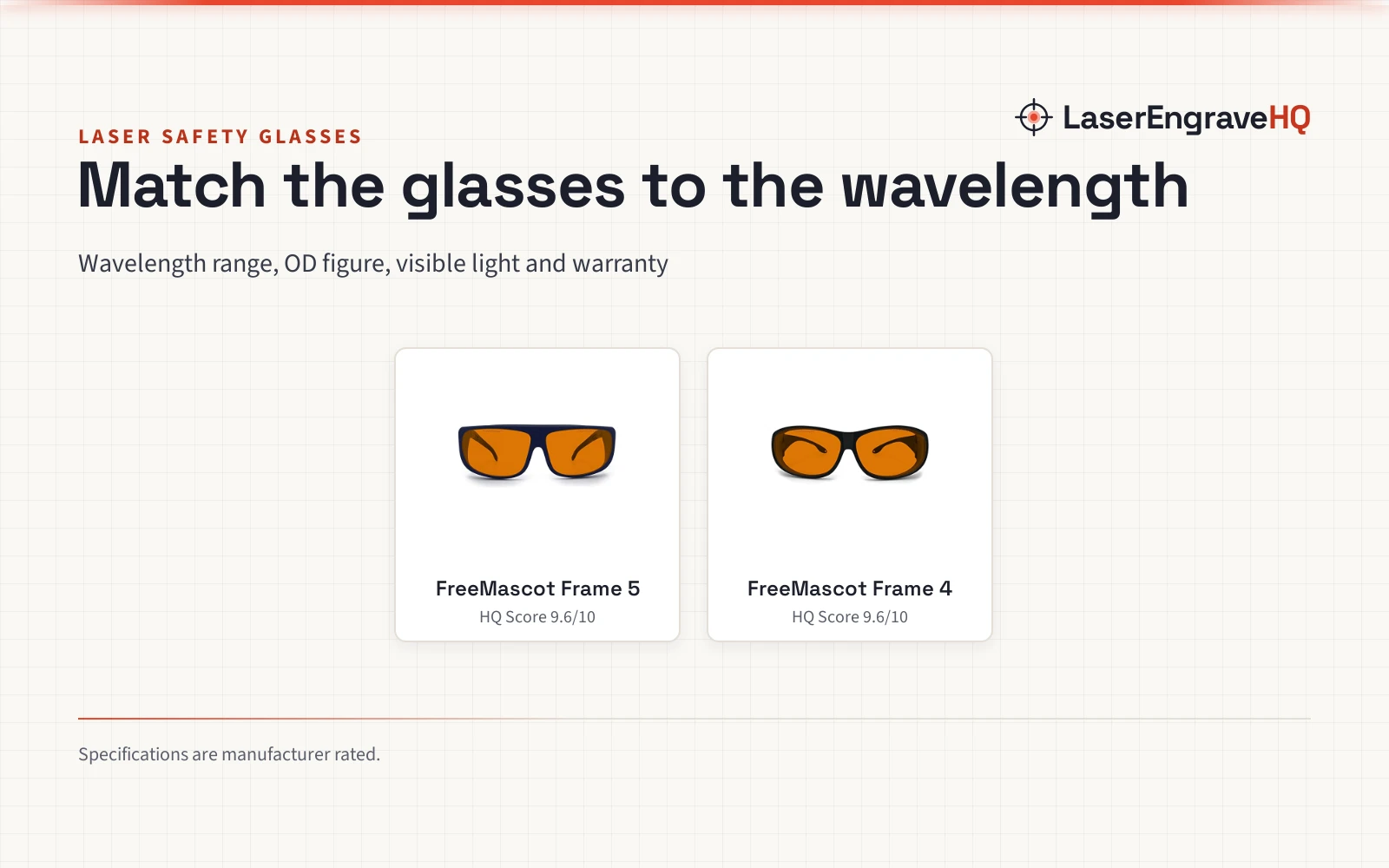
The pairs below are ranked by the breadth of their stated wavelength coverage and the detail of their stated certifications, with the broader infrared coverage first. Both state OD5+ and both name blue, green, diode and YAG use. The differences are in range, visible light transmittance, lens material and coverage design.
MCWlaser 190-540nm and 800-1700nm glasses. The listing states OD5+ with absorption type lenses, a visible light transmittance of 35%, and CE certification to standard EN 207:2017. Its title states a range of 190-540nm and 800-1700nm, while its bullets state 190nm-550nm and 800nm-1700nm, so the upper end of the lower band reads 540nm in the title and 550nm in the bullets; both figures are stated here because the listing contradicts itself on that point. The bullets name compatibility with wavelengths including 405nm, 445nm, 450nm, 532nm, 808nm, 980nm, 1064nm and 1080nm, and the listed applications include ND:YAG, diode, blue and green laser protection and UV resin work. The broader upper range, reaching 1700nm, is the reason this pair ranks first here.
JustHot Professional OD5+ wrap-around glasses. The listing states OD5+ protection across 190-540nm and 800-1100nm, with 20% visible light transmission, thickened coated polycarbonate lenses described as scratch-resistant and shatterproof, and a wrap-around frame with side shields and eyebrow protection. Its listing names CE EN207 and what it calls FDA international standards, and its spec table lists a 30 DAY warranty description. The listed laser types include UV, blue, green, diode, fiber, ND:YAG and infrared radiation, and the listed uses include laser marking and engraving. The wrap-around coverage and the named FDA standards are its strengths, while its stated infrared range ends at 1100nm, narrower than the MCWlaser pair, and its lower VLT dims the view more.
Neither listing states a rating for CO2 lasers, so CO2 coverage is Not stated for both pairs, and neither listing states an OD7 rating. Readers with a CO2 machine, or with a written OD7 requirement, need a different listing that states that coverage directly.
What to check before you buy
Run through this list against the listing, not against a general idea of what glasses should do:
- Wavelength range: the machine wavelength must fall inside the range the listing states, including both bands where the listing gives a split range.
- OD rating: the listing must state an OD value, and the value must meet the requirement for the job. OD5+ is not OD7, and the listing should be read as written.
- Visible light transmittance: compare the stated VLT figures when alignment visibility matters. The pairs above state 35% and 20% respectively.
- Coverage and fit: wrap-around side shields and eyebrow protection change how much stray light reaches the eyes from the sides. Check whether the listing states that coverage.
- Standards stated: note which standards the listing actually names, such as CE EN207, and do not read a standard into a listing that does not state one.
Safety habits around the laser
Eyewear is one layer of a safe setup, not the whole setup. Ventilation matters on every job: exhaust fumes outdoors or use a filter designed for laser fumes, and never leave a running job unattended, since a laser can start a fire. An enclosure or a rated barrier adds another layer; see our laser enclosure vs safety curtain comparison for that side of the setup. Our materials you should never laser cut guide lists PVC, vinyl, PVC-based faux leather, polycarbonate and ABS as materials to avoid, since those materials can release harmful fumes and damage the machine.
FAQ: lasers and CNC
Do I need OD7 if my glasses state OD5+?
It depends on the requirement for the job. OD7 means stronger attenuation than OD5 at the rated wavelengths, so where a machine manual, a workplace rule or a job specification calls for OD7, an OD5+ pair does not meet that requirement, even if its wavelength range matches. Where no higher rating is required and the wavelength range matches, an OD5+ pair that states the right range is the listed level of protection.
Can one pair cover diode, fiber and YAG lasers?
Only if the listing states a range that covers the wavelengths of each machine in use. The pairs above both name diode, blue, green and YAG wavelengths, and the JustHot listing also names fiber lasers, but coverage must be checked wavelength by wavelength against each machine manual. A pair that covers one machine type is not automatically a match for another.
What does visible light transmittance change in use?
Visible light transmittance describes how much ordinary light passes through the lens, so it changes how bright the work area looks during alignment and setup. The MCWlaser listing states 35% and the JustHot listing states 20%, so the MCWlaser pair keeps the view brighter on the stated figures, while the JustHot pair dims it more. Neither figure changes the OD rating; it only describes brightness.
Do safety glasses replace an enclosure?
No. Glasses protect the eyes of the person wearing them, while an enclosure or barrier helps contain the beam and the fumes for everyone in the room. The two layers work together, and a shop that relies on glasses alone is missing the enclosure layer.
How do I match glasses to my laser?
Read the machine wavelength from the manual, then read the OD and the wavelength range from the glasses listing, and confirm the machine wavelength falls inside the stated range. Then check the stated VLT, the coverage design and the standards the listing names. If any of those entries reads Not stated for the machine in question, check with the maker before relying on the pair. For the full safety picture, see the laser safety glasses guide and the how to choose laser safety glasses guide.
Are the pairs above suitable for CO2 lasers?
Not stated. Neither listing in this guide states a range for CO2 lasers, so neither pair can be recommended for CO2 use on the basis of these listings. Readers with a CO2 machine should find a listing that states CO2 coverage directly.
Related: the laser safety glasses guide, how to choose laser safety glasses, best laser safety glasses for diode lasers and best laser safety glasses for fiber laser. Also see od5 vs od6 laser safety glasses for the next rating step down.