Od5 vs Od6 Laser Safety Glasses: Which One Should You Buy?
Two laser safety glasses pairs, one OD5+ and one OD6+, compared on wavelength range, transmittance, fit and stated standards.

On this page
Top picks at a glance
As an Amazon Associate I earn from qualifying purchases.
- 1
 Laser Safety Glasses OD5+ 190-540nm & 800-1700nm9.6/10View on Amazon
- 2
 LaserPair Laser Safety Glasses 200-460nm OD6+ & 800-1095nm9.7/10View on Amazon
- 3
 Laser Safety Goggles OD5+9.6/10View on Amazon
- 4
 1064nm Laser Safety Glasses for YAG Fiber Laser EngraverView on Amazon
- 5
 OD6 Laser Safety Glasses UV light Violet Blue for 405nmView on Amazon
- 6
 Professional OD6+ CO2 Laser Safety GlassesView on Amazon
- 7
 xTool Laser Safety GlassesView on Amazon
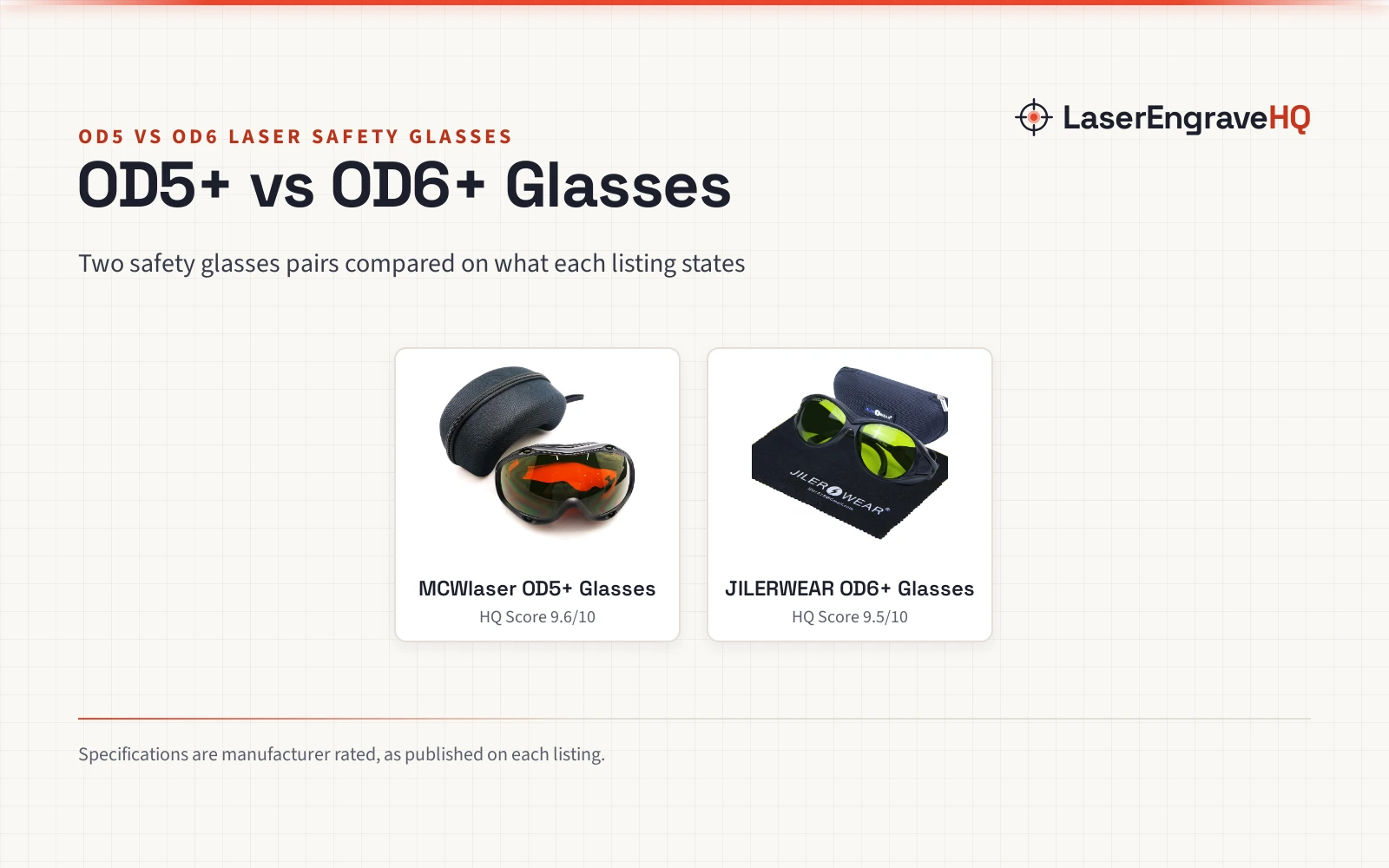
A laser engraver throws a bright beam at wood, leather and acrylic, and the operator’s eyes need protection matched to that beam. The od5 vs od6 laser safety glasses question turns on optical density and the wavelength range each pair covers. This comparison puts the MCWlaser pair against the JILERWEAR pair, using what each listing states about density, range, transmittance and fit.
LaserEngraveHQ earns a commission from purchases made through these links, at no extra cost to you. Read our affiliate disclosure.
Verdict: pick the MCWlaser OD5+ pair for its 190-540nm and 800-1700nm coverage and over-glasses fit. Pick the JILERWEAR OD6+ pair for OD6+ density at 808, 980 and 1064 nm work. Match the pair to your laser’s wavelength, not to the density number alone.
Machines on the list

Laser Safety Goggles OD5
An OD5+ absorption pair covering 190-540nm and 800-1700nm, with a 35% transmittance and an over-glasses fit.
Pros
- OD5+ protection over 190-540nm and 800-1700nm, including 445nm, 450nm, 455nm, 532nm, 808nm, 980nm and 1064nm
- 35% visible light transmittance for a clear view of the work
- Large body fits over prescription eyeglasses, with flank and eyebrow protection
- CE available to EN 207:2017, with a hardened polycarbonate lens
Cons
- Spec table lists 10600nm, reflective type and 99.7% transmittance against the bullets
- No warranty term is stated
- No frame dimensions are stated
- Large body made to fit over prescription glasses, with no slim-fit option stated

JILERWEAR Professional OD6+ Laser Safety Glasses
An OD6+ pair for 180-420 and 740-1100 nm work, with a 60% transmittance and a skinny fit.
Pros
- OD6+ density for 808, 980 and 1064 nm YAG, semiconductor and fiber work
- 60% visible light transmittance for a bright view
- Lightweight at 30 g with a flexible frame
- Full rim frame with a professional protective laser coating
Cons
- Listing gives no bullet details beyond the title and spec table
- Spec table lists 9000-10600nm and CO2 use against the title ranges
- No warranty term is stated
- No EN 207 or CE statement is listed
Other machines to compare
 1064nm Laser Safety Glasses for YAG Fiber Laser EngraverCheck price on Amazon
 OD6 Laser Safety Glasses UV light Violet Blue for 405nmCheck price on Amazon
 Professional OD6+ CO2 Laser Safety GlassesCheck price on Amazon
 xTool Laser Safety GlassesCheck price on Amazon
Side by side
| Spec | MCWlaser OD5+ Glasses | JILERWEAR OD6+ Glasses | What it means |
|---|---|---|---|
| HQ Score | 71 | 67 | Raw totals from the scores below |
| Optical density | OD5+ | OD6+ | Density at the rated wavelengths |
| Wavelength range | 190-540nm and 800-1700nm | 180-420 and 740-1100 nm | Match the range to your laser |
| Visible light transmittance | 35% | 60% | Higher means a brighter view |
| Lens material | Polycarbonate | Polycarbonate | Same lens material on both pairs |
| Fit | Over glasses, large body | Skinny fit | Check fit before ordering |
| Certification | CE available, EN 207:2017 | Not stated | Stated standard or none |
| Weight | 0.05 kg | 30 g | As listed, in different units |
| Warranty | Not stated | Not stated | No term stated on either listing |
Specifications are manufacturer rated, as published on each listing and collected 28 October 2026.
od5 vs od6 laser safety glasses: the difference
Optical density is the figure on the pair, and the wavelength range says where that figure applies. The MCWlaser pair is OD5+ over 190-540nm and 800-1700nm, while the JILERWEAR pair is OD6+ over 180-420 and 740-1100 nm. A higher density number does not extend the range: each pair covers only its stated wavelengths, so the range matters as much as the number. See the laser safety glasses guide for how density and wavelength work together.
Eyewear protects only where the listing states both a density and a wavelength range that matches the machine. Tinted acrylic or an orange shield without a stated density is not protection. Check the machine’s wavelength against the stated range before ordering.
Wavelength coverage and contradictions
The MCWlaser bullets list typical wavelengths including 445nm, 450nm, 455nm, 532nm, 808nm, 980nm and 1064nm, for Alexandrite, green, blue, diode, fiber, ND: YAG and KTP work. Its spec table disagrees, listing a 10600nm range, a reflective type and 99.7% transmittance against the bullets, which say absorption type and 35% transmittance. This comparison trusts the bullets, so the 10600nm figure is not counted as coverage.
The JILERWEAR title is clear about its range: 180-420 and 740-1100 nm, designed for 808, 980 and 1064 nm YAG, semiconductor and fiber laser engraving. Its spec table lists a 9000-10600nm wavelength and CO2 use, which conflicts with the title. This comparison trusts the title, so CO2 coverage is not counted for either pair. For diode versus CO2 differences, see the diode vs CO2 guide.
Transmittance and visibility
Visible light transmittance says how much ordinary light reaches the eye through the lens. The MCWlaser pair gives 35% and the JILERWEAR pair gives 60%, so the JILERWEAR view is brighter on the stated figures. A brighter view helps with positioning work.
Fit and build
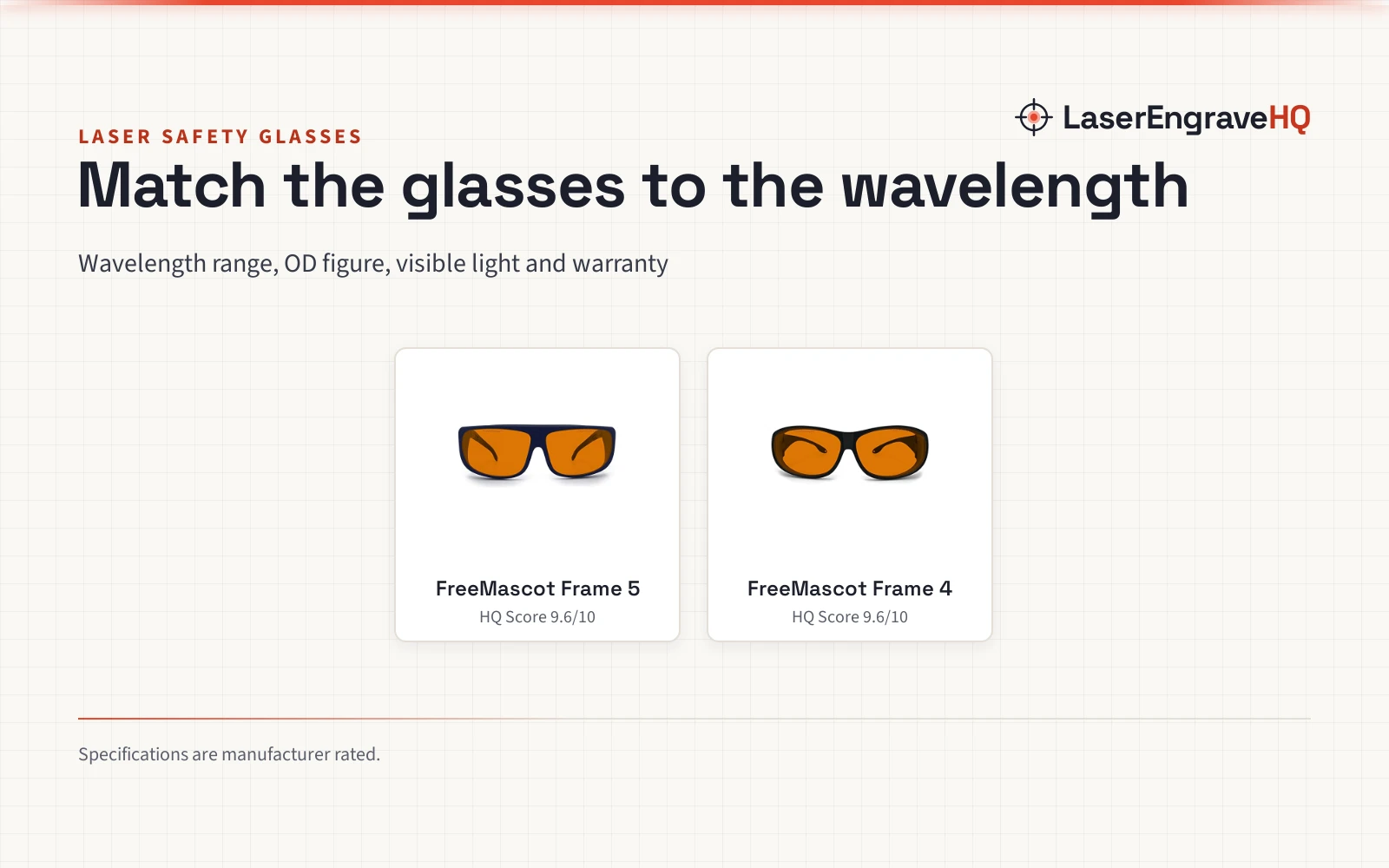
The MCWlaser pair has a large body that fits over prescription eyeglasses, with flank and eyebrow protection and a hardened polycarbonate lens in a lightweight black polycarbonate frame. The JILERWEAR pair has a skinny fit, a flexible full rim frame, a professional protective laser coating and a polycarbonate lens. Weights are listed in different units, 0.05 kg and 30 g, so this comparison states each as listed without converting. The JILERWEAR dimensions are 5.91 x 1.97 x 2.36 inches, with a 10 centimeter temple-to-temple width; the MCWlaser listing gives no frame dimensions.
Choose the MCWlaser OD5+ Glasses if
- You work across blue, green, diode and fiber wavelengths the listing names, including 445nm, 532nm, 808nm and 1064nm.
- You wear prescription glasses and want a pair that fits over them.
- A stated EN 207:2017 CE availability matters for your shop.
Choose the JILERWEAR OD6+ Glasses if
- You work at 808, 980 or 1064 nm and want the OD6+ density.
- You want a brighter view at 60% transmittance.
- You want a lightweight 30 g pair with a skinny fit.
For more fiber options, see best laser safety glasses for fiber laser.
Match the glasses to your machine’s wavelength and density figure. Never rely on a tinted shield without a stated OD and wavelength range, and never laser PVC or vinyl. See the laser safety glasses vs acrylic shield comparison for why a shield is not a substitute for rated eyewear.
Project Match
- Fiber laser engraving at 1064 nm: either pair lists 1064 nm coverage.
- Blue and green diode work from 445nm to 532nm: the MCWlaser pair lists those wavelengths.
- Semiconductor and YAG work at 808 and 980 nm: the JILERWEAR pair is designed for those wavelengths, and the MCWlaser pair lists both.
- CO2 laser work at 10600 nm: Not stated in the MCWlaser bullet ranges or the JILERWEAR title range, and the spec tables disagree with the bullets and title.
FAQ: lasers and CNC
Is OD6 better than OD5?
OD6+ is a higher density figure than OD5+, but only within its stated range. The JILERWEAR OD6+ pair covers 180-420 and 740-1100 nm, while the MCWlaser OD5+ pair covers 190-540nm and 800-1700nm, so pick by matching your laser’s wavelength to the stated range, not by the number alone.
Can I wear these over prescription glasses?
The MCWlaser pair has a large body that fits over prescription eyeglasses. The JILERWEAR pair has a skinny fit and states no over-glasses fit, so check its dimensions of 5.91 x 1.97 x 2.36 inches against your frames.
Why do the spec tables disagree with the bullets?
The MCWlaser spec table lists 10600nm, a reflective type and 99.7% transmittance against bullets that say absorption type, 190-540nm and 800-1700nm ranges and 35% transmittance. The JILERWEAR spec table lists 9000-10600nm and CO2 use against title ranges of 180-420 and 740-1100 nm. This comparison trusts titles and bullets over spec tables.
Do these glasses cover CO2 lasers?
Neither the MCWlaser bullet range nor the JILERWEAR title range covers 10600 nm, so CO2 coverage is not counted for either pair here. Check your machine’s wavelength against the stated range, and see how to choose laser safety glasses before ordering.
Related: laser safety glasses guide, best laser safety glasses for fiber laser, laser safety and diode vs CO2 guide.