30w vs 50w Fiber Laser: Which One Should You Buy?
A practical comparison of 30W and 50W fiber lasers: understand marking speed, deep engraving depth, cycle times and which power level suits your metal projects.

On this page
Top picks at a glance
As an Amazon Associate I earn from qualifying purchases.
- 1
 GWEIKE G2 Max 50W Fiber Laser Engraver with 3D & Deep9.7/10View on Amazon
- 2
 OMTech 50W Fiber Laser Engraver Machine9.5/10View on Amazon
- 3
 xTool F1 Ultra 20W Fiber & Diode Dual Laser Engraver 16MP9.7/10View on Amazon
- 4
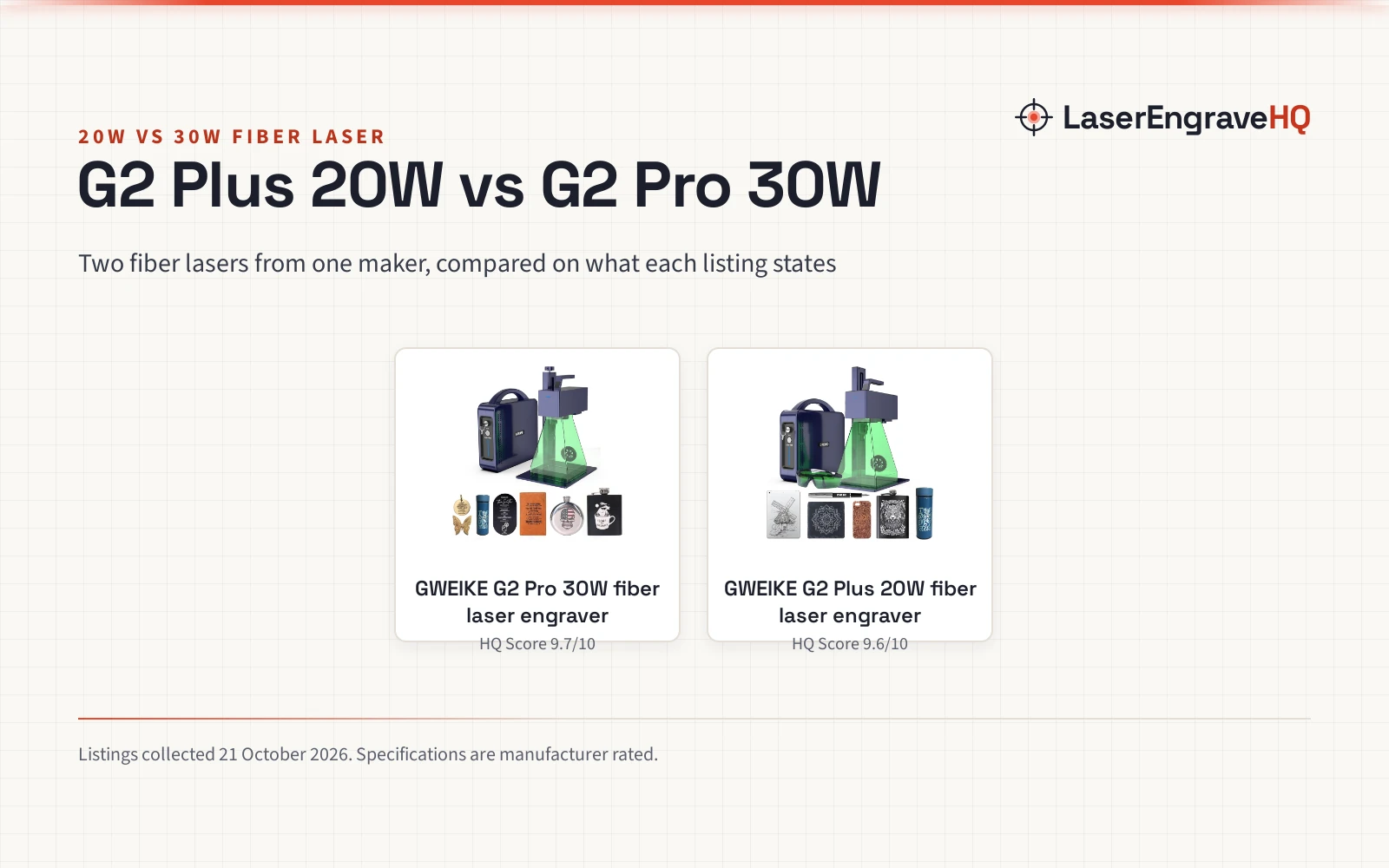
 GWEIKE G2 Pro 30W Fiber Laser EngraverView on Amazon
- 5
 Longer Laser B1 30W Laser Engraver Cutter with Auto Air AssistView on Amazon
If you plan to mark stainless steel tumblers, serialize brass tags, engrave silver jewelry or personalize knives, deciding between a 30w vs 50w fiber laser comes down to marking speed, engraving depth and cycle time. A 30W fiber laser delivers plenty of optical output for sharp surface marking, dark annealing on bare metals and shallow engraving at a lower investment. A 50W fiber laser provides higher optical power density to vaporize metal faster, carve deep relief into coin dies or firearm slides, and cut thin metal sheet with significantly fewer passes. For low-volume custom gifts and barcode marking, a 30W system handles daily jobs with ease, whereas production workshops needing deep metal removal or rapid batch throughput benefit from stepping up to 50W.
Other machines to compare
 GWEIKE G2 Pro 30W Fiber Laser EngraverCheck price on Amazon
 Longer Laser B1 30W Laser Engraver Cutter with Auto Air AssistCheck price on Amazon
LaserEngraveHQ earns a commission from purchases made through these links, at no extra cost to you. Read our affiliate disclosure.
Both 30W and 50W fiber lasers operate at a 1064nm wavelength and process the same metal families. Extra wattage does not automatically mean sharper resolution; detail depends on your scan lens, galvo accuracy, and beam quality. Wattage primarily determines material removal rate, maximum practical depth, and cycle duration on deep passes.
How fiber galvo systems deliver optical power
To understand the practical differences between power ratings, it helps to examine how a galvanometer fiber marker operates. Unlike gantry lasers that move a heavy toolhead along mechanical rails, a fiber laser generates its beam inside an optical fiber doped with rare-earth elements at a 1064nm wavelength. This invisible infrared beam routes into a compact galvo head, where high-speed motorized mirrors steer the focused spot across the workpiece.
Because galvanometer mirrors have minimal mass, these systems achieve rapid marking speeds. Manufacturer listings illustrate these capabilities across different models: GWEIKE lists its G2 Pro 30W fiber laser achieving marking speeds up to 15000 mm/s with an accuracy rating down to 0.001 mm. OMTech lists its solid-state 30W fiber marker operating at speeds up to 10000 mm/s with an accuracy rating of 0.01 mm, while Monport lists its 30W units at speeds up to 10000 mm/s. Rated marking speed reflects galvanometer mirror positioning limits, while your chosen optical power determines how much metal vaporizes during each pass. If you are new to this machine category, our guide on what is a fiber laser engraver explains the core optical setup.
Surface marking and high-contrast annealing
Most workshop tasks involve surface modification rather than removing material depth. Typical jobs include adding serial numbers, QR codes, logos and annealing marks to stainless steel, aluminum, titanium, brass and copper.
For surface marking, a 30W fiber laser delivers exceptional results. Annealing stainless steel involves heating the metal surface without vaporizing it, creating a durable oxide layer that changes appearance based on heat input. The maker of the GWEIKE G2 Pro 30W fiber laser lists the ability to mark over 90+ colors on metals such as stainless steel and titanium. Because surface marking requires controlled surface heating rather than deep ablation, jumping to 50W offers minimal speed advantage on flat surface graphics. A 30W unit creates clean dark marks on titanium, crisp marks on bare aluminum tags, and bright etches on hardened steel with outstanding clarity.
Deep metal engraving and material removal
When your workflow shifts from surface etching to deep relief carving, wattage becomes the deciding factor. Deep engraving is essential for custom coin dies, embossed stamps, gunsmithing, mold making and tactile serial plates. Learn more about depth limits in our practical guide on how deep a fiber laser can engrave.
Removing solid metal requires vaporizing metal layer by microscopic layer. While 30W units support deep work (for example, Monport lists 2.5D deep metal engraving on its 30W machines, and GWEIKE lists 3D embossing capabilities), progress requires dozens or hundreds of repetitive passes. A 50W fiber laser delivers greater pulse energy per burst. It vaporizes more metal volume on every sweep, cutting cycle times dramatically on deep relief jobs while reducing thermal buildup in the workpiece.
Thin sheet metal cutting capabilities
A frequent question among jewelers and custom fabricators is whether a galvo fiber marker can cut sheet metal. As detailed in our guide on whether a fiber laser can cut metal, galvo fiber systems do not function like heavy industrial CNC fiber cutting tables with assist gas. Instead, galvo cutting works through repeated ablation along vector outlines.
A 50W fiber laser handles thin jewelry sheets, brass pendants and custom silver charms far more effectively than a 30W machine. The higher power density punches through thin metal stock with fewer passes, leaving smoother edge walls with less slag accumulation. A 30W laser can slice thin metal foil, but cutting thicker sheet requires excessive passes that transfer excess heat into the surrounding stock, resulting in burned edges and distortion.
Lens selection, working area, and optical density
Galvo fiber lasers rely on specialized F-theta scan lenses that determine both the working field dimensions and the optical spot diameter. Choosing a lens directly impacts the effective energy density delivered to your material.
Common lens configurations found in manufacturer listings include compact 110×110 mm fields (listed on GWEIKE models), standard 150x150mm fields (listed on GWEIKE and Monport units), 5.9″x5.9″ fields (listed by OMTech and Monport), and larger 175×175 mm fields (listed on OMTech models with 6.9″x6.9″ workspace). Swapping to a larger field lens expands the focused spot diameter and disperses optical power across a wider surface area.
On a 30W laser, running a larger field lens can reduce surface power density to the point where deep engraving slows down noticeably. A 50W fiber laser provides the extra energy margin required to drive larger marking fields without losing efficient processing tempo.
Source lifespan, reliability, and workshop workflow
Solid-state fiber laser sources offer exceptional operating lifespans compared to consumable glass CO2 tubes. Reference listings for desktop fiber units illustrate this durability: OMTech and Monport both list an estimated fiber laser source operating lifespan of up to 100,000 hours. Read our detailed analysis on how long does a fiber laser last for maintenance best practices.
Because solid-state fiber laser sources do not require water chiller refills, mirror alignment or routine tube replacements, day-to-day machine maintenance remains minimal across both power tiers. Where workflow diverges is production capacity on deep engraving and multi-pass metal removal. If your daily work consists of shallow surface marks and serialized tags, galvo mirror speed is the primary pacing factor and both wattages perform similarly. But if your shop produces deep relief coin dies, tactile engravings, or cuts custom metal blanks, a 50W laser removes material in substantially fewer passes, significantly reducing cycle time on intensive batch jobs. For commercial batch work, compare top-rated machines in our guide to the best fiber laser engraver and our curated picks for the best laser engraver for metal.
Essential workshop safety and beam containment
Operating a fiber laser demands strict safety protocols. Fiber lasers operate in the 1064nm near-infrared band, which is completely invisible to the human eye. Because the human blink reflex does not trigger on invisible wavelengths, stray reflections can cause severe, permanent retinal damage before you realize exposure occurred.
Safety classifications vary across manufacturer listings depending on housing and beam guidance. Open-frame models from GWEIKE and Monport list a Class 4 safety rating, requiring comprehensive optical safety controls. GWEIKE also states FDA Accession Number 2211667-002 and includes protective glasses along with an emergency stop button. Always verify that your eyewear is rated specifically for 1064nm with adequate optical density, as outlined in our laser safety glasses guide. Never rely on orange or green acrylic shields meant for blue diode lasers.
Additionally, vaporizing bare metals generates fine metal particulate fumes. An effective extraction system is mandatory to maintain safe workshop air; consult our fume extractor guide to select appropriate filtration. Finally, review our comprehensive list of materials you should never laser cut: never process PVC, vinyl, PVC-based faux leather, polycarbonate or ABS under any laser, as thermal decomposition releases toxic gases and corrosive acids that destroy optical components.
30w vs 50w fiber laser: the short version
- Choose 30W if your work consists primarily of surface marking, barcode serialization, personalized pens, jewelry engraving, and light production batches.
- Choose 50W if your business requires deep metal relief carving, custom coin dies, embossing stamps, or thin jewelry sheet cutting.
- Choose 50W if you regularly operate larger marking field lenses, where higher wattage compensates for beam expansion.
- Choose 30W if machine budget is your primary constraint, as it handles surface marking and light engraving across standard metal blanks.
FAQ: lasers and CNC
Can a 30W fiber laser cut brass or silver jewelry blanks?
A 30W fiber laser can separate thin metal foil or thin craft sheet using repeated vector passes, but the process requires significant time and can introduce heat buildup into small workpieces. A 50W fiber laser cuts thin precious metal sheets and brass blanks more cleanly and in fewer passes, though galvo markers remain primarily engraving and marking machines rather than dedicated industrial cutting tables.
Does a 50W fiber laser engrave with finer detail than a 30W laser?
No. Finer graphic detail and resolution depend on optical spot diameter, precision galvanometer calibration and lens focal length, rather than laser wattage. Manufacturer listings cite accuracy ratings such as 0.001 mm on GWEIKE models and 0.01 mm on OMTech and Monport units. Both 30W and 50W machines achieve fine detail when paired with high-quality galvo scanners and a suitable marking lens.
Do 30W and 50W fiber lasers use the same software?
Yes. Both power configurations operate on industry-standard laser software. Reference listings across brands confirm full compatibility with LightBurn, as well as EZCad and EZCad2 control suites. Your design files, vector layers, raster engraving settings and hatch patterns transfer seamlessly between 30W and 50W setups.
How long does a solid-state fiber laser source last?
Solid-state fiber laser sources are among the most durable laser modules available. Reference listings from manufacturers like OMTech and Monport specify an estimated service lifetime of up to 100,000 hours. With proper dust prevention, clean lens maintenance and adequate airflow, a fiber source can operate reliably for many years of daily shop use.
Which materials should never be placed under a fiber laser?
Never process PVC, vinyl, PVC-based faux leather, polycarbonate or ABS plastic. When exposed to a high-intensity laser beam, these synthetic materials decompose and release toxic gases including hydrogen chloride. These fumes pose severe health hazards and rapidly corrode machine chassis, precision mirrors and sensitive galvanometer electronics.
Related: the fiber laser engraver hub, our guide to the best fiber laser engraver and our roundup of the best laser engraver for metal. Also see our guides on whether a fiber laser can cut metal and how deep a fiber laser can engrave.