Od4 vs Od5 Laser Safety Glasses: Which One Should You Buy?
A plain guide to od4 vs od5 laser safety glasses, covering what each rating means, which wavelength ranges matter, and how to match eyewear to a laser.

On this page
Top picks at a glance
As an Amazon Associate I earn from qualifying purchases.
- 1
 Laser Safety Glasses OD5+ 190-540nm & 800-1700nm9.6/10View on Amazon
- 2
 Laser Safety Goggles OD5+9.6/10View on Amazon
- 3
 LaserPair Laser Safety Glasses 200-534nm and 740-1095nm Laser9.7/10View on Amazon
- 4
 1064nm Laser Safety Glasses for YAG Fiber Laser EngraverView on Amazon
- 5
 LaserPair Laser Safety Glasses 200-460nm OD6+ & 800-1095nmView on Amazon
- 6
 xTool Laser Safety GlassesView on Amazon
Engraving signs, tumblers, leather patches and cut parts all share a simple workshop need: eyewear that matches the laser in use. That match is where od4 vs od5 laser safety glasses becomes a practical question, not a label to guess at. In short, the higher rating blocks more light at the wavelengths it covers, so the right choice depends on the laser wavelength, the rating stated for that wavelength, and a fit that stays in place during work.
Other machines to compare
 1064nm Laser Safety Glasses for YAG Fiber Laser EngraverCheck price on Amazon
 LaserPair Laser Safety Glasses 200-460nm OD6+ & 800-1095nmCheck price on Amazon
 xTool Laser Safety GlassesCheck price on Amazon
LaserEngraveHQ earns a commission from purchases made through these links, at no extra cost to you. Read our affiliate disclosure.
Od4 vs od5 laser safety glasses: what the rating means
Optical density, shortened to OD, describes how much light a lens blocks at a stated wavelength. A higher OD value means less light passes through at that wavelength. That is the whole idea behind the comparison: an OD5 rating blocks more than an OD4 rating, provided both ratings apply to the same wavelength and both listings state the range clearly.
The rating alone never tells the full story. A lens rated for violet and blue light may offer no stated rating for a longer wavelength, and a lens rated for a broad range may state a different rating across parts of that range. Always read the OD value together with the wavelength range, never apart from it. If a listing leaves either part unstated, the match to a laser cannot be confirmed from that listing.
Visible light transmission also matters for workshop use. A darker lens can make layout marks, material edges and the work area harder to see, while a clearer lens can make the same job easier to follow. The listings below state different transmission figures, and that difference is worth weighing alongside the OD rating, since eyewear that is awkward to see through is eyewear that invites mistakes.
How to match eyewear to a laser
Start with the laser itself. Note the wavelength the machine uses, then look for eyewear whose listing states an OD rating covering that wavelength. A match means the wavelength falls inside the stated range and the OD value is stated for that range. A near match is not a match: a lens rated only for violet and blue light does not become suitable for a longer wavelength simply because the frame looks similar.
Next, check the listing for contradictions. Some listings state one rating in the title and another in the spec table, or describe the lens material in one place and differently in another. Where the title and the spec table disagree, treat the listing with caution and favor a listing whose title, bullets and spec table agree. Consistency across the listing is part of what makes a rating easy to trust.
Then consider fit. A full rim frame and a semi-rimless frame sit differently, and a fit-over fit type is made to sit over prescription eyewear. The listing should state the fit type and the frame style, so the choice can be made from stated facts rather than guesswork. Anti-fog coatings, where stated, help keep the view clear during longer sessions, and a stated case or cloth helps keep lenses clean between jobs.
Finally, remember the wider workshop setup. Eyewear is one layer of protection, alongside ventilation, fire safety and a tidy work area. Never laser PVC, vinyl, PVC-based faux leather, polycarbonate or ABS, since those materials can release harmful fumes and damage a machine. For guidance on laser products, see the laser safety glasses guide and the how to choose laser safety glasses guide.
The gear in this guide
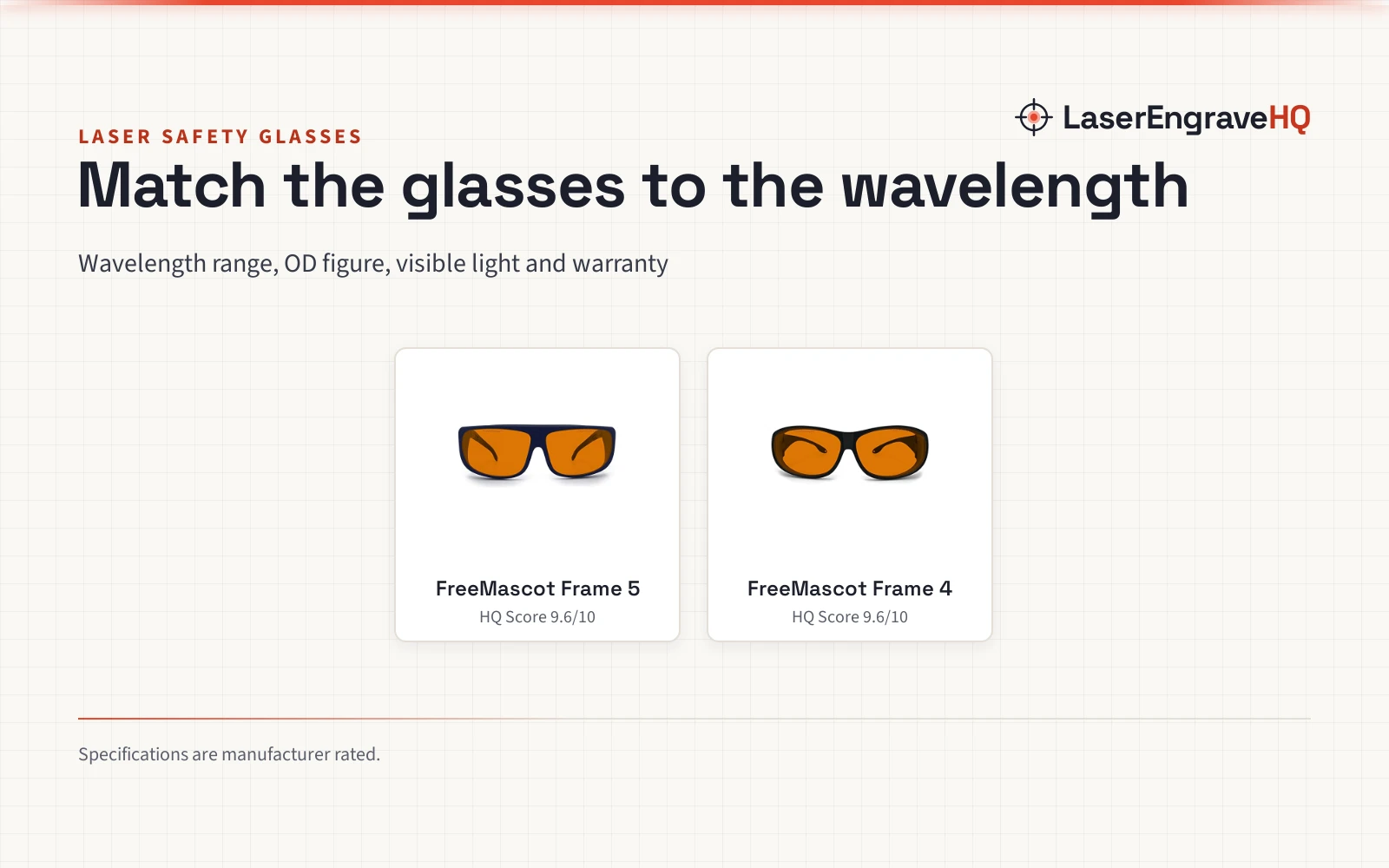
The listings in this guide are ranked with the listing whose OD rating agrees between its title and its spec table first. Both come from the same brand, yet they differ in rating, wavelength range, lens color, fit and transmission, so the comparison below shows why a higher rating is not automatically the right pick for every laser.
Ranked first is the FreeMascot OD 6+ 190nm-490nm Wavelength UV light, Violet and Blue Laser Safety Glasses. The listing states an OD 6+ rating in both its title and its spec table, with typical wavelengths of 405nm, 445nm, 515nm and 532nm, and applications listed as Violet Laser, Blue Laser and Green Laser. Its title states a range of 190-490nm while its spec table states a scope of 190-550nm, so the green typical wavelengths of 515nm and 532nm fall inside the spec table scope but outside the title range; confirm which range applies before relying on green coverage. It states a transmittance of 40% and a visible light transmission percentage of 55, a semi-rimless frame, a fit-over fit type, an orange lens color, a black frame, anti-fog coating, and ultraviolet light protection. The frame material is stated as polycarbonate, while the lens material is stated as glass in the spec table and the material line describes ABS frame with polycarbonate glasses, so readers should note that inconsistency in the listing itself. Its fit-over design makes it a natural pick for makers who wear prescription eyewear and need violet, blue or green coverage with a brighter view.
Ranked next is the FreeMascot OD 6+ 190nm-550nm and 800nm-1100nm Wavelength Professional Laser Safety Glasses. This listing needs a careful read, because its title states OD 6+ while its spec table states an optical density of OD 4+, with a wavelength scope of application of 190-2000nm in its spec table and typical wavelengths of 405nm, 445nm, 532nm, 650nm, 808nm, 980nm and 1064nm. Its title states ranges of 190-550nm and 800-1100nm instead, so the 650nm typical wavelength falls in neither title range. Its stated applications are IPL and Laser Hair Removal. It states a transmittance of 30% and a visible light transmission percentage of 35, a full rim frame, a regular fit type, an amber lens color, a black frame, an anti-fog special feature, a UV protection coating, and a warranty description of 6 Months. Included components are stated as a case with a clean cloth. The broader stated scope may suit makers whose work spans the 800-1100nm title range, but the title and spec table disagreements on the OD value and the wavelength scope mean the rating and the range should be confirmed from the listing before relying on them.
Seen side by side, the first listing offers a consistent OD 6+ statement for a narrower stated range and a brighter view, while the second listing offers a broader stated scope with a darker view and a rating and wavelength scope that the listing itself states differently in its title and its spec table. Neither listing is a universal pick. The right pick is the listing whose stated rating and stated range cover the laser in use, with a fit that stays comfortable and a view clear enough for careful work.
Common mistakes to avoid
- Choosing by OD alone, without checking that the stated wavelength range covers the laser in use.
- Assuming a lens rated for violet and blue light also covers longer wavelengths that the listing does not state.
- Ignoring a title and spec table disagreement on the OD value.
- Picking a dark lens without weighing the stated visible light transmission for layout and detail work.
- Treating tinted acrylic or an orange shield without a stated rating as protection. Eyewear protects only if the listing states an OD rating and a wavelength range that matches the machine.
Od4 vs od5 laser safety glasses: the short version
- Note the laser wavelength, then find a listing that states an OD rating covering that wavelength.
- Favor the higher rating only when it covers the same wavelength.
- Check that the title, bullets and spec table agree on the rating and the range.
- Weigh visible light transmission and fit alongside the rating.
- Keep ventilation, fire safety and material choice as part of the same workshop plan.
FAQ: lasers and CNC
What is the difference between OD4 and OD5?
The higher rating blocks more light at the wavelengths it covers. An OD5 rating therefore offers stronger attenuation than an OD4 rating at the same wavelength, but the comparison only holds where both ratings are stated for that wavelength.
Does a higher OD rating always mean a better choice?
Not always. A higher rating for violet and blue light does not help a laser whose wavelength falls outside the stated range, and a darker lens can make detail work harder to see. Match the rating and the range to the laser first, then weigh fit and clarity.
Can a pair cover every laser wavelength?
No listing in this guide states coverage for every wavelength. Each listing states its own ranges in its title, such as 190-490nm or 190-550nm and 800-1100nm, with its own typical wavelengths, while its spec table states a broader scope. Check the stated range against the laser in use rather than assuming broad coverage.
What should I check before buying laser safety glasses?
Check the OD rating, the wavelength range, the fit type, the lens color and the visible light transmission percentage, all as stated in the listing. Also check that the title and the spec table agree, and look for a stated warranty term, such as the 6 Months term stated for one listing here.
Are tinted shields without a rating safe for laser work?
No. Tinted acrylic or an orange shield without a stated rating is not protection. Eyewear protects only if the listing states an OD rating and a wavelength range that matches the machine.
Where can I learn more about choosing laser eyewear?
Read the laser safety glasses guide, the how to choose laser safety glasses guide, and the related od5 vs od6 laser safety glasses comparison for the next step up in rating.
Related: the laser safety hub, best laser safety glasses for fiber laser and best laser safety glasses for diode lasers.