Nylon vs ASA Filament: Which One Should You Buy?
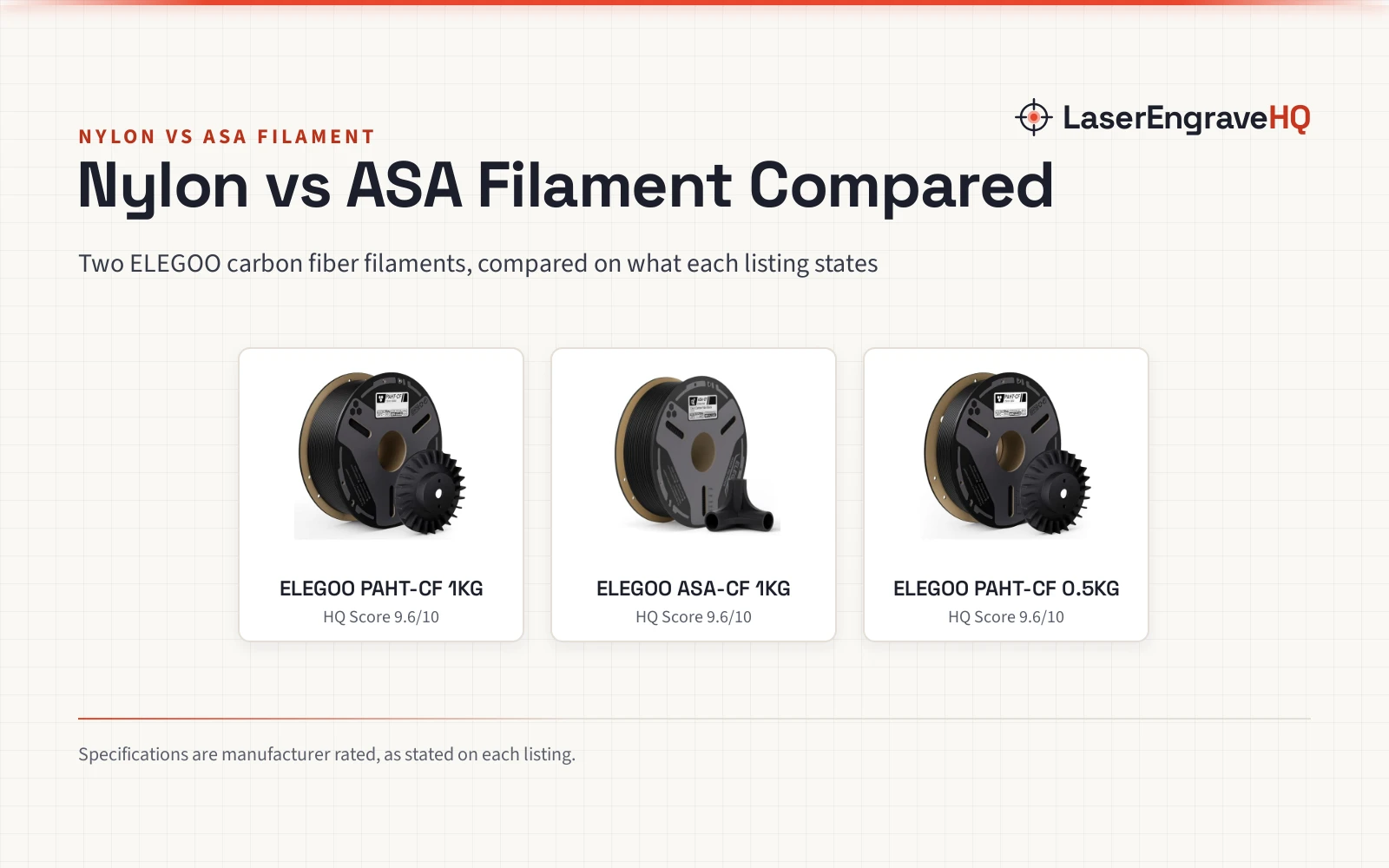
ELEGOO carbon fiber nylon and ASA filament compared on heat, weather, strength and print settings, using what each listing states.

On this page
Top picks at a glance
As an Amazon Associate I earn from qualifying purchases.
- 1
 ELEGOO Carbon Fiber PAHT 3D Printer Filament9.6/10View on Amazon
- 2
 ELEGOO Carbon Fiber ASA Filament 1.75mm Black 1KG9.6/10View on Amazon
- 3
 ELEGOO Carbon Fiber PAHT 3D Printer Filament9.6/10View on Amazon
Functional parts that live under a hood, on a bracket, or out in the weather ask more of a filament than a display model does. This comparison looks at nylon vs asa filament through ELEGOO carbon fiber listings on both sides, and weighs what each listing actually states about heat, weather, strength and print settings.
LaserEngraveHQ earns a commission from purchases made through these links, at no extra cost to you. Read our affiliate disclosure.
Verdict: Pick the nylon side for high-temperature structural parts, where the PAHT listing states ambient heat resistance up to 194 °C. Pick the ASA filament side for outdoor parts, where the ASA-CF listing states weather resistance and lower warping than standard ASA. Both sides use carbon fiber for strength and rigidity, so the choice turns on where the part will live.
Machines on the list
ELEGOO Carbon Fiber PAHT 3D Printer Filament
A carbon fiber nylon filament for enclosed FDM printers, with stated heat resistance up to 194 °C and carbon fiber strength for gears, bearings and structural parts.
Pros
- Withstands ambient temperatures of up to 194 °C, per the listing
- Carbon fiber adds strength and stiffness for gears, bearings and structural parts
- Lower water absorption than regular PA-CF, per the listing
- Abrasion resistance and dimensional accuracy stated for precise fits
Cons
- Compatibility is stated for most enclosed 1.75 mm FDM printers
- Hardened steel nozzle of no less than 0.4 mm is recommended
- No warranty term is stated in the listing
- No weather resistance claim is stated for this listing
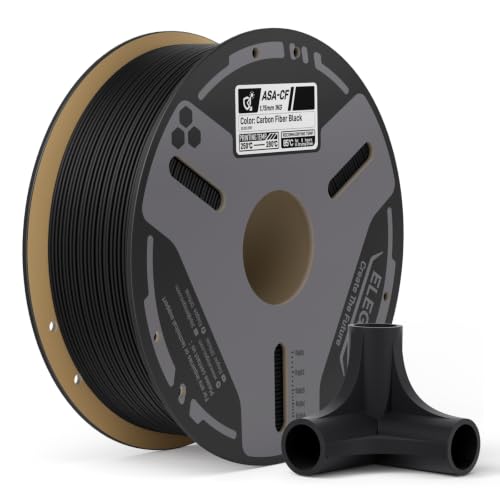
ELEGOO Carbon Fiber ASA Filament 1.75mm Black 1KG
A carbon fiber ASA filament built for outdoor parts, with stated weather resistance, lower warping than standard ASA and a textured matte finish.
Pros
- Weather resistance stated for outdoor parts, automotive accessories and enclosures
- Lower warping and better dimensional control than standard ASA, per the listing
- Carbon fiber rigidity for brackets, jigs and drone parts
- Textured matte finish that softens layer lines straight off the plate
Cons
- No print temperature or bed temperature is stated in the listing
- No nozzle recommendation is stated in the listing
- No warranty term is stated in the listing
- Heat figure is an HDT figure, not an ambient-temperature figure
ELEGOO Carbon Fiber PAHT 3D Printer Filament
The same carbon fiber nylon listing as the 1KG spool, with the same stated heat and strength claims, on a smaller 0.5KG spool.
Pros
- Withstands ambient temperatures of up to 194 °C, per the listing
- Carbon fiber adds strength and stiffness for gears, bearings and structural parts
- Lower water absorption than regular PA-CF, per the listing
- Same stated print settings as the 1KG spool: 260-300 °C print, 100-120 °C bed
Cons
- Smaller 0.5KG spool, so less material per spool than the 1KG version
- Compatibility is stated for most enclosed 1.75 mm FDM printers
- Hardened steel nozzle of no less than 0.4 mm is recommended
- No warranty term is stated in the listing
Other machines to compare
 Creality Nylon 3D Printer Filament 1.75mmCheck price on Amazon
 SUNLU PA6-CF20 Carbon Fiber Nylon 3D Printing Filament 1.75mmCheck price on Amazon
 SUNLU Nylon Filament 1.75mmCheck price on Amazon
 SUNLU PA6-GF 25% Glass Fiber Nylon 1.75mm 3D PrintingCheck price on Amazon
 SUNLU Easy PA Nylon Filament 1.75mmCheck price on Amazon
 SUNLU Easy PA FilamentCheck price on Amazon
Side by side
| Spec | ELEGOO PAHT-CF 1KG | ELEGOO ASA-CF 1KG | ELEGOO PAHT-CF 0.5KG |
|---|---|---|---|
| HQ Score | 60 | 59 | 58 |
| Side | nylon | asa filament | nylon |
| Diameter | 1.75 mm | 1.75 mm | 1.75 mm |
| Spool | 1KG | 1KG | 0.5KG |
| Heat figure | Up to 194 °C ambient | Up to 108°C HDT | Up to 194 °C ambient |
| Print temperature | 260-300 °C | Not stated | 260-300 °C |
| Bed temperature | 100-120 °C | Not stated | 100-120 °C |
| Nozzle | Hardened steel, no less than 0.4 mm | Not stated | Hardened steel, no less than 0.4 mm |
| Printer fit | Most enclosed 1.75 mm FDM printers | Most FDM printers | Most enclosed 1.75 mm FDM printers |
| Stated strengths | Heat resistance, low water absorption, abrasion resistance | Weather resistance, low warp, rigidity | Heat resistance, low water absorption, abrasion resistance |
| Warranty | Not stated | Not stated | Not stated |
Specs are what each manufacturer publishes as its rating on the listing, collected 4 November 2026.
Nylon vs ASA filament: heat, weather and strength
The nylon listings state heat resistance first. The PAHT-CF listing states that the material holds its structural strength at ambient temperatures of up to 194 °C, adds carbon fiber for strength and stiffness, and claims lower water absorption than regular PA-CF, with abrasion resistance and dimensional accuracy for gears, bearings and structural parts. The ASA-CF listing leads with weather instead: ASA weather resistance for sun, rain and changing seasons, aimed at automotive accessories, protective enclosures and outdoor equipment.
Care is needed with the heat figures. The PAHT figure is an ambient-temperature figure of up to 194 °C, while the ASA figure is an HDT of up to 108°C, and the two measures do not compare directly. On strength, both sides lean on carbon fiber: the nylon listing cites interlaminar adhesion for robust and durable objects, while the ASA listing cites rigidity that keeps brackets, jigs and drone parts in shape under stress. No listing states a warranty term.
Print settings and fit
The nylon listings are the more specific about setup. They call for most enclosed 1.75 mm FDM printers, a hardened steel nozzle of no less than 0.4 mm, a print temperature of 260-300 °C and a hotbed temperature of 100-120 °C. The ASA listing states a 1.75 mm diameter and a 1KG spool for most FDM printers, but gives no print temperature, bed temperature or nozzle recommendation, so its settings are left to the printer’s own guidance.
Spool choice is simple: the nylon side comes in 1KG and 0.5KG spools, while the ASA side comes in a 1KG spool. A maker choosing between the two nylon spools is choosing spool size only, since the stated claims and settings match.
Choose nylon if
- You print structural parts for high-temperature environments, where the PAHT listing states ambient resistance up to 194 °C.
- You print gears, bearings or structural parts that need abrasion resistance and dimensional accuracy.
- Your printer is enclosed and you can fit the recommended hardened steel nozzle.
Choose ASA filament if
- Your parts live outdoors, where the ASA listing states weather resistance for sun, rain and changing seasons.
- You print large parts and want lower warping than standard ASA, per the listing.
- You want a textured matte finish that softens layer lines straight off the plate.
Project Match
- Gears, bearings and structural parts: the PAHT-CF nylon listings, which state abrasion resistance and dimensional accuracy for exactly those uses.
- Outdoor automotive accessories and protective enclosures: the ASA-CF listing, which states weather resistance for those uses.
- Brackets, jigs and drone parts: the ASA-CF listing, which cites carbon fiber rigidity for those parts.
- Large prints: the ASA-CF listing, which claims lower warping and better dimensional control than standard ASA.
- High-temperature environments: the PAHT-CF nylon listings, which state ambient resistance up to 194 °C.
FAQ: lasers and CNC
Which side suits outdoor parts?
The ASA filament side. Its listing states ASA weather resistance for sun, rain and changing seasons, aimed at automotive accessories, protective enclosures and outdoor equipment. The nylon listings state no weather resistance claim.
Which listing states the higher heat figure?
The PAHT listing states ambient resistance up to 194 °C, while the ASA listing states an HDT of up to 108°C. The two figures measure different things, so they do not compare directly.
What printer and nozzle does the nylon listing call for?
Most enclosed 1.75 mm FDM printers, with a hardened steel nozzle of no less than 0.4 mm, a print temperature of 260-300 °C and a hotbed temperature of 100-120 °C.
Does the ASA listing state print temperatures?
Not stated. The ASA listing gives a 1.75 mm diameter and a 1KG spool for most FDM printers, but no print temperature, bed temperature or nozzle recommendation.
Which spool sizes are listed?
The nylon side lists 1KG and 0.5KG spools, and the ASA side lists a 1KG spool.
Related: hips vs abs filament, pc vs abs filament, Elegoo PETG vs Sunlu PETG, Bambu Lab PLA vs Elegoo PLA Plus and best large 3D printer enclosure with ventilation.