How to Make Continuous Bias Tape
How to make continuous bias tape: cut a square on the diagonal, sew it into a tube, cut one continuous spiral strip, feed it through a maker and press the folds.

On this page
Top picks at a glance
As an Amazon Associate I earn from qualifying purchases.
- 1
 5 Sizes Bias Tape Maker for Sewing Quilting9.6/10View on Amazon
- 2
 5 Sizes Bias Tape Makers Kit, Binding Foot, Awl9.6/10View on Amazon
- 3
 HONEYSEW Bias Tape Maker Kits All 5 Sizes 6MM 9MM9.6/10View on Amazon
- 4
 HONEYSEW Bias Tape Maker Set 6MM 12MM 18MM 25MM9.5/10View on Amazon
How to make continuous bias tape starts with a square of fabric, cut on the diagonal and sewn into a tube, then cut in one continuous spiral strip, folded into tape with a bias tape maker and pressed with an iron. The maker folds the raw edges toward the center as you pull the strip through, and the iron sets the folds. This guide walks through the cut, the join, the fold and the press.
LaserEngraveHQ earns a commission from purchases made through these links, at no extra cost to you. Read our affiliate disclosure.
5 Sizes Bias Tape Maker for Sewing Quilting
A metal 5-size bias tape maker set in 6, 9, 12, 18 and 25 mm for single and double fold, with a 90 day manufacturer warranty.
Pros
- 5 sizes: 6, 9, 12, 18 and 25 mm (1/4, 3/8, 1/2, 3/4, 1 in)
- Listed for single and double fold
- Metal construction, stated weight 0.125 lb
- 90 day manufacturer warranty
Cons
- No clips, awl, pins or binder foot in the box
- No usage steps in the listing
- Sizes are listed in mm, and the listing says to convert them to inches
- No fabric types are named in the listing
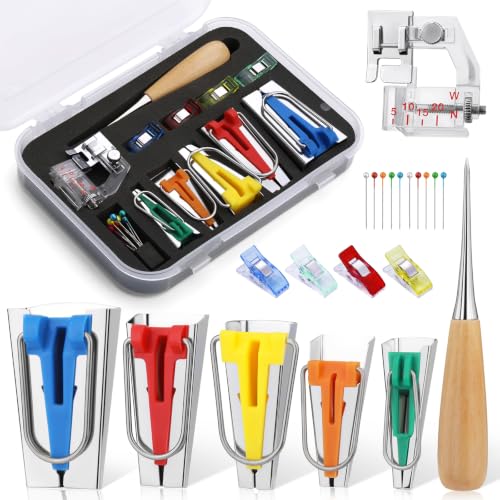
5 Sizes Bias Tape Makers Kit, Binding Foot, Awl
A 21-piece bias tape maker kit in 5 sizes with clips, an awl, positioning pins and a binder foot, with step-by-step usage in the listing.
Pros
- 5 sizes in 1/4, 3/8, 1/2, 3/4 and 1 in
- 21 pieces: 4 fixing clips, a wooden awl, 10 positioning pins and an adjustable binder foot
- Usage steps in the listing: cut, feed with the awl, pin and press
- Names cotton, silk and linen as compatible fabrics
Cons
- The listing states no warranty
- No weight stated
- No maker material stated
- Sizes are listed in inches only, with no mm figures
HONEYSEW Bias Tape Maker Kits All 5 Sizes 6MM 9MM
A 5-size bias tape maker kit in 6, 9, 12, 18 and 25 mm with 4 craft clips, a binder foot, an awl and 10 quilting pins.
Pros
- 5 sizes in 6, 9, 12, 18 and 25 mm
- Includes 4 craft clips, a binder foot, an awl and 10 quilting pins
- Binder foot fits Brother, Babylock, Janome, Kenmore, Singer snap-on foot machines
- Listed for leathercraft, patchwork and DIY as well as sewing
Cons
- No warranty term is stated
- No weight or maker material stated
- No usage steps in the listing
- No fabric types named in the listing
HONEYSEW Bias Tape Maker Set 6MM 12MM 18MM 25MM
A 4-piece bias tape maker set in 6, 12, 18 and 25 mm for sewing and quilting.
Pros
- 4 sizes in 6, 12, 18 and 25 mm
- Four makers in yellow, red, green and blue
- Listed for napkins, handbags and bibs as well as quilting
- Stated dimensions of 6.0 x 4.4 x 1.0 in for the set
Cons
- No 9 mm maker; the set covers 6, 12, 18 and 25 mm
- No warranty term is stated
- No clips, awl, pins or binder foot in the box
- No usage steps or fabric types in the listing
Cut the fabric on the bias
Start with a square of fabric and cut it on the diagonal, at a 45-degree angle. The BUTUZE listing says to cut at a 45-degree angle, based on the width you need. A strip cut on the bias stretches around curves, which is why bias tape binds curved edges. The rotary cutter guide covers the tool for long straight cuts.
Sew the triangles into a tube
Sew the triangles from the diagonal cut into a tube, offset by one strip width, then cut along marked lines in one continuous spiral, and the tube opens into one long strip. The Jeimier listing says one easy motion creates any length of bias tape: the spiral cut is what makes one length from the square, with no strips to join end to end.
Match the strip width to the maker
Each maker takes one strip width, so mark the tube at the strip width that pairs with the maker. The Jeimier listing pairs each strip width with its maker, from a 12 mm strip with the 6 mm tool to a 46 mm strip with the 25 mm tool. In inches, the 5-size sets cover 1/4, 3/8, 1/2, 3/4 and 1 in.
Feed the strip and press as you pull
Feed the strip into the wide mouth of the maker with the back of the tape facing up, then pull it through with the awl. The BUTUZE listing gives the steps: insert the strip into the wide mouth, use the awl to pull the strip from the head of the maker, and pin the pulled strip to the ironing plate. Keep the iron close to the head of the maker while you pull, so the folds set as the tape comes out. The pressing tools guide covers irons and pressing surfaces.
The bias tape makers in this guide
The makers below do the folding step: each one folds the strip as you pull it through, so pick the set that covers the widths you sew and the tools you want in the box.
How to make continuous bias tape: the short version
- Pick the finished width, then the maker that pairs with it.
- Cut a square on the diagonal at a 45-degree angle, then sew the triangles into a tube.
- Mark the tube at the strip width and cut one continuous spiral strip.
- Feed the strip through the maker with the awl, back facing up.
- Pin the pulled strip and press with the iron close to the maker head.
FAQ: lasers and CNC
What width strip do I cut for a 12 mm bias tape maker?
Mark the tube at 24 mm and cut the spiral strip at that width. The Jeimier listing pairs strip and maker widths: 12 mm strip with the 6 mm maker, 18 mm with 9 mm, 24 mm with 12 mm, 36 mm with 18 mm and 46 mm with 25 mm.
What is the difference between single fold and double fold bias tape?
The Jeimier set is listed for single and double fold. A single fold brings the raw edges to the center in one pass. A double fold folds the tape a second time, so no raw edge shows.
Which fabrics work with a bias tape maker?
The BUTUZE listing names cotton, silk and linen. The Jeimier listing says its makers work with any fabric for quilting projects.
Do I need an iron to make bias tape?
Yes, for the method in this guide. The BUTUZE usage keeps the iron close to the head of the maker while you pull the strip, so the folds set as the tape comes out. Pin the pulled strip to the ironing plate to hold it.
How many sizes of bias tape maker do I need?
One maker makes one finished width, so a set covers more widths. The Jeimier and HONEYSEW 5-size sets cover 6, 9, 12, 18 and 25 mm, the BUTUZE 5-size kit covers 1/4, 3/8, 1/2, 3/4 and 1 in, and the HONEYSEW 4-piece set covers 6, 12, 18 and 25 mm.
Related: the sewing and embroidery machines hub, best rotary cutter for sewing, best pressing tools for sewing and best sewing pins for quilting.