Direct Drive vs Belt Driven CNC Spindle: Which One Should You Buy?
Direct drive vs belt driven CNC spindle explained: how each type works, how torque and speed differ, and which rated figures to check in the listings.

On this page
Top picks at a glance
As an Amazon Associate I earn from qualifying purchases.
- 1
 6050 CNC Router Machine9.6/10View on Amazon
- 2
 CNC Router Machine 4040-PRO for Metal Acrylic Cutting Milling9.4/10View on Amazon
- 3
 SainSmart Genmitsu 4040-PRO MAX CNC Router with 710W Trimmer9.6/10View on Amazon
- 4
 CNC SpindleView on Amazon
- 5
 Genmitsu Air-Cooled 300W Brush DC Spindle Motor with 0-48VView on Amazon
- 6
 RATTMMOTOR 500W CNC Air Cooled Spindle Motor ER11 12000RPMView on Amazon
- 7
 Huanyang Water Cooled CNC Spindle Milling Motor 110V 2.2KWView on Amazon
- 8
 NBS-6040 CNC Router MachineView on Amazon
- 9
 710W CNC Router Spindle Motor with Speed DisplayView on Amazon
If you are carving signs, cutting plywood parts or milling aluminum brackets for customers, the spindle on your CNC router decides how clean the cut is and how long the machine lasts. Direct drive vs belt driven cnc spindle is the first fork in that decision: in a direct drive spindle the motor shaft drives the tool directly, while in a belt driven spindle a belt and pulleys sit between the motor and the tool. Direct drive gives you fewer moving parts and simpler maintenance; belt drive lets the maker gear the speed and torque for the job. The sections below explain each one, compare them side by side, and show which rated figures in real listings matter for your projects.
Other machines to compare
 CNC SpindleCheck price on Amazon
 Genmitsu Air-Cooled 300W Brush DC Spindle Motor with 0-48VCheck price on Amazon
 RATTMMOTOR 500W CNC Air Cooled Spindle Motor ER11 12000RPMCheck price on Amazon
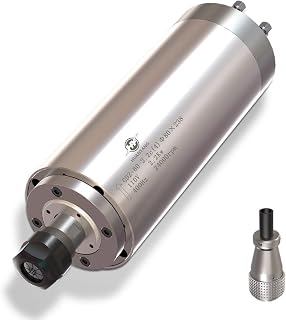 Huanyang Water Cooled CNC Spindle Milling Motor 110V 2.2KWCheck price on Amazon
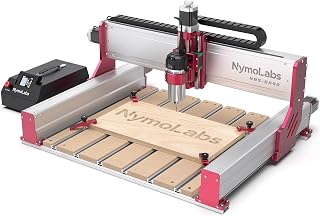 NBS-6040 CNC Router MachineCheck price on Amazon
 710W CNC Router Spindle Motor with Speed DisplayCheck price on Amazon
LaserEngraveHQ earns a commission from purchases made through these links, at no extra cost to you. Read our affiliate disclosure.
We do not own a torque meter for these spindles, so this guide uses only the figures makers publish in their listings: rated speeds, power, runout and warranties. Where no figure exists, we explain the idea without a number.
What direct drive means on a CNC spindle
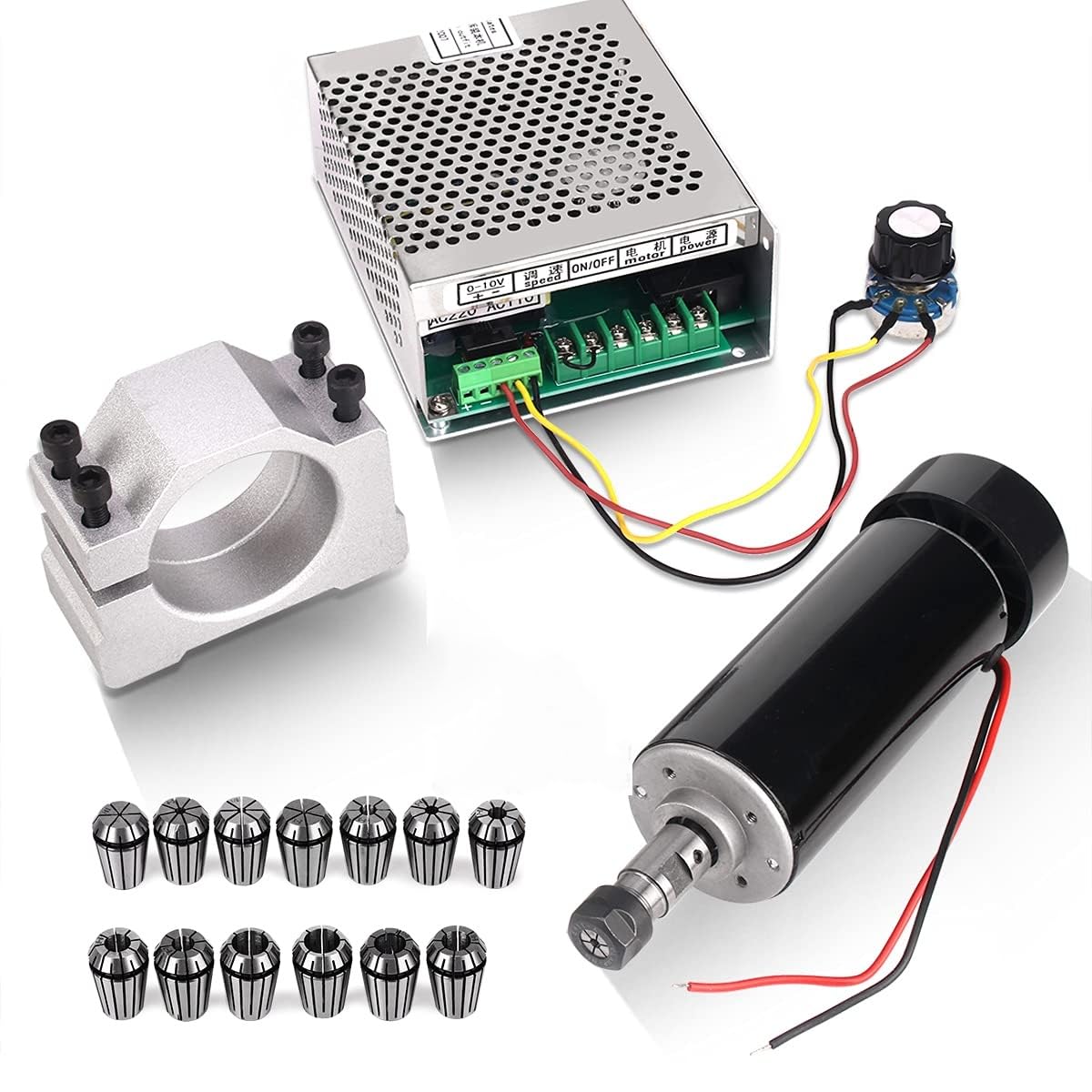
A direct drive spindle connects the motor to the tool holder with no belt in between. The motor shaft and the spindle shaft are effectively one line, so the speed you set is the speed the tool turns. Every spindle in these listings is a direct drive. The compact DC spindles are the small end: the MYSWEETY 500 W listing, for example, rates up to 12,000 rev/min on a 100 VDC motor with a 52 mm clamp and ER11 collets, while the Genmitsu 300 W listing gives stepped speeds of 3,000 to 12,000 r/min across 12 to 48 V. These are the spindles people bolt onto desktop routers and 3018-class machines. The 1.5 and 2.2 kW kits are direct drive too: their VFD sets the motor speed electrically, with no belt anywhere in the listing.
The appeal is mechanical simplicity. There is no belt to tension, align or replace, and no pulleys to wear. The trade off is that the motor and the tool share one speed range, so the maker picks a motor whose happy zone matches the work. Run far outside that zone and you get heat and weak cutting, which is why the RATTMMOTOR 2.2 kW listing warns that the spindle must not run below 9,000 rpm during use.
What belt driven means
A belt driven spindle puts a belt and two pulleys between a separate motor and the spindle shaft. The pulley ratio steps the speed up or down, so the motor can run where it is happiest while the tool turns at a different rate, trading speed for torque. None of the reference listings describes a belt-and-pulley drive. The 1.5 and 2.2 kW kits pair a spindle motor with a VFD, a variable frequency drive, that sets the motor speed electrically: the RATTMMOTOR 2.2 kW square spindle listing pairs the motor with a VFD covering 0 to 400 Hz and 0 to 24,000 rpm, and the AnoleX 1.5 kW kit lists a 0 to 24,000 rpm range with the speed set by g-code S values. Those are direct drive units with electronic speed control, not belt drives.
The belt is a wear part and an alignment part. It can slip, stretch and shed dust, and a loose belt shows up as chatter marks in the cut. On the other hand, a belt is cheap and easy to swap, and it adds a little compliance that can absorb a sudden load. The VFD kit listings compete on smoothness instead: the Zhong Hua Jiang 1.5 kW kit listing calls out upgraded steel bearings and advanced dynamic balance tech for reduced noise, while the FoxAlien 1.5 kW listing claims under 0.005 mm radial runout.
Direct drive vs belt driven cnc spindle: the trade offs
Put simply, direct drive trades flexibility for simplicity, and belt drive trades simplicity for flexibility. Here is how the differences play out in the shop.
| Point | Direct drive | Belt driven |
|---|---|---|
| Moving parts | Motor shaft drives the tool directly; no belt to wear | Belt and pulleys add wear points that need checking |
| Speed range | Set by the motor or its VFD; compact DC listings rate up to 12,000 rev/min, VFD kits 0 to 24,000 rpm | Pulleys gear the range on true belt drives; none of these listings shows one |
| Torque | Whatever the motor makes at its speed; the 500 W listings state 0.5 NM and 5000 g/cm | Pulley ratio can trade speed for torque; the maker sets the balance |
| Maintenance | Little beyond bearings and cooling | Belt tension and alignment join the checklist |
| Typical home-shop size | 300 to 500 W compact spindles for desktop machines; 1.5 to 2.2 kW VFD spindle motors for larger routers | Separate motor plus belt and pulleys; not shown in these listings |
Note the power figures there are the makers’ own: 300 W and 500 W on the compact DC listings, 1.5 kW and 2.2 kW on the VFD kits. Bigger power is not automatically better for your work; it has to match the machine frame, the bits and the materials.
Which projects suit each type
For light engraving work, signs, plaques, leather patches, thin plywood cutouts, a compact direct drive spindle is the common choice. It is simple to mount, the 52 mm clamp these listings state, and ER11 collets cover shanks from 1 to 7 mm per the MYSWEETY listing. You give up low-end grunt, so deep cuts in hardwood or aluminum go slowly, if at all.
For production-style cutting, cabinet parts, thicker hardwood, regular aluminum work, the VFD spindle kits make more sense. The 24,000 rpm top end suits small bits, the VFD lets you dial speed from g-code, and ER20 collets on the 2.2 kW listings hold larger shanks than ER11. The AnoleX kit even includes an emergency stop, which is worth having on a machine that can spin a cutter at 24,000 rpm.
Neither type is right for every material. Wood, plywood, MDF, acrylic, brass and soft aluminum all show up in these listings as intended materials. If a material is not named in the listing, do not assume the spindle is meant for it.
What the listings tell you to check before you buy
Five figures separate a good listing from a thin one, and all of them appear in the listings above:
- Rated speed: the listings state ranges like 3,000 to 12,000 r/min or 0 to 24,000 rpm. Make sure your planned bits and materials sit inside the range, not at its edge.
- Runout: the VFD kit listings state under 0.005 mm radial runout; the RATTMMOTOR 2.2 kW square listing states less than 0.01 mm. Smaller runout means cleaner edges and longer bit life.
- Collet system: ER11 grips 1 to 7 mm shanks; ER20 goes larger. Buy for the shank sizes your bits actually use. Our ER11 vs ER20 collet guide compares them.
- Cooling: air cooled kits are simpler and the Huanyang 2.2 kW water cooled listing exists for long hot runs. See air cooled vs water cooled spindle for the trade offs.
- Warranty: stated terms vary widely, from 90 days on one LCRHLCNC listing to 1 year on the RATTMMOTOR 2.2 kW listing to half a year on the Huanyang. No stated term means no stated term; do not assume one.
Also check the input voltage and phase. The listings name 110 V and 220 V, single and three phase options, and AC to DC speed controllers. Our single phase vs three phase guide explains what your shop wiring has to provide.
Safety and shop setup
A spindle is a machine tool, and it deserves machine tool habits. Secure the workpiece so it cannot shift mid-cut, keep hands and loose clothing clear of the spinning tool, and never leave a running job unattended. A 1.5 kW spindle at 24,000 rpm throws chips and dust fast, so dust extraction and eye protection are part of the setup, not extras.
Ventilation matters too. Wood dust is a known shop hazard, and some plastics give off fumes you do not want to breathe. Cut with extraction running, and check your machine manual before cutting any unfamiliar material. Our CNC router maintenance guide covers the routine that keeps a spindle healthy: collet cleaning, belt checks on belt driven units, and bearing care.
FAQ: lasers and CNC
Is direct drive or belt driven better for a beginner?
Direct drive is simpler to install and maintain, since there is no belt to tension, which suits a first desktop router. VFD spindle kits give a wider speed range and more power for larger machines, at the cost of more setup. Match the spindle to the machine you have, not the one you wish you had.
Can a belt driven spindle cut metal?
Belt-driven spindles are built for this kind of work, but none of these listings shows one. The listings name soft aluminum, brass and copper among intended materials for the VFD kits, with wood, plywood, acrylic and plastics besides. Hardened steel is not in these listings, and neither is any material the maker does not name. When in doubt, the listing decides.
What does runout mean, and why do the listings state it?
Runout is how far the tool tip wobbles off center as it spins. The listings state figures like under 0.005 mm or less than 0.01 mm. Smaller runout gives cleaner cuts and less bit breakage, especially with small bits at high rpm.
Do I need a VFD with my spindle?
The compact DC spindles in these listings use a simple speed controller instead, with adjustable DC output such as 0 to 100 V or 12 to 48 V. The 1.5 and 2.2 kW kits pair the motor with a VFD for wider speed control, including g-code speed commands on some kits. Use the controller the listing was designed for.
How long should a spindle last?
The listings do not state service life figures. What they do state are bearings grades, dynamic balance claims and warranty terms from 90 days to 1 year. Keep collets clean, respect the stated speed limits, such as the 9,000 rpm minimum on the RATTMMOTOR 2.2 kW listing, and the machine will tell you when something is wearing.
Related: spindle vs router for CNC, air cooled vs water cooled spindle and best CNC router bits for hardwood. Also see our ER11 vs ER16 collet guide.