Desoldering Braid vs Desoldering Pump: Which One Should You Buy?
Desoldering braid wicks solder into copper strands for fine pads, while a pump clears larger joints with a vacuum pull; compare both methods and the four braids ranked in the gear section.

On this page
Desoldering braid vs desoldering pump comes down to how each tool pulls molten solder away from a joint. Braid is fine copper strands that draw molten solder up into the weave through capillary action, giving fine control on small pads and tight spots. A pump is a spring-loaded tube that sucks molten solder away in a sharp vacuum pull, clearing a through-hole joint in a quick motion. Every product in the gear section below is described as braid, and no pump is described among the listed products, so the pump side of this comparison rests on how the method works rather than on a listed pump. For small electronics repair, braid is the usual starting point, while a pump earns its place on through-hole joints.
As an Amazon Associate I earn from qualifying purchases. LaserEngraveHQ earns a commission from purchases made through these links, at no extra cost to you. Read our affiliate disclosure.
Desoldering braid vs desoldering pump: how each method works
Desoldering braid, also called solder wick, is copper braid used with flux. The braid rests on the joint, a soldering iron heats braid and solder together, and molten solder flows up into the strands. The used section is cut away and a fresh section takes the next joint. The listings describe the same action in plain terms: finely braided copper, strong capillary action, and a clean pad left behind. Flux-coated braid works without extra flux, and the how to use soldering flux guide covers the cases where separate flux helps.
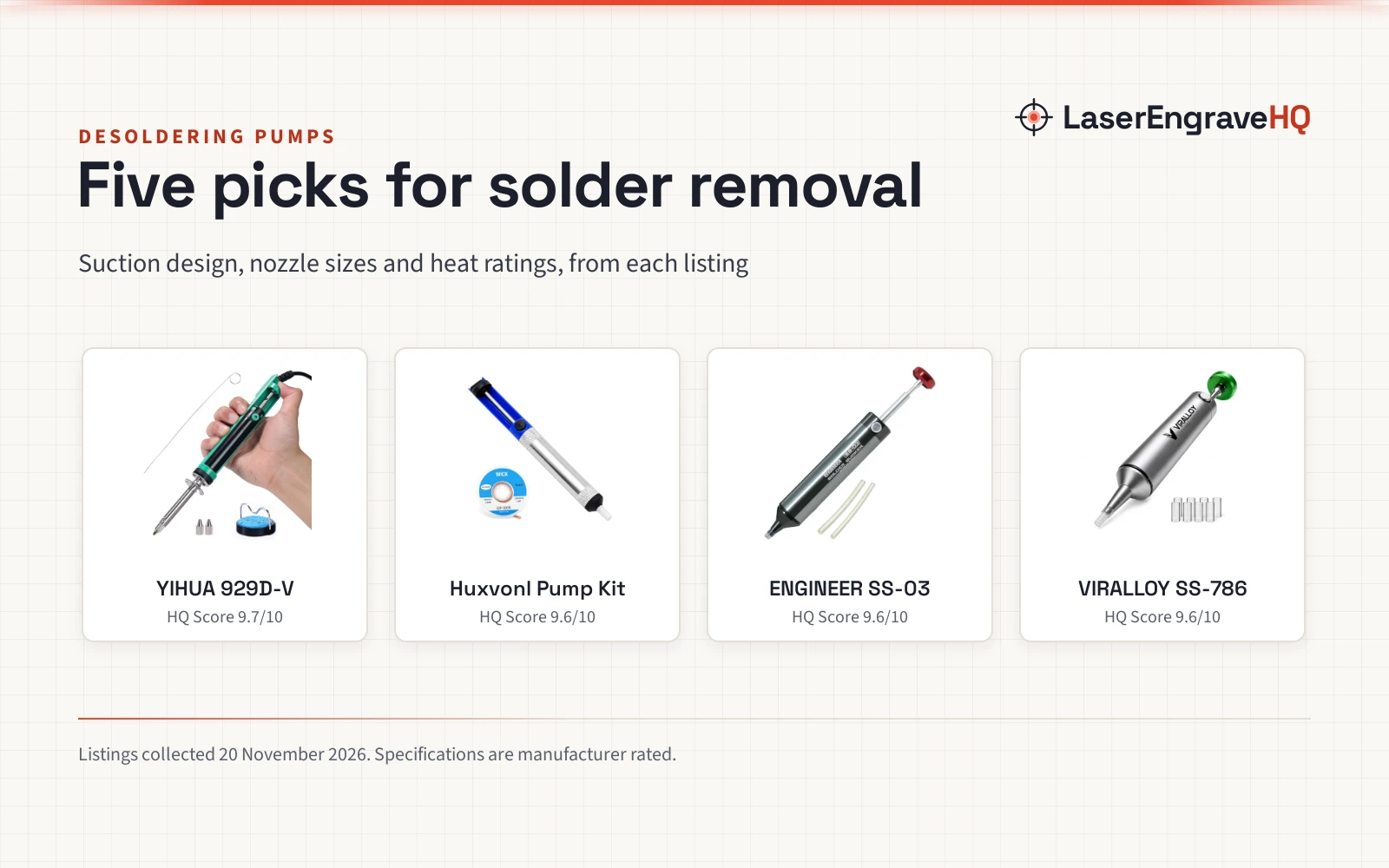
A desoldering pump, also called a solder sucker, works the other way. The plunger is pressed down to load the spring, the tip is placed at the molten joint, and the trigger releases the spring to pull solder into the chamber. The method suits joints with enough molten solder to fill the pull, such as through-hole pins and larger pads. The pump leaves no consumable behind per joint, while braid is used up a section at a time. The best desoldering pump guide covers pumps in full.
When braid wins
Braid wins where precision matters more than speed: small surface-mount pads, bridged pins on a tight board, and cleanup after removing a component. Braid also doubles as a cleanup tool: after a pump leaves a thin film, braid lifts the rest. For phone repair, laptop repair and small board rework, the listings point to braid as the go-to tool.
When a pump wins
A pump wins where a joint holds a lot of solder and the board can take a firm pull. Through-hole joints, connector pins and old wire joints clear faster with a pump, because the vacuum takes molten solder in each pull. A pump also suits repeated desoldering on the same board, since there is no braid to use up. Where the board is delicate or the pads are small, braid is the gentler choice.
Side by side: braid and pump
| Braid | Pump | |
|---|---|---|
| Best for | Small pads and surface-mount parts | Through-hole joints and larger pads |
| Control | Fine, takes solder a little at a time | Strong, takes molten solder in each pull |
| Cleanup | Lifts thin films and bridges | Leaves a film that braid can finish |
| Consumable | Braid is used up a section at a time | Nothing used up per joint |
The gear: four desoldering braids, ranked
The gear section ranks the four braids below by the stated specs: width choice, flux, length and pack size. All four are copper braid with a no-clean finish, so the ranking turns on range and extras.
JoTownCand 3-pack rosin flux wick kit
The JoTownCand kit leads the ranking on range: a 3-pack with 0.08, 0.1 and 0.12 inch widths, each 10ft long, in pure copper braid pre-coated with rosin flux. The coating means the wick works without extra flux and leaves a low residue finish, and the maker lists it for micro SMD components through to larger THT joints, plus phone, laptop and circuit board repair. No separate flux paste is listed, so heavy oxidation work relies on the coating alone.
Kaisiking solder flux and desoldering wick kit
The Kaisiking kit pairs a 0.1 inch braided copper wick, 3m long, with 10cc of no-clean flux paste. The rosin flux breaks down oxidation on PCB surfaces, the paste applies through a plunger rod that resists jamming, and the maker lists the set for SMD work, BGA reballing and guitar pedal repair. A single width covers fewer pad sizes than a multi-width kit.
Lesnow solder wick braid
The Lesnow set is listed as a 5-piece pack, each piece 10ft long and 0.1 inch wide, in copper with a no-clean finish, at 2.5 ounces. The maker gives two counts for this set, 5 pieces and 1 piece, and names a solder sucker while describing only the wicks; check before ordering. The maker lists it for correcting mistakes on small PCB boards, removing relays, re-soldering mechanical keyboard switches, unsoldering old wire and cleaning alloy on SMD components. The precise weave is stated to improve capillary action, so solder is absorbed fast and the working area is left clean. A single width is listed, and no flux coating is stated.
TOWOT solder wick braid
The TOWOT braid is a single piece, 10ft long and 0.1 inch wide, in finely braided copper with a no-clean, low residue design. The maker lists it for removing unwanted solder from PCB pads, correcting soldering mistakes and cleaning solder joints, and for use in electronics repair, schools and workshops. The maker gives two lengths, 10ft and 9.8ft; check before ordering. A single piece and a single width make it the simplest pick here, suited to occasional repair.
How to use desoldering braid
- Add flux to the joint if the braid is uncoated; coated braid already carries flux.
- Lay a fresh section of braid flat over the joint.
- Press the soldering iron onto the braid and hold it until the solder melts and flows into the strands.
- Lift the iron and the braid together, so the solder comes away with the braid.
- Cut off the used section and repeat on the next joint with fresh braid.
Mistakes to avoid
- Reusing a saturated section, which has no room left to absorb solder.
- Pressing hard on the braid, which can lift a pad from the board.
- Heating a joint with dry, uncoated braid and no flux, which slows the flow.
- Expecting one section of braid to clear a large through-hole joint without fresh sections and flux.
Desoldering braid vs desoldering pump: the short version
- Pick braid for small pads, surface-mount parts and cleanup.
- Pick a pump for through-hole joints and larger solder volumes.
- Match braid width to the pad: the gear section lists 0.08, 0.1 and 0.12 inch widths.
- Keep flux on hand, either as a coating on the braid or as a separate paste.
- Start with braid when the board is delicate or the joint is small.
FAQ: lasers and CNC
Which removes solder better, desoldering braid or a desoldering pump?
Neither method wins on every joint. Braid gives finer control on small pads and surface-mount parts, while a pump clears through-hole joints faster. The gear section lists braid only.
Can desoldering braid damage a circuit board?
Heat and pressure can lift a pad, so the braid should rest on the joint with light pressure while the iron does the heating. The JoTownCand listing states its braid works without lifting pads: fresh braid, enough flux and no force on the joint.
What width of desoldering braid should I buy?
Match the width to the pad. The JoTownCand kit lists 0.08, 0.1 and 0.12 inch widths for work from micro SMD parts to larger THT joints. A single 0.1 inch spool, such as the Lesnow or TOWOT braid, covers general repair.
Do I need extra flux with desoldering braid?
Rosin-flux coated braid works without extra flux, as the JoTownCand listing states. The Kaisiking kit adds 10cc of no-clean flux paste for joints with oxidation, and the best soldering flux for electronics guide covers paste options.
Can I reuse desoldering braid?
No. Once a section has absorbed solder it is saturated, so the used section is cut away and a fresh section takes the next joint. That is why pack size and length matter: a multi-piece pack or a 3-pack lasts longer than a single spool.
Is a desoldering pump better for through-hole joints?
Yes, for clearing pins and holes a pump is usually the faster tool, since each vacuum pull takes molten solder from the joint. Braid still has a role after the pump, lifting the thin film the pump leaves behind.
Related: the best desoldering pump guide, the best soldering station picks and the soldering iron vs soldering station comparison. Also see the soldering hub.