How Long Does a Fiber Laser Last: Expected Hours, Degradation, and Workshop Care
A practical guide to how long a fiber laser lasts, examining stated laser source service life, galvo scanner wear, optics cleaning, and workshop maintenance.

On this page
Top picks at a glance
As an Amazon Associate I earn from qualifying purchases.
- 1
 GWEIKE G2 Max 50W Fiber Laser Engraver with 3D & Deep9.7/10View on Amazon
- 2
 xTool F1 Ultra 20W Fiber & Diode Dual Laser Engraver 16MP9.7/10View on Amazon
- 3
 ComMarker B4 20W Fiber Laser Engraver9.6/10View on Amazon
Makers personalizing brass nameplates, jewelry, stainless steel drinkware, knives, and custom gun parts frequently ask one question before investing: how long does a fiber laser last? The direct answer depends on the component: while manufacturers such as OMTech list over 100,000 hours of service life for their 60W fiber laser source, real-world machine longevity depends on the health of auxiliary components like galvanometer scanners, cooling fans, and optical lenses. Unlike glass-tube CO2 machines that require periodic tube replacements or diode modules with shorter lifespans, a solid-state fiber source experiences very slow degradation during normal workshop production. The guide below breaks down how each component holds up over time, what causes degradation, and how to maintain your setup for maximum reliability.
LaserEngraveHQ earns a commission from purchases made through these links, at no extra cost to you. Read our affiliate disclosure.
A benchmark of 100,000 hours represents the internal fiber laser source under standard factory operating conditions, not an unconditional promise for the entire machine. Auxiliary hardware such as internal cooling fans, digital control boards, and focusing lenses experience normal workshop wear and require periodic inspection.
Step 1: Understand the solid-state laser source and stated lifespan
The core reason fiber machines last so long lies in their solid-state architecture. In a fiber laser, semiconductor pump diodes generate light that passes through an optical fiber doped with rare-earth elements. There are no fragile glass discharge tubes, no internal gas mixtures to deplete over time, and no internal alignment mirrors that shift with vibration. In commercial listings, OMTech lists over 100,000 hours of service life for its 60W fiber laser source. If you compare that against other machine categories in our guide to how long CO2 laser tubes last or our breakdown of how long diode laser modules last, the solid-state fiber source provides far greater longevity.
Over extended operating cycles, a fiber source experiences gradual diode aging rather than sudden catastrophic failure. The laser beam continues to mark metal cleanly, though maximum beam intensity can slowly diminish over years of heavy use. To understand how this beam technology works in detail, explore our guide explaining what is a fiber laser engraver.
Step 2: Track galvanometer scanner and mirror wear
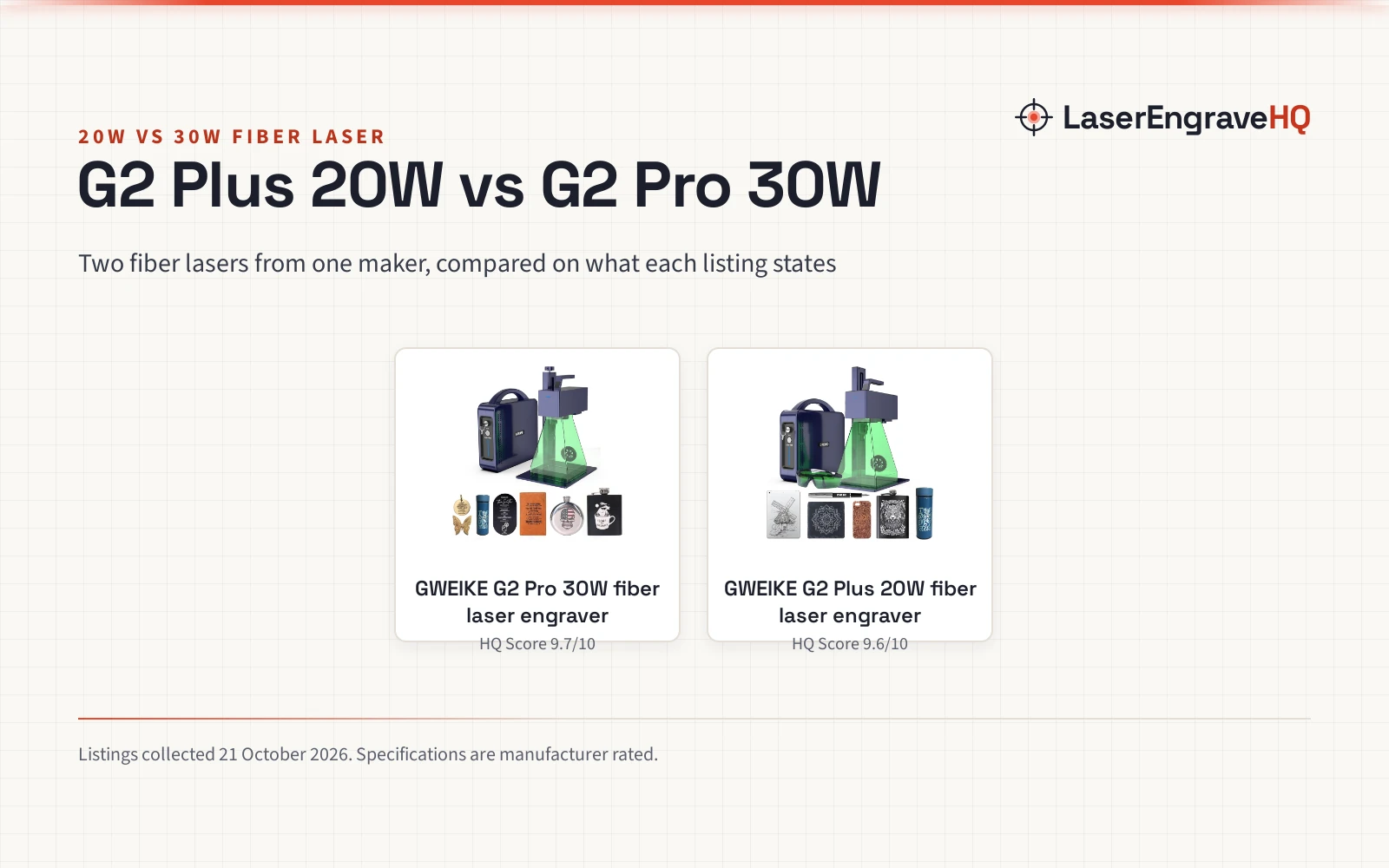
While the fiber source generates the beam, high-speed galvanometer scanners direct that beam across your workpiece. Unlike gantry lasers that move a heavy laser head along mechanical rails, belts, and lead screws, a galvo machine uses miniature silicon mirrors mounted to high-frequency galvanometer motor shafts. For example, Monport lists high-speed galvanometer scanners achieving speeds up to 10,000 mm/s on its 30W fiber engraver, while GWEIKE lists galvo speeds up to 15,000 mm/s on its 30W G2 Pro model. Because the galvo mechanism has low moving mass and rotates on precision motor shafts rather than traveling along linear guide rails, drive mechanism wear is minimal during routine operation.
However, galvo scanners remain a potential wear point over extensive operational cycles. Rapid repositioning and continuous vector marking generate internal heat within the galvanometer housing. If dust enters the housing or mirror coatings degrade from airborne debris, beam reflection efficiency drops and marking accuracy can suffer. Keeping the galvo enclosure sealed and avoiding physical shock helps maintain scanning precision over long production runs.
Step 3: Protect and clean the optical field lens
The field lens focuses the 1064nm laser beam onto your engraving area. It sits directly above the engraving bed, making it vulnerable to smoke, metal vapor, and spatter generated during deep engraving. Monport lists a minimum spot size of 0.01 mm on its 30W model, while OMTech lists 0.01 mm accuracy for its 60W machine. That fine optical precision degrades rapidly if smoke film deposits onto the quartz lens surface. If debris accumulates on the lens, the laser beam heats the residue, scorching the optical coating and causing permanent optical pitting.
Inspect the field lens before each production run. If dust appears, blow it away using an air bulb rather than compressed canned air that may spit propellants. When cleaning is necessary, use optical-grade lens tissue moistened with high-purity isopropyl alcohol, wiping gently in a single direction without scrubbing. Proper lens maintenance prevents premature optical replacement and ensures consistent beam penetration when working on metal, as described in our guide on how deep can a fiber laser engrave.
Step 4: Maintain cooling and electrical power supplies
Solid-state fiber sources generate less waste heat than CO2 laser tubes, allowing most desktop fiber units to rely on air cooling rather than liquid chillers. Internal cooling fans pull ambient air across the power supply and laser module heat sinks. If cooling vents become clogged with workshop dust or ambient room temperatures rise too high, internal thermal protection circuits engage, or semiconductor components experience thermal stress that accelerates aging.
The electrical switching power supply inside the chassis often fails before the laser source itself. Power surges, electrical noise, and dirty workshop power stress internal capacitors and transformer windings. Connecting your engraver to a dedicated surge protector or uninterrupted power supply shields delicate electronic components from voltage spikes. When comparing machines for heavy shop duty, our roundup of the best fiber laser engraver models compares build quality and power supply configurations across leading brands.
Step 5: Control workshop dust, fumes, and harmful materials
Metal engraving releases fine metallic particulates that float through the workspace. If metal dust settles inside the laser chassis, it can cause short circuits across high-voltage power terminals or coat cooling fan bearings. Installing dedicated ventilation keeps dust away from sensitive electronics. You can evaluate shop filtration systems in our review of the best fume extractor for laser engraver setups.
Material selection also directly impacts machine lifespan. Never mark or cut PVC, vinyl, PVC-based faux leather, polycarbonate, or ABS plastic. When heated by a laser, PVC and vinyl release hydrogen chloride gas, which combines with moisture in the air to form hydrochloric acid. This acid rapidly corrodes galvo mirror coatings, electrical connections, and aluminum frame structures, ruining an expensive engraver in a single session. Fiber lasers excel at bare metals, coated blanks, and dense engineering plastics; consult our guide on the best laser engraver for metal to see safe materials for production.
Step 6: Review manufacturer warranty coverage and parts availability
Because a fiber engraver represents a significant workshop investment, manufacturer warranty terms indicate factory confidence in component durability. For example, Monport lists a 2 Year Manufacturer warranty on its 30W fiber marking machine, covering the laser unit against manufacturing defects. GWEIKE lists FDA accession number 2211667-002 and Class 4 compliance for its G2 Pro model, reflecting formal regulatory registration of its laser hardware.
When planning for long-term ownership, verify whether replacement field lenses, digital control boards, external cables, and foot switches are available from the manufacturer. Even with a durable solid-state source, small consumable items and external accessories will occasionally require renewal over years of continuous production.
Common mistakes that shorten fiber laser lifespan
- Operating in unventilated spaces where metallic debris settles inside the chassis.
- Wiping optical lenses with rough paper towels or abrasive shop cloths that scratch quartz coatings.
- Engraving prohibited plastics like PVC or vinyl that produce corrosive hydrochloric acid fumes.
- Ignoring ambient heat buildup around the cooling intake fans during long production runs.
- Running without an electrical surge protector on ungrounded workshop circuits.
- Bumping the galvanometer housing, which misaligns delicate mirror positioning.
How long does a fiber laser last: the short version
- Solid-state fiber sources offer extensive operational durability, with OMTech listing over 100,000 hours of service life for its 60W unit.
- Auxiliary parts like power supplies and cooling fans dictate real-world maintenance intervals.
- Galvanometer scanners provide years of service when kept clean, sealed, and free from airborne dust.
- Field lenses require gentle optical cleaning to prevent burning residue onto quartz coatings.
- Ventilating metallic dust and avoiding corrosive materials like PVC prevents chassis degradation.
- Selecting machines with clear warranty terms ensures long-term operational support.
With basic optical cleaning, clean workshop power, and effective dust extraction, a fiber engraver remains productive across years of daily workshop use.
FAQ: lasers and CNC
How many hours does a fiber laser last?
While source longevity varies by maker and build quality, OMTech lists over 100,000 hours of service life for its 60W fiber laser source. In a typical small business workshop running daily shifts, reaching that level of active beam time represents many years of regular production.
Does a fiber laser lose power over time?
Yes, but very gradually. Unlike CO2 laser tubes that lose gas pressure and show sharp power drops, a solid-state fiber laser source experiences slow diode aging. Beam output diminishes by only a slight margin across thousands of operating hours.
Can a fiber laser tube be refilled or replaced?
Fiber lasers do not contain gas tubes or refillable reservoirs. The fiber source is a solid-state module. If the source eventually fails after its operational lifespan, the entire fiber module is replaced rather than refilled.
What part of a fiber laser fails first?
The electrical switching power supply, internal cooling fans, or field lens coatings typically fail before the fiber laser source. Replacing a worn cooling fan or an auxiliary power supply restores the machine to full operation.
Can a fiber laser cut metal without wearing out faster?
Cutting thin metal sheets requires higher continuous power, which generates sustained heat within the machine chassis and pump diodes. Operating continuously at maximum power causes faster thermal wear on components than light surface marking. As long as cooling vents remain unobstructed and duty cycles are respected, sheet cutting remains within standard operational parameters. See our guide on whether can a fiber laser cut metal for detailed material capabilities.
Do fiber lasers need special eye protection?
Yes. Fiber lasers emit at 1064nm, which is invisible near-infrared radiation. Standard sunglasses or diode laser goggles do not protect your eyes. Always wear certified safety eyewear specifically rated for 1064nm optical density, as detailed in our laser safety glasses guide.
Related: explore the laser engraver hub, our roundup of the best fiber laser engraver models, and our guide to the best laser engraver for metal. For workshop category options, visit the fiber laser engravers section.