What Is a Fiber Laser Engraver? How It Works and What It Marks
A comprehensive guide to what a fiber laser engraver is, how solid-state fiber sources mark bare metal, how galvo systems work, and when to choose fiber over diode or CO2.

On this page
Top picks at a glance
As an Amazon Associate I earn from qualifying purchases.
- 1
 GWEIKE G2 Max 50W Fiber Laser Engraver with 3D & Deep9.7/10View on Amazon
- 2
 xTool F1 Ultra 20W Fiber & Diode Dual Laser Engraver 16MP9.7/10View on Amazon
- 3
 ComMarker B4 20W Fiber Laser Engraver9.6/10View on Amazon
- 4
 WECREAT Vision Pro 45W Laser Engraver and Cutter with RotaryView on Amazon
- 5
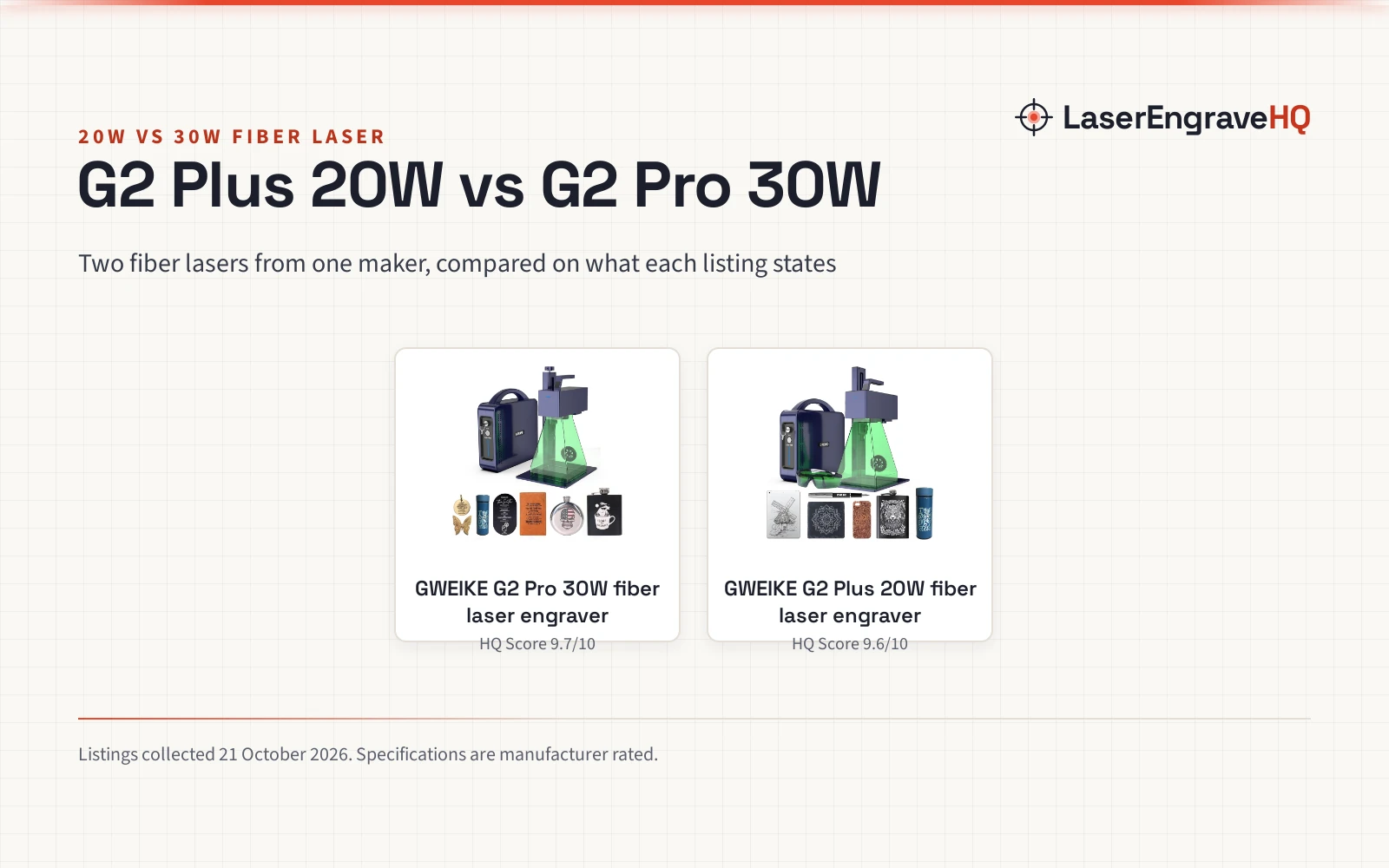
 GWEIKE G2 Pro 30W Fiber Laser EngraverView on Amazon
- 6
 xTool SafetyPro AP2 Smoke Purifier for Laser EngraverView on Amazon
- 7
 Genmitsu Laser Engraver Kortek 10W 10000mWView on Amazon
- 8
 GWEIKE G2 20W Fiber Laser EngraverView on Amazon
- 9
 GWEIKE G2 Plus 20W Fiber Laser EngraverView on Amazon
What is a fiber laser engraver? A fiber laser engraver is a solid-state marking machine that uses a doped glass fiber cable to generate an infrared laser beam, engineered for fast, permanent marking on bare metals and dense plastics. Unlike traditional gantry systems that slowly move a laser head on mechanical rails, a fiber laser steers its beam with high-speed galvo mirrors. This makes it the industrial standard for serial numbers, barcodes, jewelry engraving, and permanent metal identification. The sections below explain how the technology works step by step, what materials it marks, and how to decide if your workshop needs a fiber machine.
Other machines to compare
 WECREAT Vision Pro 45W Laser Engraver and Cutter with RotaryCheck price on Amazon
 GWEIKE G2 Pro 30W Fiber Laser EngraverCheck price on Amazon
 xTool SafetyPro AP2 Smoke Purifier for Laser EngraverCheck price on Amazon
 Genmitsu Laser Engraver Kortek 10W 10000mWCheck price on Amazon
 GWEIKE G2 20W Fiber Laser EngraverCheck price on Amazon
 GWEIKE G2 Plus 20W Fiber Laser EngraverCheck price on Amazon
LaserEngraveHQ earns a commission from purchases made through these links, at no extra cost to you. Read our affiliate disclosure.
A fiber laser engraver is a specialized marking system. It excels at etching bare metal and engineering plastics at high galvanometer speeds, with listings like the GWEIKE G2 Pro publishing speeds up to 15000 mm/s, but it cannot cut thick wood sheets or engrave clear glass like a CO2 machine.
Step 1: Understand how a fiber laser source generates its beam
The heart of a fiber laser engraver is its solid-state source. Inside the power cabinet, semiconductor pump diodes emit light into an optical fiber made of silica glass. This core is doped with rare-earth chemical elements, typically ytterbium. As pump light travels through the core, it excites the ytterbium atoms, releasing photons through stimulated emission. Fused Bragg gratings serve as internal mirrors, creating an optical cavity that amplifies the light into a concentrated laser beam.
This design produces a near-infrared beam at a 1064nm wavelength. For example, published specifications for both the GWEIKE G2 Pro and the ComMarker B6 confirm a 1064nm laser wavelength. Bare metals absorb near-infrared energy far more efficiently than visible blue diode beams. Because the beam stays entirely inside a sealed fiber assembly, there are no glass discharge tubes to replace and no external mirrors to align. For example, the Monport GM20 listing publishes a 100000 Hour lifespan for its fiber laser source.
Step 2: Learn how galvanometer scanning heads deliver high speed
A fiber laser engraver achieves its speed through a galvanometer scanning head, commonly called a galvo head. Desktop diode and CO2 machines drag a heavy laser head along mechanical rails using belts and stepper motors, which limits motion speed.
In a fiber engraver, the laser source stays stationary. The beam travels through an armored fiber cable to a galvo head mounted on a vertical column. Inside the galvo head, miniature mirrors mount directly to high-speed galvanometer motors. A primary mirror steers the beam across the X axis, while a secondary mirror steers it across the Y axis, directing the beam through an F-theta scan lens that maintains a flat focal plane.
Because only tiny mirrors pivot, the galvo head accelerates with almost zero mechanical inertia. For example, the GWEIKE G2 Pro listing states an engraving speed of 15000 mm/s, driven by an industrial-grade digital galvo system that delivers 0.001 mm accuracy and 8K engraving resolution. Similarly, the ComMarker B6 listing publishes an engraving speed of 15,000mm/s.
Step 3: Review materials a fiber laser can mark and carve
The 1064nm wavelength couples into conductive and dense materials:
- Bare metals: Fiber lasers mark metals directly without chemical sprays. Compatible metals include stainless steel, mild steel, aluminum, brass, copper, titanium, gold, and silver.
- Deep metal carving: Running repeated passes vaporizes metal layer by layer to carve coins, badges, and stamps. For light cutting, the LaserPecker LP5 listing states its fiber laser slices 0.5mm brass and titanium.
- Color marking on steel and titanium: Adjusting pulse repetition frequency, marking speed, and focal height heats stainless steel and titanium to create controlled oxide layers that display vibrant colors. For example, the GWEIKE G2 Pro listing states it marks over 90 vibrant colors on stainless steel and titanium.
- Plastics and leather: Fiber lasers create high-contrast marks on dense plastics like nylon, POM (Delrin), and dark acrylic, as well as leather blanks.
- Unsuitable materials: Raw wood, clear glass, and clear acrylic do not absorb 1064nm light. For organic materials, read our diode vs CO2 laser comparison, or see whether you can engrave metal with a 10W diode machine.
Step 4: Set up safety protocols and workspace ventilation
Operating a fiber laser requires strict eye protection and fume control:
Eye protection: The 1064nm beam is invisible, so your blink reflex provides no protection against specular reflections. Safety ratings and stated laser classes vary across manufacturer listings. For instance, the GWEIKE G2 Pro listing states a Class 4 safety level for its 30W (30000mW) output and cites FDA Accession Number 2211667-002. In contrast, the ComMarker B6 listing publishes a Class 1 laser product rating with FDA Accession No. 2521455-000 and IEC 60825-1 Report Number 2501Q25848E-SFA1, while also listing a 60W source and packing protective goggles. Whenever an open 1064nm beam is accessible, certified safety eyewear is mandatory. Eyewear protects only if its rating states optical density (OD) coverage for 1064nm. Unrated tinted shields do not protect your eyes. See our guide to the best safety glasses for laser engraving.
Ventilation and hazardous materials: Vaporizing metal coatings and plastics releases fine particulates. Always run a dedicated filter; see our best fume extractor for laser engraver guide. Never engrave PVC, vinyl, PVC faux leather, polycarbonate, or ABS. When heated, PVC and vinyl emit toxic hydrogen chloride gas that damages lungs and corrodes machine components.
Step 5: Compare MOPA and standard Q-switched sources
Fiber laser engravers use either standard Q-switched or MOPA source architectures.
A standard Q-switched fiber laser operates with a fixed pulse duration. You can adjust frequency, power, and speed, but each pulse discharges energy across a preset duration. By tuning frequency and speed, Q-switched lasers handle general metal etching, serial tags, barcode etching, color marking on stainless steel, and deep metal carving.
A MOPA (Master Oscillator Power Amplifier) source lets you adjust pulse duration and pulse frequency independently. Shorter pulses deliver peak power with minimal heat diffusion. This wider parameter space enables finer thermal tuning, allowing crisp black marking on anodized aluminum without surface ablation, clean marks on sensitive plastics without melting, and broader color control on stainless steel. For example, the ComMarker B6 features a 60W JPT M7 MOPA fiber laser source capable of high-definition color marking and multi-layer processing.
Step 6: Choose optical power and marking field sizes
Configuring a fiber engraver requires matching optical power and lens field size to your production requirements:
Optical output power: Common options include 20W, 30W, and 60W. A 20W machine, such as the Monport GM20, handles surface marking and jewelry etching. A 30W model, such as the GWEIKE G2 Pro with its 30W (30000mW) output, speeds up marking cycles and handles deep relief carving. A 60W unit, such as the ComMarker B6, accelerates deep engraving and commercial batch production.
Marking field and lens selection: A galvo laser’s work area depends on its F-theta lens. A smaller field concentrates the beam into a smaller spot with higher energy density. For example, the GWEIKE G2 Pro offers an 110×110 mm marking area and a 150x150mm working area, the Monport GM20 lists a 4.3″x4.3″ marking area, and the ComMarker B6 lists a 150mm x 150mm field. Use an 110×110 mm field for high-precision jewelry, and a 150x150mm lens for larger items.
Step 7: Decide if a fiber laser fits your workshop
Before purchasing, confirm that your intended products match what a fiber machine delivers:
Who should buy a fiber laser: If your business focuses on bare metal jewelry, custom knives, firearms, industrial serial plates, or dense plastic tags, a fiber laser is the fastest, most permanent tool available. Compare models in our best fiber laser engraver and best laser engraver for metal buying guides.
Who should skip a fiber laser: If your projects focus on cutting thick wood boards, plywood crafts, clear acrylic displays, or glassware, choose a diode or CO2 laser instead. To evaluate all machine types, read our guide on how to choose a laser engraver.
Common mistakes to avoid
- Assuming a fiber laser can cut thick sheets of wood or clear acrylic like a CO2 machine.
- Operating an open Class 4 galvo laser without wavelength-matched protective glasses.
- Skipping dedicated fume extraction when vaporizing metal coatings and plastics.
- Attempting to engrave forbidden materials like PVC, vinyl, or ABS that release corrosive fumes.
- Choosing a large marking field when the project requires ultra-fine engraving precision.
What is a fiber laser engraver: the short version
- A fiber laser uses a 1064nm infrared beam generated inside a doped optical fiber.
- High-speed galvo mirrors steer the beam across the workpiece without moving gantries.
- The wavelength absorbs readily into metals such as steel, aluminum, brass, and titanium.
- Stated safety classifications range from Class 1 to Class 4 across manufacturer listings.
- Standard fiber sources mark bare metals, while MOPA designs add pulse duration control.
- Choose fiber when your primary materials are bare metals and dense industrial plastics.
Everything after that comes down to matching power output and marking area to your production volume.
FAQ: lasers and CNC
Can a fiber laser engraver cut metal?
A fiber laser engraver can cut thin metal foil using multiple overlapping passes, but it is built primarily for surface marking and deep engraving. For example, the LaserPecker LP5 listing states its fiber laser slices 0.5mm brass and titanium. Cutting thick metal sheets requires high-power industrial cutting tables with assist gas systems.
Can a fiber laser engrave wood or clear glass?
No. Organic materials like wood and transparent materials like clear glass do not absorb the 1064nm near-infrared wavelength. The beam passes through clear glass without marking it, and it burns wood unevenly. For wood and glass, choose a diode or CO2 machine.
What is the difference between a fiber laser and a diode laser?
Fiber lasers use a 1064nm near-infrared wavelength that absorbs efficiently into bare metals, paired with galvo mirrors that reach speeds up to 15000 mm/s on models like the GWEIKE G2 Pro. Standard diode lasers use visible blue light on mechanical gantries, making them suited for wood and leather but ineffective on bare reflective metals.
What does MOPA mean on a fiber laser engraver?
MOPA stands for Master Oscillator Power Amplifier. While a standard Q-switched fiber laser operates with a fixed pulse duration, a MOPA machine like the ComMarker B6 allows independent adjustment of pulse duration and pulse frequency. This expanded thermal control allows operators to fine-tune heat input, achieving dark marking on aluminum without melting, cleaner marks on sensitive plastics, and broader color control on stainless steel and titanium.
Do I need protective safety glasses with a fiber laser?
Yes. Open-frame fiber lasers are Class 4 devices emitting invisible 1064nm radiation. Diffuse reflections off metal can cause permanent eye damage. Eyewear is mandatory and must carry an optical density (OD) rating matching 1064nm. Tinted plastic shields or diode goggles do not provide protection against 1064nm beams.
What is the lifespan of a fiber laser source?
Solid-state fiber laser sources require no internal alignment mirrors or consumable gas tubes. For example, the Monport GM20 listing publishes a 100000 Hour lifespan for its fiber laser source, eliminating tube replacements.
Related: the laser engraver hub, the fiber laser engraver category, and our guide to the best fiber laser engraver models. Also see our roundups for the best laser engraver for metal and how to choose a laser engraver, or explore diode vs CO2 laser differences.