Fixed Bridge vs Moving Gantry CNC Router: Which One Should You Buy?
An informational guide comparing fixed-bridge and moving-gantry CNC routers by rigidity, footprint, work area and moving mass, with figures from real listings.

On this page
Top picks at a glance
As an Amazon Associate I earn from qualifying purchases.
- 1
 LASER TREE 5W Laser Module9.5/10View on Amazon
- 2
 8pcs Upgrade V Solid POM Wheels OD 24mm Rollers Gantry Pulley9.5/10View on Amazon
- 3
 3D Printer Rollers v Slot9.5/10View on Amazon
- 4
 FoxAlien XE-Ultra 8080 CNC Router Machine with NEMA 23View on Amazon
- 5
 LUNYEE 3020 Nova CNC Router MachineView on Amazon
- 6
 CNC Spoilboard Surfacing Router Bit 1/4 Inch ShankView on Amazon
- 7
 CNC Spoilboard Surfacing Router BitsView on Amazon
- 8
 CNC Spoilboard Surfacing Router Bit 1/4" ShanView on Amazon
- 9
 CNC Spoilboard Surfacing Router BitView on Amazon
Fixed bridge vs moving gantry cnc router comes down to what moves: the work or the tool. In a moving gantry router, the bridge carrying the spindle travels over a stationary table; every desktop machine in the reference listings here, from the 11.8 x 8.1 inch Genmitsu 3020-PRO MAX V2 to the 33 x 33 inch FoxAlien XE-Ultra 8080, works this way. In a fixed bridge router, the bridge stays put and the table moves the work under it. For desktop sizes, moving gantry dominates; fixed bridge shows up where rigidity matters most. Listings referenced were collected 19 October 2026.
Other machines to compare
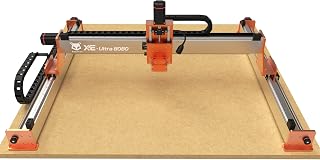 FoxAlien XE-Ultra 8080 CNC Router Machine with NEMA 23Check price on Amazon
 LUNYEE 3020 Nova CNC Router MachineCheck price on Amazon
 CNC Spoilboard Surfacing Router Bit 1/4 Inch ShankCheck price on Amazon
 CNC Spoilboard Surfacing Router BitsCheck price on Amazon
 CNC Spoilboard Surfacing Router Bit 1/4" ShanCheck price on Amazon
 CNC Spoilboard Surfacing Router BitCheck price on Amazon
LaserEngraveHQ earns a commission from purchases made through these links, at no extra cost to you. Read our affiliate disclosure.
Every reference listing for this guide is a moving gantry desktop router; no fixed-bridge machine is among them. The fixed-bridge side below is explained from general machine knowledge, without listing figures, and every number in this guide comes from the moving-gantry listings cited by brand.
Fixed bridge vs moving gantry cnc router: the short answer
Choose moving gantry for the desktop class. It is the standard layout for every machine here, with work areas from 11.8 x 8.1 x 3.1 inches on the Genmitsu 3020-PRO MAX V2 to 33 x 33 x 4.72 inches on the FoxAlien XE-Ultra 8080, and weights from 14.86 kg to 40 kg. Choose fixed bridge when the work is heavy or the cuts demand maximum rigidity: with the bridge fixed to the base, only the table moves, so cutting forces meet a stiffer frame. For home shops and small businesses cutting wood, acrylic, PCB and aluminum, the moving gantry machines in the listings cover the need.
How a moving gantry router works
In a moving gantry router, the bridge is the moving part. It rides on rails along the Y axis, carrying the X axis and the Z spindle assembly, and travels over a table that never moves. Your work stays clamped where you put it, which makes workholding simple: set the stock, zero the axes and cut. The listings show the hardware that makes this layout work. The FoxAlien XE-Ultra 8080 runs 16mm ball screws on X and Y with 12mm on Z, HG-15 linear rails on all axes and a 46x80mm aluminum frame at 40 kg. The LUNYEE 3020 Nova pairs 1204 ball screws with HG-15 linear guides, lists accuracy of plus or minus 0.05mm and a top speed of 5000mm per minute. The Genmitsu 4040-PRO MAX uses SBR16 linear rails with a 710W spindle over a 410 x 405 x 77mm work area. Ball screws and linear rails are the difference between a gantry that cuts true and one that chatters: they keep the moving bridge stiff with low backlash.
How a fixed bridge router works
A fixed bridge router inverts the motion. The bridge, with the spindle, is bolted to the base and never moves; the table underneath carries the workpiece back and forth on the Y axis. The moving mass is the table plus the work instead of the gantry, and the cutting forces push against a bridge that deflects far less along the axis of travel. This is the layout of heavier milling machines and production routers, where stiffness decides the finish and the tool life. The trade is footprint and complexity: the table must travel the full Y length plus the work size, so the machine grows, and workholding moves with the cut, which complicates dust collection and fixturing. No fixed-bridge machine appears in the reference listings, which is itself the point: at desktop scale, makers overwhelmingly choose the gantry.
Side by side: what the listings show
| Moving gantry | Fixed bridge | |
|---|---|---|
| What moves | Bridge with spindle over a fixed table | Table with work under a fixed bridge |
| Rigidity | Good; ball screws and heavy extrusions stiffen it (16mm ball screws, 46x80mm frame on the XE-Ultra 8080) | Higher; the bridge never moves |
| Footprint vs work area | Frame must exceed the travel; a 600x600mm cut needs a 37 in wide machine (Masuter Pro MAX) | Table travel extends the footprint further |
| Work area cited | 11.8×8.1 in to 33×33 in | Not listed here |
| Weight cited | 14.86 kg to 40 kg | Not listed here |
| Suits | Home shops, signs, parts, prototypes | Heavy cuts, production, hard materials |
The table pairs the listed gantry machines against the general fixed-bridge layout. Where the bridge column cites a figure, it comes from a listing; where it says not listed, the listings cover only gantry machines.
Footprint: measure the machine, not the cut
The gantry has to travel past the work, so the machine is always bigger than its work area. The FoxAlien Masuter Pro MAX cuts 600x600mm but measures 37 inches wide; the XE-Ultra 8080 cuts 33×33 inches on a frame wider than that. The 3020-class machines are kinder: the LUNYEE 3020 Nova is 19.2 kg and the Genmitsu 4040-PRO MAX 16.4 kg, both bench-friendly. Before buying, check the machine dimensions against your bench, plus room for the drag chain, the controller box and stock overhang. A fixed bridge machine would demand more: its table travels the full Y length, so the footprint grows with every inch of work area.
Who should buy which
- Moving gantry, for makers and small shops. Every listing here is one, and they cover wood, acrylic, MDF, PCB, leather and aluminum. The LUNYEE’s plus or minus 0.05mm figure shows what a gantry machine can achieve when the motion hardware is right. See our desktop CNC router buying guide and CNC routers for small business.
- Moving gantry, for first machines. The work stays still, workholding is obvious, and setup is simpler. The 3020-PRO MAX V2 even ships its XZ gantry module pre-assembled.
- Fixed bridge, for rigidity-first work. If you are taking heavy cuts all day or running production, the fixed bridge earns its footprint. At desktop scale and budget, it is rarely on the menu.
FAQ: lasers and CNC
Is a moving gantry router less accurate?
Not necessarily. Accuracy comes from the motion system: the LUNYEE 3020 Nova lists plus or minus 0.05mm with 1204 ball screws and HG-15 linear guides, and the XE-Ultra 8080 pairs 16mm ball screws with closed-loop steppers. A well-built gantry cuts true; a flimsy one chatters, whatever the layout.
Why are most desktop CNC routers moving gantry?
Simplicity. The work sits still, so clamping is easy and dust stays where you put the shoe. A fixed bridge needs the table to travel the full cut length, which costs footprint and complicates the build, for rigidity most desktop jobs do not need.
Can a moving gantry router cut aluminum?
Yes, per the listings. The LUNYEE 3020 Nova cuts aluminum and brass with its 800W spindle, the XE-Ultra 8080 lists aluminum among its materials, and the 4040-PRO MAX lists metal with its 710W spindle. Fixed bridge helps with heavier metals, but aluminum is squarely in gantry territory.
How much bench space does a gantry router need?
More than the work area suggests. The Masuter Pro MAX cuts 600x600mm but measures 37 inches wide, and you also need room for the controller, drag chain and stock overhang. Check machine dimensions, not just the cutting envelope.
Does a heavier machine cut better?
Weight helps, but the frame and motion parts decide. The listings run from 14.86 kg to 40 kg; the 40 kg XE-Ultra pairs its mass with a 46x80mm aluminum frame, 16mm ball screws and linear rails. Rigidity comes from the whole structure, not the scale alone.
Related: our desktop CNC router buying guide, cantilever vs gantry CNC router, rack and pinion vs belt drive and CNC router vs laser engraver.