Rack and Pinion vs Belt Drive Cnc Router: Which One Should You Buy?
Rack and pinion vs belt drive CNC router: how each drive moves the gantry, where ball screws fit in, and which drive suits which table, with figures from the listings.

On this page
Top picks at a glance
As an Amazon Associate I earn from qualifying purchases.
- 1
 SpeTool Carbide Single Flute CNC Router Bits 1/8" Cutting9.7/10View on Amazon
- 2
 SainSmart Genmitsu 3020-PRO Ultra CNC Router Machine9.7/10View on Amazon
- 3
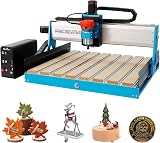 6050 CNC Router Machine9.6/10View on Amazon
- 4
 Genmitsu Cubiko Desktop CNC Router Machine with Enclosure forView on Amazon
- 5
 CNC Spoilboard Surfacing Router Bit 1/4 Inch ShankView on Amazon
- 6
 CNC Spoilboard Surfacing Router BitsView on Amazon
- 7
 CNC Spoilboard Surfacing Router Bit 1/4" ShanView on Amazon
- 8
 CNC Spoilboard Surfacing Router BitView on Amazon
- 9
 FOOSView on Amazon
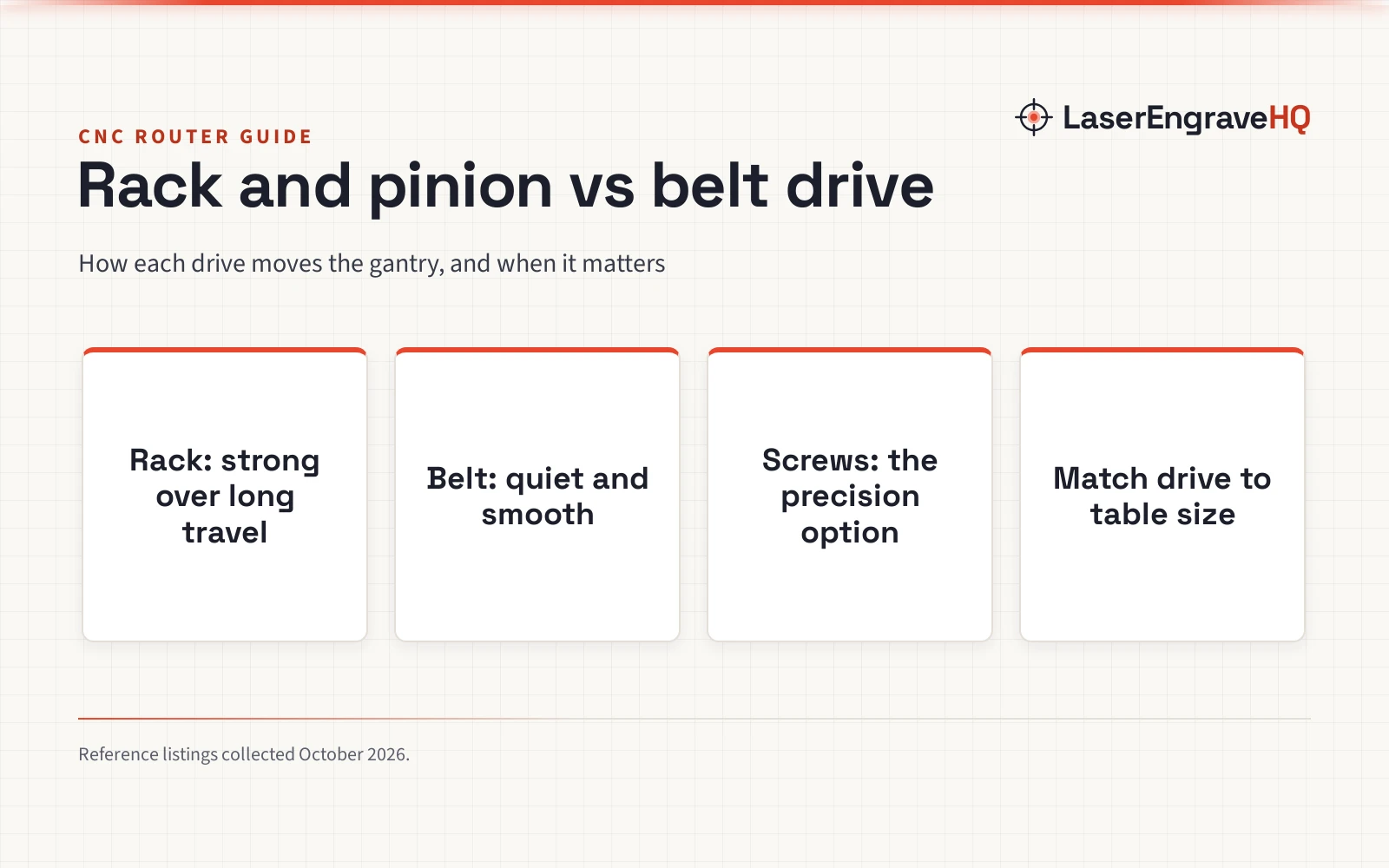
Rack and pinion vs belt drive cnc router comes down to how the machine moves its gantry. Rack and pinion uses a gear walking along a toothed rail, which suits long travel on large tables. Belt drive uses a timing belt looped between pulleys, which suits smaller machines where quiet, smooth motion matters more than brute travel. Most desktop routers in the reference listings use neither: they run ball screws or lead screws, the precision option for short travel.
Other machines to compare
 Genmitsu Cubiko Desktop CNC Router Machine with Enclosure forCheck price on Amazon
 CNC Spoilboard Surfacing Router Bit 1/4 Inch ShankCheck price on Amazon
 CNC Spoilboard Surfacing Router BitsCheck price on Amazon
 CNC Spoilboard Surfacing Router Bit 1/4" ShanCheck price on Amazon
 CNC Spoilboard Surfacing Router BitCheck price on Amazon
 FOOSCheck price on Amazon
LaserEngraveHQ earns a commission from purchases made through these links, at no extra cost to you. Read our affiliate disclosure.
None of the reference listings for this guide states a rack-and-pinion or belt drive; the Genmitsu machines cited here run ball screws or lead screws. The two drive types below are explained from general machine knowledge, without listing figures, and every number in this guide comes from those screw-drive listings.
Rack and pinion vs belt drive cnc router: the short answer
Choose rack and pinion when the table is long and the gantry has real distance to cover. The gear-and-rail setup handles long travel without the sag or whip a long screw would suffer, which is why it shows up on large gantry routers. Choose belt drive when the machine is small and you value quiet, smooth motion at a lower price: the belt loop is simple, light and easy to replace. Choose ball or lead screws, like the reference listings use, when travel is short and precision is the priority.
How rack and pinion works
A pinion gear on the motor shaft meshes with a fixed toothed rack along the axis. Turn the motor and the gear walks the gantry down the rail. There is no long screw to whip at speed and no belt to stretch, so the design scales well to multi-foot travel. The tradeoffs are maintenance and feel: the rack teeth collect dust and chips, so they want regular cleaning, and a coarse setup can show backlash, the small slop when the axis reverses direction. A well-adjusted rack and pinion is rigid and positive; a neglected one is noisy and sloppy.
How belt drive works
A timing belt loops between a motor pulley and an idler pulley, with the gantry clamped to the belt. Turn the motor and the belt drags the gantry along. Belts are quiet, smooth and cheap, and a snapped or worn belt swaps out in minutes with basic tools. The weakness is stretch: belts elongate under load and with age, which shows up as lost steps or rounded corners on direction changes. Short belts on small machines suffer less; long belts amplify every bit of flex. Belt tension is a maintenance item, not a set-and-forget one.
Where screws fit in
The reference listings show the third option, and on desktop machines it is the most common. The Genmitsu 3030-PROVer Ultra lists HG15 dual linear rails with 1204 ball screws on every axis and claims ±0.03mm precision. The Genmitsu 4040-PRO MAX lists SBR16 linear rails and a lead screw on its X-axis, with a 16.1 by 15.9 by 3.0 in work area and a 710W spindle. Ball screws are the precision pick for short travel: the nut recirculates bearings around the screw for smooth, low-backlash motion. Lead screws are simpler and cheaper with more friction. Neither scales to very long tables the way rack and pinion does, which is exactly why the drive types split by machine size: screws on desktops, rack and pinion on long gantries, belts where cost and quiet matter most.
Which drive suits which work
Match the drive to the table, not the brand. Cutting large sheet goods on a long gantry points to rack and pinion, which stays rigid across the travel. Small detailed work on a desktop points to ball screws, like the ±0.03mm claim on the 3030-PROVer Ultra. Light hobby machines where budget rules often use belts, and they cut wood, plastic and thin stock just fine within their limits. If you are shopping the smaller end, our best desktop CNC for beginners and best 2×4 CNC router guides cover machines where screws do the driving.
Common mistakes to avoid
- Chasing the drive instead of the machine. Rack and pinion on a flimsy frame still cuts like a flimsy machine. Frame rigidity decides more than drive type.
- Ignoring maintenance. Racks want cleaning, belts want tension checks, screws want lube. Every drive type has a care routine; skipping it is what creates the backlash and noise people blame on the design.
- Assuming belt means imprecise. A well-tensioned belt on a small machine holds fine tolerances for wood and plastic. It is long belts under heavy load where flex shows.
- Assuming rack means industrial. A cheap rack with a sloppy pinion mesh cuts worse than a good ball screw. Implementation beats category.
FAQ: lasers and CNC
Which drive is more accurate: rack and pinion or belt?
Neither wins outright; setup decides. On short travel, ball screws beat both, which is why the reference listings use them: the 3030-PROVer Ultra claims ±0.03mm with 1204 ball screws. Between rack and belt, a well-adjusted rack is more rigid over long travel, while a well-tensioned belt is smoother on a small machine.
Do belt drives stretch over time?
Yes, belts elongate with load and age, and tension drifts. That shows up as lost steps or soft corners. Check tension as routine maintenance and replace the belt when adjustment no longer holds; it is a common wear part and a quick swap.
Is rack and pinion noisy?
It can be, especially dry or dirty. Chips packed into the rack teeth make every pass louder and rougher. Keep the rack clean and lightly maintained and the noise stays reasonable; let it cake up and you will hear it.
Can I convert a belt drive to ball screws?
Not as a bolt-on. The mounts, motor plates and axis geometry all differ, so a drive swap is a rebuild. The 4040-PRO MAX listing names a Y-axis extension kit among its accessories, which shows makers sell upgrades within a drive family, not across them. Buy the drive you want in the machine.
What drive do the Genmitsu listings in this guide use?
Screws, not rack or belt. The 3030-PROVer Ultra lists 1204 ball screws with HG15 dual linear rails on every axis, and the 4040-PRO MAX lists SBR16 linear rails with a lead screw on the X-axis. None of the reference listings states a rack-and-pinion or belt drive.
Related: the CNC router hub, best CNC router for small business and CNC router vs laser cutter. For the machines behind these drives, see our desktop CNC machines for beginners.