Desktop CNC vs Benchtop Mill: Which One Should You Buy?
A practical guide comparing desktop CNC routers and benchtop milling machines to help makers choose the right tool for wood, plastics, and metals.

On this page
Top picks at a glance
As an Amazon Associate I earn from qualifying purchases.
- 1
 CNCTOPBAOS 3018-PRO CNC Router Engraving Machine w/GRBL9.5/10View on Amazon
- 2
 SpeTool Carbide Single Flute CNC Router Bits 1/8" Cutting9.7/10View on Amazon
- 3
 CNCTOPBAOS 3018-PRO-MAX CNC Router Engraver Machine+GRBL9.4/10View on Amazon
- 4
 Genmitsu Cubiko Desktop CNC Router Machine with Enclosure forView on Amazon
- 5
 FoxAlien XE-Ultra 8080 CNC Router Machine with NEMA 23View on Amazon
- 6
 8PCS HSS 4-Flute End Mill Set CNC Milling Bits 1/16''-1/2''View on Amazon
- 7
 Genmitsu 40pcs End Mills CNC Router BitsView on Amazon
- 8
 HQMaster 1/8" Shank CNC Router Bits 2 Flute Upcut CNC Bit EndView on Amazon
- 9
 8Pcs End Mill Bits HSS CNC End Mill Cutter Drill BitsView on Amazon
When making custom wood signs, carved relief panels, aluminum brackets, or machined metal prototypes, choosing between a desktop CNC vs benchtop mill depends on your material density and part size. A desktop CNC router typically uses a high rotational speed spindle over a horizontal work bed to shape sheet goods, plastics, and non-ferrous metals quickly. A benchtop mill relies on a rigid column, immense frame mass, and high low-speed torque to carve deep profiles into dense metals like steel with tight precision. If you primarily cut sheet stock, relief panels, or decorative plates, a desktop router fits your shop; if you need to square dense steel billets or bore precise bearing pockets in thick blocks, buy a benchtop mill.
Other machines to compare
 Genmitsu Cubiko Desktop CNC Router Machine with Enclosure forCheck price on Amazon
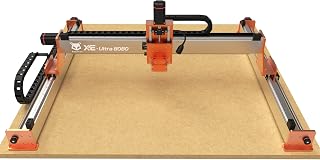 FoxAlien XE-Ultra 8080 CNC Router Machine with NEMA 23Check price on Amazon
 8PCS HSS 4-Flute End Mill Set CNC Milling Bits 1/16''-1/2''Check price on Amazon
 Genmitsu 40pcs End Mills CNC Router BitsCheck price on Amazon
 HQMaster 1/8" Shank CNC Router Bits 2 Flute Upcut CNC Bit EndCheck price on Amazon
 8Pcs End Mill Bits HSS CNC End Mill Cutter Drill BitsCheck price on Amazon
LaserEngraveHQ earns a commission from purchases made through these links, at no extra cost to you. Read our affiliate disclosure.
Machining results depend heavily on proper feeds, cutter choice, and rigid workholding. We do not invent performance figures for unlisted setups, so every specification cited below comes strictly from published manufacturer listings.
Step 1: Compare frame architecture and structural rigidity
The mechanical difference between these machine types begins with how the chassis manages cutting forces. A desktop CNC router uses a gantry architecture, either with a moving bridge across the bed or a fixed gantry over a sliding table. For instance, the FoxAlien XE-Ultra 8080 listing specifies a 46x80mm aluminum frame with an item weight of 40 kg, the AnoleX 4030-Evo Ultra 2 listing specifies an all-metal chassis with an item weight of 38 kg, and the Genmitsu 3030-PROVer Ultra listing states an all-metal chassis with an item weight of 23 kg. Aluminum extrusions and sheet plates keep the machine manageable for workbench placement, but they provide less resistance to deflection than heavy cast structures when resisting high cutting forces.
A benchtop mill relies on a completely different architecture built around a vertical column anchored to a heavy base. The milling head travels along a rigid vertical upright while the work table moves on precise ways below it. Benchtop mills concentrate their mass into cast iron columns rather than aluminum extrusions. This cast construction absorbs vibration and resists deflection when a large cutter engages hard materials, providing structural mass that a wide gantry cannot match.
Step 2: Compare spindle rotational speed and cutting torque
Spindle characteristics dictate which cutters you can run and how fast you can remove material. Desktop CNC routers rely on high rotational speeds paired with modest torque. For example, the Genmitsu 3020-PRO Ultra listing specifies an upgraded 710W spindle with a 6500-30000 RPM range and 6-speed settings, the AnoleX 4030-Evo Ultra 2 listing features an 800W trim router with an 8000-24000 RPM range, and the compact Genmitsu Cubiko listing specifies 96 watts with a maximum rotational speed of 9000 rpm. High rotational speeds allow small-diameter router bits to achieve clean surface finishes in soft stock.
Benchtop mills operate in the opposite performance envelope. A milling machine spindle delivers high continuous torque at much lower rotational speeds through reduction gearing or pulleys. This allows a benchtop mill to drive large end mills, face mills, and slitting saws through tough metals without stalling the motor or overheating the cutting flutes.
Step 3: Match machine capabilities to your primary materials
Material selection is the clearest dividing line between a router and a mill. Desktop CNC routers excel in wood, plastics, acrylic, machinable wax, PCB blanks, and non-ferrous soft metals. The Genmitsu PROVerXL 4030S listing highlights carving capabilities in wood, aluminum, and acrylic with its 710W spindle, while the Genmitsu 3020-PRO Ultra listing notes cutting aluminum up to 1.5mm in one pass. Pairing a router with the right spiral bit, such as an end mill from our best end mill for aluminum guide, yields clean edges on soft metal plates without overloading the machine.
Ferrous metals demand the rigidity of a milling machine. Cutting mild steel, stainless steel, cast iron, or tool steel creates high cutting resistance that quickly overpowers a gantry machine. A benchtop mill provides the rigidity, low-speed torque, and chip clearance needed to push heavy cutters through steel blocks. To see tooling suited for dense ferrous metals, browse our best end mill for steel guide.
Step 4: Evaluate work envelope and part dimensions
The physical dimensions of your projects determine which envelope format you need. Desktop CNC routers emphasize horizontal travel relative to their vertical clearance. Larger desktop formats, such as the FoxAlien XE-Ultra 8080 listing with a 33x33x4.72in workspace and a 5.3″ pass height, provide ample space for processing sheet stock and carving signs. Compact desktop units, such as the Genmitsu 3020-PRO Ultra listing with an 11.8″ x 8.1″ x 3.1” work area or the CNCTOPBAOS 1610-PRO listing with a working area of 7.08×3.93×1.77 inches (18x10x4.5cm), accommodate smaller panels and circuit boards. If you need help sizing a router table, read our guide on how to choose a desktop CNC router.
A benchtop mill offers a compact, cube-shaped working envelope. The table travel along the X and Y axes is relatively small, but the vertical Z-axis clearance and rigidity allow you to work on tall, thick billets. For machining cubic components, brackets, and deep mechanical parts, the compact table of a mill provides unmatched stability under heavy tool pressure.
Step 5: Examine drive mechanics, lead screws, and ball screws
Linear motion components govern positioning accuracy and backlash resistance. Many metal-capable desktop CNC routers use linear profile rails and screw drives for improved rigidity. The Genmitsu 3030-PROVer Ultra listing specifies HG15 dual linear rails and 1204 ball screws to deliver ±0.03mm precision, and the AnoleX 4030-Evo Ultra 2 listing pairs HGH-15 dual linear rails with 1204 ball screws to achieve repeatability accuracy of ±0.005mm and 6061 aluminum cutting accuracy of ±0.02mm. For detailed guidance on how motion components differ, check our comparisons on ball screw vs lead screw CNC and linear rails vs V wheels CNC.
Benchtop mills employ heavy lead screws or precision ground ball screws supported by substantial thrust bearings and cast iron sliding ways. Hand-cranked or motorized milling tables utilize dovetail or box ways that can be adjusted with gib strips to eliminate mechanical play. While linear rail routers move faster across open space, the heavy mechanical damping of a mill way system provides rock-solid stability during aggressive metal removal.
Step 6: Plan tooling, workholding, and chip clearing
Tooling and workholding methods differ significantly between these platforms. Desktop routers typically use small collets, such as an ER11 collet on the AnoleX 4030-Evo Ultra 2, to secure cutters with small shank sizes. Workpieces on a router table are usually held using t-track clamps, cam locks, or double-sided tape on a disposable spoilboard, though some compact routers also accept small low-profile fixtures, such as the 20×10 cm CNC vise supported by the LUNYEE 3020 Nova listing. Our best CNC hold down clamps guide covers common options for securing sheet materials. Wood and plastic cutting generates fine airborne debris, requiring a dedicated dust boot and extraction system like those detailed in our best dust collector for desktop CNC guide.
Milling machines use heavier toolholders and rigid clamping accessories. A benchtop mill table features standard T-slots designed to secure heavy cast precision milling vises and step-clamp sets that lock solid metal blocks against immense cutting loads. Machining metals also produces sharp metal chips rather than fine dust. While routers rely on vacuum collection, metal milling requires chip brushes, compressed air blasts, or mist coolant to lubricate the cutter flutes and clear chips from deep pockets.
Step 7: Decide based on your workshop space and workflow
Your available workshop footprint and typical job orders should finalize your choice. Desktop routers are relatively easy to position on a sturdy workbench. For example, the Genmitsu Cubiko listing specifies an item weight of 11.06 kg, the Genmitsu 3020-PRO Ultra listing states 15.3 kg, the Genmitsu 3030-PROVer Ultra listing states 23 kg, and the AnoleX 4030-Evo Ultra 2 listing specifies 38 kg. Their horizontal work beds let makers produce signs, decorative art, and custom panels with minimal setup friction. If you are starting out with computer-controlled machining, read our review of the best desktop CNC for beginners.
Benchtop mills pack substantial weight into a compact bench footprint. Their dense cast iron structures demand a reinforced stand that will not wobble when the heavy head travels. If your workshop focuses on automotive components, custom metal hardware, or precision prototype mechanisms, a benchtop mill is the appropriate investment. To learn more about how computer-controlled routers compare to dedicated milling machinery, review our comprehensive breakdown in CNC vs milling machine.
Common mistakes to avoid
- Expecting an aluminum gantry router to mill heavy steel blocks without vibration or tool deflection.
- Buying a benchtop mill to carve wide wooden signs or expansive plastic panels.
- Running small router cutters at insufficient spindle speeds in soft materials.
- Attempting to turn large-diameter face mills on high-speed router spindles without adequate low-speed torque.
- Overlooking the necessity of rigid vise workholding when taking heavy milling cuts in metal.
Desktop cnc vs benchtop mill: the short version
- Assess your primary materials: choose a router for wood, plastics, and aluminum; choose a mill for steel and dense alloys.
- Evaluate part dimensions: wide flat sheets require a router bed; thick compact blocks fit a milling table.
- Check spindle speed and torque: high rotational speed suits light routing; low-speed torque powers heavy metal carving.
- Inspect frame rigidity: gantry frames provide wide reach; cast iron column bases absorb heavy cutting vibration.
- Plan your workholding: spoilboards and clamps hold sheet stock; heavy precision vises secure milled billets.
- Match machine capabilities to your daily shop projects rather than occasional edge cases.
FAQ: lasers and CNC
Can a desktop CNC router cut aluminum?
Yes, a rigid desktop router can machine aluminum when using appropriate feeds, speeds, and sharp carbide cutters. For example, the Genmitsu 3020-PRO Ultra listing specifies cutting aluminum up to 1.5mm in one pass. Taking shallow passes and clearing chips prevents tool binding and chatter.
Can a benchtop mill cut wood and plastic?
A benchtop mill can machine wood and plastic, but its lower spindle speed makes material removal much slower than on a high-speed router. In soft materials, achieving clean chip formation with small cutters requires high surface speed; at lower spindle speeds, feed rates must remain conservative to prevent tearing wood fibers, and cutters must shear cleanly to prevent friction.
What is the main difference in spindle speed between them?
Desktop routers feature high-speed spindles, such as the 6500-30000 RPM range on the Genmitsu 3020-PRO Ultra listing and the 8000-24000 RPM range on the AnoleX 4030-Evo Ultra 2 listing. Benchtop mills operate at much lower rotational speeds to deliver continuous torque for driving large cutters through dense metals.
Do I need coolant when cutting metals?
Cutting fluid or mist coolant is recommended when machining aluminum on a router to prevent chips from sticking to the cutter flutes. On a benchtop mill cutting steel, cutting oil or flood coolant extends tool life and clears heavy metal chips from deep cuts.
Which machine is easier for a beginner to learn?
Desktop CNC routers are generally more accessible for beginners because software like Easel and Candle simplifies design and toolpath creation for flat panels. Benchtop mills require a firmer grasp of manual setup, feeds, speeds, and rigid vise clamping to avoid stalling cutters or breaking tools in metal.
Can a desktop CNC router mill steel parts?
Standard desktop routers lack the structural mass and low-speed torque required to machine steel blocks effectively. The tool deflection and frame vibration cause poor finishes and broken bits. For machining steel components, a rigid column mill is necessary.
Related: the CNC router hub, desktop CNC router guide and how to choose a desktop CNC router. Also see our CNC vs milling machine comparison. Also see our best desktop CNC for beginners.