Brilliance Laser Inks BLI101 Review: Pros, Cons & Who It’s For
A research-based review of Brilliance Laser Inks BLI101 metal marking spray: what the specs mean, how CO2 and diode lasers pair with it, and who should skip it.

On this page
Makers personalizing metal items like stainless steel tumblers, brass plaques, copper tags, and pewter gifts frequently face challenges with bare metal: CO2 lasers reflect off bare metal surfaces, and diode lasers struggle to create dark, consistent contrast across different metals. That is where laser marking compounds come into play. This Brilliance Laser Inks BLI101 review examines a 2-pack aerosol spray designed to bond a permanent black mark onto bare metal surfaces under laser heat. We have not used the product ourselves; this review is based on the manufacturer listing data and published specifications.
As an Amazon Associate I earn from qualifying purchases. LaserEngraveHQ earns a commission from purchases made through these links, at no extra cost to you. Read our affiliate disclosure.

Brilliance Laser Inks Black Metal Laser Marking
A 2-pack of 12 oz aerosol cans formulated to produce permanent black marks on stainless steel, brass, copper, and pewter using CO2, fiber, or diode lasers.
Pros
- Compatible with CO2 lasers (25 Watt minimum), fiber lasers, and diode lasers
- Marks bare metals including stainless steel, brass, copper, and pewter
- Anti-clog aerosol nozzle delivers a thin coating with 25% more coverage claimed
- Drying within minutes at room temperature, or within seconds using a heat gun or hair dryer
Cons
- No warranty term is stated on the listing
- Listing title and highlights omit diode lasers despite the bullet points claiming diode laser support
- Listing does not state square-inch or square-foot coverage for the 12 oz cans
- Spec table contains listing errors such as listing ink color as 2 Pcs
Brilliance Laser Inks BLI101 review: the short verdict
Brilliance Laser Inks BLI101 is an aerosol marking spray engineered to bond durable black marks onto bare metals. Instead of engraving or cutting into the metal substrate, the laser beam provides focused thermal energy that fuses the spray compound to the surface. Once the job finishes, rinsing or wiping away the unheated powder leaves a crisp, high-contrast black mark. For small shops running a CO2 or diode laser, this spray expands product offerings to bare metal blanks without investing in a dedicated fiber machine.
The formula uses nanoparticle technology designed to deliver a thinner coating and prevent spray nozzle clogging, with the maker claiming 25% more coverage compared to traditional 12 oz aerosols. The listing states compatibility with CO2 lasers at a 25 Watt minimum, along with fiber, YAG, and diode lasers. It specifies suitability for stainless steel, brass, copper, and pewter.
Key trade-offs include gaps in the published documentation. The listing highlights and title mention CO2, fiber, and YAG lasers but omit diode lasers, even though the bullet points list diode compatibility. In addition, the listing claims 25% more coverage without stating the actual square-inch or square-foot area, gives no warranty term, and contains errors in the Amazon spec table.
Key specs
| Product | Laser Sources | Compatible Metals | Can Volume |
|---|---|---|---|
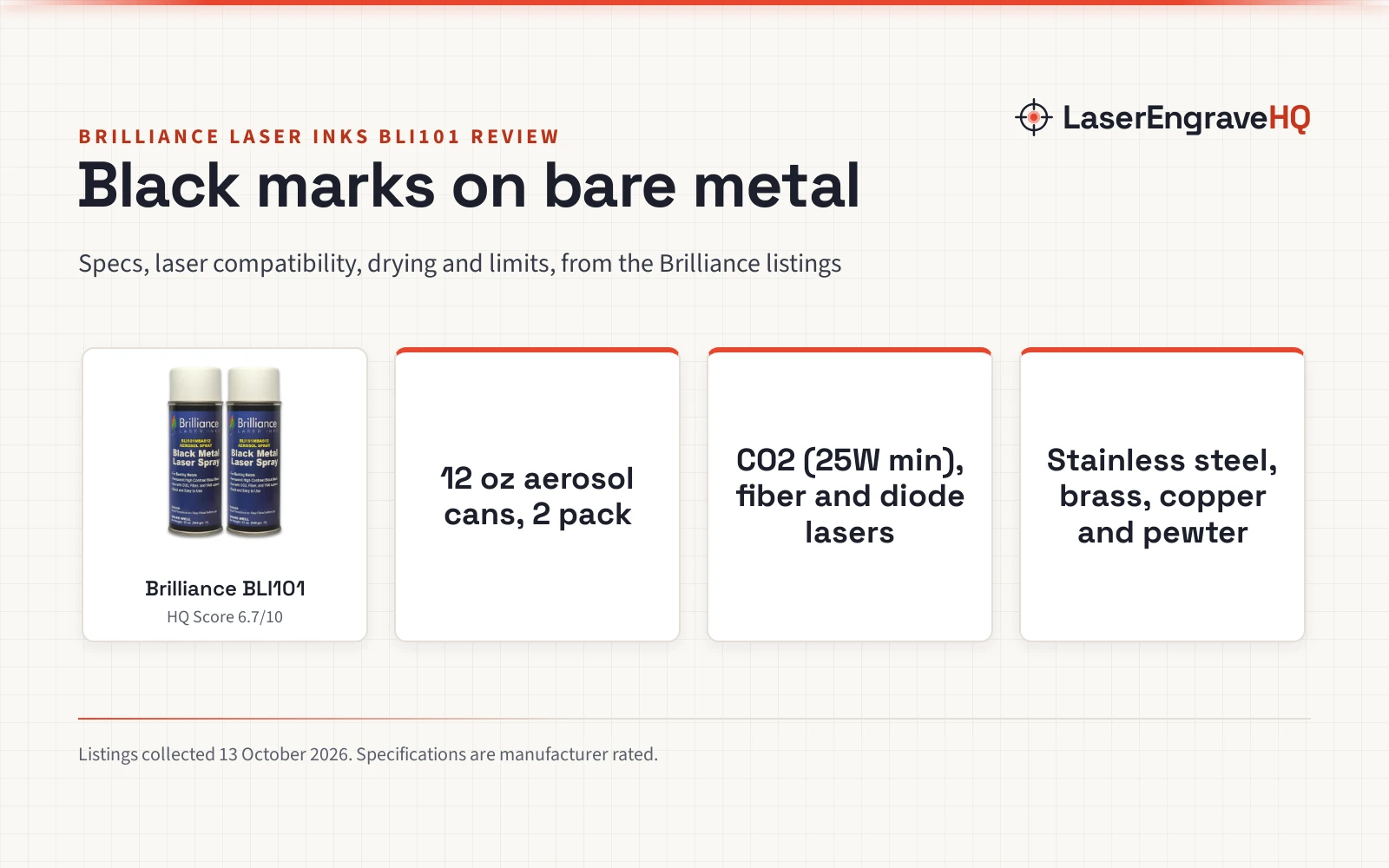
| Brilliance BLI101 | CO2 (25W min), fiber and diode lasers | Stainless steel, brass, copper, pewter | 12 oz cans (2 pack) |
Specifications are manufacturer rated, as published on the Brilliance Laser Inks listing and collected 13 October 2026.
The marking spray
What Brilliance Laser Inks BLI101 does well
Marking bare metals with multiple laser types
Bare metals present optical and thermal hurdles for hobby and craft laser systems. CO2 laser wavelengths reflect heavily off bare metal, while diode lasers require high thermal concentration to produce contrast directly on metal. Brilliance Laser Inks addresses this challenge by acting as a thermal bonding agent. According to the maker, the spray works across multiple laser categories: CO2 lasers with a 25 Watt minimum, along with fiber, YAG, and diode lasers. This wide compatibility allows owners of diode engravers or CO2 machines to achieve dark marks on bare metal blanks. The listing explicitly names stainless steel, brass, copper, and pewter as compatible surfaces.
Anti-clog aerosol delivery
A common frustration with laser marking compounds is uneven application and nozzle blockages. Brilliance Laser Inks states that BLI101 features an anti-clog aerosol design powered by nanoparticle technology. The manufacturer claims this formulation creates a thinner, more uniform surface layer while eliminating the need to clean the spray head between uses. Furthermore, the listing states that this efficient atomization yields 25% more coverage from each 12 oz can than conventional formulations.
Fast drying and simple water cleanup
Workflow efficiency is crucial when producing personalized blanks in batches. The listing notes that BLI101 dries within minutes under ambient room conditions. For faster turnaround, makers can use a heat gun or hair dryer to accelerate drying within seconds. The maker notes that the coating will not blister under high heat. Once the laser run is complete, excess unbonded compound cleans up easily by rinsing under water or wiping with a damp cloth, leaving clean, intricate lines intact.
High-contrast permanent marks
The primary appeal of BLI101 is visual contrast. On bright metals like stainless steel, brass, and pewter, light surface etching can be difficult to read under direct light. The thermal bond formed by this spray leaves an opaque black finish that stands out sharply against the bare metal background, making it suitable for barcodes, serial numbers, logos, and decorative graphics.
Limitations
While BLI101 offers useful capabilities for makers working with metal, several listing limitations and workflow considerations stand out:
- Listing contradictions on diode lasers. The listing title and item highlight advertise compatibility for CO2, fiber, and YAG lasers, omitting diode lasers entirely. Only the detailed bullet points state compatibility with diode lasers. While diode lasers can heat marking compounds, buyers should verify their specific laser wattage before purchasing.
- Coverage area is not specified. The listing advertises 25% more coverage with the 12 oz aerosol, but fails to provide a concrete square-inch or square-foot figure. Without a baseline coverage area, calculating per-piece consumable costs for production runs remains difficult.
- Spec table errors. The Amazon specification table lists the ink color as 2 Pcs rather than black, reflecting careless data entry in the listing.
- No stated warranty. The listing states no warranty term or return guarantee period.
- Overspray and cleanup discipline. Aerosol sprays generate airborne mist that settles on surrounding surfaces. Applying BLI101 requires a dedicated spray box or outdoor spraying area, plus careful masking of areas where marking is not desired.
- Metal specific. The manufacturer formulates this compound specifically for bare metals. The listing does not state compatibility with glass, ceramics, or non-metallic substrates.
Which Brilliance Laser Inks pack to buy
The listing reviewed here (ASIN B084T63Y4M) includes a 2-pack of 12 oz aerosol cans under manufacturer part number BLI101MBAS12-2. Buying the 2-pack bundle provides a spare can on hand, which helps avoid running out of compound midway through customer orders. For makers who only need to mark an occasional blank, a single 12 oz can may be sufficient if available, but small engraving businesses producing regular runs of tumblers, tags, or plaques benefit from keeping backup inventory in the workshop.
Aerosol spray vs laser marking paste
Makers evaluating laser marking compounds generally choose between aerosol sprays like BLI101 and brush-on pastes. An aerosol can offers speed and simplicity: shake the can, spray a light, even coat across the workpiece, let it dry, and run the laser. There are no brushes to wash, no sponge rollers to store, and no manual dilution steps before application.
The trade-off is control over application. Aerosol nozzles disperse a cone of mist, which can lead to overspray on workbenches or unmasked sections of the blank. Paste formulations allow targeted brush application to small areas with less overspray. For large flat blanks or tumblers, aerosol application saves substantial prep time, provided you use a simple spray booth or cardboard shield.
Who should buy it, and who should skip it
Buy it if you operate a CO2 laser (25 Watt minimum) or a diode laser and want to produce permanent, high-contrast black marks on stainless steel, brass, copper, or pewter without purchasing a dedicated metal-marking laser. It fits small engraving businesses personalizing metal gifts, drinkware, and identification tags.
Skip it if your existing laser setup already produces the dark metal contrast you need without consumables, or if you work exclusively with organic materials like wood, leather, or acrylic, where marking compounds are not needed.
Alternatives
If you are deciding between marking sprays and other metal-marking solutions, explore our related guides. Compare other top formulations in our best laser marking spray for metal roundup. If you run a blue diode machine, read our walkthrough on how to engrave stainless steel with a diode laser and our analysis of can a diode laser engrave metal. Makers looking for blanks can check our guide to stainless steel blanks for laser engraving. For shops considering dedicated equipment, review our comparisons of the best laser engraver for metal and explore our laser accessories hub.
BLI101 is a pressurized aerosol product. Apply the spray in a well-ventilated space or dedicated spray booth to avoid breathing propellant fumes and solvent vapors. When bonding the compound under your laser, thermal reaction vapors are generated; always run an active exhaust fan or fume extractor. Wear protective laser safety glasses matching the optical wavelength of your machine. Keep a fire extinguisher within arm’s reach of your workstation, and never leave an active laser unattended. Never attempt to laser PVC, vinyl, ABS, or polycarbonate, as these materials produce hazardous fumes. Consult OSHA and FDA CDRH guidelines for workshop laser safety standards.
Project Match
Based strictly on the materials and machine specifications published in the BLI101 listing, here is how the spray pairs with common engraving shop projects:
- Stainless steel tumblers and drinkware. Compatible metal: stainless steel. Minimum laser power required by the listing is 25 Watt for CO2 lasers, with compatibility also stated for diode and fiber lasers. Maximum work area: Not stated.
- Brass keychains, nameplates, and commemorative plaques. Compatible metal: brass. Produces high-contrast black marks against the brass surface. Laser compatibility: CO2 (25 Watt minimum stated), fiber, and diode lasers. Work area: Not stated.
- Copper jewelry blanks and electrical tags. Compatible metal: copper. Thermal bonding allows marking on high-conductivity copper surfaces using CO2 (25 Watt minimum stated), fiber, or diode lasers. Work area: Not stated.
- Pewter ornaments and customized gift items. Compatible metal: pewter. Creates dark black lettering and fine vector line designs. Laser compatibility: CO2 (25 Watt minimum stated), fiber, and diode lasers. Work area: Not stated.
FAQ: lasers and CNC
Can you use Brilliance Laser Inks BLI101 with a diode laser?
Yes, according to the listing bullet points, which state compatibility with diode lasers. Note, however, that the listing title and summary highlights only mention CO2, fiber, and YAG lasers, omitting diode lasers. Lower-powered diode machines may struggle to generate sufficient surface temperature for a durable bond on reflective metals.
What metals can Brilliance Laser Inks BLI101 mark?
The manufacturer listing states compatibility with stainless steel, brass, copper, and pewter, noting that the spray marks a wide range of metals.
How do you clean off excess spray after engraving?
The unbonded compound cleans up with water. The listing specifies that you can rinse the workpiece under running water or wipe it away with a damp cloth to reveal the finished black design.
How fast does Brilliance Laser Inks BLI101 dry?
The listing states that the spray dries within minutes under ambient air. Using a heat gun or hair dryer dries the coating within seconds, and the maker notes the formula will not blister under high heat.
What laser types are compatible with BLI101?
The listing specifies a 25 Watt minimum for CO2 lasers, along with compatibility for fiber, YAG, and diode lasers.
Related: our guide to the best laser marking spray for metal, how to engrave stainless steel with a diode laser, and the laser accessories hub.