Textured vs Smooth Pei Sheet: Which One Should You Buy?
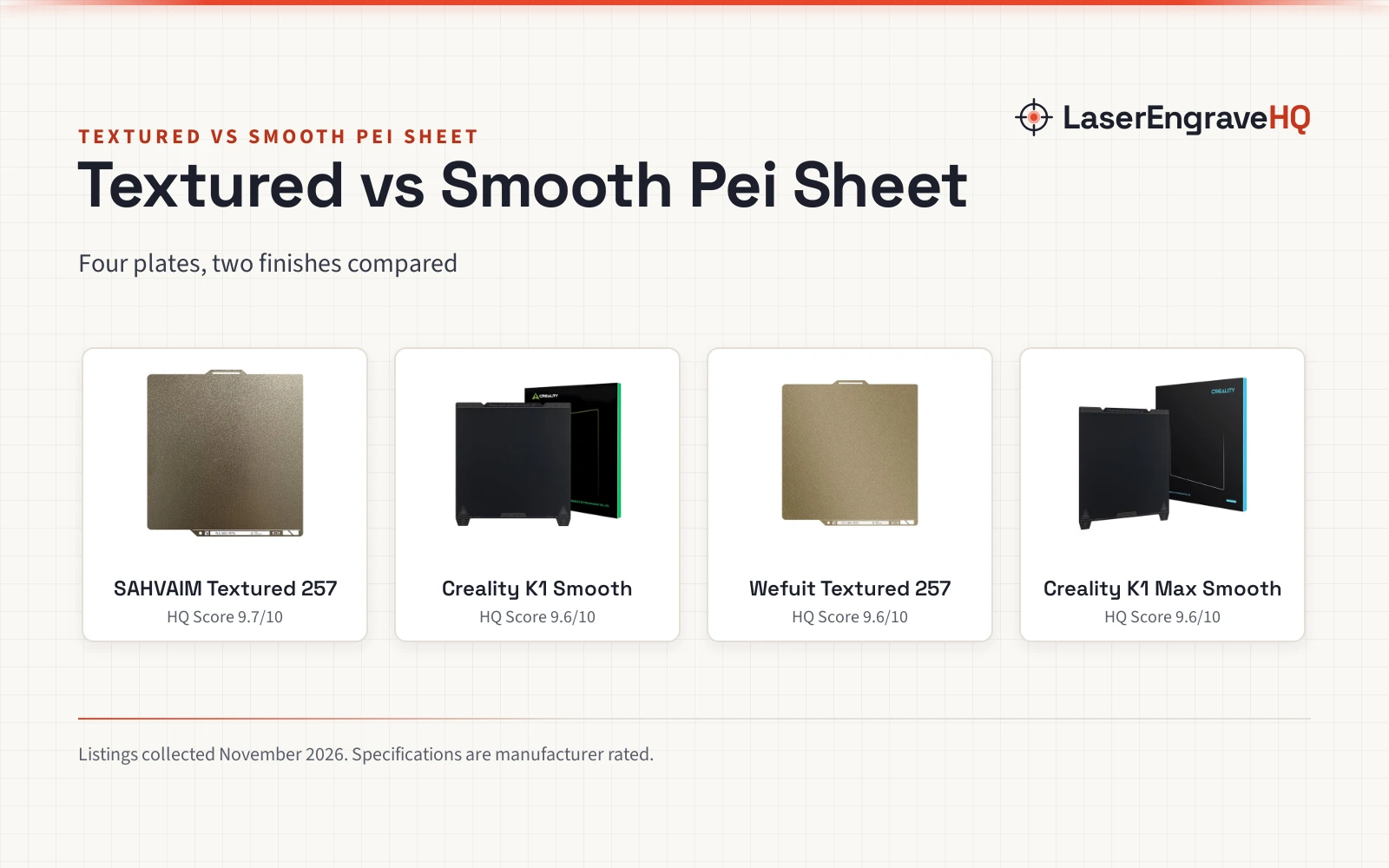
Two textured and two smooth PEI build plates for Bambu Lab and Creality printers, compared on stated size, thickness and material support.

On this page
A print that will not stick wastes filament and time, and a print that sticks too hard risks damage when it comes off. The textured vs smooth pei sheet choice comes down to the bottom finish you want and the printer the plate fits. This comparison uses only what each listing states, and keeps each figure tied to the plate it came from.
As an Amazon Associate I earn from qualifying purchases. LaserEngraveHQ earns a commission from purchases made through these links, at no extra cost to you. Read our affiliate disclosure.
Verdict: Pick a textured plate for a textured bottom finish and easy release on a Bambu Lab platform, and pick a smooth plate for a smooth PEI surface on a Creality K1 or K1 Max. The textured listings state a thickness and a temperature limit, while the smooth listings leave thickness unstated, so compare them on size and printer fit instead.
Machines on the list

Upgraded Thicker Textured PEI Plate 0.77mm with QR
A dual-sided textured PEI plate for Bambu Lab printers with a 257x257mm platform.
Pros
- Dual-sided textured plate, with both sides usable freely
- Total thickness of 0.77mm in flexible spring steel
- Resistant to high temperature 300℃
- Good adhesion with no need for glue, and easy release at room temperature
Cons
- No warranty term is stated in the listing
- Spec table lists NumberOfItems as 0, which does not match a single plate
- Powder-sprayed texture gives the model bottom a texture, not a smooth finish
- Fits only Bambu Lab models with a 257x257mm platform
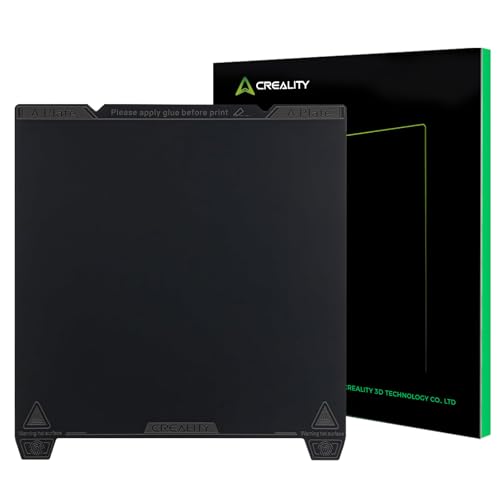
Official Creality Original K1 Build Plate
A smooth PEI build plate for Creality K1 and listed Ender printers, with handles and positioning holes.
Pros
- Smooth PEI coating with wear resistance and high-temperature durability
- Reliable adhesion under both high and low temperatures
- Dual handles and positioning holes for accurate alignment
- High-precision spring steel whose elasticity eases removal by bending
Cons
- Product includes a PEI sheet only, with no magnetic sheet
- No warranty term is stated in the listing
- Printing area of 220x220mm is smaller than the 235x235mm plate
- Maker still recommends adhesive for high-speed printers such as K1, K1 Max and K1C

Thicker 0.77mm Textured PEI Build Plate with QR
A dual-sided textured PEI plate for Bambu Lab printers with a 257x257mm platform.
Pros
- Dual-sided textured plate, with both sides usable freely
- Total thickness of 0.77mm in flexible spring steel
- Resistant to high temperature 300℃
- Good adhesion with no need for glue, and easy release at room temperature
Cons
- Listing reads nearly identically to the SAHVAIM textured plate
- No warranty term is stated in the listing
- Powder-sprayed texture gives the model bottom a texture, not a smooth finish
- Fits only Bambu Lab models with a 257x257mm platform

Creality Official K1 Max Build Plate Smooth
A smooth PEI build plate for the Creality K1 Max and Ender 3 V3 Plus, sized 315x310mm.
Pros
- Large 315x310mm smooth plate for bigger prints
- Frosted PEI powder coating that is heat and wear resistant
- Double handles and positioning holes for quick installation
- Bends repeatedly after printing without deforming, for easy model removal
Cons
- Product ships with no magnetic base included
- No warranty term is stated in the listing
- Fits only the K1 Max and the Ender 3 V3 Plus
- Listing leaves thickness unstated, so it cannot be compared on thickness
Side by side
| Sheet | HQ Score | Side | Size | Thickness |
|---|---|---|---|---|
| SAHVAIM Textured 257 | 9.7/10 | Textured | 257x257mm | 0.77mm |
| Creality K1 Smooth | 9.6/10 | Smooth | 235x235mm | Not stated |
| Wefuit Textured 257 | 9.6/10 | Textured | 257x257mm | 0.77mm |
| Creality K1 Max Smooth | 9.6/10 | Smooth | 315x310mm | Not stated |
Specifications are manufacturer rated, as published on each listing and collected 4 November 2026.
Textured vs smooth pei sheet: what actually differs
The textured listings describe a powder-sprayed surface that gives the bottom of the model a texture, and both textured plates are dual-sided, so either side can be used. The smooth listings describe a smooth PEI surface, but neither smooth listing states what finish it leaves on the bottom of a print, so the finish comparison rests on the surface description rather than on a stated bottom finish for the smooth side. Neither side is better in general: the finish you want decides it.
Size and printer fit
Size here follows the printer, not the finish. Both textured plates measure 257x257mm and list Bambu Lab models with a 257x257mm platform, including the X1, X1C, P1P, P1S and A1, so they suit only that platform size. See our bambu lab a1 vs p1s comparison for two of those machines.
The smooth plates cover Creality machines. The K1 plate measures 235x235mm with a printing area of 220x220mm, and lists the K1, K1C and a long run of Ender-3 and Ender-5 models. The K1 Max plate measures 315x310mm and lists only the K1 Max and the Ender 3 V3 Plus. Check the platform size before ordering, since none of these plates fits the other side’s printers.
Thickness and temperature
Thickness can only be compared on the textured side. Both textured plates state a total thickness of 0.77mm, while neither smooth listing states a thickness at all, so the listings leave a cross-side thickness comparison unclear rather than giving either side a win.
Temperature is similar. The textured listings state resistance to high temperature 300℃, while the smooth listings describe high-temperature durability and heat resistance without giving a figure. A buyer who needs a stated temperature limit will find it only on the textured side.
Adhesion and release
Both sides claim strong adhesion. The textured plates state good adhesion with no need for glue, and say the model comes off easily when the heated bed reaches room temperature, with the plate returning to flatness. The smooth K1 plate states reliable adhesion under both high and low temperatures, while still recommending adhesive for high-speed printers such as the K1, K1 Max and K1C.
Release works by bending on the smooth side. The K1 plate uses high-precision spring steel whose elasticity eases removal by gently bending, and the K1 Max plate states that bending it multiple times after printing removes the model, without deforming after repeated bending. Both sides describe a magnetic design, but the Creality listings state the sheet ships without a magnetic sheet or base.
Choose a textured plate if
- You print on a Bambu Lab machine with a 257x257mm platform.
- You want a textured finish on the bottom of your prints.
- You want a stated thickness and a stated temperature limit in the listing.
Choose a smooth plate if
- You print on a Creality K1, K1 Max or a listed Ender model.
- You want a smooth PEI surface with dual handles and positioning holes for alignment.
- You already have a magnetic base on the printer, since the Creality plates ship without one.
For more build plate options, see pei vs glass build plate.
Let a textured plate cool to room temperature before removing a print, and never clean a textured PEI plate with acetone, which the textured listings say damages the surface and causes irreversible damage.
Project Match
- Bambu Lab prints on a 257x257mm platform: the two textured plates, with PLA, PETG, ABS, TPU, Nylon, PC, PA, ASA and PVA listed as printable on the PEI surface.
- Creality K1 or Ender-3 family prints: the K1 smooth plate, with a printing area of 220x220mm.
- K1 Max or Ender 3 V3 Plus prints: the K1 Max smooth plate, with PLA, ABS, ASA, PETG, TPU, PC and PA listed.
- Prints where the bottom finish matters: textured plates for a textured bottom, smooth plates for a smooth PEI surface.
FAQ: lasers and CNC
Do textured and smooth PEI sheets fit the same printers?
Not these four plates. The textured examples fit Bambu Lab models with a 257x257mm platform, while the smooth examples fit Creality and Ender models in the sizes stated.
What thickness are these PEI sheets?
Both textured plates state a total thickness of 0.77mm. Neither smooth listing states a thickness, so thickness cannot be compared across the two sides.
Can I clean a PEI sheet with acetone?
No, not the textured plates: their listings say acetone damages the PEI surface and causes irreversible damage, and recommend detergent and water instead. The smooth listings do not state a cleaning method.
Do these plates include a magnetic base?
The K1 listing states the plate ships without a magnetic sheet and suits users whose original magnetic sticker is still functional, while the K1 Max listing states no magnetic base is included. The textured listings do not state whether a base is included.
Which materials can print on these PEI sheets?
The textured listings name PLA, PETG, ABS, TPU, Nylon, PC, PA, ASA and PVA, and the K1 Max listing names PLA, ABS, ASA, PETG, TPU, PC and PA. The K1 listing describes wide applicability to various printing materials without enumerating them.
Related: pei vs glass build plate, creality k1c vs k1 max, best pla filament for creality k1c and 3d printer accessories.