Slate vs Ceramic Coasters for Engraving: Which One Should You Buy?
A practical guide to slate vs ceramic coasters for engraving: compare laser beam compatibility, marking spray requirements, durability, and blank prep.

On this page
Top picks at a glance
As an Amazon Associate I earn from qualifying purchases.
- 1
 68 Pcs Slate Coasters9.7/10View on Amazon
- 2
 60 Pcs Blank Ceramic Coasters White Ceramic Tiles for Crafts9.7/10View on Amazon
- 3
 36pcs Black Slate Coasters Bulk Set 18 Round & 18 Square9.6/10View on Amazon
- 4
 VIBRATITE 6 Pack 4 Inch Square Black Slate Drink CoastersView on Amazon
- 5
 VIBRATITE 60 Pack 4 Inch Square Black Slate Drink CoastersView on Amazon
- 6
 48 PCS Slate Coasters BulkView on Amazon
- 7
 60 Pcs Slate CoastersView on Amazon
- 8
 4 Inch 24 PCS Round Slate Drink Coasters for Laser EngravingView on Amazon
- 9
 24 PCS Slate Drink CoastersView on Amazon
When making custom drinkware gifts or wedding favors to sell, choosing between slate vs ceramic coasters for engraving comes down to your laser type, prep workflow, and surface finish. Natural slate engraves directly with sharp, frosty white marks using any standard diode or CO2 laser without chemical coatings. White glazed ceramic coasters provide a smooth modern surface but reflect blue diode wavelengths and require marking spray to create dark designs. If your priority is rapid turnaround, slate is the practical pick; if your customers prefer sleek, non-porous pieces, ceramic is worth the effort.
Other machines to compare
 VIBRATITE 6 Pack 4 Inch Square Black Slate Drink CoastersCheck price on Amazon
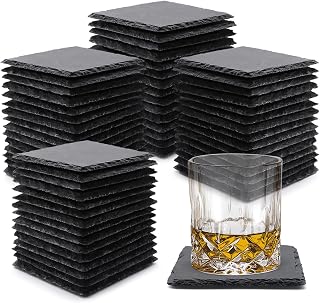 VIBRATITE 60 Pack 4 Inch Square Black Slate Drink CoastersCheck price on Amazon
 48 PCS Slate Coasters BulkCheck price on Amazon
 60 Pcs Slate CoastersCheck price on Amazon
 4 Inch 24 PCS Round Slate Drink Coasters for Laser EngravingCheck price on Amazon
 24 PCS Slate Drink CoastersCheck price on Amazon
LaserEngraveHQ earns a commission from purchases made through these links, at no extra cost to you. Read our affiliate disclosure.
Ceramic tiles with commercial white glaze reflect blue diode laser light, preventing direct dark marks without contrast agents. Natural slate contains silicate minerals that fracture directly under the beam, creating immediate contrast without pre-treatment.
Step 1: Understand material composition and surface contrast
Natural slate is a metamorphic rock formed from compressed clay and ash. Its layered stone structure provides rustic edges, a dark body, and natural face texture. When a laser beam strikes dark slate, localized heat micro-fractures the rock surface, turning dark stone into a crisp, frosted white mark. The contrast is sharp and permanent, requiring no chemical coatings or pigment.
Ceramic coasters are kiln-fired clay blanks finished with a smooth mineral glaze. The glaze produces a flat, non-porous surface that cleans easily and resists stains. However, white ceramic glazes do not darken under standard laser radiation; the beam either reflects or slightly pits the surface without color change. Producing a readable dark design on white ceramic requires an external bonding agent.
Step 2: Match your laser machine to the coaster blank
Your laser hardware dictates which coaster material fits your shop without extra equipment. Diode lasers operating in visible blue wavelengths excel on dark slate because the stone readily absorbs blue light for detailed vector text, monograms, and artwork. CO2 lasers also engrave slate effectively, micro-fracturing the mineral face to leave clean white lettering. Compare machines in our diode vs CO2 laser guide, and consult how to choose a laser engraver.
Ceramic is more restrictive. Glossy white ceramic reflects blue diode wavelengths, so bare tiles cannot be marked with a diode laser alone. CO2 lasers can etch ceramic glazes, but bare etching on white ceramic creates subtle frosted engraving with minimal visual contrast. Producing distinct black graphics on ceramic requires a marking medium that fuses to the substrate.
Step 3: Set up workspace ventilation and safety gear
Both slate and ceramic release fine airborne particles during processing. Engraving stone generates mineral dust, while etching ceramic glazes or heating marking sprays releases microscopic particulate. Maintain dedicated workshop ventilation to protect your breathing zone:
- Ventilation: exhaust fumes outdoors or run a dedicated charcoal and HEPA filter. See our fume extractor guide.
- Eye protection: wear protective eyewear only if the frame and lenses state an optical density and wavelength rating matching your laser source. See our laser safety glasses guide.
- Fire safety: keep an appropriate fire extinguisher within reach of your workstation, and never leave an active laser unattended.
- Material restrictions: never process PVC, vinyl, faux leather made with vinyl polymers, polycarbonate, or ABS plastic, as these release hazardous chlorine fumes that degrade equipment.
Step 4: Evaluate marking sprays and pre-treatment steps
Preparation is the primary workflow difference. Slate requires almost no pre-processing: wipe loose dust from the blank with a damp cloth, let the stone dry fully, focus your laser, and begin engraving. Substrate care details appear in our guide on how to laser engrave slate. Because slate relies on physical fracturing, there are no sprays, fumes, or drying delays.
Ceramic coasters demand pre-treatment for dark marks. Makers use laser marking sprays, bonding pastes, or laser marking paper, as compared in our guide on laser marking paper vs spray. Marking spray requires an even coat, complete drying before engraving, and a warm-water rinse to remove unbonded compound. This adds labor per piece, increases consumable costs, and introduces solvent odor to your shop.
Step 5: Check blank sizing, weight, and backing pads
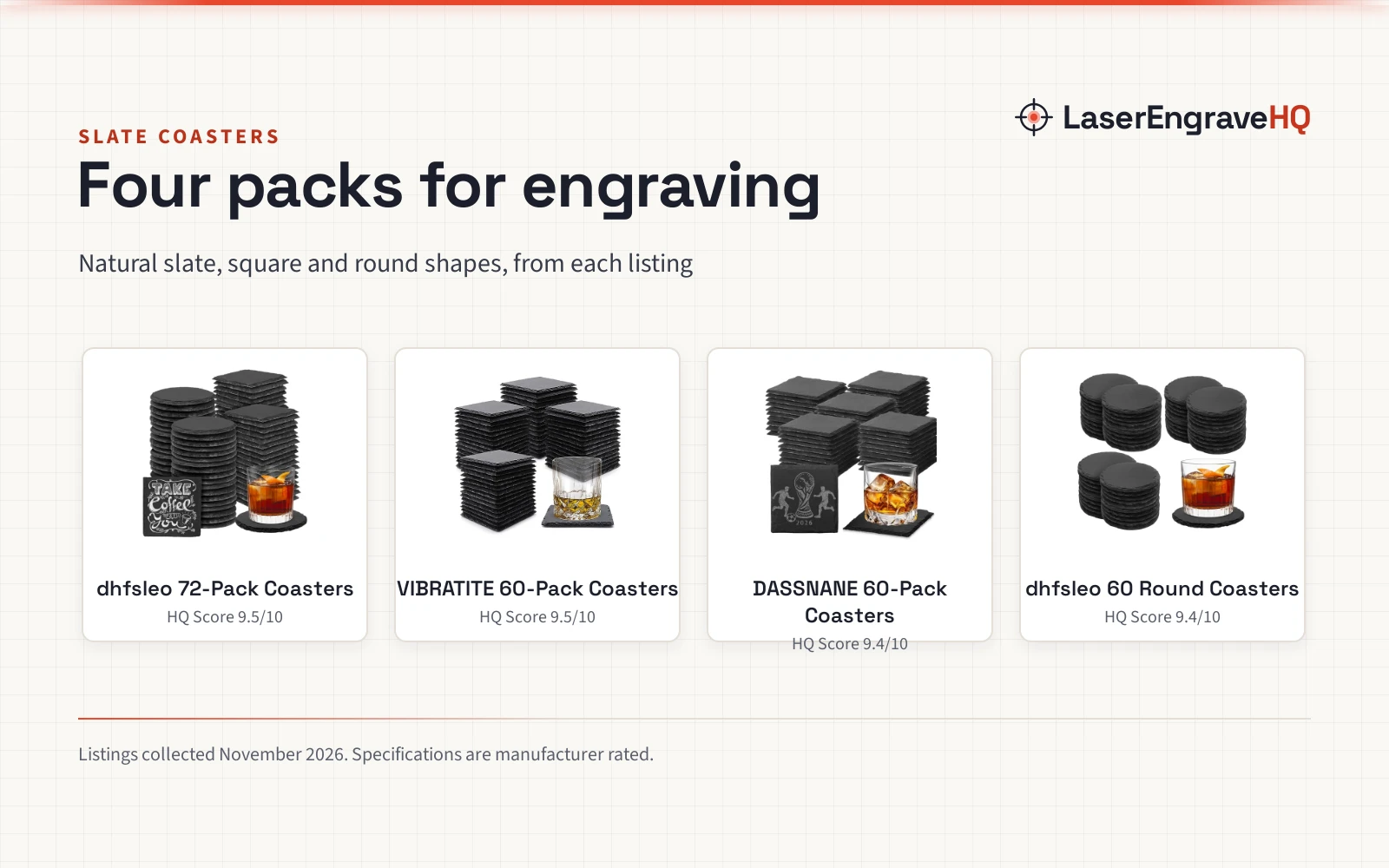
Drink coasters must sit flat and protect furniture from heat, moisture, and scratches. Slate blanks appear in square and round shapes across reference listings, commonly specified at 4 x 4 inches or 4 inches across. MONKEY SUN lists square slate blanks measuring 4 x 4 inches in packs of 24 and 60 pieces with pre-attached soft mini mats. VIBRATITE publishes square slate blanks measuring 4 inches across in packs of 6, 12, 60, and 72 pieces, featuring four felt pads on the base, with select sets providing a metal holder. MAPRIAL lists slate blanks measuring 4 x 4 inches with a thickness of 3.8 millimeters to 5.7 millimeters (also noted as 0.38 to 0.55 cm) in packs of 24 and 48 pieces, equipped with 4 soft mats. In comparison, dhfsleo lists round blanks measuring 4 x 4 inches in packs of 60 pieces with 4 soft mats, while GOH DODD lists packs of 13 round pieces with 4 rubber pads (the title states 4 Inch, though the spec table contradicts this with 10″L x 10″W). Explore blanks in our best slate coasters for laser engraving roundup.
Ceramic coaster blanks appear as square or round craft tiles sized for common drinkware. Explore tile options in our best ceramic tiles for laser engraving guide. Unlike slate blanks that ship with pre-installed rubber or felt cushions, ceramic craft blanks often arrive as bare glazed tiles, requiring makers to apply self-adhesive cork backing or silicone bumper dots manually.
Step 6: Assess daily durability and moisture absorption
Drink coasters must handle moisture and shield tabletops. Natural slate is a porous metamorphic stone that tolerates hot mugs and cold drinks without warping. However, unsealed slate absorbs condensation and dark liquids like wine or coffee, which can leave rings over time. Moisture also temporarily darkens the frosted white laser mark until the stone dries. Many sellers apply a protective top coat to seal pores, protect mark contrast, and repel stains. Our guide to the best clear coat for slate coasters reviews protective sealants.
Glazed ceramic offers superior stain resistance because its vitrified surface is non-porous, allowing liquids to wipe away without residue. The trade-off is that glazed ceramic does not absorb condensation, causing moisture from chilled glasses to pool on top. Unglazed bisque absorbs condensation quickly but stains if dark liquids penetrate porous clay. Glazed ceramic suits wipe-clean priorities, while sealed slate delivers natural stone character.
Step 7: Calculate production time and customer appeal
Production time directly impacts profit margins when selling custom coasters. Slate enables fast batch manufacturing: with zero masking, zero bonding spray, and zero drying cycles, you can align multiple blanks, engrave vector graphics, wipe the surface, and package immediately. See our guide on the best laser engraver for small business for batch equipment, and consult how to price laser engraving work to calculate production rates.
Ceramic coasters require a longer workflow. Spraying, drying, engraving, washing, and applying cork backing increases active labor per piece. However, finished ceramic appeals strongly to buyers seeking modern kitchen aesthetics or corporate merchandise. Slate appeals to customers looking for rustic home decor, barware, and personalized gifts. Match your material to customer demand.
Common mistakes to avoid
- Attempting to engrave bare glossy white ceramic with a blue diode laser without marking spray or paper.
- Skipping ventilation when engraving slate, which spreads fine mineral rock dust across machine rails.
- Leaving engraved slate unsealed when selling drinkware intended for high-stain dining environments.
- Purchasing bare ceramic tiles without ordering adhesive cork or felt pads for furniture protection.
- Neglecting to include pre-treatment spray and washing time when pricing ceramic coaster sets.
Slate vs ceramic coasters for engraving: the short version
- Natural slate engraves directly with frosted white contrast on diode or CO2 lasers without chemical coatings.
- Ceramic coasters with factory glazes require marking spray or bonding paper to produce dark, legible graphics.
- Slate blanks arrive with pre-installed soft backing pads, whereas ceramic tiles often require separate cork backing.
- Glazed ceramic resists drink stains effortlessly, while slate benefits from a light clear coat to prevent moisture rings.
- Slate enables faster batch production, making it practical for high-volume custom orders and rustic decor.
- Ceramic offers a smooth modern aesthetic favored for corporate merchandise and contemporary dining settings.
Choose slate for rapid turnaround, natural stone texture, and direct diode marking. Choose ceramic when buyers demand a sleek, wipe-clean tabletop finish and you have the workflow for spray application and washing.
FAQ: lasers and CNC
Can a diode laser engrave slate coasters directly?
Yes. Diode lasers mark natural slate directly without sprays or masking. The blue beam micro-fractures the dark silicate stone surface on contact, producing a crisp, frosted white mark with sharp contrast.
Can you laser engrave ceramic coasters without marking spray?
Generally no for high-contrast black marks on white ceramic. Standard diode and CO2 lasers do not darken white glaze. Without laser marking spray or paper, the beam reflects or leaves a faint, low-contrast etch.
Do slate coasters need to be sealed after laser engraving?
Sealing is recommended for drink coasters. Natural stone is porous, so a light sealer or clear acrylic spray repels stains and keeps moisture from temporarily dimming the white mark. If using mineral oil, apply it before engraving to darken the stone without muting the white graphic.
How do you clean slate and ceramic coasters after engraving?
For slate, wipe the surface with a damp microfiber cloth to remove residual rock dust. For ceramic treated with marking spray, rinse the coaster under warm water with a soft sponge to remove excess unbonded compound, then dry thoroughly before packaging.
Which coaster material is more durable for everyday use?
Glazed ceramic offers superior stain resistance because its glass-like surface is non-porous. Slate is heat-resistant and durable, but its natural layered edges can chip if dropped on hard floors.
Do laser engraved slate and ceramic coasters need backing pads?
Yes. Both materials can scratch furniture without backing. Reference slate listings include pre-installed soft foam or felt pads. Ceramic tiles often ship as bare blanks, so makers should apply adhesive cork sheets or silicone feet before selling.
Related: the laser engraver hub, our best slate coasters for laser engraving guide, and our roundup of the best ceramic tiles for laser engraving. Also see our instructions on how to laser engrave slate, best clear coat for slate coasters, and our guide on how to choose a laser engraver.