Sewing Machine Foot Types and Their Uses
Sewing machine foot types decide how fabric feeds under the needle: the standard foot, walking foot, free-motion foot and 1/4 inch foot, plus a magnetic seam guide for straight seams.

On this page
Top picks at a glance
As an Amazon Associate I earn from qualifying purchases.
- 1
 Magnetic Seam Guide for Sewing Machine,Guide9.6/10View on Amazon
- 2
 AMZTKDIY Metal Open Toe Free Motion Quilting9.6/10View on Amazon
- 3
 1/4 inch Snap on Foot w/Guide9.6/10View on Amazon
- 4
 HONEYSEW Open Toe Walking Foot W/Guide for Brother9.6/10View on Amazon
A quilt top with rows of patchwork, a dress with a lining that slides, a tote bag with seams that wander off the line: each job asks the foot under the needle to do a different thing. Sewing machine foot types are the presser feet that hold the fabric and feed it past the needle, and the right foot keeps the layers together while you sew. This guide walks through the main kinds, what each foot handles, and how to check the fit.
LaserEngraveHQ earns a commission from purchases made through these links, at no extra cost to you. Read our affiliate disclosure.
Magnetic Seam Guide for Sewing Machine,Guide
A magnetic seam guide that sits on the needle plate and holds a straight seam line, for machines with a metal surface.
Pros
- Magnetic hold stays put without shifting, per the listing
- Adjusts to the seam width you need
- Fits household and light industrial machines with a metal surface
- Compact 3.2 x 2.0 in footprint
Cons
- Not a presser foot: it guides fabric, it does not feed it
- Needs a metal surface near the presser foot
- Warranty description gives only '2.'
- No weight stated
AMZTKDIY Metal Open Toe Free Motion Quilting
A metal open-toe free-motion quilting and darning foot, spring-loaded, for quilting, embroidery, stippling and thread painting on low-shank machines.
Pros
- Open toe gives a clear view for following patterns
- Spring-loaded to keep fabric flat and reduce skipped stitches
- Metal with a polished surface that resists rust
- Fits most low-shank machines, including Brother, Singer and Janome
Cons
- No warranty term stated
- Free-motion quilting takes practice to steer the fabric by hand
- No weight stated
1/4 inch Snap on Foot w/Guide
A snap-on 1/4 inch foot with a guide and reference markings, for 1/4 inch seams in patchwork and piecing.
Pros
- Guide holds a 1/4 inch seam allowance
- Reference markings on the side for accuracy
- Flat bottom keeps material in contact with the feed dogs
- Dimensions stated: 1.4 x 0.63 x 0.3 inches
Cons
- Suits 1/4 inch seams, pivoting and topstitching, not general-purpose sewing
- Adapter may be required on some low-shank machines
- No warranty term stated
- No weight stated
HONEYSEW Open Toe Walking Foot W/Guide for Brother
An open-toe walking foot with a guide bar for quilting, layered sewing and decorative stitching.
Pros
- Open toe leaves room for dense decorative stitches
- Guide bar helps on plaids, knits and minky cloth
- Heavy-duty construction for thicker fabric layers, per the listing
- Fits low-shank Brother, Singer, Pfaff, Husqvarna Viking and more
Cons
- No dimensions stated
- No weight stated
- No warranty term stated
- Stated fit is low-shank models only; check your machine before buying
Sewing machine foot types: the main kinds
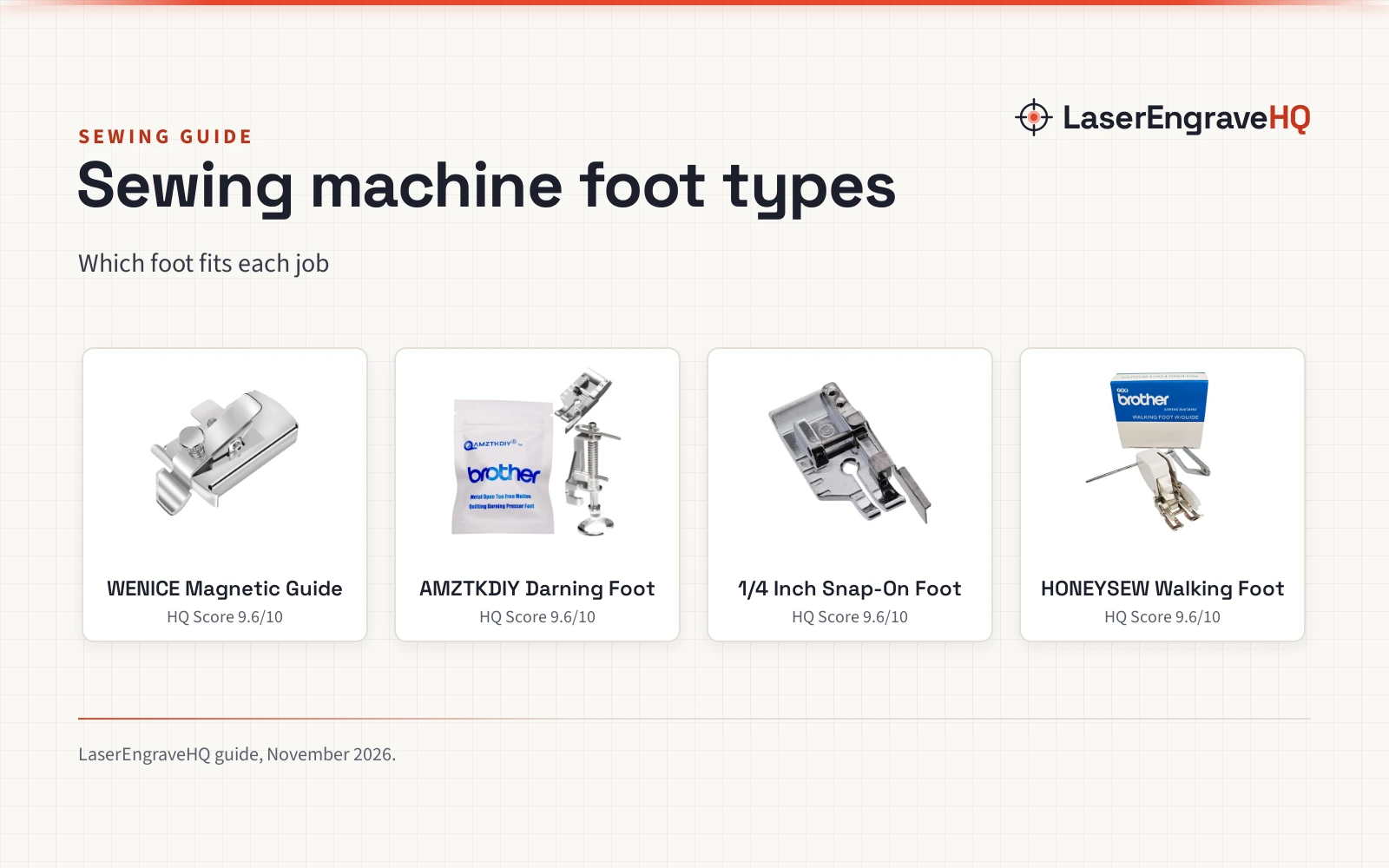
The foot that comes with most machines is the standard foot, made for straight seams on ordinary fabric. It holds the fabric flat against the feed dogs, and it suits everyday seams in garments and home sewing.
A walking foot feeds the top layer along with the bottom layer, so plaids stay matched and slick fabrics do not creep. The open-toe version leaves the stitching area in view for dense decorative stitches; the HONEYSEW listing pairs it with plaids, knits and slick minky cloth.
A free-motion foot, also called a darning foot, lets you move the fabric by hand in any direction, which is how quilters follow curves and stitch stippling and thread painting. The AMZTKDIY listing describes a spring-loaded open-toe foot for that work, for hollow cotton, silk and leather.
The 1/4 inch foot sets a 1/4 inch seam allowance, the seam quilters use for patchwork and piecing. Its guide holds the fabric edge in place, and the reference markings on the side keep the line visible.
A magnetic seam guide is not a foot at all: it sits on the needle plate and holds the fabric edge on a straight seam line. The WENICE listing describes it for straight seams on machines with a metal surface near the presser foot.
How to pick the right foot
Match the foot to the job first, then check the fit. Piecing and patchwork call for the 1/4 inch foot, layers that shift call for the walking foot, free-motion quilting calls for the darning foot, and long straight seams are where the magnetic guide fits.
Then check the shank. The three feet in this guide fit low-shank machines, and their listings name the brands they fit, including Brother, Singer, Janome, Juki and Babylock. The Sewing Parts Online listing notes an adapter may be required on some machines, so check the listing for your model. The magnetic guide needs a metal surface near the presser foot, so check the needle plate area on your machine. Pair the foot with the right needle: the types of needles for sewing guide covers the match.
The gear: feet and a guide for these jobs
The gear below covers the jobs above: the walking foot for layered work, the free-motion foot for quilting, the 1/4 inch foot for piecing, and the magnetic guide for straight seams.
FAQ: lasers and CNC
What foot do I need for quilting?
It depends on the quilting. A walking foot feeds layered quilts evenly, and a free-motion foot lets you steer curves and stippling by hand.
What is a walking foot for?
A walking foot feeds the top and bottom layers together so they do not shift, which suits plaids, knits and slick fabrics. The open-toe version keeps decorative stitches in view.
What does a 1/4 inch foot do?
It holds a 1/4 inch seam allowance for patchwork, quilting and piecing. Place the fabric edge against the guide and sew, and the seam lands on the 1/4 inch line.
Do presser feet fit all sewing machines?
No. The three feet in this guide fit low-shank machines, and each of their listings names the brands it fits. The magnetic guide is different: it needs a metal surface near the presser foot rather than a low shank. Check the listing for your machine; the Sewing Parts Online listing says an adapter may be required on some machines.
What is a magnetic seam guide?
It is a magnetic guide that sits on the needle plate and holds the fabric edge on a straight seam line, for machines with a metal surface near the presser foot.
Can I use a free-motion foot for embroidery?
Yes. The AMZTKDIY listing names embroidery, stippling and thread painting among the uses for its free-motion foot, and the open toe keeps the pattern in view.
Related: the best sewing machine presser feet, the best quilting machine for home use picks, the walking foot sewing machine vs regular sewing machine comparison and the sewing and embroidery machines hub.