Pla vs Nylon Filament: Which One Should You Buy?
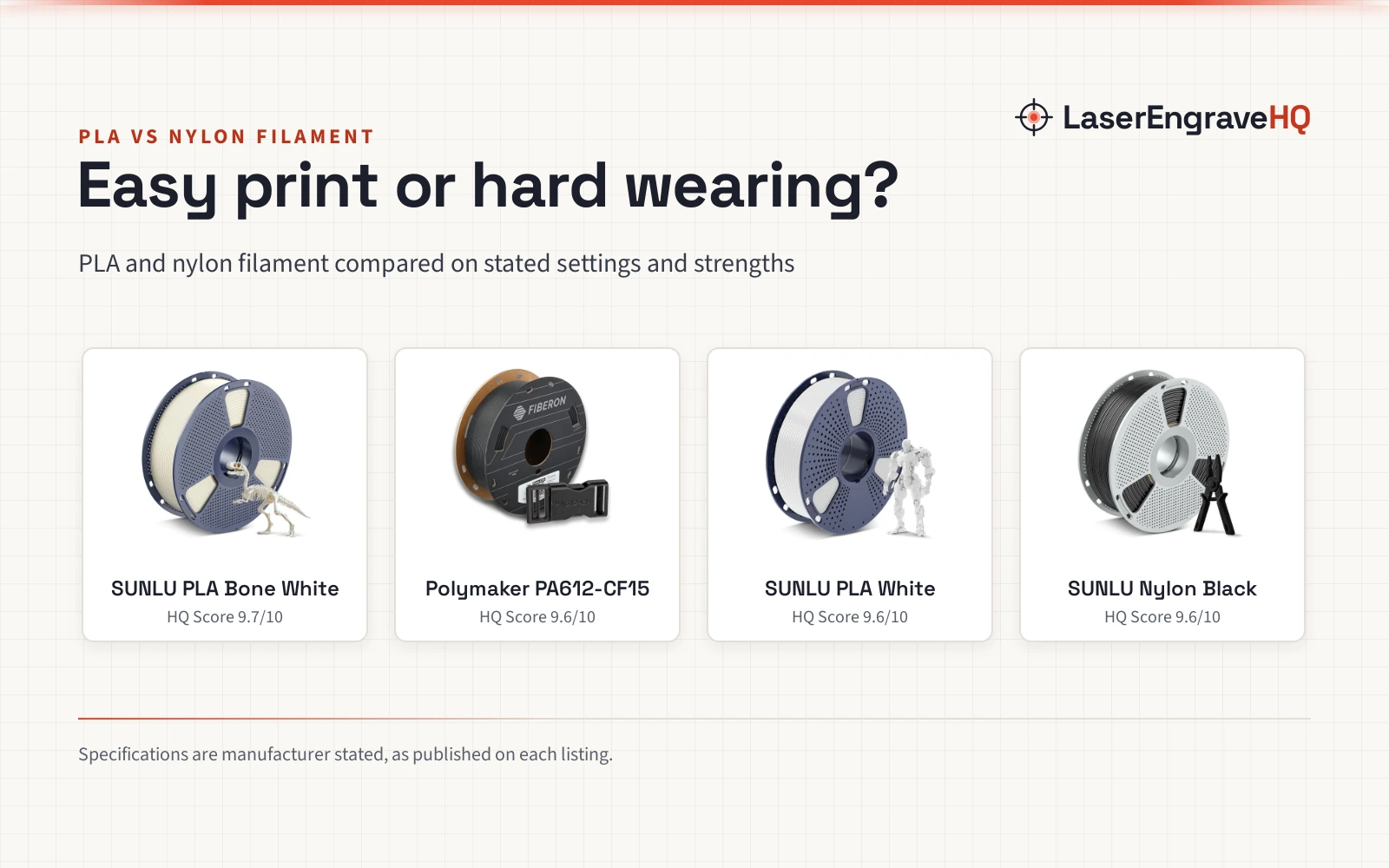
PLA examples print at lower nozzle temperatures with simple settings, while nylon examples state higher temperatures, dry storage steps and functional-part use.

On this page
A maker choosing filament for a new part usually starts with the part itself: a simple print that should just work, or a functional part that must hold up under load. This pla vs nylon filament comparison puts PLA examples against nylon examples, using what each listing states about settings, strength, and storage.
As an Amazon Associate I earn from qualifying purchases. LaserEngraveHQ earns a commission from purchases made through these links, at no extra cost to you. Read our affiliate disclosure.
Verdict: Pick the PLA examples for simple printing at a nozzle temperature of 200-230 degrees Celsius, with a stated diameter accuracy of plus or minus 0.02mm. Pick the nylon examples for functional parts, accepting the higher nozzle temperatures, dry storage steps and extra steps those listings state.

SUNLU PLA 3D Printer Filament, Bone White, 1KG
A bone white PLA spool with a stated diameter accuracy of plus or minus 0.02mm, neatly wound, with vacuum packaging and a stated 1 year manufacturer warranty.
Pros
- Diameter accuracy of plus or minus 0.02mm stated
- Neatly wound spool for smoother printing as stated
- Vacuum packaging to keep filament moisture-free as stated
- 1 year manufacturer warranty stated
Cons
- Nozzle temperature of 200-230 degrees Celsius stated, so settings still need care
- No tensile strength figure stated
- Spool size stated in millimetres only, at 195mm diameter
- White colour range is limited to bone white in this listing

Polymaker Fiberon PA612-CF15 Carbon Fiber Nylon
A carbon fiber reinforced PA612 nylon filament with stated tensile strength and heat deflection figures, for rigid functional parts and engineering prototypes.
Pros
- 15 percent carbon fiber reinforced PA612 as stated
- Dry tensile strength of 91.9 MPa stated
- Heat deflection temperature of 175 degrees Celsius at 0.45 MPa after annealing as stated
- Speeds up to 300 mm/s may be possible with a tuned profile as stated
Cons
- No warranty term is stated
- Requires an all-metal hotend and a hardened steel or ruby nozzle as stated
- Must be kept below 20 percent relative humidity during storage and printing as stated
- Heated chamber is not required under the stated conditions, but drying and annealing still add steps

SUNLU PLA 3D Printer Filament, White, 1KG
A white PLA spool with a stated diameter accuracy of plus or minus 0.02mm, neatly wound, with recommended settings for most FDM printers.
Pros
- Diameter accuracy of plus or minus 0.02mm stated
- Neatly wound spool for smoother printing as stated
- No clogs, bubbles, or tangles as stated
- Recommended settings stated for nozzle, bed, and speed
Cons
- No warranty term is stated
- No tensile strength figure stated
- Spool diameter of 8.00 inches may not suit every printer holder
- White colour only in this listing
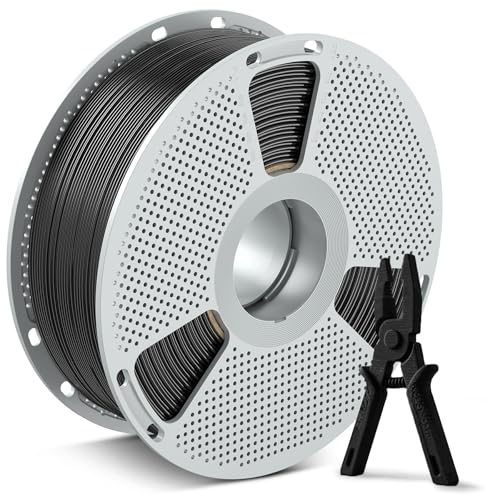
SUNLU Nylon Filament 1.75mm
A black Nylon 6 plus 66 filament with a stated heat deflection temperature of 121 degrees Celsius, warp-free printing, and a PC spool.
Pros
- Heat deflection temperature of 121 degrees Celsius stated
- Low shrinkage and warp-free printing as stated
- PC spool resistant to high temperature of 110 degrees Celsius as stated
- Vacuum packaging with an aluminum foil bag as stated
Cons
- No warranty term is stated
- No tensile strength figure stated
- One bullet mentions carbon fiber reinforcement, but the title and other bullets describe Nylon 6 plus 66 without carbon fiber
- Annealing at 90-130 degrees Celsius adds a step after printing as stated
Side by side
| Spec | SUNLU PLA Bone White | Polymaker PA612-CF15 | SUNLU PLA White | SUNLU Nylon Black |
|---|---|---|---|---|
| HQ Score | 65 | 60 | 59 | 57 |
| Diameter | 1.75mm | 1.75mm | 1.75mm | 1.75mm |
| Nozzle | 200-230 degrees Celsius | 250-300 degrees Celsius | 200-230 degrees Celsius | 270-280 degrees Celsius |
| Bed | 50-65 degrees Celsius | 40-50 degrees Celsius | 50-65 degrees Celsius | 30-50 degrees Celsius |
| Speed | 50-100mm/s | Up to 300 mm/s | 50-100mm/s | 100-150mm/s |
| Pack | 1 kg | 0.5kg | 1 kg | 1KG |
| Warranty | 1 year manufacturer | Not stated | Not stated | Not stated |
Specifications are manufacturer stated, as published on each listing and collected 3 November 2026.
Print settings
Settings separate the sides on figures stated by listings on both sides. The PLA examples state a nozzle temperature of 200-230 degrees Celsius, a bed temperature of 50-65 degrees Celsius, and a printing speed of 50-100mm/s. The Polymaker nylon example states a nozzle temperature of 250-300 degrees Celsius and a build plate temperature of 40-50 degrees Celsius, with speeds up to 300 mm/s possible with a tuned profile as stated. The SUNLU nylon example states a nozzle temperature of 270-280 degrees Celsius, a platform temperature of 30-50 degrees Celsius, and a speed of 100-150mm/s.
Strength and heat
Strength figures are not stated on both sides, so this section does not rank the sides on a single strength number. The Polymaker example states a dry tensile strength of 91.9 MPa and a strength of 83.1 MPa after the stated annealing and moisture-conditioning process, with a heat deflection temperature of 175 degrees Celsius at 0.45 MPa after annealing at 100 degrees Celsius for 16 hours. The SUNLU nylon example states a heat deflection temperature of 121 degrees Celsius, and states tensile strength and bending strength exceeding that of regular PLA and ABS, without a stated figure. The PLA examples state no tensile strength figure at all.
Moisture and storage
The Polymaker example states that the filament remains hygroscopic, must be kept below 20 percent relative humidity during storage and printing, and should be dried at 100 degrees Celsius for 10 hours before use if exposed to ambient humidity. The SUNLU nylon example states vacuum packaging with an aluminum foil bag, a drying temperature of 90 degrees Celsius, a drying time of 12H, and annealing at 90-130 degrees Celsius with slow cooling. The bone white PLA example states vacuum packaging that keeps the filament moisture-free as stated, with no drying temperature or time stated.
Spool and compatibility
All examples state a diameter of 1.75mm. The PLA white example states a spool diameter of 8.00 inches, a spool width of 2.50 inches, and a spool hub hole diameter of 2.20 inches. The bone white PLA example states a spool diameter of 195mm, a spool width of 59mm, and a spool hub hole diameter of 63mm. The SUNLU nylon example states a spool diameter of 203.2mm, stated as 8 inches, a spool width of 63.5mm, stated as 2.5 inches, and a spool hub hole diameter of 55.88mm, stated as 2.20 inches. The Polymaker example states no spool dimensions. For more PLA options, see best PLA filament for 3D printers, and for drying gear, see best filament dryer for nylon.
The picks: pla vs nylon filament
Choose PLA if
- You want simple settings at a nozzle temperature of 200-230 degrees Celsius.
- You want a stated diameter accuracy of plus or minus 0.02mm.
- You want a stated warranty, as in the bone white PLA example with 1 year manufacturer.
- You are printing general parts where no strength figure is stated as a requirement.
Choose nylon if
- You are printing rigid functional parts, tooling, jigs, fixtures, or engineering prototypes, as stated for the Polymaker example.
- You are printing high-stress parts such as gears and bearings, as stated for the SUNLU nylon example.
- You can meet the stated nozzle, hotend, and dry storage requirements for the nylon example you choose.
- You accept annealing and drying steps as stated for the nylon examples.
Project Match
- General prints and beginner projects: the PLA examples state easy use, neat winding, and a diameter accuracy of plus or minus 0.02mm.
- Rigid functional parts, tooling, jigs, fixtures, and engineering prototypes: the Polymaker example states that use.
- High-stress parts such as gears and bearings: the SUNLU nylon example states that use.
- Dynamic parts such as drone arms or robotic joints: the SUNLU nylon example states that use, without crediting carbon fiber to that example.
- Parts where a strength figure is required: not stated for the PLA examples or the SUNLU nylon example; only the Polymaker example states tensile strength figures.
FAQ: lasers and CNC
Which filament is easier to print?
From these listings, PLA is simpler. The PLA examples state a nozzle temperature of 200-230 degrees Celsius, with recommended settings only. The nylon examples state higher nozzle temperatures, with the Polymaker example also stating an all-metal hotend and a hardened steel or ruby nozzle.
Does nylon need drying?
Both nylon listings state drying steps. The Polymaker example states storage below 20 percent relative humidity and drying at 100 degrees Celsius for 10 hours before use if exposed to ambient humidity. The SUNLU nylon example states a drying temperature of 90 degrees Celsius and a drying time of 12H.
Can PLA and nylon both print at 1.75mm?
Yes. All examples in this comparison state a diameter of 1.75mm, so diameter alone does not separate the sides.
Is the SUNLU nylon example a carbon fiber filament?
No, from its title and other bullets. The title and model describe Nylon 6 plus 66, and only one bullet mentions carbon fiber reinforcement. This article therefore does not credit carbon fiber to that example; the Polymaker example is the carbon fiber example, with 15 percent carbon fiber stated.
What about annealing?
Annealing is stated for nylon only in these listings. The Polymaker example states annealing at 100 degrees Celsius for 16 hours, with a heat deflection temperature of 175 degrees Celsius at 0.45 MPa after annealing. The SUNLU nylon example states annealing at 90-130 degrees Celsius with slow cooling. The PLA examples state no annealing settings.
Related: pla vs PETG filament, nylon vs PETG filament, best PLA filament for 3D printers and FDM 3D printers.