Pla vs Metal Filled Pla: Which One Should You Buy?
Plain PLA, metal-filled PLA and carbon-filled PLA compared for makers: what each filament offers, where each shines, and how to pick the right spool for the project.

On this page
Top picks at a glance
As an Amazon Associate I earn from qualifying purchases.
- 1
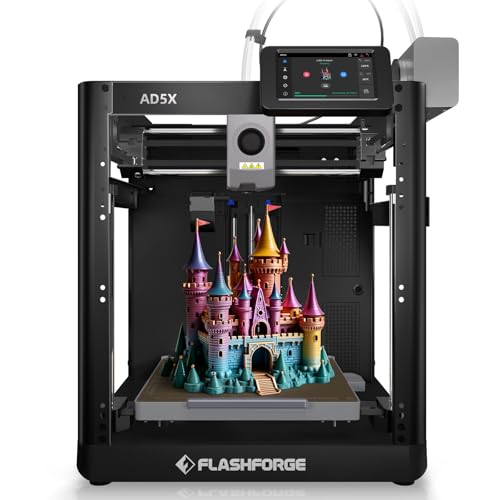 FLASHFORGE AD5X Multi-Color & Material 3D Printer with IFS9.7/10View on Amazon
- 2
 iSANMATE 16KG Matte PLA Filament Bundle 1.75MM 30-300mm/s for9.7/10View on Amazon
- 3
 Comgrow Filament Dryer 4 Spools9.7/10View on Amazon
- 4
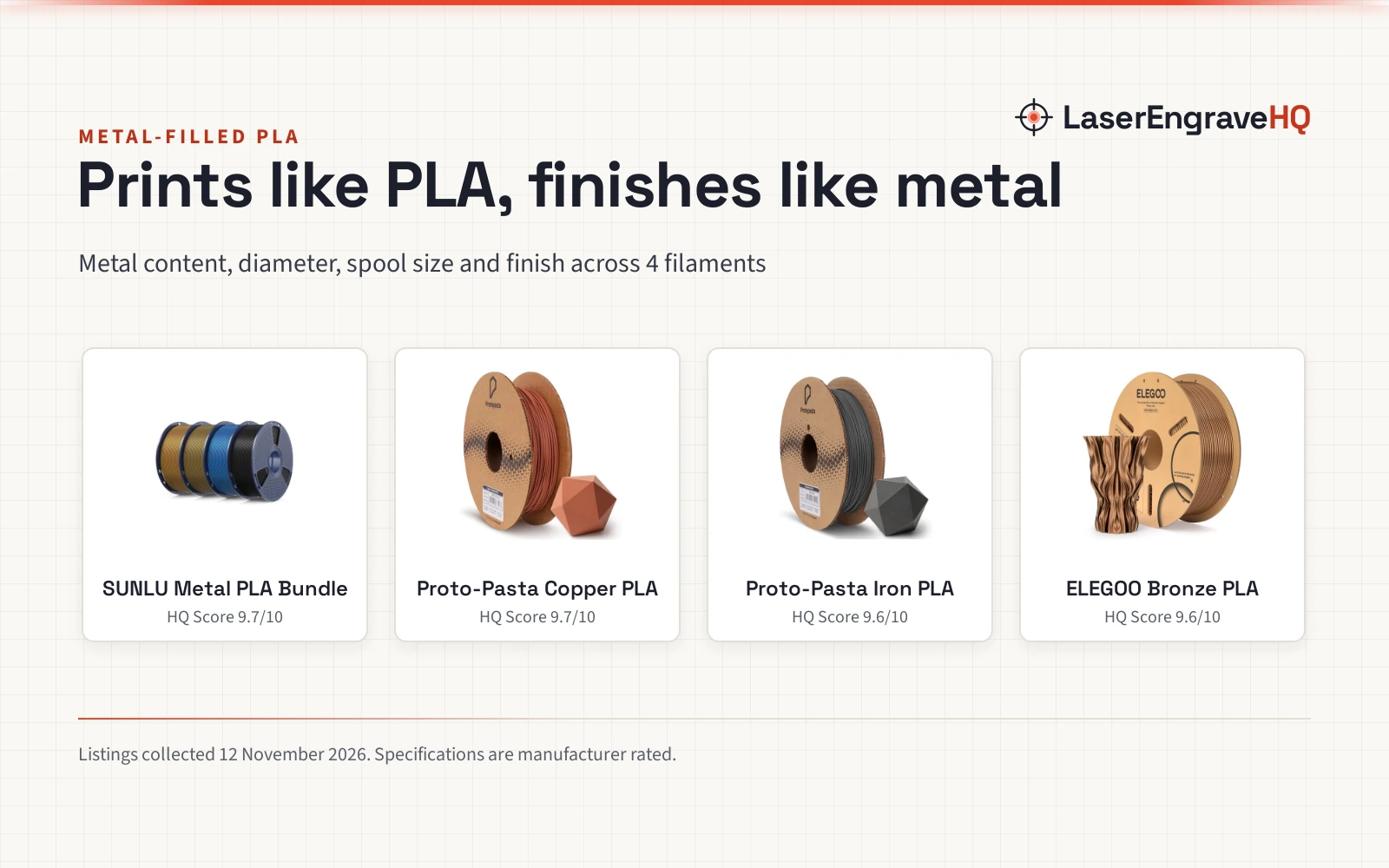
 SUNLU Metal PLA Filament Bundle 1.75mmView on Amazon
- 5
 SUNLU Metal PLA Filament 1.75mm Brass Gold 1KGView on Amazon
- 6
 SUNLU 2KG Metal PLA Filament 1.75mmView on Amazon
- 7
 Creality Hyper PLA-CF Filament 1.75mmView on Amazon
- 8
 Protopasta Ferromagnetic Iron PLA 3D Printer FilamentView on Amazon
- 9
 Protopasta Stainless Steel Filled PLA 3D Printer FilamentView on Amazon
Pla vs metal filled pla comes down to this: plain PLA is the light everyday filament, while metal-filled PLA blends real metal powder into a PLA base so the finished print looks and feels like metal. Pick plain PLA for simple, light prints that need no special finish, and pick metal-filled PLA when the piece should carry the weight, sheen and patina of metal. Carbon-filled PLA, covered below, trades the metal look for strength.
Other machines to compare
 SUNLU Metal PLA Filament Bundle 1.75mmCheck price on Amazon
 SUNLU Metal PLA Filament 1.75mm Brass Gold 1KGCheck price on Amazon
 SUNLU 2KG Metal PLA Filament 1.75mmCheck price on Amazon
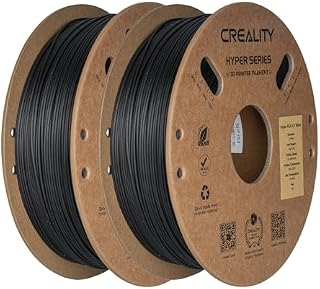 Creality Hyper PLA-CF Filament 1.75mmCheck price on Amazon
 Protopasta Ferromagnetic Iron PLA 3D Printer FilamentCheck price on Amazon
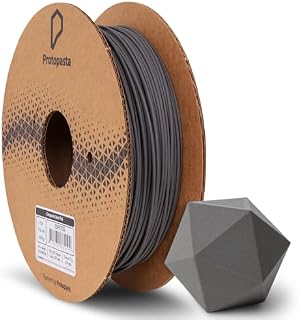 Protopasta Stainless Steel Filled PLA 3D Printer FilamentCheck price on Amazon
LaserEngraveHQ earns a commission from purchases made through these links, at no extra cost to you. Read our affiliate disclosure.
Pla vs Metal Filled Pla: What Changes When Metal Joins PLA
Plain PLA is the baseline every filled filament compares itself against. The SUNLU listing states its metal filament offers increased density, greater toughness and stronger layer adhesion than standard PLA, and the Protopasta listing states its iron PLA has twice the density of standard PLA filament. That extra density is the point: a metal-filled print feels heavier in the hand, which suits display pieces, models and decor that should feel as solid as they look.
The look changes just as much as the weight. The SUNLU listing describes fine metal particles combined with surface-modification technology for a premium, authentic metal-like sheen and smooth satin luster without any painting or polishing, and states the filament is perfect for mechanical armor, intricate sculptures, figurines and retro coins. The Protopasta listing goes further on finish: its iron PLA is patina friendly, so a print can take on a truly metallic-looking finish, and it is ferromagnetic, so magnets stick to it. Plain PLA cannot offer either quality, because it contains no metal at all.
Color is part of the choice too. The SUNLU bundle in the gear section below comes in Black, Bronze, Brass Gold and Azurite, and the listing also names Iron Black, Titanium Grey, Silver, Champagne Gold and Bronze among its metallic shades. Lowering the outer wall print speed boosts gloss and pearlescent effects, according to the listing, which matters for art crafts and home decor where the finish is the feature.
How Metal-Filled PLA Prints
Metal-filled PLA still prints as FDM filament, and the listings stress easy printing. The SUNLU listing states its filament is engineered for hassle-free FDM printing at standard PLA temperatures, with rigorous mechanical wire winding and strict double-checks to eliminate tangles, knots and nozzle clogs, and claims 99% printer compatibility. Each 1kg spool is individually vacuum-sealed with a desiccant pack to block out moisture and dust, and the listing states a precise diameter accuracy of plus or minus 0.03mm for smooth extrusion.
The Protopasta listing makes a similar ease-of-printing claim: its iron PLA is compatible with most consumer printers such as Prusa, Bambu, Creality and Ender, and prints smoothly without causing clogs or bubbles. The spool is 500g of 1.75mm metallic composite filament, and the listing states the products are made in the USA. Neither metal-filled listing names a special printer requirement beyond ordinary FDM printing.
Where Carbon-Filled PLA Fits
Carbon-filled PLA is the odd one out in this comparison, and the distinction matters. The Creality Hyper PLA-CF listing describes a carbon-filled filament, not a metal-filled one, and states nothing about a metallic sheen, iron content or patina. What it offers instead is strength and speed: the listing states 30% higher mechanical properties than PLA in flexural strength, flexural modulus and impact strength, and a print speed of up to 300 mm per second without compromising the printing effect.
That profile suits functional parts rather than display pieces. The listing names structural parts in more complicated working conditions, such as unmanned aerial vehicles, aircraft model joints and drives, and states the filament is engineered to be self-supporting, with support removal notably simpler than standard PLA while preserving a sleek support surface. It is compatible with all Creality closed and open printers and widely compatible with most printers on the market, and states a dimensional accuracy of plus or minus 0.03mm. Pick carbon-filled PLA when the part must work hard, and metal-filled PLA when the part must look like metal.
The Gear: Three Filaments Ranked
Ranked first is the Protopasta Ferromagnetic Iron PLA. It states a metal content the other two listings do not quantify: a base PLA plastic mixed with 45% by weight iron powder, twice the density of standard PLA, ferromagnetic behavior so magnets stick to it, and a patina friendly finish for a truly metallic look. It suits cars, tools, tabletop game miniatures and other metallic accessories, according to the listing. The listing states no warranty, which is the main drawback, and the spool is 500g.
Ranked second is the SUNLU Metal PLA Filament Bundle. It offers four 1kg spools in Black, Bronze, Brass Gold and Azurite, with a realistic metallic finish without post-processing, increased density and toughness over standard PLA, low shrinkage and zero warping, and a 1 year warranty. The bundle format suits makers who want several metallic colors on hand for sculptures, figurines and decor. The title describes a 2.2lbs spool, and the bullets describe each spool as 1kg, so the bundle reads as four spools rather than a single large one.
Ranked third is the Creality Hyper PLA-CF. Its figures focus on strength and speed: 30% higher mechanical properties than PLA and speeds up to 300 mm per second, plus simpler support removal and a 1 year warranty. It ranks last for this keyword only because it is carbon-filled, not metal-filled, and the listing states nothing about a metallic look, patina or magnetic behavior. One contradiction needs a note: the title describes a 2-Pack of 2KG, while the spec table lists NumberOfItems 1. Following the title and bullets, this guide counts it as a 2-pack.
How to Pick the Right Spool
Start from the finished piece, not the spool. For decor, display models and anything that should feel heavy and look metallic, pick metal-filled PLA: Protopasta when patina or magnets matter, SUNLU when several metallic colors and a metallic finish straight off the print bed matter. For functional parts that must hold up under load, pick the carbon-filled Creality filament, whose listing claims strength and speed rather than a metallic finish. For simple everyday prints with no special finish or strength demand, plain PLA remains the baseline, and the filled options above exist to improve on it in one direction each.
Storage deserves a note as well. The SUNLU listing vacuum-seals each spool with a desiccant pack against moisture and dust, which supports long-term storage stability. The other two listings do not describe their packaging the same way, so keep any opened spool dry and sealed between jobs, as the SUNLU listing links moisture protection to consistent performance.
FAQ: lasers and CNC
Is metal-filled PLA real metal?
No. Metal-filled PLA is a PLA base mixed with metal powder: the Protopasta listing states 45% by weight iron powder, and the SUNLU listing describes fine metal particles. The print looks and feels like metal, but it prints as filament and is not solid metal.
Does metal-filled PLA stick to magnets?
Only the Protopasta listing states this. Its iron PLA is ferromagnetic, allowing magnets to stick to it. The SUNLU listing does not state ferromagnetic behavior, so do not assume every metal-filled filament attracts magnets.
Can metal-filled PLA get a patina?
Yes, according to the Protopasta listing, which describes its iron PLA as patina friendly for a truly metallic-looking finish. That finish is one of the reasons to pick iron PLA for models and accessories that should read as real metal.
Is carbon-filled PLA the same as metal-filled PLA?
No. The Creality listing describes a carbon-filled filament, with carbon fiber as the filler, aimed at strength and speed rather than a metallic look. Metal-filled PLA uses metal powder as the filler and aims at weight, sheen and patina instead.
What print speed does the Creality PLA-CF list?
The listing states a print speed of up to 300 mm per second without compromising the printing effect, and states it supports high-speed and normal-speed printing at the same time.
Related: the PETG vs PLA Plus comparison, the carbon fiber PLA vs PLA comparison and the filament dryer vs dry box comparison.