Melamine vs MDF Spoilboard: Which Should You Buy? (2026)
Melamine vs MDF spoilboard explained: flatness, resurfacing, moisture and clamping, with four MDF spoilboard examples from the listings.

On this page
Top picks at a glance
As an Amazon Associate I earn from qualifying purchases.
- 1
 Genmitsu CNC MDF GRID Spoilboard for 3018 CNC Router Machine9.6/10View on Amazon
- 2
 SpeTool 2+2 Flute Slab Flattening Router Bit 1/4" Shank9.4/10View on Amazon
- 3
 Genmitsu CNC MDF Spoilboard Table for 3018 CNC Router Machine9.3/10View on Amazon
- 4
 CNC MDF Spoilboard for LUNYEE 3018 CNC Router MachineView on Amazon
- 5
 Genmitsu 4040 Aluminum & MDF Hybrid Spoilboard Table forView on Amazon
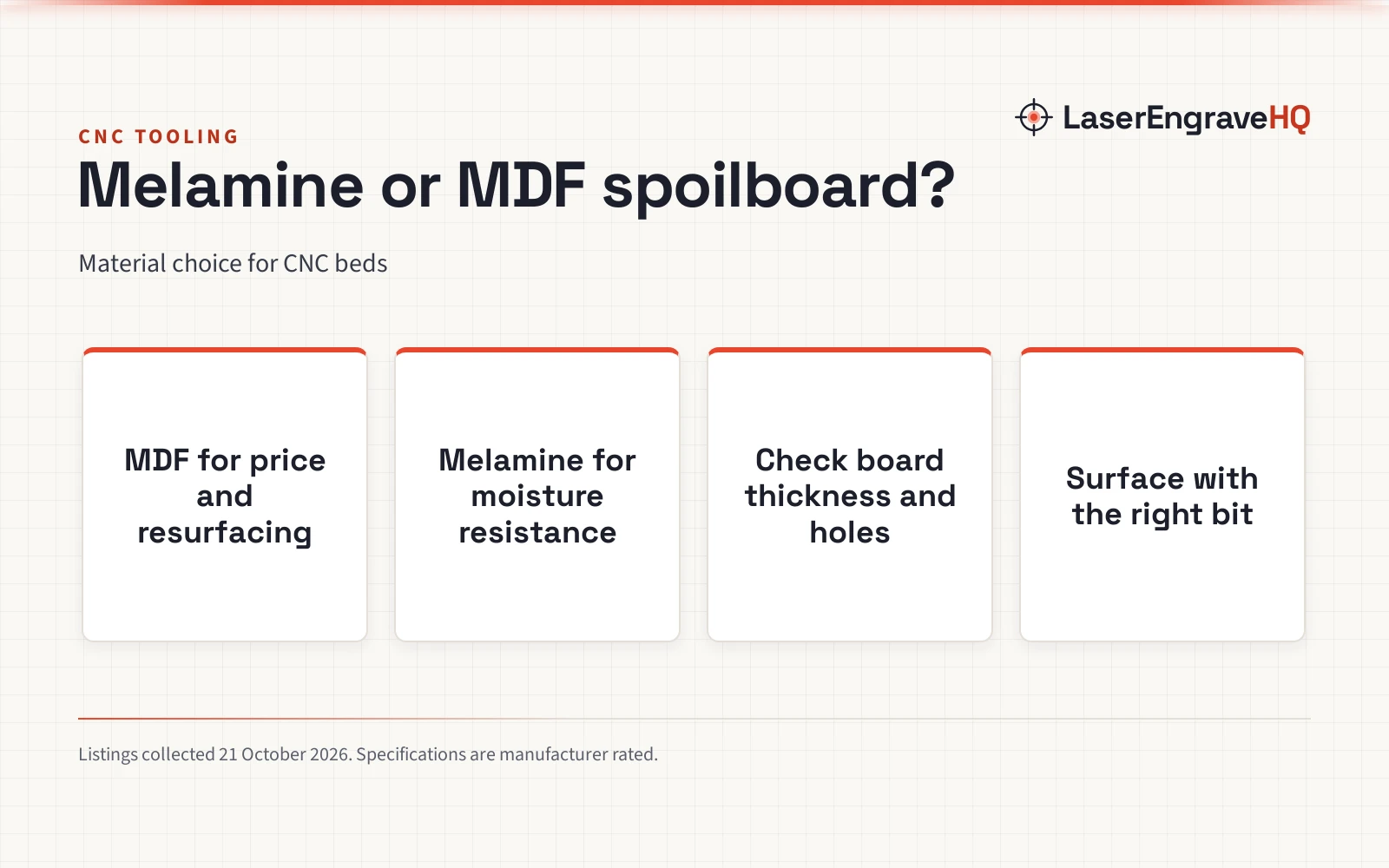
In the melamine vs mdf spoilboard choice, MDF is the standard spoilboard material: cheap, flat and easy to resurface, but it swells with moisture and wears fast. Melamine is particle board with a hard resin face: flatter, harder and more moisture-resistant, but harder to cut into. For most CNC router owners, plain MDF wins on price and resurfacability; melamine wins where humidity or long service life matters. All four examples in the listings are MDF boards.
Other machines to compare
 CNC MDF Spoilboard for LUNYEE 3018 CNC Router MachineCheck price on Amazon
 Genmitsu 4040 Aluminum & MDF Hybrid Spoilboard Table forCheck price on Amazon
LaserEngraveHQ earns a commission from purchases made through these links, at no extra cost to you. Read our affiliate disclosure.
MDF: the default spoilboard
MDF (medium-density fibreboard) is dense, flat and cheap, and it cuts cleanly with a surfacing bit. The Genmitsu 3040 board is 30 x 36 x 1.5 cm (11.8 in x 14.1 in x 0.6 in) and 1.2 kg, with pre-installed threaded holes for clamping, sized for a 3018-PRO or 3018-MX3 with the 3040 Y-axis extension kit. The Genmitsu 3020 grid board is 300 x 200 x 12 mm (11.81 x 7.87 x 0.47 in) and 1.4 lb, with M6 holes, screws and a wrench included, and a scale grid printed in centimeters for positioning. The LUNYEE 3018 board is 300 x 180 x 12 mm (11.81 x 7.87 x 0.47 in) and 1.3 lb, with 24 holes (maximum distance between two holes less than 54 mm), screws included and a centimeter scale grid. MDF resurfaces easily: that is why the Amana Tool RC-2239 exists, a 1.5 in cutting diameter spoilboard surfacing bit with a 2+2 insert knife design, solid carbide inserts with four cutting edges and a 6 mm shank, at 4.16 oz.
Melamine: the hard-faced alternative
Melamine board is particle board with a hard resin face on one or both sides. The face resists moisture better than raw MDF, stays flatter between resurfacings and gives a slick surface that workpieces slide on. The downsides: it is heavier, the resin face dulls bits faster, and once you surface through the face you are back to plain particle board. None of the four listings is a melamine board, so weigh these general properties against the MDF figures above.
Melamine vs MDF spoilboard: flatness and resurfacing
A spoilboard is sacrificial: you cut into it, then resurface it. MDF resurfaces to a fresh flat face with a surfacing bit like the Amana RC-2239, whose 2+2 insert knife design gives a smoother bottom of cut and whose inserts rotate to a fresh edge when dull. Melamine gives you a factory-flat face to start but only one face of it: surface past the resin and you lose the advantage. If you resurface often, MDF is the cheaper cycle.
Moisture and shop conditions
Raw MDF swells and loses strength when wet. Melamine’s resin face shrugs off coolant mist and humidity that would puff an MDF board. In a dry indoor shop the difference is small; in a garage or a humid climate it is real. Neither listing type states a moisture rating, so treat this as a material property, not a listing claim.
Clamping and threaded holes
MDF takes threaded inserts and T-nuts well, which is why the Genmitsu boards come with pre-installed threaded holes (3040) or M6 holes with screws (3020). Melamine’s dense face holds screws fine but chips when you drill it without care. The LUNYEE board’s 24 holes with less than 54 mm maximum spacing give flexible clamp positions on a small 3018 bed.
Match the board to your machine
Spoilboards are machine-specific, so start with the bed size. The Genmitsu 3040 board is 30 x 36 x 1.5 cm (11.8 x 14.1 x 0.6 in) and weighs 1.2 kg; it is built for the 3040 Y-axis extension kit on 3018-PRO and 3018-MX3 machines and is listed as compatible with most 3018 routers, with pre-installed threaded holes and assembly instructions included. The Genmitsu 3020 grid board is 300 x 200 x 12 mm (11.81 x 7.87 x 0.47 in) and 1.4 lb, with M6 (6 mm) holes, screws and a wrench in the box; it mounts above the Genmitsu 3020-PRO MAX and 3020-PRO MAX V2 platform with just 4 screws, and the front carries a scale grid printed in centimeters for positioning work.
The LUNYEE 3018 board is 300 x 180 x 12 mm (11.81 x 7.87 x 0.47 in) and 1.3 lb, made for LUNYEE 3018 PRO MAX and 3018 Pro Ultra machines; for other 3018 series machines the listing says to verify the mounting hole spacing before buying. It carries 24 holes with a maximum distance between two holes of less than 54 mm, so clamps are never too far apart, and it ships with two sets of accessories to suit different 3018 worktop forms. Both the Genmitsu 3020 and the LUNYEE print their positioning grid in centimeters, which speeds up repeat setups.
The surfacing bit is part of the board budget
A spoilboard only stays flat if you resurface it, so price the bit with the board. The Amana Tool RC-2239 is a 1.5 in cutting diameter spoilboard surfacing bit with a 2+2 insert knife design that the listing says gives a smoother bottom of cut, plus solid carbide inserts with four cutting edges that you rotate to a fresh edge when one side dulls. It weighs 4.16 oz with a 6 mm shank, and the same bit doubles as a surface planer for large glued-up panels and timber slab machines. One bit with rotatable inserts outlasts several throwaway straight bits, which is what makes MDF’s easy resurfacing cheap in practice.
[leh_safety kind=”cnc”]
The gear: four MDF examples from the listings
The Genmitsu 3040 MDF spoilboard (11.8 x 14.1 x 0.6 in, 1.2 kg, pre-installed threaded holes) is the pick for a 3018-PRO or 3018-MX3 with the 3040 extension. The Genmitsu 3020 grid spoilboard (11.81 x 7.87 x 0.47 in, 1.4 lb, M6 holes, screws and wrench, centimeter grid) is the pick for 3020 machines. The LUNYEE 3018 board (11.81 x 7.87 x 0.47 in, 1.3 lb, 24 holes, screws, centimeter grid) is the pick for LUNYEE 3018 routers. The Amana Tool RC-2239 surfacing bit (1.5 in cut diameter, 6 mm shank, 2+2 carbide inserts, 4.16 oz) is the tool that keeps any of them flat.
FAQ: lasers and CNC
Is melamine better than MDF for a spoilboard?
Melamine’s resin face resists moisture and stays flat longer; MDF is cheaper, lighter and easier to resurface. Most small shops default to MDF.
How thick should a spoilboard be?
The listings here run 12 mm (0.47 in) on the 3020 and 3018 boards and 1.5 cm (0.6 in) on the 3040 board: thicker boards survive more resurfacings.
What bit resurfaces a spoilboard?
A spoilboard surfacing bit like the Amana RC-2239: 1.5 in cutting diameter, 2+2 insert knife design, solid carbide inserts with four edges.
Do the boards come with mounting hardware?
The Genmitsu 3020 includes screws and a wrench; the LUNYEE includes screws; the Genmitsu 3040 has pre-installed threaded holes.
Related: our best CNC spoilboard picks and the CNC tooling hub.