How to Laser Engrave Glass: Spray, Etch and Rinse
A plain, step-by-step guide to laser engraving glass with a marking spray, from cleaning the glass to rinsing off a dark, lasting mark.

On this page
Top picks at a glance
As an Amazon Associate I earn from qualifying purchases.
- 1
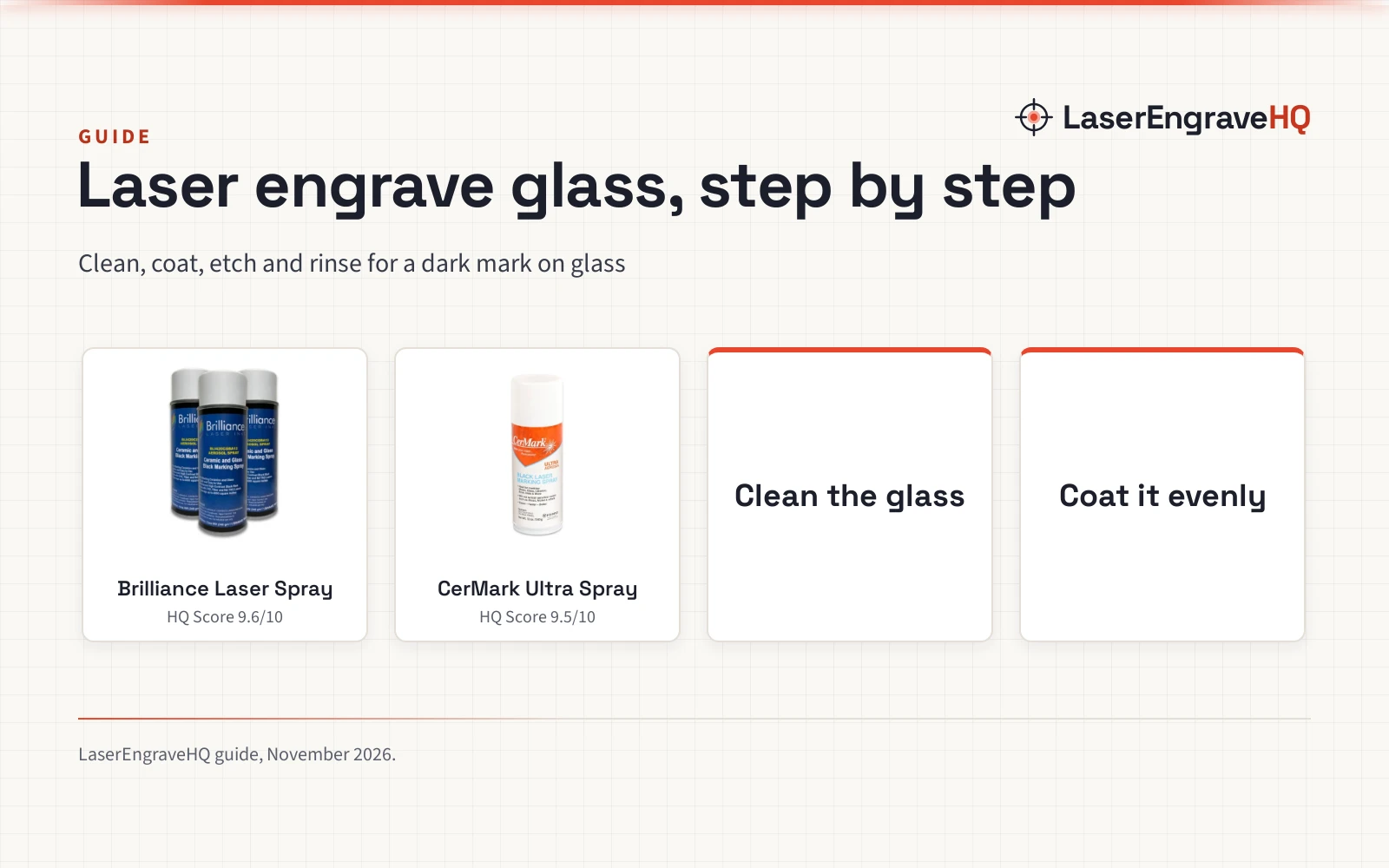
 Brilliance Laser Inks Black Ceramic & Glass9.6/10View on Amazon
- 2
 CerMark Ultra Aerosol Spray for Black Laser9.5/10View on Amazon
A glass tumbler with a name etched into it, a flat panel with a logo, a jar with a date: glass takes a mark that lasts, and a dark mark takes a coating step. Learning how to laser engrave glass with a dark mark means coating the glass first, because the sprays in the gear section are made to bond a dark mark to glass where the beam passes. A CO2 beam can mark glass on its own, but the mark it leaves is a pale, frosted etch rather than a dark one. The job runs in a plain order: clean the glass, coat it, run the laser pass and rinse. This guide walks through that order.
LaserEngraveHQ earns a commission from purchases made through these links, at no extra cost to you. Read our affiliate disclosure.
Below: cleaning, coating, the laser pass, rinsing, the gear that does the coating, and the mistakes that spoil a mark.
Brilliance Laser Inks Black Ceramic & Glass
A 12 oz marking spray in a 3 pack for glass and ceramics, made for CO2, Fiber/YAG and Diode lasers, with a 1 year warranty.
Pros
- Lists CO2 (25 Watt minimum), Fiber/YAG (10 Watt) and Diode (10 Watt) lasers
- Anti-clog aerosol with a thinner coating and 25% more coverage
- Shake for 2 minutes, spray from 6-8 inches, etch and rinse
- Nano particle formula for high-contrast, heat resistant, durable black marks, with a 1 year warranty
Cons
- CO2 lasers need at least 25 Watt, so a weaker machine falls outside what the maker lists
- Adds a clean, shake, spray and rinse routine to every glass job
- Sold as a 3 pack, so a buyer who wants a lone can must buy the pack
- The maker lists glass and ceramics only, so other surfaces are outside what this spray is made for
CerMark Ultra Aerosol Spray for Black Laser
A 12oz aerosol for black laser marking on glass, stainless, slate, metal and ceramic, with each 12oz can covering up to 2,700 square inches.
Pros
- Ready-to-use, ethanol-based formula with no mixing or diluting
- Each 12oz can covers up to 2,700 square inches
- Quick-dry, smudge-free layer that will not rub off before the laser pass
- Patented bonding for marks that resist chemicals, abrasion, extreme temperatures and weathering
Cons
- No warranty term is stated
- Sold as a lone 12oz can, so there is no spare can when it runs out
- Coverage is stated as up to 2,700 square inches, so heavy coats cover less ground
- The spray adds a consumable to every glass job, since each mark uses coating from the can
Clean the Glass Before Anything Else
Start with clean glass. The Brilliance routine starts by cleaning with denatured alcohol, and the reason is plain: dust, fingerprints and old residue sit between the spray and the surface, and a mark bonds where the coating meets bare glass. Wipe the piece down, let the alcohol dry off, and handle the glass by the edges from here on.
Coat the Glass With Marking Spray
Shake the spray for 2 minutes, then spray from 6-8 inches away in a thin, even coat. That is the Brilliance routine, and the thin coat matters: the maker pairs a thinner coating with 25% more coverage, and an even layer is what the beam bonds to. CerMark Ultra needs no mixing or diluting, since it is a ready-to-use formula, and it dries rapidly to a stable layer that will not rub off before the laser pass.
Set the Design and Run the Laser Pass
With the coat dry, set the design and run the laser pass. Brilliance lists the lasers its spray suits: CO2 with a 25 Watt minimum, Fiber and YAG at 10 Watt, and Diode at 10 Watt. CerMark Ultra names the surfaces instead, with glass among stainless, slate, metal and ceramic, and its patented bonding is made to resist harsh chemicals, abrasion, extreme temperatures and weathering. Keep the beam on the coated area.
How to Laser Engrave Glass: The Gear That Makes the Mark
The coating step needs a spray that bonds a dark mark to glass, and the sprays below are the gear for that step. Each card says which surfaces and lasers the maker lists, and what part of the job the spray handles.
Rinse and Check the Finished Mark
After the pass, rinse the piece: that rinse is the last step in the Brilliance routine. The finished mark is the high-contrast black layer the makers describe, made to resist chemicals, abrasion, extreme temperatures and weathering on the CerMark side, and heat resistant and durable on the Brilliance side.
Mistakes That Spoil a Glass Mark
- Skipping the clean: the Brilliance routine starts with denatured alcohol for a reason, and a dirty face gives the spray nothing to bond to.
- Spraying a heavy coat: the maker pairs a thinner coating with 25% more coverage, so a thick coat goes against the thinner coating the maker describes.
- Using a laser below the stated minimums: Brilliance lists a 25 Watt minimum for CO2 and 10 Watt for Fiber, YAG and Diode, and a machine below those minimums falls outside what the maker lists.
- Coating a surface the maker does not list: Brilliance is made for ceramics and glass.
FAQ: lasers and CNC
Can you laser engrave glass with a diode laser?
Yes, with the right spray. Brilliance lists Diode lasers at 10 Watt among the lasers its spray suits, with CO2 and Fiber and YAG alongside. See the can you laser engrave glass with a diode laser guide for the full routine.
What does marking spray do when you laser engrave glass?
It gives the beam a layer to bond into a black mark. The Brilliance formula uses a nano particle formula that penetrates deep into the surface and creates high-contrast, heat resistant and durable black marks, while CerMark Ultra uses patented laser bonding for the same kind of dark mark on glass.
Can you laser engrave glass without spray?
Yes, with a CO2 laser, which etches bare glass directly into a pale, frosted mark. A diode laser needs the spray, since its beam passes through bare glass. The sprays in the gear section are for a dark, bonded mark instead, and the routine here follows what their makers state: clean, coat, etch and rinse.
How much glass does a can of spray cover?
CerMark Ultra (on Amazon) states that each 12oz can covers up to 2,700 square inches. Brilliance states 25% more coverage from a thinner coating, and sells the spray as a 3 pack of 12 oz cans.
Do I need to clean the glass before spraying?
Yes. The Brilliance routine starts by cleaning with denatured alcohol, before shaking the spray for 2 minutes and spraying from 6-8 inches away.
Which laser types work with marking spray?
Brilliance lists CO2 with a 25 Watt minimum, Fiber and YAG at 10 Watt, and Diode at 10 Watt. CerMark Ultra names the surfaces its spray suits, with glass among them, and does not state laser types.
Related: the can you laser engrave glass with a diode laser guide, UV laser vs CO2 laser for glass engraving, diode vs CO2 for glass engraving and laser marking spray vs fiber laser.