How Long Do Respirator Cartridges Last
Respirator cartridges have no fixed clock: service life depends on what you breathe through them and how they are stored. Here are the signs to watch and four options compared.

On this page
Top picks at a glance
As an Amazon Associate I earn from qualifying purchases.
- 1
 3M P100 / OV / AG Multi-Purpose Reusable9.6/10View on Amazon
- 2
 3M Particulate Filter 5P71, P959.6/10View on Amazon
- 3
 North N75001 Organic Vapor OV Cartridge 2 Each per9.2/10View on Amazon
- 4
 Replacement Carbon Filters for Respirator Masks9.2/10View on Amazon
How long do respirator cartridges last? There is no fixed clock on a cartridge: how long it serves depends on what you breathe through it, how often you wear the mask, and how the cartridges are stored between jobs. The listings in this guide do not print a fixed service time, so the honest answer is to watch for the signs below and follow the maker’s change guidance for your work.
LaserEngraveHQ earns a commission from purchases made through these links, at no extra cost to you. Read our affiliate disclosure.
No listing in this guide states a service life in hours or days. Treat any single number you see elsewhere as a story, not a schedule, and set your change routine from the signs below and the maker’s guidance.
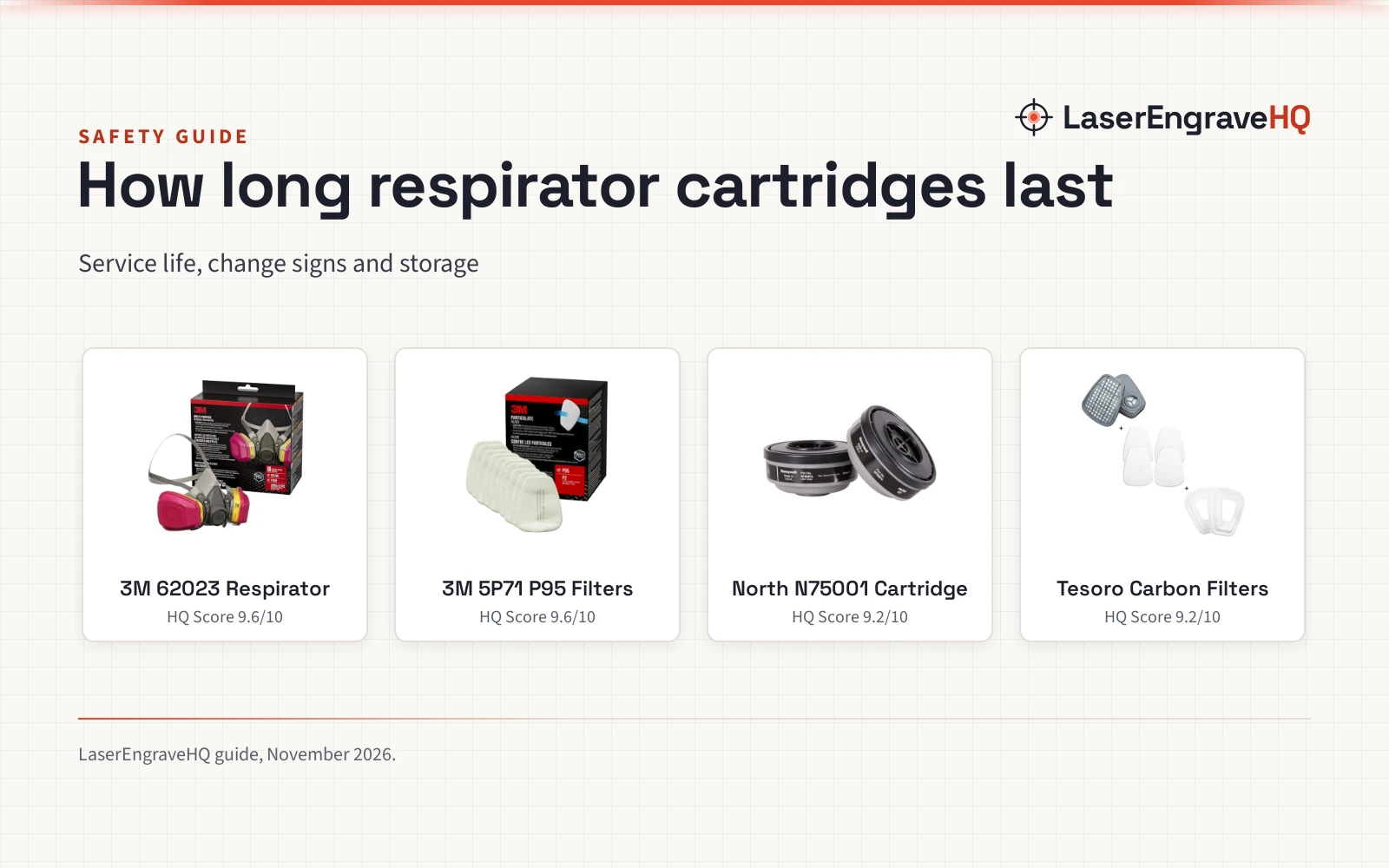
3M P100 / OV / AG Multi-Purpose Reusable
A reusable respirator with NIOSH-approved P100/OV/AG combination cartridges rated at at least 99.97% filtration efficiency, with adjustable head straps.
Pros
- NIOSH-approved P100/OV/AG filters, at least 99.97% filtration efficiency
- Facepiece included with adjustable head straps
- Oil proof P-series particulate filter
- Bayonet connection works with 3M cartridges and filters
Cons
- Workplace and occupational use only, per the maker
- This listing is the Medium size
- Bayonet connection fits 3M cartridges and filters
- 0.8 lb with the facepiece
3M Particulate Filter 5P71, P95
Five pairs of NIOSH-approved P95 particulate filters rated at at least 95% filtration efficiency, oil-proof, for 3M 5000 series respirators and 6000 series cartridges.
Pros
- NIOSH-approved P95, at least 95% filtration efficiency
- 5 pairs of filters in the pack
- Oil-proof for oil-based particulates
- Fits 3M 5000 series respirators and 6000 series cartridges with retainer 501
Cons
- Cartridge only: facepiece not included
- Needs the 3M Filter Retainer 501 to attach to cartridges
- P95 rating, below the P100 figure of the 62023
- Workplace and occupational use only, per the maker
North N75001 Organic Vapor OV Cartridge 2 Each per
A low profile organic vapor cartridge from Honeywell Safety Products, sold 2 per pack, with a maker-stated long service life.
Pros
- Low profile cartridges stay out of the work zone
- Maker states a long service life without frequent change outs
- Organic vapor cartridge for solvent work
- 2 cartridges per pack
Cons
- No filtration efficiency figure is stated
- No warranty term is stated
- No service-life figure in hours or days is stated
- 2 per pack, so spares run out sooner
Replacement Carbon Filters for Respirator Masks
Eight replacement carbon filters with multi-layered cotton that snap on to most standard respirator masks, for painting, carpentry and DIY work.
Pros
- 8 pieces of replacement carbon filters
- Multi-layered cotton with carbon layering
- Snap on to most standard respirator masks
- Built-in filter boxes slide on and lock into place
Cons
- No filtration rating is stated
- No warranty term is stated
- Carbon cotton layers, not a rated cartridge
- Snap-on fit: check your mask model first
How long do respirator cartridges last: what sets the clock
Two kinds of wear run the clock. Particulate filters load up with the dust and spray they catch, so breathing through them gets harder over time. Vapor cartridges hold vapor in their carbon bed until the carbon can no longer hold it back, and then vapor starts to pass through. Heavy work, long shifts and dirty air shorten both clocks; light, occasional use stretches them. Storage matters too: cartridges left open in a solvent-filled shop keep absorbing vapor while they sit.
That is why makers avoid printing one number for every user. The 3M 5P71 filter in this guide points users to the manufacturer’s time use restrictions when oil aerosols are present, and the North cartridge (on Amazon) states a long service life without frequent change outs, again without a figure. OSHA expects workplaces to run a change schedule for cartridges rather than guess, and the same habit serves a home shop: decide your signs in advance and change on them.
Signs a cartridge is done
- Harder breathing: a particulate filter that has loaded with dust resists airflow. If drawing a breath takes real effort, change the filter.
- Damage or soiling: torn, crushed, wet or visibly dirty filters and cartridges come off the mask.
- Vapor breakthrough: if you smell or taste the vapor through an organic vapor cartridge, change the pair; some vapors have poor warning properties and cannot be smelled in time, so a change schedule set in advance matters more than your nose.
- Unknown history: a cartridge with no record of when it went on the mask is a cartridge to replace.
The cartridges and filters for this work
Watching those signs only helps if a fresh pair is on the shelf, so the options below are grouped by the step they cover: full mask, spare particulate filters, vapor cartridges and snap-on replacements.
Particulate filters and vapor cartridges wear out differently
Particulate filters such as the P95 and P100 options here are rated by filtration efficiency: the 3M 5P71 is rated at at least 95% and the 3M 62023 cartridges at at least 99.97% against solids and liquid aerosols. They wear out by loading, and the sign is breathing resistance. Vapor cartridges such as the North N75001 wear out by saturation, and the sign is breakthrough. Combination cartridges, like the P100/OV/AG set in the 62023, carry both clocks at once, so change them on whichever sign arrives first. Our types of respirator cartridges guide maps the ratings to the work.
Storing spares so they last
Keep spare cartridges sealed in their packaging until they go on the mask, and store them away from solvents, paint and fuel so the carbon bed stays empty for your lungs instead of the shelf air. Tag the mask with the date a fresh pair goes on. For resin work, our best respirator filter for resin guide covers the vapor side in more detail, and the laser safety hub collects the rest of the safety gear.
FAQ: lasers and CNC
How long do 3M respirator cartridges last?
The 3M listings in this guide state no fixed service time in hours or days. The 5P71 filter points to the manufacturer’s time use restrictions when oil aerosols are present. Change 3M cartridges on the signs above: harder breathing for particulate filters, breakthrough for vapor cartridges, and any damage or soiling.
What do P95 and P100 mean?
They are filtration efficiency ratings. The 3M 5P71 P95 filter is rated at at least 95% efficiency against solids and liquid aerosols, and the 3M 62023 P100 cartridges at at least 99.97%. Both are NIOSH-approved and oil proof, so they also cover oil-based particulates.
Can I wash respirator cartridges to make them last longer?
Treat cartridges and filters as replace-only parts. Washing does not empty a loaded particulate filter or a saturated carbon bed, and a wet filter breathes badly. Swap in a fresh pair when the signs appear.
How do I know which cartridge fits my mask?
Match the connection. The 3M 62023 uses the 3M bayonet connection, the 5P71 attaches to 3M 5000 series respirators and 6000 series cartridges with the retainer 501, and the Tesoro filters snap on to most standard masks with a stated match for the M-101. Check your facepiece model before ordering.
Do cartridges expire on the shelf?
The listings in this guide state no shelf date. Keep spares sealed, dry and away from solvents and paint, and check the packaging of the set you buy for any date the maker prints.
Related: types of respirator cartridges, best respirator filter for resin and the laser safety hub.