Embroidery Machine Needle Sizes: Chart and Guide
A chart and guide to embroidery machine needle sizes: read the size code, match the needle system to the machine, and pick a size for the fabric.

On this page
Top picks at a glance
As an Amazon Associate I earn from qualifying purchases.
- 1
 SCHMETZ Universal Sewing Machine Needles9.6/10View on Amazon
- 2
 Sewing Machine Needles 50 PCS HAX1 Universal 5 Sizes9.7/10View on Amazon
- 3
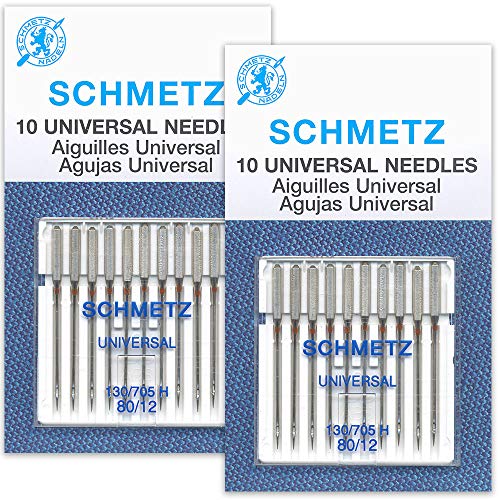 SCHMETZ Universal Sewing Machine Needles9.6/10View on Amazon
Embroidery machine needle sizes answer a simple question: which needle fits the machine and the fabric. A size code pairs a metric number with a Singer number, and the right pick starts with the needle system the machine takes, then the weight of the fabric. Get the system wrong and the needle will not fit at all; get the size wrong and the thread shreds, the stitches skip, or the fabric puckers.
LaserEngraveHQ earns a commission from purchases made through these links, at no extra cost to you. Read our affiliate disclosure.
Sizes are listed by each maker, and the same size code can sit on a different needle system, so check the system before the size. This guide uses only the sizes and pack counts the listings state.
Step 1: Match the needle system to the machine
A needle system is a group of needles made to fit specific sewing machines. All needles in a system share the same length and shank size and differ in diameter, so the system comes before the size. The DBXK5 system uses a round shank and fits industrial embroidery machines, including Tajima, Barudan, SWF and Brother industrial machines, and the listings state plainly that it is not suitable for household embroidery machines. Home machines take home needles instead: SCHMETZ embroidery needles are made for all home sewing machines. The gold 75/11 states compatibility with Baby Lock, Bernina, Brother, Janome, Singer and Pfaff. Check the system in the machine manual before ordering, because a needle from the wrong system will not seat correctly however right the size looks. For an industrial machine, see the multi-needle embroidery machine guide for beginners.
Step 2: Read the size code
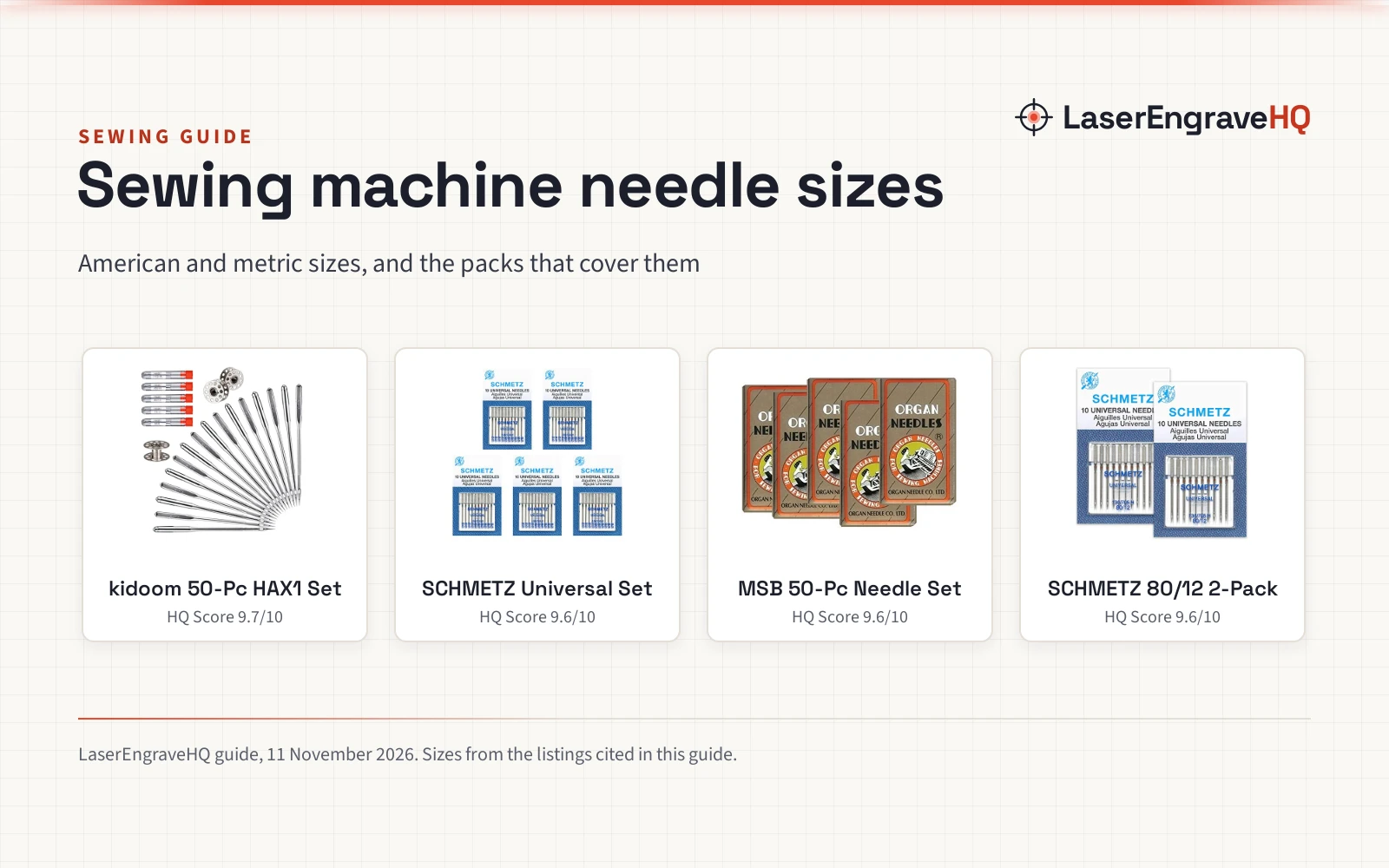
A size code such as 75/11 pairs a metric number with a Singer number. Lower size numbers are narrower, thinner needles for lighter materials, and higher size numbers are thicker needles for heavier materials. The DBXK5 range in the listings runs from 60/8 to 110/18, with 65/9, 70/10, 75/11, 80/12, 90/14 and 100/16 in between. SCHMETZ home embroidery needles come in assorted sizes on 5-needle cards, with 75/11 in the gold titanium range and 90/14 in the standard range.
| Size | Diameter |
|---|---|
| 60/8 | Thinnest listed |
| 65/9 | Thinner |
| 70/10 | Thinner |
| 75/11 | Middle of the range |
| 80/12 | Middle of the range |
| 90/14 | Thicker |
| 100/16 | Thicker |
| 110/18 | Thickest listed |
The code tells the diameter, not the point or the coating. A 75/11 ball point and a 75/11 sharp point share a diameter and behave differently in fabric, so read the point type next.
Step 3: Match the size to the fabric
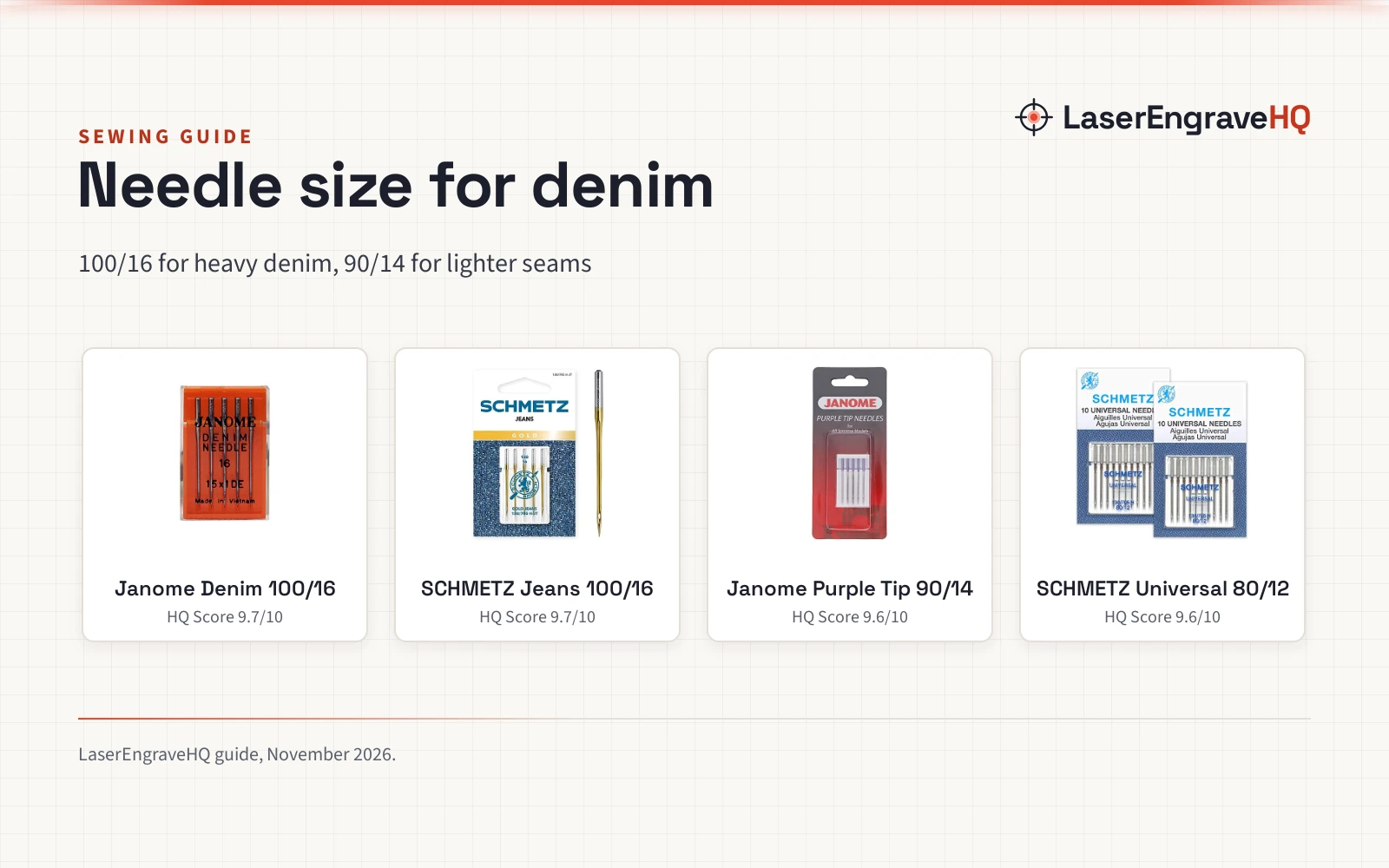
Match the size to the fabric weight, not to the thread alone. Lighter materials take the lower numbers in the range, and heavier materials take the higher numbers, because a needle that is too thick for the fabric leaves visible holes and a needle that is too thin flexes and breaks. SCHMETZ embroidery needles are made for rayon, polyester and other specialty threads, with a widened groove and an enlarged eye that reduce friction and protect delicate thread. The gold titanium 75/11, with a medium ballpoint, suits medium to heavy fabrics and dense, woven material such as denim, while the standard embroidery needle suits decorative stitching and specialty thread work. A 75/11 appears in both the DBXK5 range and the SCHMETZ gold range, which makes it an easy size to find in either system. For denim work, see the sewing machine guide for denim and beginners.
Step 4: Pick the point and the coating
Point shape decides how the needle moves through the fabric. Organ DBXK5 needles are ball point, and the SCHMETZ gold 75/11 has a medium ballpoint, which the maker says pierces medium to heavy fabrics and dense, woven material such as denim without damaging fibers. Coating decides how long the needle keeps its edge: Groz-Beckert DBXK5 SAN1 GEBEDUR needles carry a titanium nitride coating, and the maker states that the GEBEDUR type increases needle life span up to 3 times compared with classical chromium needles. SCHMETZ gold embroidery needles also carry a titanium nitride coating, which the maker says lasts longer, resists adhesives and wear, and suits metallic or fragile specialty threads. A coated needle needs the same attention at the machine as an uncoated needle: change it when stitches start to skip or the thread starts to shred.
Step 5: Buy the right pack
Needles are sold in boxes and cards, and the pack size decides how often the drawer runs out. Groz-Beckert DBXK5 needles come in boxes of 100 and boxes of 50, with 5 boxes of 10 making up the 50-piece pack. Organ DBXK5 needles come in boxes of 100. SCHMETZ embroidery needles come on 5-needle cards, in packs of 1 card, 5 cards with 25 needles, and 10 cards with 50 needles, and the gold 75/11 comes in a box of 10 cards with 50 needles. For a mixed set, the DBXK5 SAN1 listing offers a mixture of sizes in a 100-needle pack. Buy a single size at a time when the fabric is settled, and keep 75/11 and 90/14 on hand for the jobs in between.
Common mistakes to avoid
- Ordering a DBXK5 round-shank needle for a household machine: the system does not fit, whatever the size.
- Choosing by size code alone without checking the system: a 75/11 exists in both industrial and home ranges, and the ranges do not interchange.
- Using the thickest size for light fabric: higher numbers are thicker needles for heavier materials, and a thick needle on light fabric leaves holes.
- Running a needle until the thread shreds: change the needle when stitches skip or the thread frays, and keep a spare card in the drawer.
- Buying a single size for every job: keep the common sizes on hand instead of reordering for each project.
Embroidery machine needle sizes: the short version
- Match the system to the machine: DBXK5 round shank for industrial machines, SCHMETZ for home machines.
- Read the code: lower numbers are thinner needles for lighter materials, higher numbers are thicker for heavier materials.
- Pick the size from the fabric: 60/8 is the thinnest listed, 110/18 is the thickest listed, and 75/11 appears in both ranges.
- Pick the point and coating: medium ballpoint for medium to heavy fabrics, titanium nitride for a longer life span.
- Buy the pack that fits: boxes of 100 or 50 for industrial needles, 5-needle cards for home needles.
FAQ: lasers and CNC
What do the numbers in a needle size mean?
A size code pairs a metric number with a Singer number. Lower numbers are narrower, thinner needles for lighter materials, and higher numbers are thicker needles for heavier materials.
Can I use DBXK5 needles in a home embroidery machine?
No. DBXK5 needles have a round shank and are made for industrial embroidery machines only, and the listings state they are not suitable for household embroidery machines. Home machines take SCHMETZ embroidery needles, which are made for all home sewing machines.
What size needle do I need for denim embroidery?
The SCHMETZ gold 75/11, with a medium ballpoint, is made for medium to heavy fabrics and dense, woven material such as denim. On an industrial machine, the DBXK5 range runs from 60/8 to 110/18, with the higher numbers for heavier materials.
Do titanium-coated needles last longer?
The maker states that the GEBEDUR titanium nitride type increases needle life span up to 3 times compared with classical chromium needles. SCHMETZ gold needles also carry a titanium nitride coating, which the maker says lasts longer and resists adhesives and wear.
How many needles come in a pack?
Groz-Beckert DBXK5 needles come in boxes of 100 and boxes of 50, and Organ DBXK5 needles come in boxes of 100. SCHMETZ embroidery needles come on 5-needle cards, in packs of 1 card, 5 cards with 25 needles, and 10 cards with 50 needles.
Related: the sewing and embroidery machines hub, embroidery machine hoop sizes and embroidery machine maintenance. Also see our needle size for machine quilting. Also see our how to remove a needle from a sewing machine. Also see our types of machine embroidery.